Sustaining ecosystems - general + Rainforests
 Call Kai
 Learn
Learn Practice Test
 Spaced Repetition
 Match
Match Flashcards
 Knowt Play
1/32

There's no tags or description
Looks like no tags are added yet.
33 Terms
ecosystem + biomes + biodiversity
note that abiotic factors are covered in bio
the community of organisms (biotic factors) interdependent with their interacting abiotic factors (climate soil water) as a functional unit
they can range from ponds to large scale e.g. tropical rainforests - biomes
Biodiversity is the variety of plant and animal species within an ecosystem - dependent on biotic and abiotic factors
Interdependence within an ecosystem
what is likely occur with changes, and main biotic interdependent interactions
the different biotic components depend on each other and the abiotic components for survival (food, water and shelter)
It means that changes in one component can have significant impacts on other parts of the ecosystem - e.g. big population and distribution migration changes
one of the main biotic interdependence interactions are feeding seen by food chains and webbs
examples of interdependence - seed dispersion, plant growth, soil fertility
trees like rowan depend on animals eating and releasing seeds to germinate and acorn trees rely on squirrels to bury them during hibernation and the forgotten ones germinate
abiotic → CO2 needed for glucose production
woodland trees are deciduous meaning that they lose their leaves that end up on the floor, and are decomposed releasing nutrients into the soil
(water cycle, nutrient cycle, carbon cycle, food webs)
Tropical rainforests - climate , location, rainfal, temp, specialties
ow latitudes within the tropics 23.5° north and south of the equator Found in South America, Asia and Africa | Annual rainfall - 2000mm High temperatures 26-28oC | Ideal conditions for plant growth High levels of biodiversity Distinct layers of vegetation |
deciduous forests - climate , location, rainfall, temp, specialties
Approximately 50° north of the equator Europe and North America | Wet, mild winters and warm, drier summers around 10°C with no extremes ~1125 mm/yr | Deciduous trees which lose their leaves in winter due to the cooler temperatures - include oak, beech, ash Wide range of animals and plants Deer, rabbits, squirrels, bears |
grasslands - savannah temperate
Between 15-40° north and south of the equator America, Central south Africa, Australia | Distinct wet and dry seasons Temperatures vary between 15-40°C -30-40 Annual rainfall 250-900mm | Dominated by grasses few trees Baobab and Acacia trees Savanna animals include giraffes, lions, zebras, elephants bison deer snakes |
desert
Approximately 20-30° north and south of the equator Africa, Australia, South and North America | Hot daytime temperatures up to 50°C but average 25°C Night time temperatures below 0°C Precipitation below 250mm | Low diversity Plants include yucca and cacti Animals include spiders, scorpions, camels |
Polar tundra
Above 60° north and south of the equator Arctic, Antarctic, Northern Canada, Siberia | Cold year-round, brief cool summers in tundra areas Below 0° C for 6-10 months Precipitation often below 250mm | Low biodiversity Short growing season Small grasses, lichens and mosses Arctic foxes, polar bears, penguins, caribou |
Coral reefs
Found in shallow tropical and sub-tropical oceans, strictly between 30° North and South of the equator (e.g., the Great Barrier Reef in Australia, carribean | consistently between 23°C and 29°C, and clear, shallow saltwater (usually less than 25 meters deep) so sunlight can penetrate. | microscopic algae, seaweed, seagrass meadows millions of coral polyps, shellfish, shark, sea turtle |
Rainforest dive → location , annual precip , temp range , seasons
Location | Within the Tropics 23.5° north and south of the equator Amazon in South America, New Guinea, South-east Asia, Zaire Basin |
|---|---|
Annual Precipitation | Over 2000mm |
Temperature Range | Low range of mean monthly temperatures - 26-28°C Constant high temperatures Diurnal range is about 7°C |
Seasons | No seasons - hot and wet all year round |
rainforest dive - soils and biodiversity
Soils | Many of the soils in the rainforest are latosols Due to leaching and rapid uptake of nutrients by plants the soils are not very fertile Nutrients are concentrated in the upper topsoil |
|---|---|
Biodiversity | Tropical rainforests contain the highest biodiversity of plants and animals on Earth Estimates range from over 50% to 80% of the world's plant and animal species |
Rainforest layers
Ground layer (0m)
Shrub layer (3-4m)
Under canopy (15m)
Canopy (30m)
Emergents (45-55m)
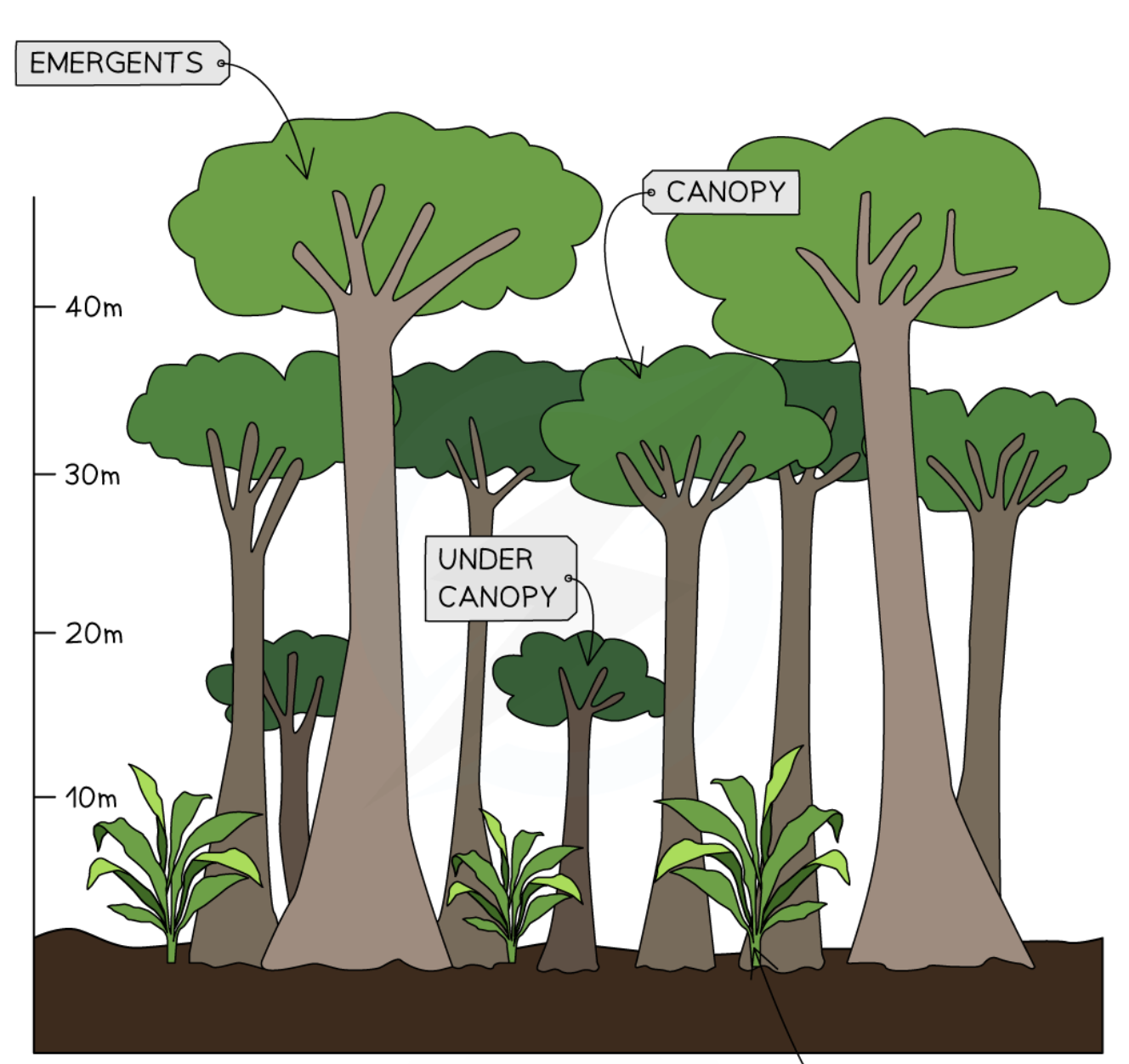
Tropical Rainforest: Upper Layers & Adaptations : emergent canopy
Emergent Layer 50m: Tallest trees fighting for maximum sunlight. Because the latosol soils have minerals heavily concentrated on the topsoil , they grow massive buttress roots above ground and for stability against winds.
Canopy Layer 35m: Thick, continuous roof containing most of the animal life. Leaves have waxy drip tips to shed heavy rain (2000mm+) quickly, preventing the leaves from snapping or growing mold.
Tropical Rainforest: Middle Layer & Adaptations - shrub, undercanopy
Conditions: Extremely dark and humid, as the thick canopy above blocks out 80-90% of the sunlight.
Adaptations: To survive in such low light, plants here have evolved massive, broad leaves. This maximizes their surface area to capture as much of the limited, dappled sunlight as possible for photosynthesis.
rainforest floor
Conditions: Almost pitch black, hot, and constantly wet.
Interdependence: Dead leaves and organic matter fall here and decompose incredibly rapidly due to the intense heat and moisture. This rapid decay is essential to quickly return nutrients to the thin topsoil layer before heavy rains wash them away (leaching).
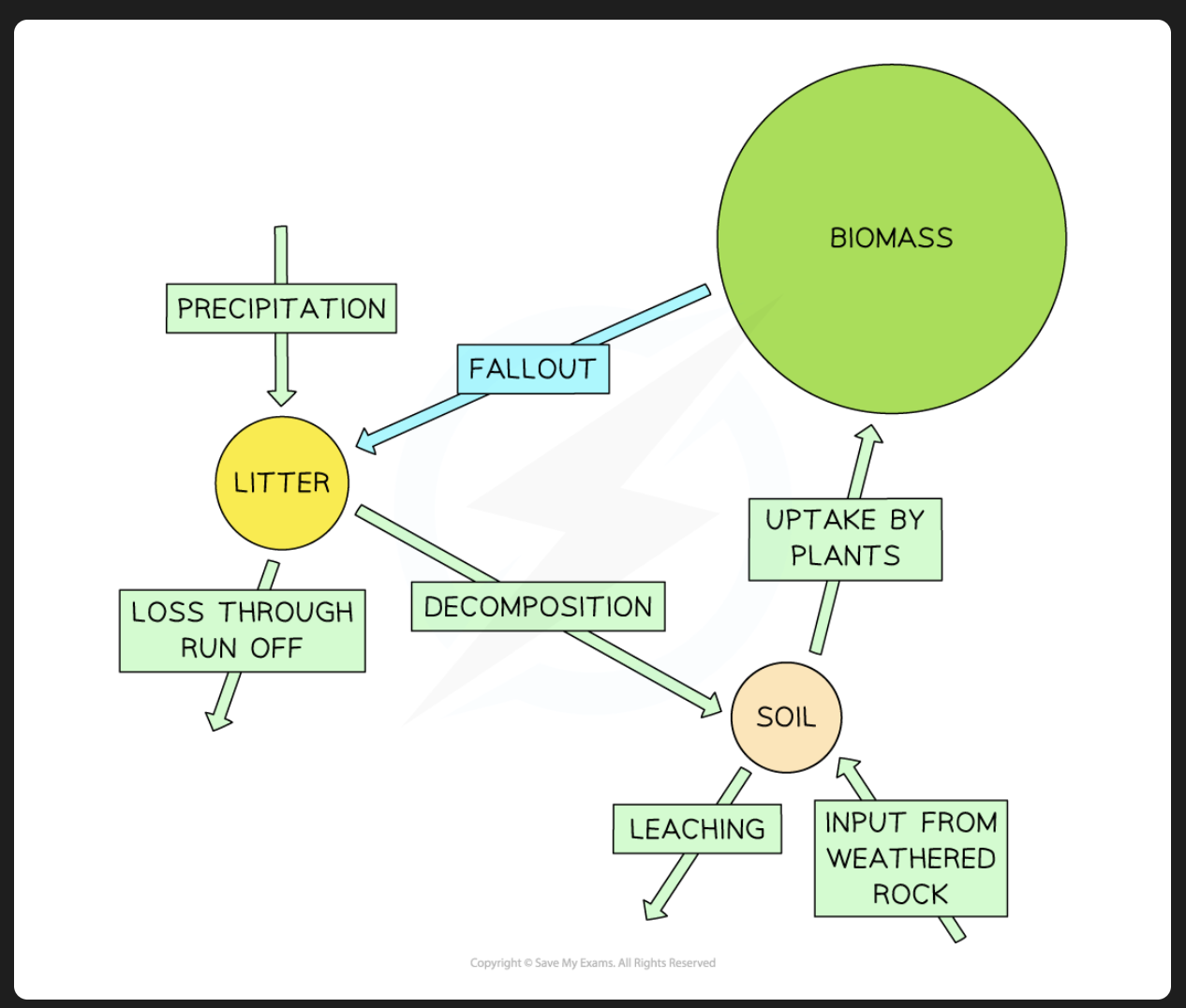
nutrient cycle
Tropical rainforests have a continual growing season with high rainfall and temperatures all year round
The nutrient cycle is rapid
Trees and plants lose their leaves all year round
The high level of moisture and high temperatures leads to rapid decomposition and recycling of nutrients (litter)
Plants grow quickly which leads to a rapid uptake of nutrients from the soil before leaching
nutrient cycle nutrient distribution
Most of the nutrients are stored in the biomass → life e.g. trees
Few nutrients are stored in the soil and the litter (dead organic matter - plants leaves dead animals on the floor)
this means that the soil is not very fertile as all the litter is rapidly decomposed and uptaken
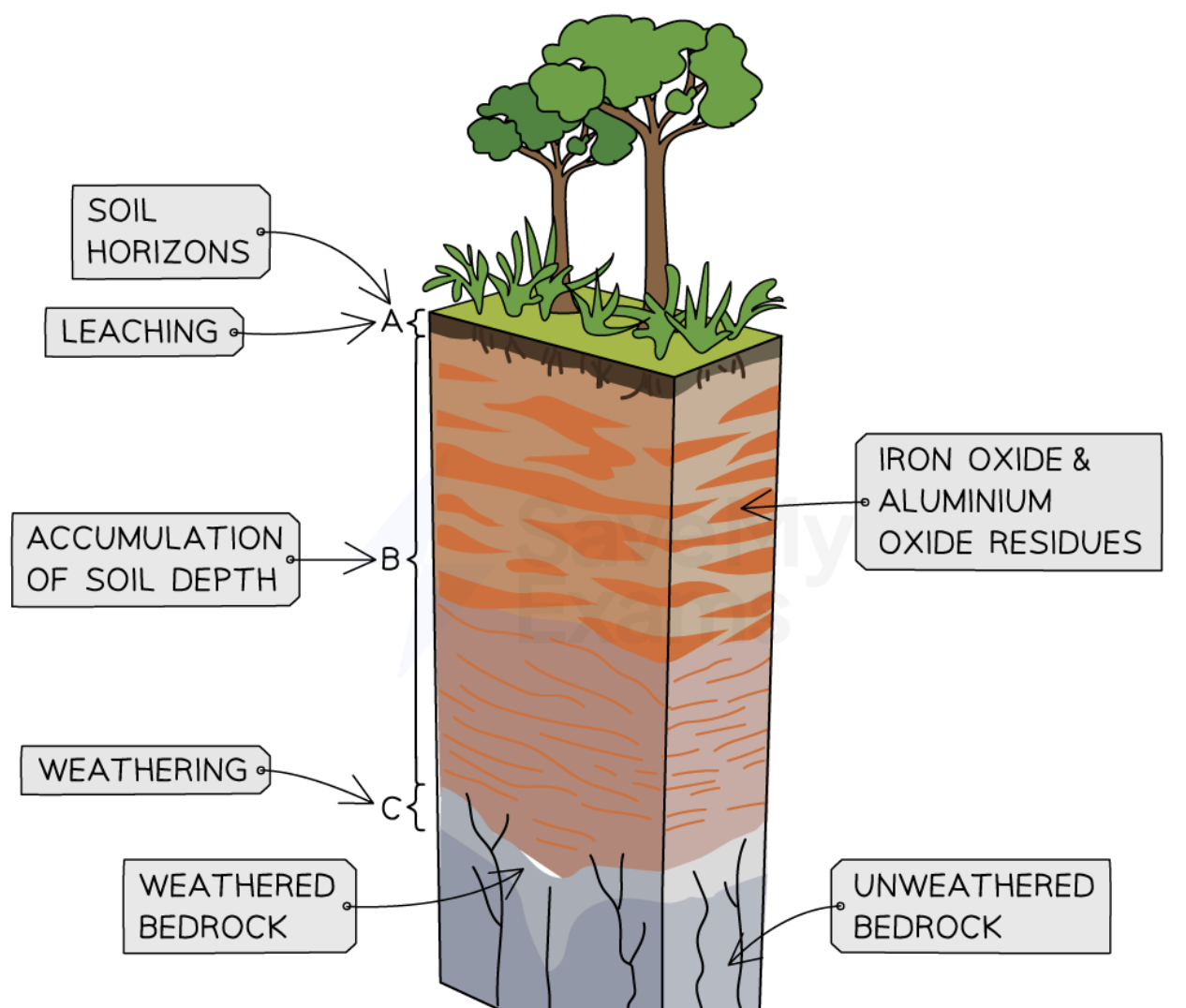
soil : Soil is an important factor in the development of vegetation within the rainforest ecosystem
The climatic conditions of rainforests, result in deep soils
The soils rely on the rainforest to maintain fertility
Nutrients leach away quickly when the forest is felled and the layer of humus is no longer being replaced
Soils are some of the least fertile in the world because:
Heavy rain causes rapid leaching of nutrients
The layer of topsoil and organic matter is thin
The soil is acidic due to the leaching of nutrients
Rapid plant growth means that any nutrients are rapidly taken up by the plants
There is a lack of weathered rock due to the depth of the soil
Tropical rainforests have some of the highest levels of biodiversity of any ecosystem
The wet and warm climate means there is year-round growth
Wide variety of plants provides a range of habitats and food
Rapid nutrient cycling increases plant growth
Lack of human activity has in the past meant that plants and animals are undisturbed
TRF water cycle + interdependence
trees act as a biophysical pump - The dense canopy absorbs massive amounts of groundwater and releases H2Og EVAPOTPN
the equatorial heat 26-28 deg causes the water to rapidly heat up of the surface of the leaves
this creates warm moist air that drives convectional rainfall 2000 mm/yr
The forest creates its own rain. DFA ↓ interception and evapoTPN, which ↓ precipitation. This breaks the cycle, leaving the soils significantly drier.
The interdependence of the rainforest components means that when one element is affected it then impacts all the other components → using zam trees
A decline in one species (especially if it is a keystone species) can lead to a decline in other species
The Zam tree seed → food for agouti dispersion
agouti is hunted for meat reducing populations ∴ ↓ seeds dispersed
↓ Zam will germinate and so there is ↓ food for leaf cutter ants ∴ less food tree frogs and the snakes which hunt them
The Zam pollinated by a particular species of butterfly. Without the flowers the numbers of the butterfly species ↓ - this also affects the beetles which lay their eggs in the butterfly faeces
effect of keystone species (species) of organism removed in interdependent rainforest system
Plant and animal species may become extinct - this may happen to some before they are even discovered
Important medicinal plants may become extinct
Indigenous communities may be forced to abandon their traditional lifestyle due to the lack of food to hunt and gather
big biodiversity loss
Rainforest goods - Goods are tangible products which can be taken from the ecosystem
Goods include:
Building materials - wood
Existing food crops - fruits, nuts, coffee
Wild meat and fish
Water
Medicines - perrywinkle flowers for leukaemia - 25% of cancer medicine ingredients derived from rainforests
Energy - hydroelectric
The services provided by rainforests - ecosystems are essential for life to survive
Nutrient recycling
Gas exchange - amazon 20% global O2 - big carbon sinks
Water cycle
Climate regulation
Soil quality
Disease and pest control
Leisure and recreation - ecotourism
Cultural heritage - indigenous ppl
rainforest value to people
Ese ejja community of the amazon
People obtain food by hunting, gathering and fishing
Homes, clothes and tools are made from the natural resources of the forest
Land is cultivated in small areas at a time through a process called shifting cultivation
many job opportunities
Threats to the rainforest biodiversity are increasing mainly due to human activity and include: - human causes of deforestion
as EDCs and LIDCs like brazil and DRC they need deforestion
Agriculture, particularly for large scale cattle ranching
Mining
Hydroelectric power
Logging - timber
Road building and settlements
Environmental impacts of deforestation
deforested areas are planted with monoculture which ↓ bio + soil diversity
Interception and infiltration ↓ ∴ ↓ evapoTPN and ∴ precipitation ↓
↑ overland flow which leads to soil erosion and leaching
Fewer trees increase the amount of CO2 in the atmosphere adding to the enhanced greenhouse effect
Soils become less fertile and drier
Social impacts of deforestation
Indigenous communities ICs have less land to sustain their traditional way of life this means:
Land does not get the opportunity to recover
Less food available
Improved quality of life for some people due to increased income and jobs
ICS may give up their way of life leading to a loss of culture and traditions
wildfires bc of GH effect - spreading through cleared and drier land
Economic impacts of deforestwtion Esp : needed as brazil is an EDC
and the rate of deforestation
More jobs available in mining, forestry, agriculture and HEP increased employment
Increased income for the country through the export of goods from the forest - minerals, timber, crops ($200 bil/yr)
Almost a quarter of Brazil's GDP comes from activities in the deforested areas of the Amazon
during the 1980s DFA peaked at 27kkm² felled, but now 47 million with trees being planted → due to the amazon being recognised as natural capital
Case study - exploitation of the Amazon
commercial cattle ranching - 80% of all the DFA there : beef exports → 10 bil annual to pay off debt
mahogany DFA cuts the emergent + canopy layer - direct exposure to 2000mm rain, habitats destroyed and humidity shield gone - dried which is vital for many plants : but intl exports allow trade in valuable foreign currency
mega mining projects like carajàs mine for gold and silver releases lots of toxic chemical runoff polluting ecosystems
Belo monte dam supports industrialisation HEP
case study, sustainability efforts in the amazon
At Infierno (posadas amazonas) Ecolodge, solar power reduces pollution It benefits the economy by creating jobs for local people .Profits are shared with the Ese Eja community (200 families approx each receiving about 2K yr (70% of profits go to families)
boat rides + eco housing using sustainable materials and limiting damage
This reduces deforestation as people don’t need to log trees It also improves quality of life through education and healthcare investment. -
limitations of posadas amazonas
overdependence on tourism + only small scale - cannot generate on a large scale to brazils gdp and pay intl debt → exploitation of the amazon will continue elsewhere