Reviewing enzyme action
 Call Kai
 Learn
 Practice Test
 Spaced Repetition
 Match
 Flashcards
 Knowt Play
1/8

There's no tags or description
Looks like no tags are added yet.
9 Terms
ENZYMES
Enzymes are biological catalysts that are able to speed up chemical reactions by lowering the activation energy. They are not consumed or altered in the reaction.
The molecule on which an enzyme acts is called the substrate. Each enzyme will combine with only one particular substrate so is involved in only one specific reaction.
The enzyme and its substrate have characteristics that are complementary to one another; they have a shape and a structure that allow them to fit together.
The part of the enzyme molecule that combines with the substrate is called the active site. When the enzyme and substrate are combined, they are called an enzyme–substrate complex.
concentration of enzyme
The higher the concentration of enzyme, the faster the rate of a chemical reaction because there are more enzyme molecules to influence reactants. By regulating the type and number of enzymes present, the body is able to control which reactions occur and the rate at which they proceed

Increasing substrate concentration
Increasing substrate concentration also increases the rate of the reaction, because there will be more substrate molecules coming into contact with the enzyme molecules. Increasing the substrate beyond a certain concentration will cease to have an effect because the active sites on all the enzyme molecules will be fully occupied.
The products of the reaction must be continually removed, otherwise the rate of the reaction will slow because it becomes more difficult for the substrate molecules to make contact with the enzyme molecules.

Enzyme inhibitors
Substances that slow or even stop the enzyme’s activity.
Inhibitors may be used to control reactions so that products are produced in specific amounts.
Penicillin inhibits an enzyme in bacteria that makes the bacterial cell wall.


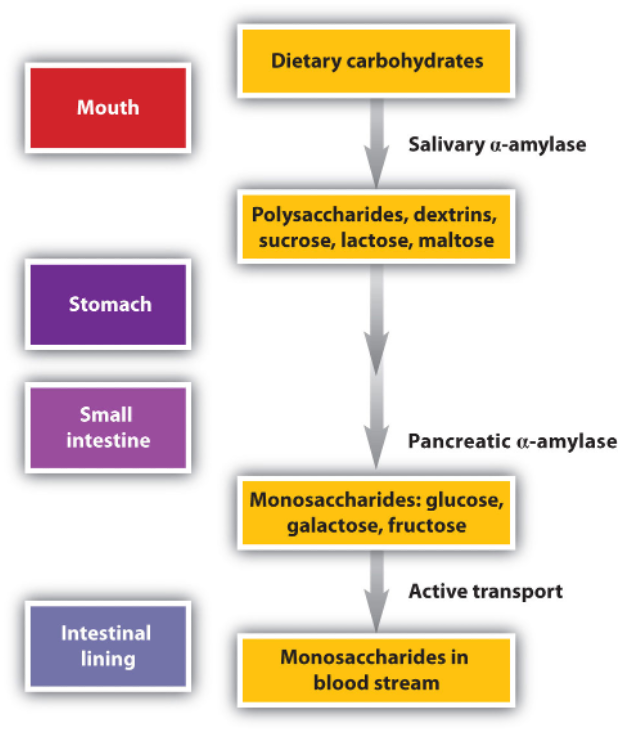
Digestion of carbohydrates
Chemical digestion
·Salivary amylase in the mouth – starch into disaccharide (maltose)
·Pancreatic amylase in the duodenum – starch into disaccharide (maltose)
·Intestinal amylase in the small intestine – disaccharides into monosaccharides (e.g. glucose, fructose)
Absorption
•absorbed directly into the capillaries in the villi lining the small intestine
Digestion of proteins
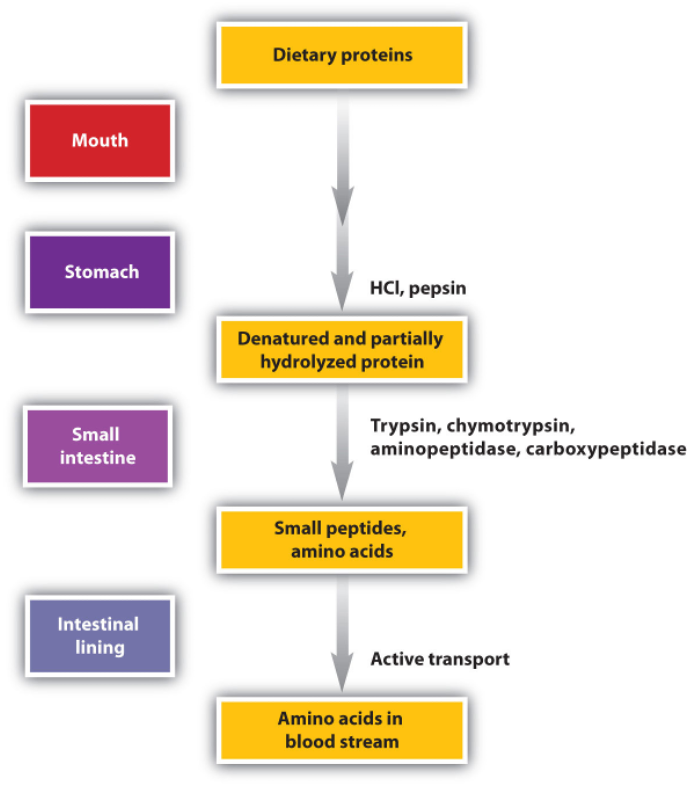
Chemical Digestion
·Gastric protease (pepsin) in the stomach – breaks down proteins into polypeptides.
·Pancreatic Juice – Pancreatic protease (trypsin) breaks down polypeptides to peptides.
·Intestinal Juice – Peptidase breaks down peptides to amino acids.
Absorption
• absorbed directly into the capillaries in the villi lining the small intestine
Digestion of lipids (fats)
Mechanical Digestion
·emulsification by bile from the liver/via gall bladder
Chemical Digestion
·pancreatic lipase in the small intestine – breaks down lipids into fatty acids and glycerol
Absorption
• absorbed into the lacteal in the villi lining the small intestine
Chemical digestion
