N236: Microbial Physiology & Growth Control
 Call Kai
 Learn
Learn Practice Test
 Spaced Repetition
 Match
Match Flashcards
 Knowt Play
1/109

There's no tags or description
Looks like no tags are added yet.
Name | Mastery | Learn | Test | Matching | Spaced | Call with Kai | Chat |
|---|
No analytics yet
Send a link to your students to track their progress
110 Terms
Microbial physiology
The study of the biological function of microbes

Functions of microorganisms
Metabolism (catabolism and anabolism), interaction with surrounding environment, reproduction, and death

Why are bacteria best suited for microbial physiology studies?
They are small, inexpensive, and don't take up space
What are nutrients?
Substances that cells need in order to live

Microorganisms can be categorized based on their sources of...
Energy and Carbon

Phototrophs
Organisms that get energy from light

Oxygenic photosynthesis
Photosynthesis that produces oxygen

Anoxygenic photosynthesis
Photosynthesis that does not produce oxygen

Chemotrophes
Organisms that get energy from chemicals
Autotrophs
Organisms that make their own food

Heterotrophs
Organisms that cannot make their own food

What is metabolism?
The sum of all chemical reactions in the cells
Catabolism
Metabolic pathways that break down molecules, releasing energy

How are anabolic and catabolic reactions related?
The energy released from catabolic reactions is used to fuel anabolic reactions
ATP
Adenosine triphosphate (aka energy)

Metabolic enzymes
Enzymes that regulate metabolic reactions

Catalysts
Enzymes that speed up chemical reactions

Substrate
The reactant of an enzyme-catalyzed reaction

Is the enzyme changed during the chemical reaction?
Nope.
How does temperature affect enzyme activity?
Higher temp = more efficient activity; enzymes can become denatured if temp is TOO hot

How does pH affect enzyme activity?
Certain enzymes function better at a lower pH + others function better at a higher pH

How does substrate concentration affect enzyme activity?
As substrate concentration increases, reaction rate increases up until the point at which all enzymes are occupied

How do enzyme inhibitors affect enzyme activity?
Non-competitive and competitive inhibitors can slow the reaction rate

Endoenzymes
Enzymes that function within the cell

Exoenzymes
Enzymes that are secreted and function outside of the cell
Example: cellulase and pectinase in fungi

What do microorganisms eat for dinner?
Glucose!

Cellular respiration
Process by which cells releases energy from food in the presence of oxygen

How much ATP does glycolysis produce?
2 ATP

How much ATP does the citric acid cycle produce?
2 ATP

How much ATP does the ETC produce?
36-38 ATP

Fermentation
Process by which cells release energy from food in the absence of oxygen
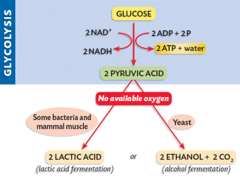
Steps of fermentation
1. Glycolysis
2. Fermentation --> conversion of pyruvic acid into an end product (alcohol or lactic acid)
I live laugh love fermentation. I will ferment anything and everything. Just call me up.

Anabolism
Metabolic pathways that construct molecules, requiring energy

Photosynthesis
Conversion of light energy from the sun into chemical energy

Chemosynthesis
Process by which some organisms use chemical energy to produce carbohydrates

How do nutrients promote microbial growth?
They serve as sources of energy that is needed to sustain life

How does moisture promote microbial growth?
Cells are 70% water, and water is needed for survival
How does temperature promote microbial growth?
Every microbe has an optimum, a minimum, and a maximum growth temperature
Psychrophiles
Microbes that grow best in low temps

Mesophiles
Microbes that grow best in moderate temps

Thermophiles
Microbes that grow best in high temps

Hyperthermophiles
Microbes that grow best in extremely high temps

How does pH promote microbial growth?
Most microbes grow best in a neutral pH

Acidophiles
Microbes that grow best in acidic environments

Alkaliphiles
Microbes that grow best in basic environments

How does osmotic pressure affect microbial growth?
Cells that are isotonic function the most optimally
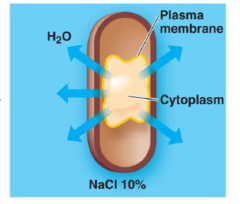
Plasmolysis
In a hypertonic solution, the cell shrinks inside its cell wall while the cell wall remains intact
Crenation
The shrinking of red blood cells when in a hypertonic solution

Plasmoptysis
The bursting of a cell when in a hypotonic solution

Hemolysis
The bursting of red blood cells when in a hypotonic solution

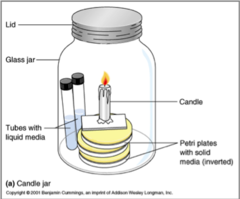
Capnophiles
Microbes that require high CO2 conditions for optimal growth
"In vitro" meaning
"In the glass"

"In vivo" meaning
"In the living"

What is meant by bacterial "growth"
Bacteria grow in quantity, not size
Culture media
The substance in which microbes are grown in a lab

Artificial media
An artificial substance that contains all the nutrients required for microbes to grow

Liquid media
Contained in tubes; tubed media

Solid media
Firm surfaces on which cells can form discrete colonies

Chemically defined media
A media in which the exact chemical composition is known
Complex media
A media in which the exact chemical composition is NOT known
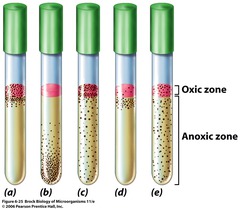
Thioglycollate broth (THIO)
A popular liquid medium in bacteriology labs; the liquid can contain different amounts of oxygen
Enriched media
A media that contain *special* ingredients in order to grow complex microbes
Example: BLOOD AGAR

Selective media
A media that contains ingredients that prevents the growth of unwanted microbes and encourages the growth of desired microbes

Differential media
A media that grows multiple types of microbes and allows us to distinguish between them based on colors

Inoculation
Adding a small sample of specific cells or microbes to a medium
Aseptic lab technique
A set of routine procedures to prevent sterile cultures from becoming contaminated by microorganisms

Incubation
After inoculation, an incubator maintains the bacteria at a favorable temperature for its development

CO2 incubators
An incubator that contain 5-10% CO2 and some O2

Non CO2 incubators
An incubator that contains 20-21% O2
Anaerobic incubators
An incubator that contains no O2

Bacterial growth curve
A graph indicating the growth of a bacterial population over time

Pure culture
A culture that contains only one kind of microorganism

Lag phase
The period in which bacteria are preparing to divide

Log phase
The period of exponential growth of bacterial population

Stationary phase
The period in which nutrients are being used up --> causing the bacterial growth rate to equal the bacterial death rate

Death phase
The period in which bacteria die due to lack of nutrients

Chemostat
A device that allows for the continuous culture of microorganisms (used for drug development and research)

Obligate intracellular pathogens
Microbes that can only survive and multiply within a living cell
How are obligate intracellular pathogens cultured?
In chicken eggs, live animals, or cell cultures

-static
No change/growth

-cidal
Killing

Disinfection
The process used to destroy microorganisms; destroys all pathogenic organisms EXCEPT SPORES

Disinfectants
Chemical used to disinfect inanimate surfaces

Antiseptics
Chemical used to disinfect skin

Sterilization
The process that completely destroys all microbial life, INCLUDING SPORES

Sterilants
Physical or chemical agents that destroy all microorganisms, INCLUDING SPORES
Can skin be sterilized?
No, it can only be disinfected
How can heat kill microbes?
Melting membranes, denaturing proteins

Thermal death point
The lowest temperature required to kill all microbes in a sample in 10 minutes

Thermal death time
The shortest length of time required to kill all microbes at a specific temperature

Dry heat sterilization
Kills microbes by baking or burning them

Moist heat sterilization
Kills microbes by boiling or steaming them

How can cold control microbial growth?
Cold doesn't kill microbes, but it freezes them so that they cannot function or perform reactions

How can desiccation (drying) control microbial growth?
When microbes are dried out, they are not killed but they also cannot function or grow

How can lyophilization (freeze drying) control microbial growth?
When microbes are freeze dried, they are not killed but they also cannot function or grow

How can radiation control microbial growth?
Exposure to UV rays can damage the DNA of microbes --> causing mutations and death

Chemotherapeutic agent
Any chemical/drug used to treat disease
Antimicrobial agent
Any chemical/drug used to treat INFECTIOUS diseases; works by either preventing growth or killing existing pathogens
Antibiotic
A chemical that is produced by a microorganism that kills or inhibits the growth of bacteria
Semisynthetic antibiotics
Antibiotics that have been chemically modified to kill/inhibit a wider variety of bacteria