hs 300 - exam 2 (review slides)
 Call Kai
 Learn
 Practice Test
 Spaced Repetition
 Match
 Flashcards
 Knowt Play
1/49

There's no tags or description
Looks like no tags are added yet.
50 Terms
Ecologic study
Unit = group/population
Fast, cheap, hypothesis-generating
Cross-sectional study
Individual level, exposure, and disease at once
Snapshot in time (single point of observation)
Do cross-sectional studies measure prevalence or incidence?
PREVALENCE
What is the key limitation of cross-sectional studies?
No temporality → cannot determine cause vs effect
Cannot establish causation, only association
What bias issue arises from cross-sectional studies?
Survivor bias
(Mix of risk + survival factors)
Advantages of cross-sectional studies
Quick, cheap, no-follow up
Good for population-level data
Useful for hypothesis generation
Case-control study
Start with disease status (useful for rare diseases)
Look backward to determine disease exposure (retrospective)
Single point in time
Key idea of case-control
Compare exposure frequency in cases vs controls
Ask! Are cases more likely to have been exposed?
2 × 2 table + odds ratio
OR = AD / BC
Measures association (not direct risk)

OR = 1
No association
OR > 1
Risk factor
OR < 1
Protective
How to select cases for case control studies
true, clearly defined disease (prefer incident cases)
How to select controls for case control studies
Same population, no disease, could become cases
Strengths of case controls
quick, inexpensive
Best for rare diseases
Can study multiple exposures
Limitations for case control studies
Retrospective → recall bias, misclassification
Cannot directly calculate risk
Temporal relationship unclear
Not good for rare exposures
What is the key measure for case-control studies?
ODDs ratio
Cohort study
Start with exposure status (notttt disease) (useful for rare exposures)
Subjects must be disease free at baseline
Do cohort studies measure prevalence or incidence?
Since we are following people over time, we measure incidence (new cases)
How many points are in a cohort studies?
always greater than or = 2 points
Exposure measured first
Disease measured later
What is the key equation in cohort studies?
Relative risk = [A/(A+B) / [C/(C+D)]
= incidence in exposed / incidence in non-exposed
What are the advantages of cohort studies?
Only study with direct measure of risk
Establishes temporality (cause → effect)
Can study multiple outcomes
Good for rare exposures
What are the disadvantages of cohort studies?
Expensive, long-follow up
Loss to follow-up
Exposure may change over time
Experimental
Researcher manipulates exposure
Observational study
No randomization, no manipulation (real-world data)
Descriptive → case report, case series, cross-sectional
Analytical → ecological case-control, cohort
Less control, more practical
Experimental study
Randomization + manipulation (clinical trials)
Goal: exposure → outcome relationship
More control, more rigorous
Always interested carefully (bias, confounding)
What is the major limitation of ecological studies?
Ecological fallacy
Group level results do not easily translate to individual-level truth
Attributable risk
(A(A+B)) - (C(C+D))

Attributable risk percentage
AR / (A/(A+B)) * 100

Experimental study design
Researcher manipulates exposure and randomly assigns subjects to treatment or control groups
2 types of experimental studies
clinical trials (individuals)
Community trials (groups)
Randomization
Ensures comparable group at the start
Blinding
Ensures comparability throughout
(Double-blind = preferred)
Strengths of experimental studies
Greatest control
Reduces confounding
Limitations of experimental studies
Artificial setting
Ethical dilemmas
Hard to enforce protocol
Key formulas for experimental study designs
Rate ratio
Rate ratio = incidence (treated) / incidence (control)
% relative effect
(RR - 1) x 100
Random error
Error that is random
Can be reduced by increasing sample size
Bias is a ____ error
Systematic
Selection bias
Error in how subjects are chosen (ex: non-response bias)
Information bias
Error in how data is collected
Recall bias
Incorrect information given due to memory loss
Interviewer bias
Interviewer asks biased questions depending on the subject being interviewed
Prevarication
Participants lying or exaggerating
Bias _____ be fixed in the analysis phase; it must be avoided in the design phase
CANNOT
Hawthorne effect
Participants tend to act differently when observed
Confounding
A “mixing” of effects
A third variable (the cofounder)
Criteria for a cofounder
Must be a risk factor for the disease
Must be associated with the exposure
Must not be an intermediate step in the causal pathway
How to control for confounders in the design phase?
Randomization
Matching
Restriction
How to control for confounders in the analysis phase?
Stratification
Adjustment
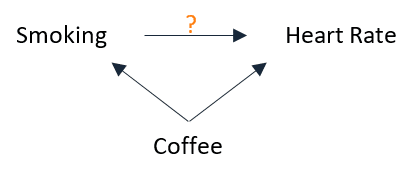
Confounding triangle
diagram that shows how a third factor—called a confounder—creates a false or distorted link between an exposure(independent variable) and an outcome (dependent variable)