Lecture 16 - Molecular Genetics Biomed
 Call Kai
 Learn
Learn Practice Test
 Spaced Repetition
 Match
Match Flashcards
 Knowt Play
1/81

There's no tags or description
Looks like no tags are added yet.
Name | Mastery | Learn | Test | Matching | Spaced | Call with Kai | Chat |
|---|
No analytics yet
Send a link to your students to track their progress
82 Terms
_______________ are the source of genetic variation.
"Mutations"
TRUE/FALSE
Mutations are part of normal human variation, and could be beneficial, harmful, or neutral.
True
What are the 4 major types of pathogenic genetic variants?
1. Missense variant leading to change-of-function
2. Protein truncating variant
3. Large deletion
4. Large duplication

What are the 6 types of variants?

____________ and ____________ can be large or small, and in-frame or frameshift.
Insertions and Deletions
How small can insertions and deletions be?
Can be small as a base or two
What are 2 examples of a small insertion/deletion?
- BRCA1/2 mutations
- Smith-Lemli-Oprtiz Syndrome
How large can insertions and deletions be?
Can encompass the entire gene, multiple genes, or only part of a gene
What are 2 examples of large insertions/deletions
- Duchenne muscular dystrophy
- 22q Deletion syndrome
What type of insertion/deletion results in the reading frame not being altered and only specific amino acids are added/missing?
In frame

What type of insertion/deletion results in the reading frame being altered and the entire sequence after insertion/deletion is abnormal.
Frameshift

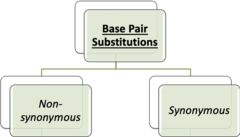
Base pair substitutions can be classified as ___________ or ________________.
- Synonymous
- Non-synonymous
What occurs during a synonymous base pair substitution?
No amino acid change

What occurs during a non-synonymous base pair substitution?
- Missense (different amino acid)
- Nonsense (premature stop codon)

What is a Missense variant?

What is a Nonsense variant?

What is a trinucleotide repeat expansion?
- Some genes have regions that contain highly repetitive sequences
- Polymerase slippage leads to excess number of repeats
- Above a certain range, extra repeats are harmful

What is Huntington's disease?
Progressive disorder of motor, cognitive, and psychiatric disturbances

What is the mean age of onset and median of survival of Huntington's disease?
Mean age of onset - 35-44y
Median survival - 15-18y
How does Huntington's disease show anticipation?
- Greater # repeats = earlier symptoms
- >60 repeats can have juvenile onset

What is Fragile X syndrome?
Causes developmental delay, intellectual disability, behavioral challenges, and specific facial features.
TRUE/FALSE
Fragile X syndrome is the most common inherited cause of developmental/intellectual disabilities in males.
True
Repeats of Fragile X syndrome in the __________________ range produce abnormal RNA
Pre-mutation
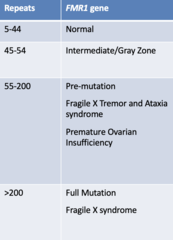
Repeats of Fragile X syndrome in the __________________ range methylate the gene and turn off transcription
Full mutation

TRUE/FALSE
Fragile X Syndrome shows anticipation
False
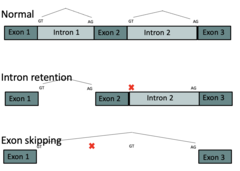
What is the sequence of intron slice sites?
GT and AG

What are the different splice site mutations?
1. Intron retention
2. Exon skipping
What is a cryptic splice site in an exon?
Sequence of the normal splice site is still in tact, however, the use of this site is reduced and the new site is preferred.
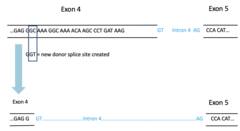
What is a cryptic splice site in an intron?
Normal splice site remains intact. New splice site has preferential use, but normal one is still used too, just reduced amount. New splice site may create a frame shift in new exon.

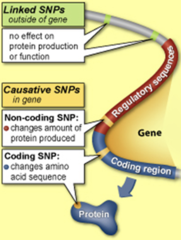
What is a variation that occurs in at least 1% of the population and can be located within a gene or outside a gene?
Polymorphisms

TRUE/FALSE
Single Nucleotide Polymorphisms always cause disease
False
SNPs could have
- no consequence
- be directly causative of disease
- contribute to disease risk
- protect against disease.
___________________ reflects the coexistence of two or more common phenotypes of a character in a natural population of organisms.
Polymorphism
What are 4 common human dimorphisms?
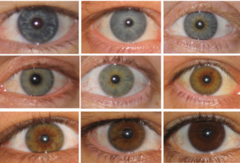
1. Brown versus blue eyes
2. Pigmented versus blonde hair
3. Attached versus free earlobes
4. Love vs Hate cilantro
a. 21% East Asian
b. 17% Caucasian
c. 14% African descent
d. 7% South Asian
e. 4% Hispanic
f. 3% Middle Eastern

What are the 2 ways that genetic variation can occur?
1. DNA replication errors
2. DNA repair errors
In DNA replication, proofreading mechanism catches __________% of errors
99.9%
In DNA replication, the overall mutation rate is ___________ per base pair per cell division
10^-10
What environmental factors cause DNA errors?
Chemical, mutagens, radiation, etc.
DNA repair errors often result in ___________ changes to the DNA sequence
Permanent
What are the 2 ways that the cells repair mutations?
1. Single Stranded Repair
2. Double Stranded Repair
What are the 3 types of single stranded repair?
1. Base excision repair (BER)
2. Nucleotide excision repair (NER)
3. Mismatch repair (MMR)
What are the 2 types of double stranded repair?
1. Homologous recombination
2. Non-homologous end joining (NHEJ)
What is Base Excision Repair (BER)?
- Incorrect base is removed from DNA backbone (deoxyribose)
- Then replaced with the correct base
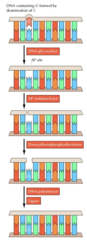
What process results in the transformation of a Cytosine base to a Uracil base?
Deamination

What is Nucleotide Excision Repair (NER)?
Entire nucleotide region, including DNA backbone must be removed

What genes are important in NER?
XPA-XPG and ERCC1 genes are important in NER
What is Mismatch repair (MMR)
Repair mismatched bases (Don't need to know mechanism)

When DNA damage is not corrected, _____________ can occur in the individual
Disease
The earlier the mutation occurs in embryology, the ___________ tissues can potentially be affected.
More
Cancer can occur when there are somatic or germline mutations in genes that control what 4 things?
1. DNA repair
2. Cell cycle check points
3. Growth promotion
4. Apoptosis
When mutations occur in _______________ cells, there is a risk to pass on a genetic condition to offspring
Germline
Mutations passed on to offspring from germline cells appear as if the child has a ________________ mutation, but the family has an increased risk of having additional children with the same condition.
de novo (new)
Mutations in what two types of genes may cause cancer?
1. Tumor suppressor
2. Proto-oncogene
What gene is responsible for regulating cell cycle, growth, or DNA damage repair?
Tumor Suppressor
What gene is responsible for regulating cell proliferation, growth, transcription factors, and apoptosis?
Proto-oncogenes
_______________ tumor suppressor genes regulate the cell cycle and initiate apoptosis
"Gate keeper"
________________ tumor suppressor genes detect and repair mutations, regulate normal disjunction in mitosis, and participate in apoptosis.
"Caretakers"
What do mutations in a proto-oncogene do?
- Mutations stimulate proliferation of cells and inhibits apoptosis
- Once mutated, is called an "oncogene"
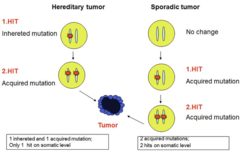
How many copies of a tumor suppressor gene must be mutated before cancer results?
Both copies
How many copies of a proto-oncogene must be mutated to cause problems?
One copy
What are some examples of tumor suppressor genes?
- APC
- RB
- TP53
What are some examples of proto-oncogenes?
- HER2
- RET
- RAS
What is the difference between a hereditary tumor and sporadic tumor in tumor suppressor cells that develop cancer?
Retinoblatoma results from the mutations in the ______ gene (Tumor suppressor)
RB1

When does retinoblastoma occur?
Rare ocular childhood cancer, usually occurs before 5 years old
What does retinoblastoma show up as in photos?
"Cat eye reflex" - Light bounces off tumor in the back of the eye

How many copies of RB1 need to be mutated for cancer to develop?
- Both copies (autosomal dominant)
- "2-hit" cancer mechanism
_______ of retinoblastoma cases are sporadic and generally occur in only 1 eye
2/3
Inherited or new germline changes account for ______ of retinoblastoma cases.
- Most likely to occur in both eyes
- Increased risk for cancers in other areas of the body
1/3
Familial Adenomatous Polyposis (FAP) results in mutations in the _______ gene (Tumor Supressor).
APC

Polyps from FAP begin to develop by ______, on average
16 years
Carpeting results when ________ - ___________s of polyps are present
100 - 1000s
FAP inevitably results in __________ cancer unless you get a colonectomy.
Colon cancer
What is the term used to describe multiple platforms that perform sequencing of small fragments of genetic material in parallel?
Next generation sequencing

What is bioinformatics used for in Next generation sequencing?
- Map these small fragments together against a reference sequence
- Shift through the data to find variants that may correspond to disease
What can Next generation sequencing be used to sequence?
Can be used to sequence panels of genes of interest, the entire exome, the entire genome, or RNA-ome.
How many genes and exons are there in the human genome?
~20,000 genes
~180,000 exons
Exons accounts for only _____% of the human genome
- 2-3%
What are the 3 pros of Whole exome sequencing?
- Vast majority of KNOWN pathogenic mutations occur in exons or in splice sites near exon junctions
- Decreases the amount of data that needs to be analyzed
- Casts a wide net when you have multiple genes of interest or are trying to identify new genes
What are the 4 cons of Whole exome sequencing?
- Actually harder to prepare DNA for sequencing since you have to create a "library" with just the exons and surrounding sequences before you can start sequencing
- Will miss mutations in regulatory regions, deep intronic, and any areas that are not covered by the exome
- Interpretation of mutations/variants can be complicated and it isn't always clear which are deleterious vs benign
- Need ~100x coverage of each nucleotide for good sensitivity
How many nucleotides are there in the human genome?
1 human genome = ~3.2 billion nucleotides
What are the 3 pros of Whole genome sequencing?
- Technically easier since you are sequencing everything
- Able to identify pathogenic mutations in non-coding regions not covered by exome
- Generally only need 30x coverage
What is the con of Whole genome sequencing?
Interpretation is MUCH more difficult