Bioenergetics and Glycolysis: Energy, Regulation, and Clinical Insights
 Call Kai
 Learn
Learn Practice Test
 Spaced Repetition
 Match
Match Flashcards
 Knowt Play
 Podcast
1/99

There's no tags or description
Looks like no tags are added yet.
Name | Mastery | Learn | Test | Matching | Spaced | Call with Kai | Chat |
|---|
No analytics yet
Send a link to your students to track their progress
100 Terms
What is the primary purpose of oxidative metabolism?
Energy production stored as ATP.

What are 'high-energy' bonds?
Bonds that release a large, negative ΔG°′ upon hydrolysis, making them effective energy carriers.

What is the significance of ATP in cellular metabolism?
ATP is the cell's energy currency, coupling energy-releasing reactions to energy-requiring ones.
What are the classes of high-energy compounds?
Phosphoric acid anhydrides (ATP), phosphoric-carboxylic anhydrides (1,3-BPG), phosphoguanidines (creatine phosphate), enol phosphates (PEP), and thioesters (acetyl-CoA).

How does the ΔG°′ relate to the equilibrium constant (Keq)?
ΔG°′ = −RT ln Keq; it indicates the favorability of a reaction at standard conditions.
What does a negative ΔG°′ indicate?
The forward reaction is favored.
What is the relationship between ΔG and metabolic pathways?
Free energies of metabolic pathways are additive, allowing unfavorable steps to proceed if coupled with favorable ones.
What is the primary purpose of glycolysis?
To oxidize glucose to pyruvate, generating ATP and NADH.

Where does glycolysis occur?
In the cytoplasm (cytosol) of mammalian cells.
What are the two possible fates of pyruvate in glycolysis?
In aerobic conditions, it is oxidized via the TCA cycle; in anaerobic conditions, it is reduced to lactate.
What is the first step of glycolysis?
Hexokinase phosphorylates glucose to glucose-6-phosphate, hydrolyzing ATP.
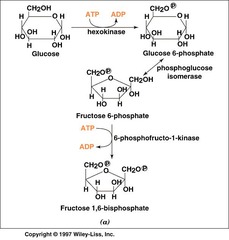
What is the ΔG°′ of the first step of glycolysis?
−4.0 kcal/mol, indicating it is strongly favored forward.
What does phosphoglucose isomerase do in glycolysis?
Reversibly rearranges glucose-6-phosphate to fructose-6-phosphate.
What is the ΔG°′ for the second step of glycolysis?
+0.4 kcal/mol, indicating it is reversible.
What is the role of phosphofructokinase-1 (PFK-1) in glycolysis?
It phosphorylates fructose-6-phosphate to form fructose-1,6-bisphosphate.
What is the ΔG°′ for the third step of glycolysis?
−3.4 kcal/mol, indicating it is favored forward.
What is the significance of the ATP investment phase in glycolysis?
It involves the initial phosphorylation steps that consume ATP to prepare glucose for further breakdown.
What is the relationship between NADH and glycolysis?
NADH is generated during glycolysis and is crucial for the oxidation of glucose.
How does glycolysis relate to cellular respiration?
Glycolysis is the first step in cellular respiration, leading to further oxidation of pyruvate in aerobic conditions.
What happens to NADH in aerobic conditions?
It is reoxidized by the mitochondrial electron transport chain.
What happens to NADH in anaerobic conditions?
It is recycled within the cytosol to allow glycolysis to continue.
What is the core transformation in glycolysis?
Glucose (6C) is oxidized to two molecules of pyruvate (3C each).
Why is glycolysis considered a universal pathway?
It requires no oxygen and no membrane-bound organelle, allowing all human cells to perform it.
What is the role of kinases in bioenergetics?
Kinases transfer phosphate groups between high-energy donors and acceptors.
What is the significance of the ΔG°′ value for a reaction?
It indicates the favorability of the reaction under standard conditions.
What enzyme phosphorylates C1 to form fructose-1,6-bisphosphate?
Phosphofructokinase-1 (PFK-1)
What is the ΔG°′ value for the reaction catalyzed by PFK-1?
−3.4 kcal/mol
What phase of glycolysis involves the investment of two ATP?
The investment phase
What happens to glucose during Step 1 of glycolysis?
It is trapped inside the cell as a charged phosphate ester.
What are the two 3-carbon products formed in Step 4 of glycolysis?
Dihydroxyacetone phosphate (DHAP) and glyceraldehyde-3-phosphate (G3P).

What enzyme interconverts DHAP and G3P?
Triose phosphate isomerase.
What is the significance of Step 4 in glycolysis?
It marks the branch point where one hexose becomes two trioses.
What is the ΔG°′ value for Step 4 of glycolysis?
+5.7 kcal/mol
What is the first ATP payoff step in glycolysis?
Step 7, where phosphoglycerate kinase generates ATP from 1,3-bisphosphoglycerate.

What is the ΔG°′ value for Step 7 of glycolysis?
−4.5 kcal/mol
What does Step 6 of glycolysis produce?
NADH and 1,3-bisphosphoglycerate.
What is the role of glyceraldehyde-3-phosphate dehydrogenase?
It oxidizes G3P, generating NADH.
What is the ΔG°′ value for Step 6 of glycolysis?
+1.5 kcal/mol
What happens in Step 9 of glycolysis?
Enolase removes H₂O from 2-phosphoglycerate to form phosphoenolpyruvate (PEP).

What is the ΔG°′ value for Step 10 of glycolysis?
−7.5 kcal/mol
What is produced in Step 10 of glycolysis?
ATP and pyruvate.
What happens to NADH under anaerobic conditions?
It is reoxidized to NAD⁺ as pyruvate is reduced to lactate.
What is the main purpose of anaerobic glycolysis?
To regenerate cytosolic NAD⁺ so glycolysis can continue.
What is the Warburg effect?
The phenomenon where rapidly proliferating cells convert glucose to lactate even in the presence of oxygen.
What is the fate of pyruvate in aerobic conditions?
It is transported into mitochondria and oxidized to acetyl-CoA.
What is the significance of pyruvate kinase in glycolysis?
It acts as a major control point due to its large negative ΔG°′.
What is the role of lactate dehydrogenase in anaerobic glycolysis?
It converts pyruvate to lactic acid, regenerating NAD⁺.
What is the ATP yield comparison between aerobic and anaerobic glycolysis?
Aerobic glycolysis yields far greater ATP than anaerobic glycolysis.
What happens to G3P in glycolysis?
It is continuously consumed in subsequent steps, maintaining a low concentration.
What is the overall stoichiometry adjustment in glycolysis after Step 4?
All stoichiometry should be counted ×2 per original glucose.
What is the ΔG°′ value for Step 8 of glycolysis?
+1.1 kcal/mol
What is the significance of ΔG values in glycolysis?
ΔG values indicate the direction and irreversibility of reactions; hexokinase, PFK-1, and pyruvate kinase have strongly negative ΔG values, making them control points.
What is the total energy yield from the complete oxidation of one glucose molecule?
30-32 ATP per glucose.
How many ATP are produced during glycolysis?
2 ATP.
What is the role of 2,3-BPG in oxygen delivery?
2,3-BPG stabilizes deoxyhemoglobin, enhancing oxygen release from hemoglobin to tissues.

What are the three main control points of glycolysis?
Hexokinase (Step 1), PFK-1 (Step 3), and pyruvate kinase (Step 10).
How does the GLUT-4 transporter function?
GLUT-4 facilitates glucose transport by passive diffusion and is regulated by insulin.
What is the purpose of the 2,3-BPG shunt in glycolysis?
To produce 2,3-BPG, a critical regulator of hemoglobin, rather than for energy production.
What is the difference between hexokinase and glucokinase?
Hexokinase saturates at low glucose levels, while glucokinase has a higher Km and is active primarily when blood glucose is high.

What is the role of PFK-1 in glycolysis?
PFK-1 catalyzes the committed, rate-limiting step of glycolysis and is regulated by ATP, AMP, and fructose-2,6-bisphosphate.
What happens to 2,3-BPG levels during high-altitude acclimatization?
2,3-BPG levels rise to enhance oxygen delivery to tissues.
What is the clinical significance of glucokinase?
Glucokinase acts as a pancreatic glucose sensor, regulating insulin secretion based on blood glucose levels.
How does ATP affect PFK-1 activity?
ATP inhibits PFK-1, signaling that the cell's energy needs are met.
What is the effect of AMP on PFK-1?
AMP activates PFK-1, indicating a need for increased glycolytic flux due to low energy charge.
What is the function of fructose-2,6-bisphosphate?
It is the most important allosteric activator of PFK-1, regulating glycolysis.
What is the significance of the ΔG values for hexokinase, PFK-1, and pyruvate kinase?
Their strongly negative ΔG values indicate that these reactions are effectively irreversible in vivo.
What is the role of NADH in glycolysis?
NADH is produced during glycolysis and contributes to the total ATP yield through oxidative phosphorylation.
What is the importance of glucose transport regulation?
Glucose transport must be regulated to ensure proper glucose availability for energy production in tissues.
What is the impact of citrate on PFK-1?
Citrate inhibits PFK-1, indicating that biosynthetic building blocks are abundant.
How does the malate-aspartate shuttle affect ATP yield?
It yields approximately 2.5 ATP per NADH, while the glycerol-3-phosphate shuttle yields about 1.5 ATP per NADH.
What metabolic pathway does pyruvate dehydrogenase participate in?
It converts 2 pyruvate into 2 acetyl-CoA, producing 2 NADH and contributing to ATP yield.
What is the function of GTP in the citric acid cycle?
GTP is produced and can be converted to ATP, contributing to the overall energy yield.
What is the relationship between hexokinase and glucose-dependent tissues?
Hexokinase ensures glucose-dependent tissues like the brain receive glucose even during fasting.
What happens to 2,3-BPG levels in stored blood?
2,3-BPG levels fall, leading to less efficient oxygen delivery immediately after transfusion.
What is the effect of high glucose levels on glucokinase activity?
Glucokinase activity increases steeply when blood glucose levels are high, allowing the liver to buffer glucose.
What is the significance of the committed step in glycolysis?
Once fructose-1,6-bisphosphate is formed, the cell is committed to completing glycolysis.
What is the role of PFK-2/FBPase-2?
It acts as a bifunctional switch that regulates glycolysis by converting fructose-2,6-bisphosphate to either stimulate or inhibit glycolysis.
What happens to PFK-2 activity when it is in the dephosphorylated form?
The dephosphorylated form favors PFK-2 (kinase) activity, stimulating glycolysis.
What is the effect of the phosphorylated form of PFK-2/FBPase-2?
It favors FBPase-2 (phosphatase) activity, inhibiting glycolysis.
Which hormones are primarily involved in the hormonal regulation of glycolysis?
Insulin, glucagon, and epinephrine.
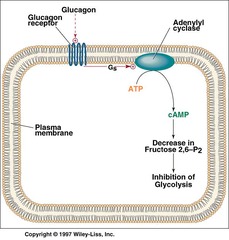
How does glucagon signal the need for fuel?
It binds to its receptor, activating a G protein that stimulates adenylyl cyclase, increasing cAMP levels.
What is the role of cAMP in hormonal signaling?
cAMP acts as a second messenger that activates protein kinase A (PKA), which regulates various metabolic pathways.
What effect does insulin have on glycolysis?
Insulin stimulates glycolysis by activating phosphodiesterase, lowering cAMP levels and reducing PKA activity.
What is the net ATP yield from glycolysis per glucose molecule?
2 ATP and 2 NADH.
Which glycolytic steps are considered control points?
Hexokinase, PFK-1, and pyruvate kinase.
What is pyruvate kinase deficiency?
It is the most common inherited glycolytic enzyme defect, leading to chronic hemolytic anemia due to impaired ATP production in red blood cells.
What causes lactic acidosis?
It occurs when anaerobic glycolysis produces lactate faster than the liver can clear it, often due to tissue hypoperfusion.
How does glucagon affect fructose-2,6-bisphosphate levels?
It decreases fructose-2,6-bisphosphate levels, inhibiting glycolysis.
What is the relationship between glucose availability and PFK-2/FBPase-2 activity?
High glucose stimulates PFK-2 activity, increasing fructose-2,6-bisphosphate and promoting glycolysis; low glucose activates FBPase-2, inhibiting glycolysis.
What are the two enzyme activities of PFK-2/FBPase-2?
Kinase activity (PFK-2) and phosphatase activity (FBPase-2).
What is the primary function of insulin in the context of glycolysis?
To promote glycolysis by decreasing cAMP levels and activating phosphatases that dephosphorylate key regulatory enzymes.
What is the significance of the phosphorylation state of PFK-2/FBPase-2?
It determines whether glycolysis is stimulated or inhibited, acting as an on/off switch for metabolic pathways.
What is the total ATP yield from glucose oxidation when including the citric acid cycle and oxidative phosphorylation?
30-32 ATP.
What is the role of adenylyl cyclase in hormonal signaling?
It synthesizes cAMP from ATP upon activation by glucagon and epinephrine.
How does insulin counteract the effects of glucagon and epinephrine?
By activating phosphodiesterase to lower cAMP levels and activating protein phosphatases to dephosphorylate regulatory enzymes.
What is the effect of high fructose-6-phosphate on PFK-2?
It stimulates phosphoprotein phosphatase, activating PFK-2 and increasing fructose-2,6-bisphosphate.
What is the main consequence of increased fructose-2,6-bisphosphate levels?
It allosterically activates PFK-1, stimulating glycolysis.
What is the relationship between glycolysis and gluconeogenesis?
They are regulated by the same bifunctional enzyme, with opposing effects based on glucose availability.
What is the primary energy currency produced during glycolysis?
ATP.
What is the significance of the ten enzyme-catalyzed steps in glycolysis?
They convert one glucose molecule into two pyruvate molecules, facilitating energy extraction.