Masking & Speech Assessment
 Call Kai
 Learn
 Practice Test
 Spaced Repetition
 Match
 Flashcards
 Knowt Play
1/41

There's no tags or description
Looks like no tags are added yet.
42 Terms
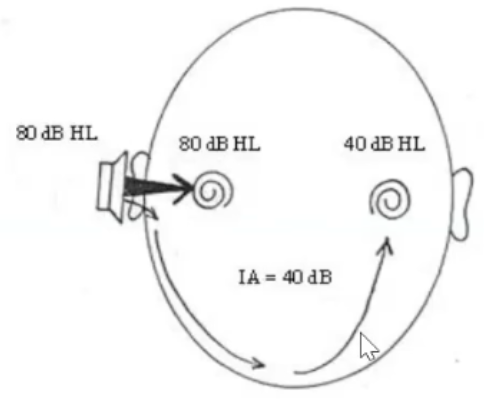
Interaural attenuation
Loss of intensity of sound introduced to one ear and heard by the other.
40dB
Traditional earphones interaural attenuation is ______ for air conduction.
70dB
For earphone inserts interaural attenuation is ______ for air conduction

0
Intra-aural attenuation of bone conduction is assumed to be______dB
Bone
Masking technique is most often used in ______conduction.
narrow band noise (NBN)
Masking for air conduction, you should use an AC signal _______ in the non-test ear (NTE) to keep that side stimulated, then can be assured that BC signal response is of the test ear (TE)
A form of masking noise in audiometry comprising a limited range of frequencies centered around a specific pure tone to block the non-test ear during assessment
What is narrow band noise?
Speech reception threshold (SRT)
The softest level at which speech can be recognized 50% of the time
Validity check of pure tones SRT ≤ PTA (w/in 12 dB) and assess functional gain in hearing aid
Two reasons for SRT testing
Same procedure as pure tone threshold search (Houghson-Westlake Down 10/ Up 5)
How do you assess SRT?
“say the word…”
Give an example of a carrier phrase
spondee words
2 syllable words used for SRT like hotdog, airplane, ice cream, baseball, cowboy
AKA Word Recognition, Speech Discrimination: Presented a suprathreshold to estimate a persons ability to understand speech
What is speech recognition score (SRS)?
Presenting speech stimuli (words/sentences) at a vol above pt’s threshold of hearing, a level that simulates normal, comfortable conversation. Not testing min level at which a pt can hear, but assesses how well a pt can understand speech when it is clearly audible
What does suprathreshold mean?
40 dB
Speech recognition scores are usually tested at ______ SL (sensation level)
% correct of 25-50 word lists
Word recognition is reported as a _________
Phonetically balanced - refers to a list of monosyllabic words designed to reflect the same phonetic composition as natural conversational speech
The word lists for SRS is…
CID W-22 (Central Institute for the Deaf) and NU-6 (Northwestern University)
The most common open-set, phonetically balanced word lists used in audiology to measure Speech Recognition Scores (SRS)
Word Intelligibility Picture Index used for pediatric speech tests to determine their word recognition score (WRS)
What is the WIPI?
Phonetically balanced kindergarten - 50 words, used for SRT in pediatrics
What is the PBK?
Impedance
Term used to describe the opposition to flow of acoustic (mechanical) energy through the middle ear.
Admittance
Describes the relative ease with which energy flows through a system, such as the middle ear.
Immitance
Term that can be used to refer to either impedance data or admittance data
1 Identify presence of fluid or pressure in the ME
2 Evaluate Eustachian tube and facial nerve function
3 Predict audiometric findings
4 Determine type of HL
5 Assist in diagnosing site of lesion (esp in young children)
List the purposes of immitance measures
Tympanometry, Static Acoustic Immittance, Threshold of Acoustic Reflex
Examples of acoustic immitance measures
Placing a small, sealed probe in the ear canal. Probe plays a low‑frequency tone bc the ear system responds most strongly to stiffness changes at low frequencies. As the air pressure in the canal changes, the eardrum moves more/less easily. Tympanometry measures how much of the sound is reflected back from the eardrum, and the peak on the tympanogram shows the pressure at which the eardrum moves most freely.
How does tympanometry work?
226 Hz
What freq is used in tympanometry?
+200 daPa, –400 daP
Tympanometry changes the air pressure in your ear canal from higher than normal ______ to lower than normal ______.
x, y
On a tympanogram the pressure is put on the ______ axis and the compliance is put on the _______axis.
Normal, Type A
What it means: ME is working normally, there is no HL
HL: possibly SNHL (bc tympanogram only measures the ME)
Disorders: inner infections, ototoxic meds, noise induced, presbycusis, vestibular schwannoma
What type of tympanogram is image showing? What does it mean? Identify the type of hearing loss. What common disorder(s) is associated with this type of tympanogram?

Shallow, Type As
What it means: there is increased stiffness in the ossicular chain or increased mass on the TM
HL: Conductive, mixed, or SNHL
Disorders: cholesteatoma
What type of tympanogram is image showing? What does it mean? Identify the type of hearing loss. What common disorder(s) is associated with this type of tympanogram?

Deep, Type Ad
What it means: TM is very hypermobile
HL: Conductive, mixed, or SNHL
Disorders: ossicles not connected, ligament problem in ME, chronic noise exposure
What type of tympanogram is image showing? What does it mean? Identify the type of hearing loss. What common disorder(s) is associated with this type of tympanogram?

Flat, Type B
What it means: large amount of pressure (fluid buildup) in the ME so the TM can’t move or there is a perforation or hole in the TM
HL: Conductive or mixed HL
Disorders: Otitis media, TM perforation
What type of tympanogram is image showing? What does it mean? Identify the type of hearing loss. What common disorder(s) is associated with this type of tympanogram?

Negative Peak, Type C
What it means: Something in the ME is causing unequal pressure with the ear canal
HL: Conductive or mixed HL
Disorders: Eustachian tube dysfunction
What type of tympanogram is image showing? What does it mean? Identify the type of hearing loss. What common disorder(s) is associated with this type of tympanogram?

True; bc of unique anatomical and physiological properties of their ear canals and ME system
True or False: Tympanometry may have limited value with children younger than 7 months.
1000Hz probe tone
What frequency should you use for tympanometry in infants?
Lowest possible intensity needed to elicit a contraction of the muscles in the ME.
The acoustic reflex threshold is…
65-95 dB HL, 85 dB HL
The acoustic reflex threshold is most often between ________with the avg response above________
False: acoustic stimulation to one ear will elicit a muscle contraction and subsequent impedance change in both ears.
True or False: The acoustic reflex is not a consensual phenomenon
Ipsilateral reflex
Sound is put into the ear that the reflexes are being measured in. Stronger than the contralateral ear. Stimulus put on the same side.
Contralateral reflex
Sound is put into the test ear and the reflex is measured from the other non-test ear. On the opposite side.

True
True or false: In the measurement of auditory function, the most meaningful information can be gleaned only when the entire test battery of pure-tone and speech audiometry together with immittance measurements is used.