Week 1
 Call Kai
 Learn
 Practice Test
 Spaced Repetition
 Match
 Flashcards
 Knowt Play
1/42

There's no tags or description
Looks like no tags are added yet.
43 Terms
Three Levels of Strategy
Corporate strategy (which businesses & markets should we be in?)
Business strategy (how do we compete in this market?)
Functional strategy (how does each function support the business strategy?)
Sport vs Business Competition
Sport competition: about being the BEST competitor; "best" is clearly defined by the rules.
Business competition: about being a DIFFERENT competitor; "best" can't even be defined.
Operational Effectiveness vs Strategy
Operational effectiveness: doing the same things better than rivals (compete to be the best); necessary, but not sufficient
Strategy: doing different things, or the same things differently (compete to be unique); aims for sustainable competitive advantage
Definition of Strategy + Its 3 Parts
The creation of a unique and valuable market position, involving a different set of activities.
Value proposition (make customers want what you offer)
Different activities (how you deliver that value)
Unique position (different from rivals)
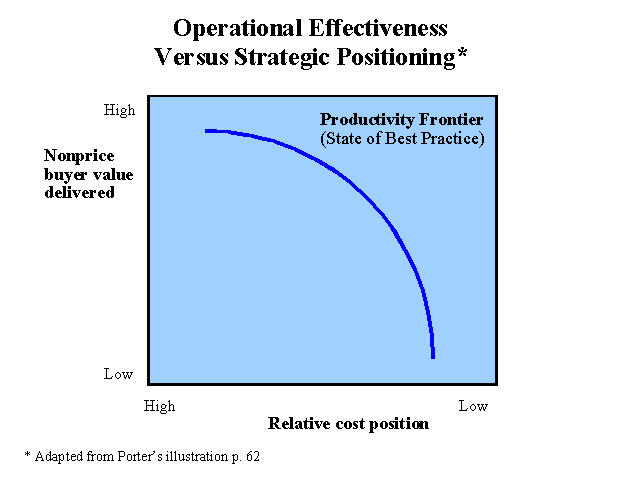
Productivity Frontier
The sum of all existing best practices: the maximum value a firm can create at a given cost. Operational effectiveness moves a firm toward it, and it keeps shifting outward, the more effective firms can be (via tech, innovation, etc).
Competing on operational effectiveness improves everyone in absolute terms, but nobody relative to rivals.
2 Reasons Operational Effectiveness Isn't Enough
Rapid diffusion (best practices get imitated quickly)
Competitive convergence (benchmarking (measuring performance against competators) & outsourcing make rivals look alike, so competition turns zero-sum and mutually destructive)
Consumer Surplus
Consumer surplus ("value for money") = willingness to pay (WTP) − price. Customers choose the product that gives them the greatest consumer surplus.
Use Value vs Exchange Value
Use value (= WTP): the qualities a customer perceives in relation to their needs; subjective and individual
Exchange value (= price): the money realized at one point in time when the exchange happens; only realized if buyer and seller trade
Value Capture
The process of turning the value a company creates—through products, services, or cost savings—into actual revenue, profit, and measurable financial results
Isolating Mechanisms + 3 Types
They protect a firm from imitation so it can capture value.
Add Barriers to imitation (patents & IP; activity systems too complex to copy)
Increase Switching costs
- customer: loyalty programs, habit, learning costs;
- supplier: relationship-specific investments, contractsBargaining relationships
- brand strength & differentiation reduce buyer power;
- scale & integration reduce supplier power
Value Proposition + Its 3 Questions
The part of a strategy that looks outward at customers (the demand side). It answers: • which customers? • which needs? • what relative price (premium or discount)?
Value Chain: Key Principle + 2 Activity Types
Every activity either increases customer willingness to pay OR decreases costs, so all activities must create value for the end user.
Primary activities:
• inbound logistics
• operations
• outbound logistics
• marketing & sales
Support activities:
• firm infrastructure
• human resource management
• technology development
• procurement
2 Routes to More Consumer Surplus
Differentiation: increase WTP
Cost leadership: lower costs, so a lower price
Generic Strategies
Two dimensions: source of advantage (low cost or differentiation) and scope (total or niche market).
Cost leadership: low cost, total market
Differentiation: differentiation, total market
Cost focus: low cost, niche market
Differentiation focus: differentiation, niche market
Competitive Advantage
Performing better than rivals in the same industry or segment through a lower cost, a premium price, or both, by doing unique things or doing similar things in a unique way. The challenge is how to sustain it over time.
2 Paths to Competitive Advantage
Cost advantage (a unique activity system & value chain that creates the SAME value at a lower cost or price)
Differentiation advantage (a unique activity system & value chain that creates SUPERIOR value customers will pay more for)
3 Bases of Strategic Position
Variety-based (a subset of an industry's products or services, which distinctive activities produce best)
Needs-based (most or all needs of one particular customer group)
Access-based (customers who are reachable in different ways, such as by geography or scale)
Strategic Position (Strategic Landscape)
Each market position (a "peak" on the strategic landscape) earns different performance (value captured) through its own activities. Pick the position that is valuable to customers AND uniquely differentiates you from rivals.
Activity Systems + Why They're Hard to Copy
Competitive advantage comes from the whole system of activities and how they link, not from individual activities. Rivals must match every linked activity, and copying only some doesn't help.
Activity-System Maps
A visual diagram showing how a company's big goals are carried out by connected daily operations that reinforce each other.
Use it to:
• check consistency (of activities)
• strengthen reinforcement (of the activities themselves)
• find activities that could eliminate others (eliminating redundancy)
3 Types of Fit
First-order fit (each activity is consistent with the overall strategy, so advantages add up instead of cancelling out)
Second-order fit (activities reinforce each other: one raises another's value or lowers its cost)
Third-order fit (optimization of effort: coordinating activities to remove redundancy & wasted effort)
Trade-offs
More of one thing means less of another. Trade-offs happen when activities are incompatible, so a unique position requires deciding what NOT to do. Without them, a firm ends up stuck in the middle.
3 Reasons Trade-offs Arise
Image or reputation (delivering two inconsistent kinds of value confuses customers & hurts credibility)
The activities themselves (different positions need different equipment, skills, behavior & systems)
Limits on internal coordination & control (being all things to all customers leaves employees without clear priorities)
Stuck in the Middle
Trying to be both the cheapest option and the highest-quality premium option usually backfires, because cutting costs and creating unique value require opposite, conflicting ways of running a business.
Repositioning vs Straddling
Repositioning: moving the firm to match the superior performer's position
Straddling: keeping your existing position while grafting on the benefits of a rival's; trade-offs make this backfire
Trade-offs at the Productivity Frontier
Far from the frontier: cost and differentiation can improve together: those trade-offs are illusions caused by poor operational effectiveness.
AT the frontier: the trade-off is real.
Five Tests for a Robust Strategy
Distinctive value proposition (do you serve customers or needs differently from rivals?)
Tailored value chain (do your activities support your unique value proposition?)
Trade-offs (what do you deliberately not do?)
Fit across the value chain (do your activities reinforce each other?)
Continuity over time (do you hold the position long enough to build it?)
Strategic Continuity + Benefits
Strategic positions should have a horizon of a decade or more, not one planning cycle. Continuity improves activities, tightens fit and builds unique capabilities, while frequent shifts are costly.
Operational vs Strategic Agenda
Operational agenda: continual improvement everywhere there are no trade-offs (constant change, flexibility, best practice)
Strategic agenda: defining a unique position, making clear trade-offs and tightening fit (needs discipline & continuity)
Old Strategy Model vs Sustainable Advantage
Implicit model of the past decade:
• one ideal competitive position
• benchmarking & best practice everywhere
• aggressive outsourcing & partnering
• advantage from a few key success factors or core competencies
• flexibility & rapid response to everything
Sustainable competitive advantage:
• unique position
• tailored activities
• clear trade-offs
• fit across activities (sustainability comes from the system, not the parts)
Threats to Strategy from Within + Why Firms Avoid Strategic Choices
The biggest threat to a strategy often comes from inside the firm: a misguided view of competition, organizational failures, and especially the desire to grow.
Firms avoid making choices because: • trade-offs feel frightening • they follow the herd • they mistake "customer focus" for giving customers whatever they ask for
The Growth Trap
Trade-offs seem to limit growth, so managers broaden the position by:
• extending product lines
• adding features
• imitating rivals
• making acquisitions
This blurs the strategy and erodes advantage.
Profitable Growth: Deepen
Deepen the position by:
• making activities more distinctive
• strengthening fit
• communicating the strategy better to customers who value it
Role of Leadership
Leaders must: • define & communicate the unique position • make trade-offs • forge fit among activities • teach the organization to say no
The Strategy Chain
Environment → position & value proposition → activities → resources & capabilities → protection → renewal.
A strategy works when every link holds.
Statement Hierarchy: Slides vs Reading (Trap!)
4 levels, getting more concrete, practical & unique:
1. mission (why we exist),
2. values (what we believe in & how we behave),
3. vision (what we want to become),
4. strategy (what we will do to win).
Reading: adds a 5th level, the balanced scorecard (how we monitor & implement the plan).
Why a Strategy Statement Matters
It aligns behavior so individual choices reinforce each other. As a result, formulating strategy gets easier and implementing it gets simpler, because the strategy is easy to communicate & internalize.
Strategy Statement + Its 3 Parts
Objective (the ends): one specific, measurable, time-bound goal
Scope (the domain): which customers & offering, which locations, how much of the value chain (vertical integration)
Advantage (the means): why customers choose you: the value proposition and the activities that deliver it
Rule of thumb: about 35 words that every employee can repeat.
Strategic Objective Rules
One specific, measurable, time-bound goal for the next ~5 years. It must be a single goal, and it is not the mission or values.
3 steps for Defining the Scope + What to Leave Out
Customer or offering (which customers the firm serves and with what)
Geographic location (where the firm operates)
Vertical integration (how many steps of the supply chain the firm takes over itself)
The scope should also say where the firm will NOT go, while still leaving room for experimentation & initiative.
Defining the Advantage + Its External & Internal Parts
The most important part of a strategy statement, because a sustainable competitive advantage is the essence of strategy.
External part (the customer value proposition: why customers should buy from you)
Internal part (the unique activities, or combination of activities, that let only your firm deliver it)
Strategic Sweet Spot
Where a firm meets customers' needs in a way rivals can't, given the conte