Archaic III: Architecture and Architectural Sculpture
 Call Kai
 Learn
 Practice Test
 Spaced Repetition
 Match
 Flashcards
 Knowt Play
1/17

There's no tags or description
Looks like no tags are added yet.
18 Terms

All the facts
What is it? Pediment of the Temple of Artemis at Corfu, ca. 580 BC
Date and time period: 580 BC
Material and techniques used: Made of stone, high-relief carving
Location: Corfu
Function and/or subject matter: Depicts Medusa (indicated by her scary grin, snake in hair, and snake belt) flanked by her children Pegasus (Poseidon’s son) and Chrysaor. Felines and young Zeus fighting giants are also depicted on the pediment.
Having her up there has an apotropaic function, warding off evil, protecting, securing a place
How is it representative of a style, time period, or cultural phenomenon? Very Archaic: frontal body, lower body in profile (body movement is schematic/symbolic). Legs are in a lunging pose to represent rapid running movement. Archaic face: four braids on both sides, bulbous eyes → sixth century style. The felines are seventh century BC, representing influence from the Near East. Young Zeus after Titanomachy: frontal torso, profile lower body, lunging down to strike the frontal giant.
Religious, social, or political significance: Apotropaic protection, triumph of civilization, monument to tyrannical identity

All the facts
What is it? Temple of Artemis at Corfu
Date and time period: 580 BC
Material and techniques used: limestone (first temple made entirely of stone in the Greek world!); Doric order
Canonical ratio of Doric order: columns in the front doubled and plus one on the sides…8 columns in the front, 17 on the sides
Peripteral: has a colonnade that goes around the temple
Pseudodipteral: there is a gap between the outer row of columns and the inner row
Has a porch, cella (where the cult statue is housed), and opisthodomos (back porch)
Inner colonnades create three aisles in the middle, allowing for the visibility of the cult statue
Location or findspot: Corfu, a colony of the city of Corinth
Size: 49m X 23.46m
Function and/or subject matter: Temple, serving as a sanctuary and worship of the deity Artemis, housing her cult statue
How is it representative of a style, time period, or cultural phenomenon? First temple made entirely of stone!
Religious, social, or political significance: Housed the cult statue of the deity Artemis! Served as a sanctuary!

Context on this place?
Delphi
Panhellenic sanctuary
History:
Mucenaen cult place—no evidence of continuity
Apollo killed Python and became the god of the sanctuary
Cult of Apollo Delphinios (Dolphin) established by priests from Krete, according to the Homeric Hymn to Apollo
Became the most significant oracular shrine in the Greek world and consulted by non-Greeks too e.g. King Croesus of Lydia
Opulent gifts from far away places both East and West
A place of military victory display; athletic statues commemorating victories
Pythian Games founded in the 6th Century BC: athletic, musical, theatrical competitions; winners received a wreath of bay laurel
Games banned with the decree of Theodosius in 393 AD
Note: lots of treasuries
Would have been very crowded

Context on this place?
Temple of Apollo at Delphi, ca. 366 BC - 326 BC
Built over earlier temples
Beneath the western end of the cella (the adyton) is the chamber where the Pythia was
We don’t know for sure how the oracle worked
Fire destroyed lots of precious sculptures

All the facts
What is it? Three 6th-century chryselephantine (golden ivory) statues from Delphi. Perhaps representing Apollo, Artemis, and Leto (Apollonian triad)
Date and time period: 6th century BC; Archaic
Materials and techniques used: ivory, hammered gold attached to wooden core (sphyrelaton) → Ionian workshop from the Greek East
Function/subject matter: Apollonian triad
How is it representative of a style, time period, or cultural phenomenon: Ivory from the Near East!
Religious, social, or political significance: Votive offerings
All the facts
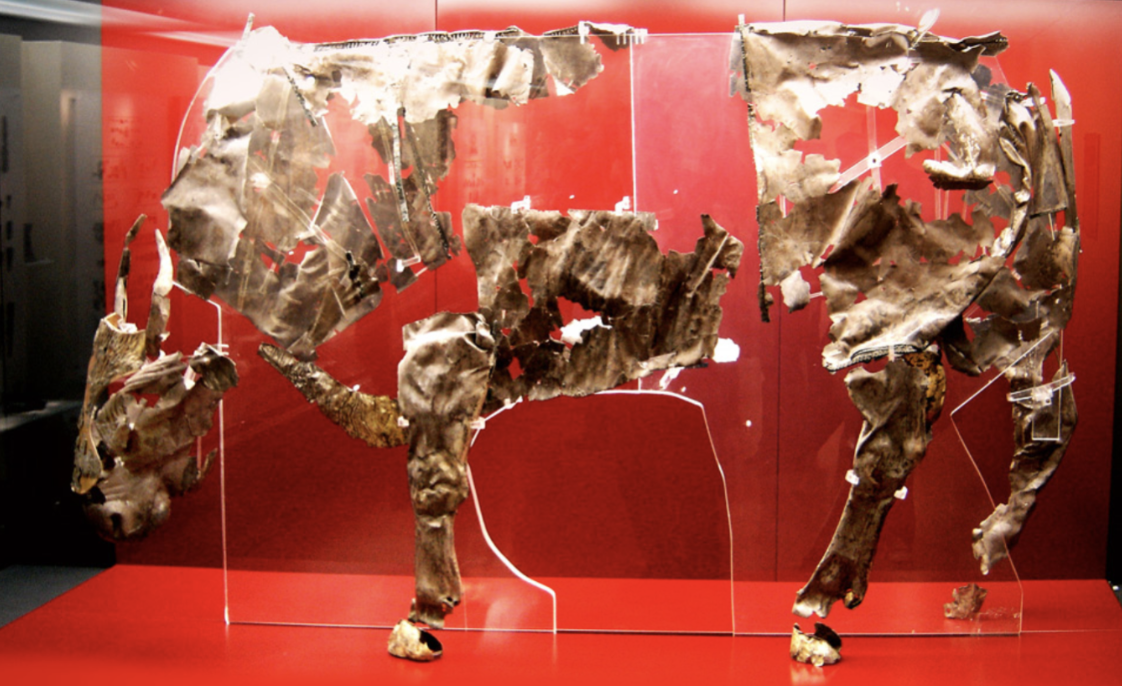
What is it? Silver bull from Delphi
Date and time period: 6th century BC; Archaic
Material/techniques used: silver, gold, wood; Sphyrelaton (hammered metal) technique from Ionian workshop; hooves, ears, and horns are gold-plated
Size: 2.5m
Function/subject matter: Depicts bull. Dedicated to Apollo as a votive offering.
How is it representative of a style, time period, or cultural phenomenon? Sphyrelaton technique. Bulls were sacrificial animals.
Religious, social, or political significance? Bulls → sacrificial animals

All the facts
What is it? Treasury of Siphnians at Delphi
Date and time period? 530-525 BC, Archaic
How do we know? We are told by Herodotus.
Material and techniques used: Parian (scultpures), Siphnian and Naxian marble (structural walls and foundations) → one of the earliest buildings made of marble
Ionic structure rich in ornamentation with a continuous frieze with pedimental scultpure
Color added with bronze attachments
Karyatids in antis: between two walls, serving as columns
Location: Delphi
Size: 8.3 m x 6 m
Function and/or subject matter: Built by the people of the island of Siphnos using a tithe (10%) of the enormous wealth they gained from their local gold and silver mines. Stored votive statues. Served as a way to flaunt Siphnian wealth.
How is it representative of a style, time period, or cultural phenomenon? Way for Siphnianians to flaunt wealth from silver mines. Caryatids → Archaic
Religious, social, or political significance? Samians attacked Siphnos in an attempt to take their silver profits during the reign of Polykrates of Samos.

What is it? Karyatids on the Treasury of Siphnians at Delphi
Date and time period: 530-525 BC, Archaic
Material and techniques used: Parian marble, paint, bronze attachments on head; Archaic smile
Location: Delphi
Function and/or subject matter: Young maidens (korai) stood on bases, supported the capital, serving as columns
How is it representative of a style, time period, or cultural phenomenon? Resemblance with Kori from Archaic Acropolis. Zigzag motif on garment; characteristic of the 6th century BC (seen in Athenian acropolis korai). Archaic smile.
Religious, social, or political significance: Karyatids stood as status symbols, representative of Siphnian wealth

All the facts
What is it? North frieze of Siphnian treasury depicting the Gigantomachy
Date and time period: 530-525 BC, Archaic
Material and techniques used: Parian marble, paint, dipinti (naming characters/objects), relief carving
Location: Delphi
Function and/or subject matter: Gigantomachy
Giants armed as hoplites
Dionysus with panther skin (dipinti in paint, visible with ultraviolet light)
Two lions drawing a chariot
Apollo and Artemis (twin gods) fighting a giant dressed in hoplite
How is it representative of a style, time period, or cultural phenomenon? Four overlapping shields nods in phalanx points to depth perception. The hoplite giant being attacked by the twin gods has a shield that sinks into the background. A fallen giant between the feet of other hoplite giants. This is all an indication of a growing understanding of naturalism, typical of late Archaic art. The patterned, symmetrical drapery is slightly rigid, beginning to work with movement. Conventions that will develop more in classical art are beginning to set in here.
Religious, social, or political significance: triumph of divine order, visual education for pilgrims

What is it? East frieze of Siphnian Treasury
Date and time period: 530-525 BC, Archaic
Material and techniques used: Parian marble, paint, dipinti (naming characters/objects), relief carving
Location: Delphi
Function and/or subject matter: Achilles vs. Memnon (king of Ethiopia) fighting over a body. Quadriga: four horse chariot: tethrippon
How is it representative of a style, time period, or cultural phenomenon? The horses are moving diagnoally in a ¾ view. This moves away from the frontality of the Archaic period. Begins to show classical period characteristics, such as foreshortening and layering depth perception.
Religious, social, or political significance: Fighting over a body points to the significance of burials. Could also indicate that it is important to capture the arms of your opponent at war.

West side changes to acropolis
Ramp to facilitate ascent of crowds and animals
Packed earth and clay
Polygonal retaining wall
18 by 10 m
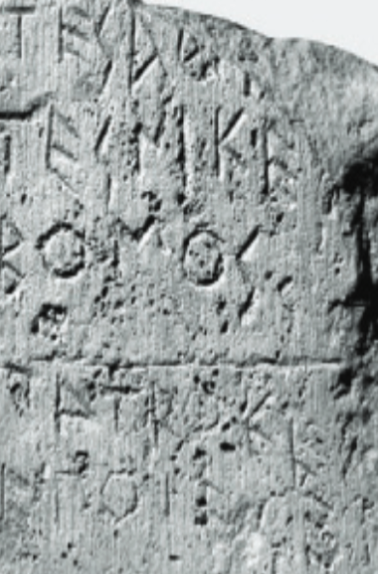
Inscription found on bomos (altar) of Athena Nike

What is it? Bluebeard temple
Date and time period: 560 BC
Material and techniques used: Doric order, limestone with local Hymettian marble metopes; limestone pediment
Location: Athenian Acropolis
Size: 41 m long x 2 m wide; 6 x 12 or 13 columns
Function and/or subject matter: Temple/sanctuary for Athenian cult statue
Religious, social, or political significance: (hecatomphedon, H architecture) → grandfather of the Parthenon

What is it? Limestone pediment from the Bluebeard temple
Date and time period: 560 BC
Material and techniques used: limestone
Location: Athenian acropolis
Function/subject matter: Heracles vs. Triton
Bluebeard: three bodied entity (daemon) with snake body intertwined
Blueish beard
Lion devouring bull
Hair + color
Influence from the near east
How is it representative of a style, time period, cultural phenomenon? Influence from the near east: lion; Archaic smile
Religious, social, or political significance? served as center for panathenic games

What is it? Old Temple of Athena Polias on the dörpfled foundations
Date and time period? 510 BC, Archaic
Material and techniques used: Foundations made of limestone; superstructure limestone and marble
Location: Dröpfled foundations
Size: 43-44 m long; c. 21 m wide; Doric temple 6 by 12 columns
Function and/or subject matter: Shrine of Athena Polias; Held the Xoanon of Athena (old wooden statue of Athena), east side
Columns on one step (usually three steps)
How is it representative of a style, time period, or cultural phenomenon? Late Archaic Doric; It demonstrated the tightening rules of the Doric order. t bridges the gap between early Greek architecture and Classical marble. The structural core and foundations utilized local Poros limestone, but the metopes, pedimental sculptures, and roof tiles were crafted from high-quality Parian marble.
Religious, social, political signficance: It was explicitly designed to house the Xoanon—the ancient, olive-wood statue of Athena Polias believed to have fallen from the sky. This object, not the gold-and-ivory statue in the later Parthenon, was the true religious heart of Athens.Every four years, the entire citizen body marched up the Acropolis to this specific temple to drape the Xoanon in a newly woven peplos (robe). The temple's grand design was engineered to provide a magnificent backdrop for this supreme expression of Athenian unity and pride.
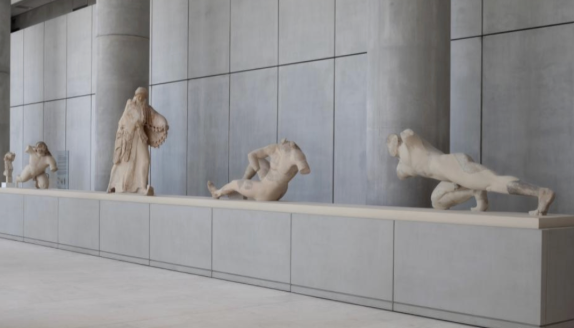
What is it? Pediment from Old temple of Athena
Date and time period: 510 BC, Archaic
Material, techniques used: Parian marble on a limestone temple. Holes on head (bronze)
Function/subject matter: Gigantomachy: battle of gods with giants, parian marble (most precious marble; Paros)
Athena striking down a giant
How is it representative of a style, time period, cultural phenomenon? Archaic restriction of movement. Archaic face, curls around Athena’s forehead.. Zig-zag motif in dress. Using protective garment (aegis).
Religious, social, political significance: Athena depicted, patron goddess of Athens. Triumph of cosmic order → triumph of democracy
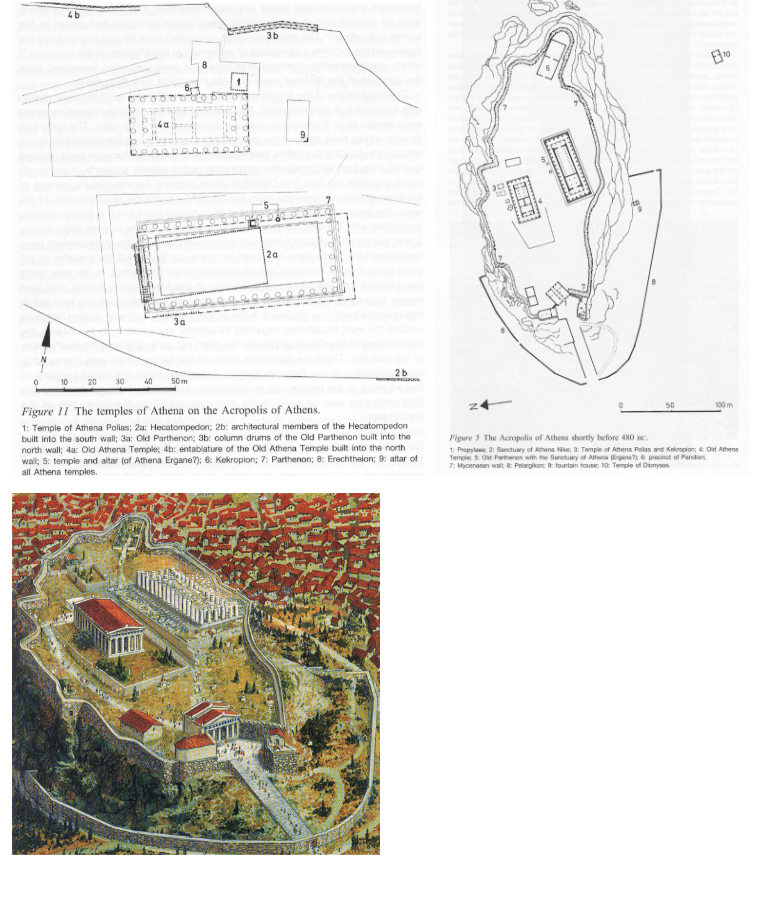
What is it? Pre-parthenon
Date and time period: 490-488 BC, following victory of battle of Marathon
Material and techniques used: Foundation: limestone; Superstructure: Pentelic marble; Massive podium using limestone from Piraeus to support the south side; 8.000 tonnes of Piraeus limestone (each block was 2 tonnes)
Size: 70m length; 26m wide
Function and/or subject matter: Largest temple on Greek mainland when built
Peristyle
East side entrance
Pronaos: porch
Cella with two line of supports
Opisthodomos: back porch
Adyton: extra room
Religious, social, or political significance: Building activity after winning battle of Marathon (first Persian invasion 490 BC); Pre-Parthenon was never completed because
480 BC: second Persian invasion
Sack of Athens (twice); pre-Parthenon was destroyed
Destruction of Acropolis, burning down temples (wood, marble…into powder)
Pererschutt: Persian debris
Some material used in later construction, eg. Parthenon, burning marks, Mycenaean walls used
Unfluted columns → indication that it is unfinished

What is it? Older propylon
Date and time period: 489-480 BC; Archaic
Material and techniques used: marble, doric order for columns
Location: Athenian acropolis
Size: 20m wide; 16.5 length
Function and/or subject matter: Sacred Entrance: It acted as the formal, monumental gateway that controlled entry into the sacred sanctuary of Athena, marking the transition from secular city space to holy ground.
Fortification: It integrated directly into the ancient Mycenaean fortification walls (the Pelargikon), serving a vital defensive role for the citadel.
Ceremonial Staging: It provided a grand architectural backdrop for religious processions, most notably the Panathenaic Festival.
Religious, social, political significance: destroyed by Persians4 80 BC: second Persian invasion
Sack of Athens (twice); pre-Parthenon was destroyed
Destruction of Acropolis, burning down temples (wood, marble…into powder)
Pererschutt: Persian debris
Some material used in later construction, eg. Parthenon, burning marks, Mycenaean walls used
Unfluted columns → indication that it is unfinished