D2 Radiology Lecture 10: Benign Tumors of the Jaw
 Call Kai
 Learn
Learn Practice Test
 Spaced Repetition
 Match
Match Flashcards
 Knowt Play
1/118

There's no tags or description
Looks like no tags are added yet.
Name | Mastery | Learn | Test | Matching | Spaced | Call with Kai | Chat |
|---|
No analytics yet
Send a link to your students to track their progress
119 Terms
1. Slow growing
2. Painless
3. No metastasis
What are the three clinical features of benign tumors?
Odontogenic
Which type of tumor originates above the inferior alveolar canal in tooth bearing areas?
Vascular/Neural
Which type of tumor originates in the mandibular canal where neurovascular tissue resides?
Smooth, well defined
What is the periphery/shape of benign tumors?
1. Displacement/Expansion
2. Root resorption
What are the two main effects of benign tumors on surrounding structures?
Hamartoma
What is the term for normal mature cells in abnormal number or distribution?
Hyperplasia
What is the term for abnormal increase in the number of cells in normal arrangement?
Ameloblastoma
What is the locally invasive true epithelial odontogenic tumor called?
Ameloblastoma
What is the most common significant odontogenic tumor?
33 - 40 years
What is the average age range for ameloblastomas?
Unicytic
What type of ameloblastoma is mural?
Ameloblastoma
What tumor is this?

Molar/ramus area
Where are ameloblastomas located on the mandible?
Third molar area
Where are ameloblastomas located on the maxilla?
Soap bubble/honeycomb
What is the radiographic appearance of ameloblastomas?
Yes
Do ameloblastomas cause root resorption?
Mandibular canal
What can be displaced by ameloblastomas?
Pindborg
What is the rare tumor that produces amyloid-like mineralization?
1. Jaw expansion
2. Swelling
What are the two physical effects of Pindborg tumors?
Mandible
Are Pindborg tumors more common on the maxilla or mandible?
Premolar-molar area
Which area are Pindborg tumors most common?
Tooth eruption
What could be prevented by Pindborg tumors?
Men
Are Pindborg tumors more common for men or women?
Pindborg tumor (Calcifying Epithelial Odontogenic Tumor)
What tumor is this?

10 - 19 years
What is the age range for Adenomatoid Odontogenic Tumors?
Women
Are Adenomatoid Odontogenic Tumors more common for men or women?
Maxilla
Are Adenomatoid Odontogenic Tumors more common on the maxilla or mandible?
Anterior
Are Adenomatoid Odontogenic Tumors more common on the anterior or posterior?
Crown of unerupted canine
Where are follicular type Adenomatoid Odontogenic Tumors mostly located?
No
Is the extrafollicular type of Adenomatoid Odontogenic Tumors involved with the crown?
30%
What percent of Adenomatoid Odontogenic Tumors are radiolucent?
Snowflake calcifications
What is the radiographic appearance of Adenomatoid Odontogenic Tumors?
Tooth eruption
What can be delayed by Adenomatoid Odontogenic Tumors?
Rarely
Do Adenomatoid Odontogenic Tumors cause root resorption?
Outer cortex
What is maintained during Adenomatoid Odontogenic Tumor expansion?
Adenomatoid Odontogenic Tumor
What tumor is this?

15 years
What is the average age for Ameloblastic Fibromas?
Unilocular
Are Ameloblastic Fibromas mostly unilocular or multilocular?
Unerupted tooth
What are Ameloblastic Fibromas mostly associated with?
Premolar/molar region of mandible
What region are Ameloblastic Fibromas most common?
Cortex
What is kept intact during Ameloblastic Fibroma expansion?
Ameloblastic Fibroma
What tumor is this?

Calcifications
What do Ameloblastic Fibro-Odontomas have that ameloblastic fibromas do not?
Posterior mandible
In what region are Ameloblastic Fibro-Odontomas most common?
0 - 10 years
What is the age range for Ameloblastic Fibro-Odontomas?
Mixed
Are Ameloblastic Fibro-Odontomas radiolucent or radiopaque?
Unerupted tooth
What are Ameloblastic Fibro-Odontomas often associated with?
Ameloblastic Fibro-Odontoma
What tumor is this?

Odontoma
What is the most common type of odontogenic tumor?
10 - 20 years
What is the age range for odontomas?
Tooth development
When do odontomas grow?
Hamartoma
What anomaly do odontomas resemble?
Compound
What is the most common type of odontoma?
Anterior maxilla
Where are compound odontomas located?
Tooth-like calcifications
What is the main feature of compound odontomas?
Posterior mandible
Where are complex odontomas located?
Amorphous calcifications
What is the main feature of complex odontomas?
Radiolucent rim
What is the radiographic sign of odontomas?
Cortical borders
What is intact with the expansion of odontomas?
Target lesion
What type of lesion is found with odontomas?
Odontoma
What tumor is this?

Odontogenic Myxoma
What is the rare benign tumor of odontogenic ectomesenchyme only found in the jaws called?
High recurrence rate
What is the main trait of Odontogenic Myxomas?
Mandible
Are Odontogenic Myxomas more common on the maxilla or mandible?
Premolar/molar area
Which area are Odontogenic Myxomas found in?
Septations
What is the main radiographic sign of Odontogenic Myxomas?
Odontogenic Myxoma
What tumor is this?

Men
Are benign cementoblastomas more common for men or women?
Permanent teeth
Where do benign cementoblastomas develop?
Premolar/molar area of mandible
In what area are benign cementoblastomas found?
Target lesion
What type of lesion is found with benign cementoblastomas?
Cortex
What is kept intact with benign cementoblastoma expansion?
Benign cementoblastomas
What tumor is this?

Schwannoma
What is the neural sheath tumors from Schwann cells?
Schwannoma
What is the most common intraosseous nerve tumor?
Paresthesia
What is caused when the Schwannoma is in the inferior alveolar nerve?
Mandible
Are Schwannomas more common on the maxilla or mandible?
Expansion of inferior alveolar canal
What is the main effect of Schwannomas?
Fusiform
What is the shape of Schwannomas?
Yes
Could Schwannomas cause root resorption?
Schwannoma
What tumor is this?

Neurofibroma
What are the proliferating schwann cells that include axons as they grow?
Cortex
What do neurofibromas perforate?
Neurofibromas
What is the most common type of peripheral nerve tumor?
1. Mandibular canal
2. Cancellous bone
3. Below periosteum
Which three areas could have neurofibromas?
Fusiform
What is the shape of neurofibromas?
40+ years
At what age are osteomas most common?
Neurofibroma
What tumor is this?

Cortex
What are osteomas connected to?
1. Boney hard swelling
2. Free moving mucosa
What are the two symptoms of osteomas?
Impinge on structures
When can osteomas cause pain?
Soft tissue
What can osteomas displace?
1. Lingual ramus
2. Inferior border
3. Paranasal sinuses
What are the three areas where osteomas are the most common?
Osteoma
What tumor is this?
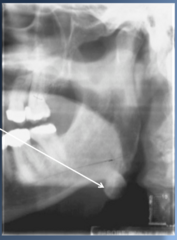
Gardner's syndrome
What disease is associated with multiple osteomas?
Epidermoid cysts
What cysts are found in Gardner's syndrome?
Intestinal polyps
What symptom of Gardner's syndrome could indicate malignant conversion?
Excision
What treatment should be done if there is impaired function with Gardner's syndrome?
Gardner's syndrome
What tumor is this?

5+
How many dense bone islands indicates Gardner's syndrome?