Perio 9 - Occlusal Forces and the Periodontium (Dr. Gyurko)
 Call Kai
 Learn
Learn Practice Test
 Spaced Repetition
 Match
Match Flashcards
 Knowt Play
1/110

There's no tags or description
Looks like no tags are added yet.
Name | Mastery | Learn | Test | Matching | Spaced | Call with Kai | Chat |
|---|
No analytics yet
Send a link to your students to track their progress
111 Terms
- Attachment of tooth to bone
- Shock absorption
- Space for blood vessels and nerves
- Transmission of forces to bone
what are the four physical functions of PDL as it relates to occlusion?
- Adaptation and remodeling in response to occlusal forces
- Remodeling in response to orthodontic forces
what are 2 adaptive functions of PDL as it relates to occlusion?
70-150N
What is considered normal occlusal force load?
axial to the root (with limited lateral component)
What is considered normal occlusal load angle?
episodic (vs cleniching)
In terms of occlusal duration, normal chewing is...
continuous
In terms of occlusal duration, clenching is
True
T/F: There is no/minimal direct contact between antagonists during normal chewing
axial
uniform stress distribution of occlusal load is known as _____ load
Lateral
excessive stress distribution on mesial root tip is known as _____ load
300-500N
What is the excessive occlusal load force?
30 degrees
What is the excessive occlusal load angle?
5 million cycles (or continuous)
What is the excessive occlusal load duration?
- Tooth/restorations
- Tooth root
- Periodontium/alveolar bone
- Masticatory muscles
- TMJ
What structures may be damaged under excessive occlusal load? (5)
no
can occlusal trauma cause increased BOP?
no
can occlusal trauma cause increased probing depth?
no
can occlusal trauma cause attachment loss?
yes
can occlusal trauma cause a widened periodontal ligament space?
no
can occlusal trauma cause horizontal bone loss?
no
can occlusal trauma cause vertical bone loss?
no
can occlusal trauma cause tooth loss?
yes
can occlusal trauma cause tooth mobility?
PDL
Irving Glickman's (Tufts) concept of occlusal trauma says that occlusal trauma jiggles the tooth and 'pumps' the infection apically along the __________
Occlusal trauma + inflammation
Vertical bone loss is caused by what two things?
horizontal bone loss
inflammation without occlusal trauma causes what kind of bone loss?
trauma from occlusion
What is a co-destructive factor of bone loss?
Extent of inflammation
What determines the extent of bone loss?
horizontal bone loss
thin bone + inflammation = what type of bone loss?
vertical bone loss
thick bone + inflammation = what type of bone loss?
true (Waerhaug's concept)
t/f: occlusal trauma is not a contributing factor to vertical bone loss
vertical bone loss
Occlusal trauma with simultaneous active periodontitis can accelerate attachment loss and can result in _________. This is only seen with large occlusal forces in animal experiments
True
T/F: While occlusal trauma alone does not cause periodontal attachment loss or bone loss, it may accelerate existing periodontal disease
acute
Acute or Chronic Occlusal Trauma:
- This occlusal trauma occurs from injury such as from biting on an olive pit or getting a filling that is too high
acute
Acute or Chronic Occlusal Trauma:
- This occlusal trauma results in toothache, percussion sensitivity and tooth mobility.
chronic
Acute or Chronic Occlusal Trauma:
- This occlusal trauma occurs in response to bruxism, clenching, tooth wear, faulty restorations, and tooth drifting
chronic
Acute or Chronic Occlusal Trauma:
- This occlusal trauma is asymptomatic; only tooth mobility is detected clinically
primary occlusal trauma
Primary or Secondary Occlusal Trauma:
- This occlusal trauma results from excessive occlusal forces
secondary occlusal trauma
Primary or Secondary Occlusal Trauma:
- This occlusal trauma results from normal occlusal forces on a weakened (reduced) periodontium
D) Attachment loss (occlusal trauma shows no attachment loss!)
Occlusal trauma will cause all of the histologic findings EXCEPT one:
A) Resorption of collagen, bone, and cementum (red zones)
B) Widened PDL
C) Increased mobility
D) Attachment loss
D. All of the above
Occlusal trauma may be due to:
A. Accidentally biting on a hard object
B. Clenching while asleep
C. Chewing with just a few teeth left
D. All of the above
B. Increased mobility
Occlusal trauma can cause:
A. Attachment loss
B. Increased mobility
C. Vertical bone loss
D. Tooth loss
Stage I: injury
In which stage of tissue response to acute occlusal trauma does PDL inflammation (microscopic vascular changes) occur?
Stage I: injury
In which stage of tissue response to acute occlusal trauma does bone resorption (microscopic; not clinical) occur?
Stage I: injury
In which stage of tissue response to acute occlusal trauma does PDL widening occur?
Stage I: injury
In which stage of tissue response to acute occlusal trauma does increased tooth mobility occur?
Stage II: repair
In which stage of tissue response to acute occlusal trauma does PDL inflammation stop (no more inflammation)?
Stage II: repair
In which stage of tissue response to acute occlusal trauma does formation of new PDL, bone and cementum occur?
Stage III: Adaptation
In which stage of tissue response to acute occlusal trauma does widened PDL remain?
Stage III: Adaptation
In which stage of tissue response to acute occlusal trauma does tooth mobility remain?
Stage III: Adaptation
In which stage of tissue response to acute occlusal trauma demonstrates no pocketing, no attachment loss?
- Widened PDL remaining
- Tooth mobility remaining
In stage 3 of tissue response to acute occlusal trauma, what compensates for persistent occlusal trauma? (2)
secondary occlusal trauma
Normal occlusal forces on reduced periodontium may cause ____________ (the periodontium is not strong enough for a given occlusal force)
true
t/f: consequences of secondary occlusal trauma are the same as with primary trauma (widened PDL, increased mobility, no progression in attachment loss)
tooth mobility and migration
A common form of secondary occlusal trauma: normal occlusal forces acting on reduced periodontium result in _________ and _________
- Periodontitis
- Increased mobility
- New interproximal gaps
- Tooth extrusion
What are clinical signs of pathologic tooth migration?
severe advanced disease
Pathologic tooth migration is generally a sign of what?
secondary occlusal trauma
Is pathologic tooth migration a result of primary or secondary occlusal trauma?
pathologic tooth migration
Patient presents with the following:
- Periodontitis
- Increased mobility
- New interproximal gaps
- Tooth extrusion
What is the diagnosis?

B, D
Which of the following are caused by occlusal trauma?
A) Periodontal attachment loss
B) Increase tooth mobility
C) Bone loss
D) Cause widened PDL
A, C
Which of the following are NOT caused by occlusal trauma?
A) Periodontal attachment loss
B) Increase tooth mobility
C) Bone loss
D) Cause widened PDL
Periodontitis treatment
Which treatment is more important: treatment of periodontitis or occlusal trauma?
attachment loss
Periodontal inflammation + occlusal trauma will result in what?
true
t/f: occlusal adjustment may aid in attachment gain after primary attachment loss due to periodontitis
false, occlusal trauma itself does not cause attachment or bone loss!
t/f: occlusal forces cause attachment loss
100 microns (0.1 nm)
There is a physiological tooth mobility due to the orientation and elasticity of periodontal ligament fibers. Under normal forces this physiological mobility is up to ___ microns
incisor
(single rooted anterior tooth > multi-rooted molars)
which tooth would you expect to have more physiologic mobility? A molar or an incisor?
- Height of alveolar bone in relation to length of root
- Width of PDL
- Shape and number of roots
What 3 things determine tooth mobility?
More
More bone loss = more or less mobility?
Less
Narrow PDL = more or less mobility?
Less
More roots and thicker roots = more or less mobility?
Move the crown in a bucco-lingual direction with two instruments or with one instrument and a finger
How can we assess mobility clinically?
No mobility
a patient that has less than 0.1mm of tooth mobility has a what grade of mobility?
grade I
a patient that has 0.1mm-1mm of tooth mobility has a what grade of mobility?
grade II
a patient that has more than 1mm of tooth mobility has a what grade of mobility?
grade III
a patient that has vertical or twist mobility has a what grade of mobility?
- Occlusal trauma
- Periodontal abscess
- Periodontitis
- Root fracture
what are 4 causes of tooth mobility?
- Occlusal adjustment
- Distributing occlusal forces (molar support)
what is the treatment for occlusal trauma causing tooth mobility? (2)
Elimination of cause (SRP, root canal treatment)
what is the treatment for periodontal abscess causing tooth mobility?
- SRP
- Splinting for patient comfort
what is the treatment for periodontitis causing tooth mobility? (2)
- Extraction
- Implant placement
what is the treatment for root fracture causing tooth mobility? (2)
ALL ARE INDICATIONS
Which of the following are indications for splinting of teeth?
A) For patient comfort on mobile teeth
B) Pathologic tooth migration
C) Guided tissue regeneration on mobile teeth
D) Prosthetics where multiple abutments needed
control of periodontal ligament
What is a prerequisite to splinting of teeth?
No - splinting only mechanically stabilizes teeth, it does NOT by itself induce periodontal regeneration
Does splinting induces periodontal regeneration?
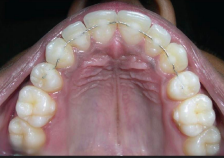
thinning
what happens to the PDL of a molar tooth that has no opposition?
all are consequences (USE IT or LOSE IT)
Which of the following is considered a consequence of having no antagonist (lack of occlusion)?
a. Thin PDL
b. Reduction in bone density
c. Supra-eruption of tooth
d. Apparent attachment loss
e. Furcation exposure
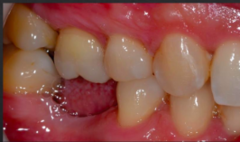
posterior bite collapse
what event has occurred due to the missing molar?

All of the above
Which of the following are periodontal/occlusal problems that can arise from misaligned teeth?
A) Super-eruption, resulting in root/furcation exposure
B) Molar tipping, psuedopocket
C) Open contact, a risk factor for food impaction and gingival inflammation
Non-carious cervical lesions (NCCL)
What event has occurred in this patient that brushes too hard but has no caries (clean hard dentin) and no sign of periodontitis?

- Abrasion
- Abfraction
What are the two chief mechanisms of causing Non-carious cervical lesions (NCCL)?
Non-carious cervical lesions
Increased frequency of ______ found in subjects with
- Improper brushing technique (horizontal scrubbing)
- Excessive manual force
- Hard bristle toothbrush
- Frequent brushing
abfraction
Define the following:
Loss of hard tissue in the cervical region of the tooth by non-axial forces exerted on the occlusal surface, which cause microfractures of dental tissues in areas of stress concentration
- Toothbrush abrasion and
- Chemical erosion due to acidic food and drinks
Toothbrush abrasion does not completely explain NCCLs as in laboratory experiments brushing eliminates only minimal amount of tooth material. Abfraction is not a satisfactory explanation either.
The current concept is that NCCL are likely caused by the combined effect of what two things?
resorption
Low PDL fiber strain leads to bone __________
formation
High PDL fiber strain leads to bone __________
true, no tooth movement without PDL!
t/f: tooth movement is only possible if PDL present
- Implants
- Ankylosed roots
what are two situations where teeth would be immobile?
creates bony defect (dehiscence)
what is the most likely consequence of moving tooth through cortical bone (buccally)?
bone/gingiva formation (good for implants)
what is the most likely consequence of extrusion of a tooth?
- Unlikely to create new attachment
- May create deeper pocket
what is the most likely consequence of intrusion of a tooth?
- Can eliminate mesial pocketing
- May expose furcation
what is the most likely consequence of molar uprighting?
inflammation
Orthodontic movement of teeth can be safely performed on an _______-free periodontium