Final Lab Practical
 Call Kai
 Learn
 Practice Test
 Spaced Repetition
 Match
 Flashcards
 Knowt Play
1/46

Earn XP
Description and Tags
Labs 8-12
47 Terms

What is this?
What is its symmetry?
What is its gut system?
What is its body cavity?
Planarian (flatworm)
Bilaterally symmetrical
Incomplete digestive system
acoelomate
What is this?
What is its symmetry?
What is its gut system?
What is its body cavity?
Hydra (Cnidarian)
Radially symmetrical
Incomplete digestive system
No coelom


What is this?
What is its symmetry?
What is its gut system?
What is its body cavity?
Clonorchis (Parasitic fluke)
bilaterally symmetrical
Incomplete digestive system
Acoelomate
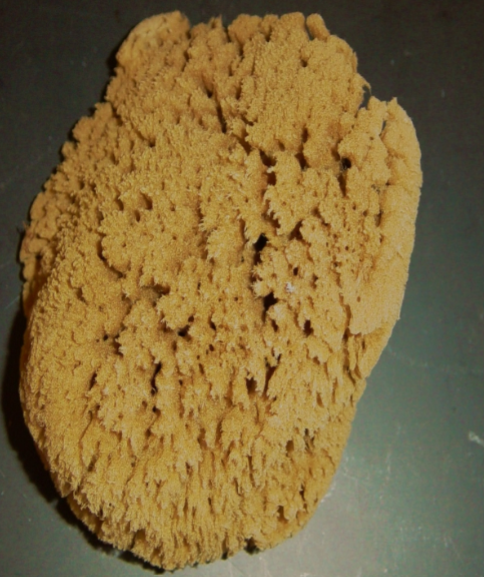
What is this?
What is its symmetry?
What is its gut system?
What is its body cavity?
Sponge (Porifera)
Asymmetrical
No digestive system
No coelom

What is this?
What are the organisms where these structures are found?
These structures are made up of what substance?
Spicules
Sponges (Phylum Porifera)
Calcium carbonate or silica

Which phylum do these belong to?
What type of symmetry do jellyfish have?
Do corals have a polyp body plan or a medusa body plan?
Do jellyfish have a polyp body plan or a medusa body plan?
Phylum Platyhelminthes & Phylum Cnidaria
Radial symmetry
Poly
Medusa

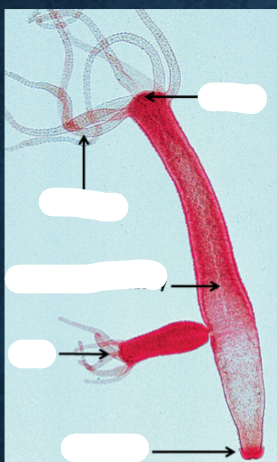
Name the organism seen here.
Identify the structure at letter A.
Name the stinging structures found in letter A.
Identify the structure at letter B.
Identify the structure at letter C.
By what reproductive process is the structure at letter C produced?
Hydra (Phylum Cnidaria)
tentacles
Nematocysts
basal disc
bud
Asexual reproduction by budding
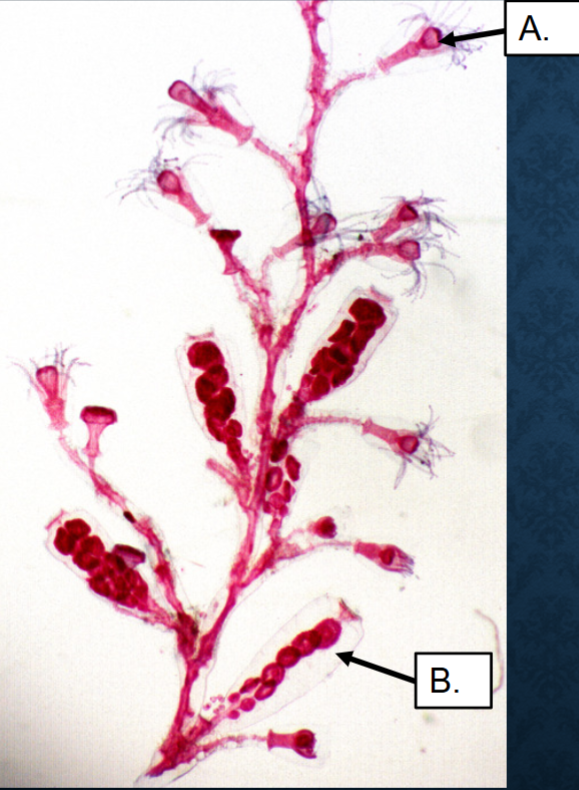
Name the organism seen in the picture.
Name the type of polyp at letter A.
Name the type of polyp at letter B
Obelia (Phylum Cnidaria)
Gastrozooid (feeding polyp)
Gonozooid (reproductive polyp)
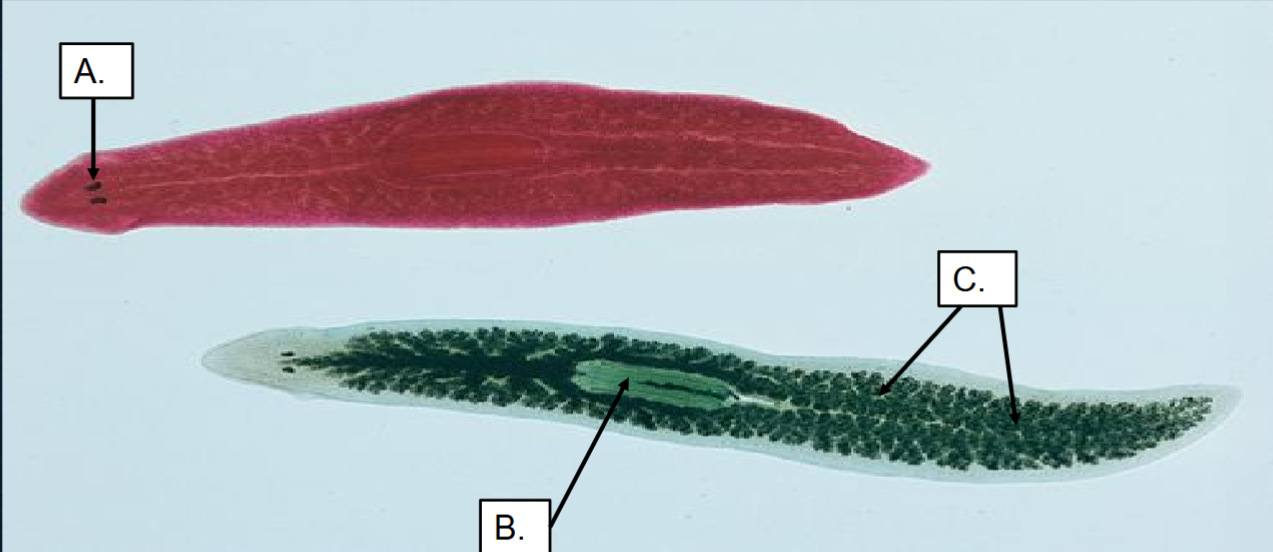
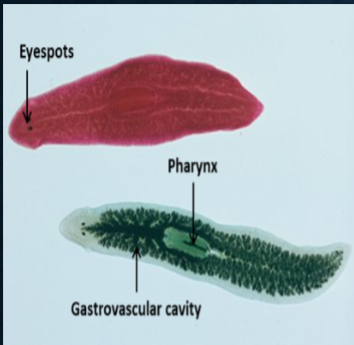
Name the organisms seen in the picture.
Name the structure at letter A.
Name the structure at letter B.
Name the structure at letter C.
The term _______________ refers to a specialization of sensory structures in the head region.
Planarians (flatworms)
eyespots
pharynx
Gastrovascular cavity
cephalization

Name the organism in figure A.
This organism is composed of segments called ________________.
Identify the reproductive structure at letter B.
Identify the reproductive structure at letter C.
Identify the reproductive structure at letter D.
Is this worm a parasite or free-living?
Name the specific type of proglottid seen in figure E
Tapeworm
Proglottids
testes
ovary
uterus
parasite
Gravid proglottid
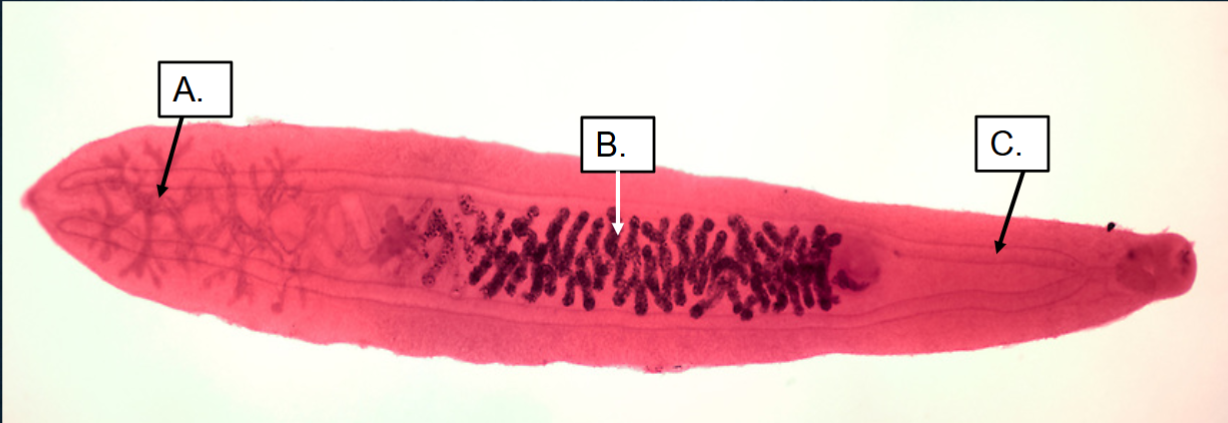
Name the organism seen in the picture.
Identify the reproductive structure at letter A.
Identify the reproductive structure at letter B.
Identify the structure at letter C.
Clonorchis
testes
uterus
intestine

Name the worm seen in the picture at letter A.
This worm forms a cyst in what type of tissue?
This worm possesses what type of body cavity?
Does this worm have a complete or incomplete
digestive tract?
Trichinella spiralis
skeletal muscle
Pseudocoelom
complete digestive tract

Identify the structure at letter A.
Identify the structure at letter B.
Identify the structure at letter C.
Type of symmetry in earthworms?
Type of gut/digestive system in earthworms?
Closed or open circulatory system in earthworms?
cuticle
coelom
intestine
bilateral symmetry
complete digestive system
Closed circulatory system
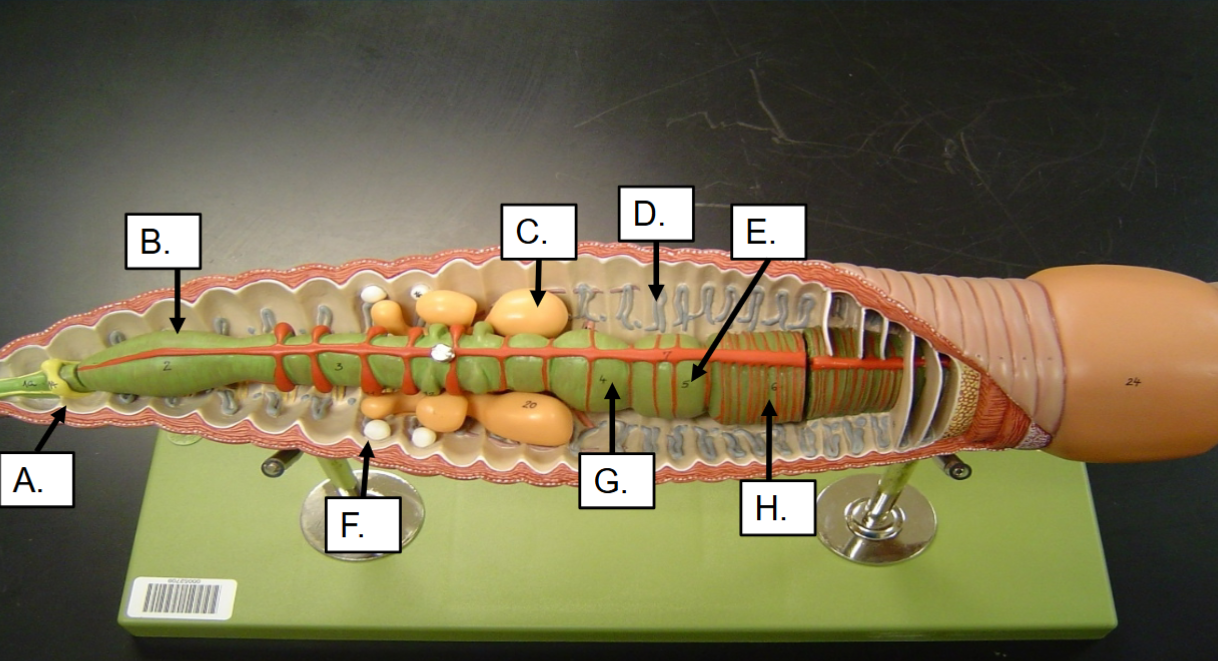
Identify the structures at each letter.
A. mouth
B. pharynx
C. seminal vesicles
D. nephridia
E. dorsal blood vessel
F. seminal receptacles
G. crop
H. gizzard

Identify the structures at each of the letters.
A. walking legs (pereopods)
B. gills
C. cheliped
D. compound eye
E. antenna

Identify the structures at each of the letters.
A. heart
B. stomach
C. green gland (excretory gland)
D. dorsal blood vessel
E. intestine

Identify the structures at each of the letters.
A. gills
B. walking legs(pereopod)

Identify the structures at each of the letters.
A. cardiac stomach
C. gastric mill


Identify the structures at each of the letters.
A. Pyloric caeca (digestive glands)
B. Gonads (reproductive organs)
C. Stomach (digestive organ)


Identify the structures at each of the letters.
A. Ampullae
B. Gonads
C. Pyloric caeca
D. Tube feet
E. Madreporite

What is this?
How many chambers in the heart?
Does this animal have jaws? Limbs?
Is this animal an ectotherm or endotherm?
Lamprey (jawless fish)
2
No
ectotherm

Are sharks ectothermic or endothermic?
How many chambers are in the heart?
Do sharks have scales? If so, what type?
Do sharks have a cartilaginous or bony endoskeleton?
Do sharks have a swim bladder?
How do sharks exchange gases? Gills? Lungs? Skin?
Ectothermic
2 chambers
yes, placoid scales
Cartilaginous endoskeleton
No
gills

Label
heart
intestine
anus
Urinary opening
gills
gill arch
swim bladder
stomach
kidney
Do carp,
Do bony fish have cartilaginous or a bony endoskeleton?
Do fish have a swim bladder?
Do fish have paired appendages and scales?
How many chambers are in the heart of bony fish?
Are bony fish ectotherms or endotherms?
How do bony fish exchange gases? Gills? Lungs?
Bony endoskeleton.
Yes
Yes
2 chambers
Ectothermic.
gills

Identify the structures at each letter.
A. brain
B. swim bladder
C. kidney
D. heart
E. stomach
F. gills
G. dorsal fin
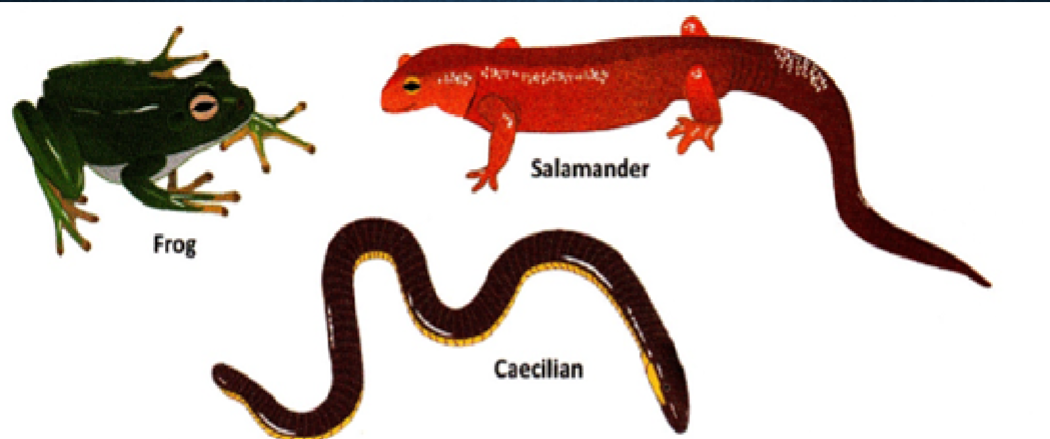
Do amphibians have scales?
How many chambers are in the heart of amphibians?
Are amphibians ectothermic or endothermic?
By what means do amphibians exchange gases?
No
3 chambers
ectothermic
through lungs and moist skin

Do reptiles have scales?
How many chambers are in the heart of most reptiles?
How many chambers are in the heart of alligators and crocodiles?
Are amphibians ectothermic or endothermic?
By what means do amphibians exchange gases?
Yes
3 chambers
4 chambers
Ectothermic
Through lungs and moist skin
Do birds have modified scales? If so, what do they become in birds?
How many chambers are in the heart of birds?
Are birds ectothermic or endothermic?
By what means do birds exchange gases?
Yes, feathers
4 chambers
Endothermic
through lungs

Do mammals have modified scales? If so, what do they become in mammals?
How many chambers are in the heart of mammals?
Are mammals ectothermic or endothermic?
By what means do mammals exchange gases?
Yes, hair (fur)
4 chambers
Endothermic
through lungs
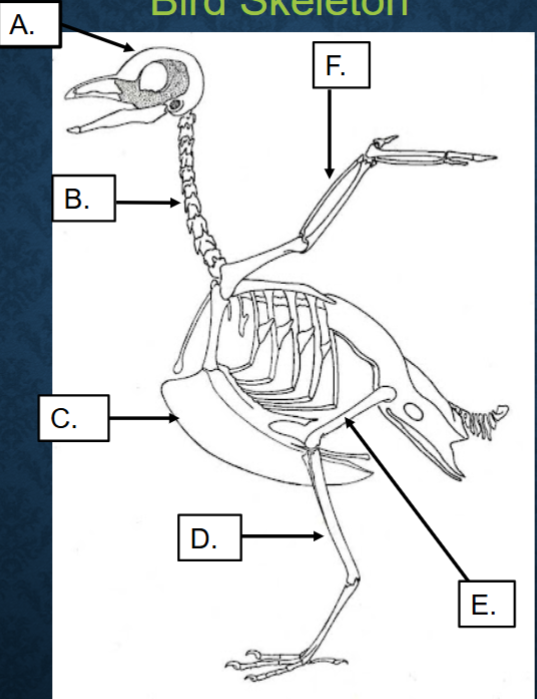
Name the bones at each letter.
A. skull (cranium)
B. Cervical vertebrae
C. sternum
D. Tibiotarsus
E. femur
F. Radius and ulna

Name the bones at each letter.
A. scapula
B. humerus
C. radius and ulna
D. ribs
E. tibia and fibula
F. pelvis

Name the bones of the human skeleton at each letter.
A. clavicle
B. humerus
C. radius
D. tibia
E. scapula
F. ulna
G. femur

Name the cells in picture A.
Name the structure at the tip of the arrow in picture A.
Name the germ tissue in picture B. (reproductive organ)
Name the cell at the tip of the arrow in picture B.
sperm cells
flagellum
ovary
oocyte

Name the tissue. Include the category name.
Name 1 location where this tissue is found.
Name the cell at the tip of the pointer
Simple cuboidal epithelium
kidney tubules.
Cuboidal epithelial cell.

Name the tissue. Include the category name.
Name 1 location where this tissue is found.
Name the cell at the tip of pointer 1.
Name the hair-like structures at the tip of pointer 2.
Pseudostratified ciliated columnar epithelium (epithelial tissue).
Trachea (respiratory tract).
Goblet cell
cilia
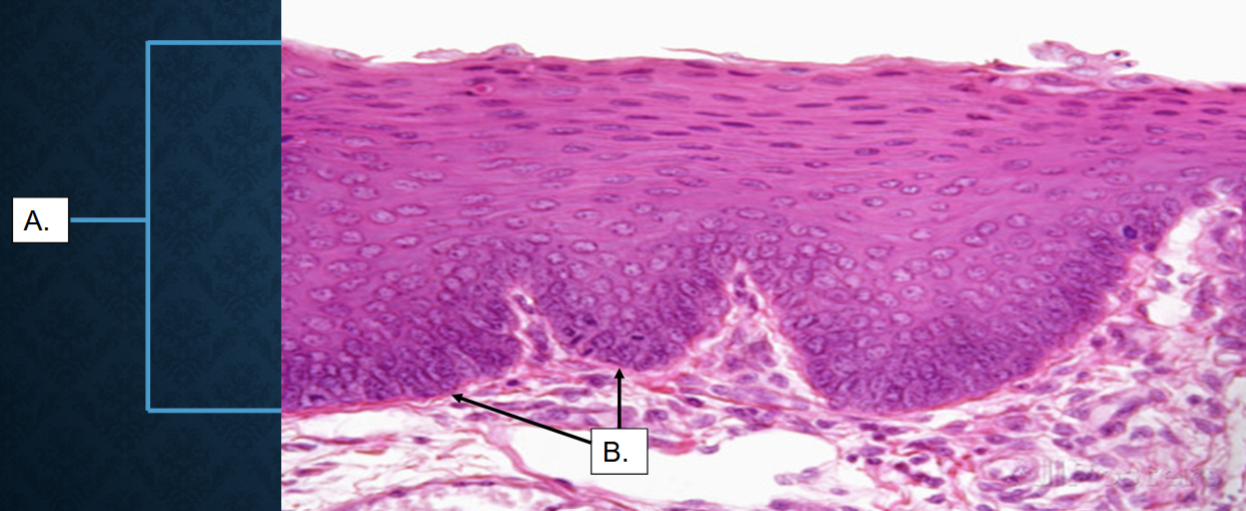
Name the tissue at letter A. Include the category name.
Name 1 location where this tissue is found.
Name the membrane at letter B that anchors epithelial tissue to connective tissue.
Stratified squamous epithelium (epithelial tissue)
Lining of the esophagus.
Basement membrane

Name the tissue. Include the category name.
Name the fiber at 1.
Name the fiber at 2.
Areolar (loose) connective tissue
elastic fiber
collagen fiber

Name the cell at 1. Give one function of this cell.
Name the cell at 2. Give one function of this cell.
White blood cell (leukocyte) - Engulfs and destroys bacteria through phagocytosis.
Red blood cell (erythrocyte) - ransports oxygen throughout the body using hemoglobin

Name the connective tissue.
Name the area at the tip of the red pointer.
Name the bone cell in the lacuna. See # 1.
This tissue is found in what organ system of the body?
compact bone
central canal
Osteocyte
Skeletal system
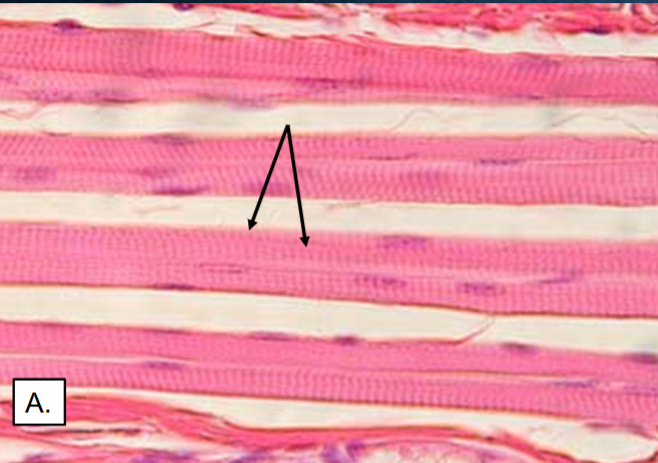
Name the muscle tissue.
Name one location in the body where this type of muscle is found.
Name the structures at the tips of the pointers.
Skeletal muscle tissue
Attached to bones
Striations

Name the muscle tissue.
Name one location in the body where this type of muscle is found.
Name the structure at the tip of the pointer.
Cardiac muscle tissue
heart
Intercalated disc

Name the cell.
Name the cells.
neuron
glial cells

Label.
A. lung - Respiratory system
B. Diaphragm
C. Small intestine - Digestive system
D. Aorta (blood vessel) - Digestive system
E. stomach - Digestive system
F. liver - Cardiovascular (circulatory) system

Label.
A. trachea - Respiratory system
B. kidney - Urinary system
C. ureter - Urinary system
D. urinary bladder - Urinary system
E. pancreas - Digestive system

Label.
A. Right atrium
B. Right ventricle
C. Left atrium
D. Left ventricle
How many chambers are in the hearts of the following animals:
Sharks, Bony fish, Amphibians, Non-avian reptiles (alligators and crocodiles), Avian reptiles (birds), Mammals
Sharks: 2
Bony fish: 2
Amphibians: 3
Non-avian reptiles (alligators and crocodiles): 4
Avian reptiles (birds): 4
Mammals: 4