Lecture 3: Socioecological Model and Health Impact Pyramid
 Call Kai
 Learn
Learn Practice Test
 Spaced Repetition
 Match
Match Flashcards
 Knowt Play
1/29

There's no tags or description
Looks like no tags are added yet.
Name | Mastery | Learn | Test | Matching | Spaced | Call with Kai | Chat |
|---|
No analytics yet
Send a link to your students to track their progress
30 Terms
How is health defined?
Socioeconomic factors, physical environment, health behaviors, and healthcare
Social determinants of health
Socioeconomic factors and physical environment
Social determinants of health definition
The non-medical factors that incfluence health outcomes. They encompass the conditions in which people are born, grow, live, work, and age, as well as the broader systems shaping the conditions of daily life.
Social determinants of health
Economic stability, education access and quality, health care access and quality, neighborhood and built environment, social and community context
Economic stability
Access to stable employment and income.
Education access and quality
Opportunities for quality education and lifelong learning.
Heathcare access and quality
Availability of health services and ability to access them.
Neighborhood and built environment
Physical environments that support or hinder health.
Social and community context
Social relationships and societal structures.
What relationship do the social determinants of health have with theories or frameworks?
Theories and models provide a way to understand how these determinants shape health so we can design and test effective interventions,
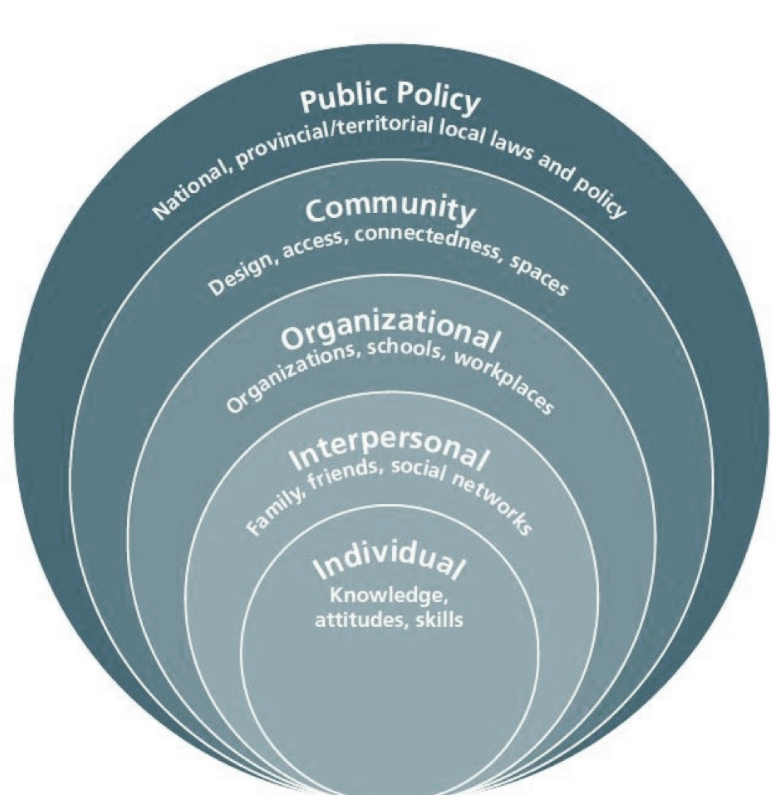
Socio-ecological framework
Socio-ecological framework (SEF)
A model examining how individual, interpersonal, community, and societal factors shape health. Health is shaped by multiple layers of influence.
SEF policy
Federal, state, and local legislation
SEF community
Cities, neighborhoods, resources and norms
SEF institutional
Organizations, schools, and workplaces
Interpersonal
friends, family and social networks
Individual
Knowledge, attitudes, skills and behaviors
Why use the socio-ecological framework?
Encourages systems thinking for public health, combines individual and structural approaches for sustainable change, identifies interventions at multiple levels of influence.
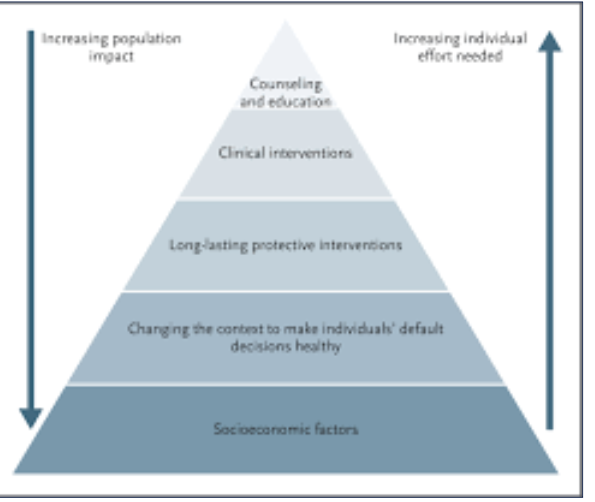
Health Impact Pyramid
Health Impact Pyramid (HIP) definition
Framework to understand the population-level impact of public health interventions. Interventions lower in the pyramid affect broader populations and have greater impact, requiring less individual effort.
HIP History
Developed by Thomas R. Frieden, former director of the Centers for Disease Control and Prevention (CDC)
Levels of HIP
socio-economic factors, changing the context to make individuals’ default decisions healthy, long-lasting protective interventions, clinical interventions, and counseling education.
HIP socio-economic factors
Anti-poverty; education; access to health care; eliminating disparities
Changing the context to make individuals’ default decisions healthy
Smoke-free, laws, tobacco/soda taxes, 0g trans fat; healthy food options, urban design promoting healthy lifestyle; iodization, lead paint ban
Long-lasting protective interventions
Immunizations; brief interventions; smoking cessation; colonoscopy; early life interventions
Clinical interventions
Control of blood pressure, cholesterol, diabetes; aspirin
Counseling, education
Health education on nutrition and physical activity
Why use HIP?
Focus on social determinants of health, tiered structure portals that individual based interventions have less impact, guides policy decisions to focus on intervention with most impact.
Similarities of SEF and HIP
Both emphasize multi-level approaches and structural changes and both recognize the socioeconomic and political components to health.
Differences between SEF and HIP
SEF focuses on interactions among levels and determinants of
health. HIP focuses on intervention impact.