3. Structural Theory Development and Defence
 Call Kai
 Learn
 Practice Test
 Spaced Repetition
 Match
 Flashcards
 Knowt Play
1/27

There's no tags or description
Looks like no tags are added yet.
28 Terms
ID, Ego and Superego form one changing system
ID Pleasure → EGO mediation → SUPEREGO rules and ideals
External reality
The agencies describe functions, not separate people or brain regions.
The superego carries social voices into the person
Rules first arrive through caregivers, teachers and institutions
Internalization turns external demands into inner commands
Gender, success and morality acquire emotional force
A harsh superego can produce shame, perfectionism and self-attack
The ego delays satisfaction without aboloshing desire
PLEASURE PRINCIPLE
Immediate relief
Reduction of tension
Little concern for consequences
Short-term solutions may create long-term harm
REALITY PRINCIPLE
Delay and planning
Recognition of consequences
Other people have needs
Social position shapes what is possible
Reality includes unequal risks, resources and power.
Anxiety warns the ego that danger is approaching — Anxiety as a signal
EXTERNAL WORLD — I may lose my job (the ego must respond)
ID — I may lose control (the ego must respond)
SUPEREGO — I may feel unbearable guilt

A sympton can express a wish and defend against it

Psychosexual development
A historically situated account of bodily pleasure, care, control and social norms, and the five phases that organize Freud’s developmental account (It does not provide a scientifically proven path that every child follows.)

The Oral Phase
The mouth and feeding are central
The main experiences include:
Feeding and bodily pleasure
Closeness and dependence
Waiting and frustration
The presence and absence of the caregiver
Later theories place greater emphasis on trust, attachment and emotional regulation
Direct claims about an “oral personality” are difficult to prove
The central insight is that human life begins with dependence on the care of others
The Anal Phase
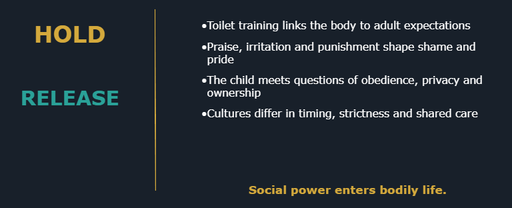
The development of control over bodily functions becomes central
Toilet training is also a social event involving authority and power
Social power enters bodily life
The main questions include:
Who controls the child’s body?
When must the child obey?
What is considered clean or shameful?
How do adults respond to resistance?
Child-rearing practices differ across cultures
There is no single universally correct form of development
The Phallic Phase
The child becomes interested in:
Bodily differences
birth
Family relationships
Exclusive attachment to parents
Jealousy and a wish to possess a caregiver may appear
Freud explained these experiences through the theory of the Oedipus complex
This phase reflects the gender assumptions of Freud’s period more strongly than any other stage

The Latency Period
Attention party turns towards school, friendships, skills, and social cooperation
Peers and institutions become increasingly important alongside the family
Sublimation appears: psychological energy is directed towards learning, sport, art or social activities
Latency does not mean the complete disappearance of sexuality

The Genital Phase
Freud’s original model treated hereosexual genital relationships as the endpoint of mature development
Conemporary psychology rejects the hierarchial ranking of sexual orientations
More appropriate criteria of maturity include:
Mutuality
Consent
Emotional responsibility
Respect for difference
The capacity to care
A balance between intimacy and autonomy

Desire, rivalry and identification form a triangle

Cultural Variations in Family Models
Freud’s theory was shaped by the heterosexual, middle-class Central European family of his time
Children may, however, grow up in many different family structures:
Single-parent families
Families with same-sex parents
Families organized around grandparents or extended kin
Adoptive or foster families
Blended families
Communal caregiving systems
Malinowski’s research in the Trobriand Islands questioned the universality of a father-centred Oedipus complex
Triangularity means accepting limits and other relationships
The child gradually learns:
Another person cannot be possessed completely
The child is not the centre of every relationship
Relationships exist beyond the child’s control
Rules and social realities and social enter intimate life
Triangularity does not require one mother, one father, and one child.

Freud treated the male model as the standard

Later thinkers shifted the focus to relationships and power
The central question moves from anatomical destiny to relationships, care and social assignment

Gender-Based and Feminist Criticisms
Freud often understood female development in relation to a male model
The concept of penis envy made male anatomy the implicit standard
It did not adequately distinguish between:
Anatomical difference
Social power
Cultural value
Important later revisions include:
Karen Horney: criticism of penis envy and the concept of “womb envy”
Melanie Klein: the importance of the early maternal relationship, love, aggression and guilt
Nancy Chodorow: gender identity and the social organization of caregiving
Juliet Mitchell: psychoanalysis does not necessarily justify patriarchy but may reveal how patriarchal power enters the unconscious
Feminist and queer approaches question:
Binary understandings of gender
The treatment of heterosexuality as the developmental norm
Contemporary feminist and queer approaches ask further questions:
Why should masculinity and femininity be treated as opposites?
Why should heterosexuality be trated as the developmental norm?
How do children develop in same-sex-parent families?
How do transgender and non-binary experiences challenge traditional theories?
How do race, class and culture shape gender development?
Who has the authority to define normality?
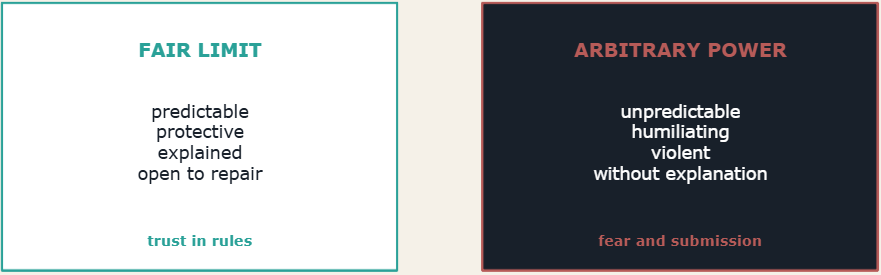
Limits can organize development or produce fear
Family life cannot be reduced to one Western model:
One parent
Adoptive care
Two mothers
Extended kin
Two fathers
Foster care
Grandparents
Shared care
Attachment, jealousy, and seperation may be widespread. Their social form varies.
Malinowski questioned the universal father-centered story
His Trobriand research examined matrilineal kinship
Authority did not follow the same European paternal pattern
The findings challenged a universal Oedipus complex
His methods and conclusions also remain debated
Can one European family model explain development everywhere?
Trauma and authority changed the psychoanalytic question
Hungarian physician (Sándor Ferenczi) and founder of the Budapest psychoanalytic movement
Close colleague of Freud who also challenged him
Placed trauma, care, and the emotional environment at the centre
Examined how analytic authority can repeat earlier injury
What happens when the adult who shouild protect becomes the source of danger?According to Ferenczi, psychoanalysis sometimes treated reports of actual abuse as fantasies
A therapist who does not believe the patient may repeat the original injury
Trauma has two main components:
The abusive itself
The failure of the adult environment to provide protection and recognition
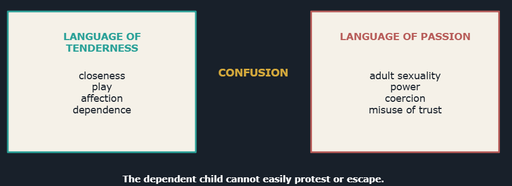
Confusion of Tongues Between Adults and the Child
The child communicates through the language of tenderness, seeking closeness, play and affection
The abusive adult responds through the language of passion, sexualizing the child’s needs
A dependent child cannot easily protest or escape
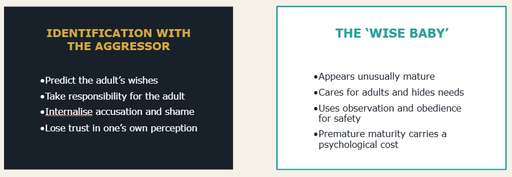
To survive, the child may identify with the aggressor
Possible consequences include:
Shame
Self-blame
Excessive obedience
Constant attention to danger
Loss of trust in one’s own perceptions
The aggressor’s voice may become part of the child’s superego
External attack may become internal self-criticism and self-punishment
The “Wise Baby”
A traumatized child may appear unusually mature and responsible
The child may care for adults while hiding their own needs
This is not genuine maturity but a defensive adaptation
The idea can be connected to parentification and premature caregiving responsibility
The Therapeutic Relationship and “Elasticity”
Therapists should not hide behind cold professional authority
Therapy requires:
Tact
Empathy
Flexibility
Emotional honesty
Recognition of the therapist’s mistakes
Rigid therapeutic authority may repeat earlier experiences of being silenced
Ferenczi’s basic principles were:
Care without boundaries can become unsafe
Authority without empathy can become traumatic
Disbelief can repeat and deepen the original injury
Trauma includes the event and the failure of the adult environment.

Therapeutic authority requires flexibility and accountability
Tact and empathy matter alongside interpretation
The same rules cannot fit every aptient mechanically
Rigid analytic authority may repeat earlier silencing
The analyst must recognize mistakes and examine power
Care without boundaries can become unsafe.
Authority without empathy can become traumatic.

Development links desire, authority and cultural meaning
Families and cultures shape which wishes become acceptable, shameful, or dangerous.
Ferenczi adds the question of “what happens when authority itself becomes traumatic?”
