T4:Mechanics and materials
 Call Kai
 Learn
 Practice Test
 Spaced Repetition
 Match
 Flashcards
 Knowt Play
1/13

There's no tags or description
Looks like no tags are added yet.
14 Terms
What is a scalar quantity?
What is a vector quantity?
What are two examples of a scalar quantity?
What are two examples of a vector quantity?
A scalar quantity has magnitude only.
A vector quantity has both magnitude and direction.
Speed and distance.
Velocity and displacement.
What are we doing when we are adding two or more vectors together?
finding the resultant.
How do you calculate the addition of vectors using a scale drawing?

How do you calculate the addition of vectors, when they are at right angles to each other?
Use pythagorus to find the missing side.
Use trignometry to find the direction.
What are we doing when ‘resolving’ a component?
How do you resolve a component?(image)
Splitting a resultant force into a horizontal and vertical component.
[Image]
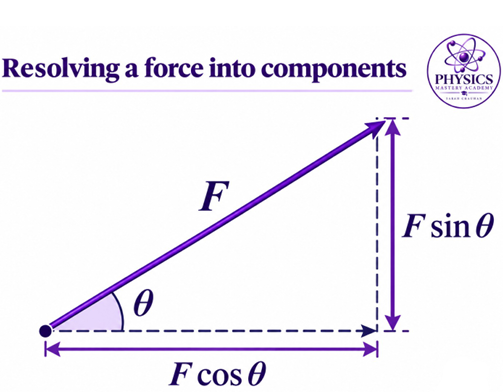
What can you do when you have three coplanar forces acting on a body in equilibrium?
You can draw the forces as a closed triangle (tip to tail)
Note: If it is a right-angled, you can use pythagorus to fina a missing force.If not, you might have to resolve the forces in each direction.

How do you add components back together to get the resultant force?
Redraw the components as tip to tail.

How do you find the components of force along an inclined plane?
Note: If the mass is given, use W=mg to fidn the weight first.

What does equilibrium mean for an object at rest?
The object remains stationary → acceleration = 0.
By Newton’s second law, \(F=ma\).
Therefore, the resultant force = 0 N.
What does equilibrium mean for an object moving at a constant velocity?
The object moves at constant velocity → velocity is not changing.
Velocity is not changing → acceleration = 0.
By Newton’s second law, \(F=ma\).
Therefore, the resultant force = 0 N.
Example 1 of two or three coplanar forces acting at a point.

Example 2 of two or three coplanar forces acting at a point (symmetric).

Example 3 of two or three coplanar forces acting at a point( not symmetric)

How are coplanar forces at a point presented as a closed triangle?
