Bacterial Pathogenicity
 Call Kai
 Learn
Learn Practice Test
 Spaced Repetition
 Match
Match Flashcards
 Knowt Play
1/46

There's no tags or description
Looks like no tags are added yet.
Name | Mastery | Learn | Test | Matching | Spaced | Call with Kai | Chat |
|---|
No analytics yet
Send a link to your students to track their progress
47 Terms
What is pathogenicity?
The ability of organism to cause disease
What is virulence?
The degree of harm caused by a microorganism
Virulence depends on infectivity, invasiveness, and degree of damage. These all depend on its virulence factors
What are the virulence factors?
Adhesion
Invasion
Acquiring nutrients
Host defence
Toxins

How do you measure virulence?
Infectious Dose
ID50 = The dose to infect 50% of hosts
Lethal Dose
LD50 = The dose to kill 50% of hosts
Whether an infection leads to disease depends on…
Virulence
Number of bacteria
Host resistance
What are the 2 methods of transmission?
Direct host-to-host transmission
Indirect host-to-host transmission - facilitated by living or inanimate objects
Which is a more common portal of entry; the skin or mucosal surfaces?
Mucosal surfaces are more favourable because they’re warm, moist, and have more nutrients
Skin could occur due to hair follicles, wounds, insect bites
Name the different direct transmission routes
Respiratory route
Body contact
STDs
Skin infections
Through damaged skin
Faecal-oral route
Through contact or through gastrointestinal pathogens
Body fluids
Vertical transmission
Prenatal, perinatal, postnatal
Germline (through viral DNA)
What pathogens directly transmit via the respiratory route?
Mycobacterium tuberculosis
Influenza virus
What pathogens directly transmit via body contact?
Through damaged skin e.g. staphylococcus aureus
What pathogens directly transmit via faecal-oral route?
Gastrointestinal pathogens e.g. Salmonella enterica
In indirect transmission, there are vehicles, and vectors. Name the vehicles for indirect transmission:
Soil
Contaminated water e.g. Vibrio cholerae
Contaminated food
Fomites (inanimate objects) e.g. Clostridioides difficile
In indirect transmission, there are vehicles, and vectors. Name the vectors for indirect transmission:
Warm blood animals
Anopheles spp.
Rat flea

Why is adhesion important for bacteria?
Bacteria must adhere to host cells or tissues to colonise
Bacteria must also survive in host environment and compete with normal microbiota
Adherence to surfaces depends on adhesins
What are the main types of bacterial adhesins?
Proteins and polysaccharides.
What are the protein types of bacterial adhesins?
Fimbrial proteins and other surface proteins.
What are the polysaccharide types of bacterial adhesins?
Capsule components and teichoic/lipoteichoic acid.
What do bacterial adhesins interact with, and what types of interactions occur?
They interact with host cell-surface receptors via protein–protein or protein–carbohydrate interactions.
Host receptors for bacterial adhesins could be:
Membrane proteins
Glycolipids
Extracellular matrix proteins
What are the adhesive properties of E.coli?
E.coli frequently cause UTIs
P-pili / type I pili bind to sugar moieties of glycolipids on epithelial cells lining urinary tract
After adherence, how may pathogens invade further into tissues or cells?
Via:
Extracellular invasion (barriers of tissues are broken down)
Intracellular invasion (microbes penetrate cells and survive intracellularly)
How does extracellular invasion work?
Allows access to niches in tissue that aid in proliferation and spreading
Achieved through production of enzymes that:
attack extracellular matrix
degrade carbohydrate-protein complexes between cells
disrupt cell surface
How does intracellular invasion work?
Some pathogens penetrate cells and survive intracellularly
Others use it as a means of proliferation or spreading
Phagocytic cells invaded through phagocytosis
Non-phagocytic cells invaded using systems that induce a phagocytosis-like process
How do pathogens survive phagocytosis?
Some reside in the phagolysosome
Some reside in unfused phagosome (like Salmonella spp.)
Some destroy or escape from the phagosome and live in the cytosol
How do pathogens invade non-phagocytic cells?
Bacterial proteins recruit host proteins to induce phagocytosis
A secretion system is used by some gram -ve bacteria (salmonella, pseudomonas)
Invasion proteins are injected
Host signalling is activated and actin is recruited
Draw a diagram of bacterial pathogen invading either extracellularly or intracellularly?

What are biofilms?
Pathogens must find a niche that is optimal for growth and colonisation
It often involves the formation of biofilms on biotic or abiotic surfaces
Bacteria attach to the surface, grow, and become enveloped in matrix
What do biofilms do?
A biofilm protects from phagocytosis, antibiotics, and disinfectants
They have high bacterial density: production of virulence factors through quorum sensing (the biological process of cell-to-cell communication that allows bacteria to detect and respond to population density by changing gene expression)
What is the main nutrient that is limiting for bacteria?
Iron
In aerobic conditions, iron is oxidised to its ferric form (FeIII) which has low solubility
In the body, most iron is complexed to proteins, so is not freely available
How do bacteria uptake iron?
Direct contact using cell surface proteins (e.g. transferrin binding protein, haemoglobin binding protein)
By secreting small compounds (siderophores) with very high affinity for iron that capture iron from host proteins or the insoluble ferric salts
What are siderophores?
Produced when concentration of iron is low
Low MW, high affinity for iron
Compete for free or bound iron
Transport iron into cell
The defense mechanisms in the body are:
Physical barriers
Innate immune system
Adaptive immune system
How do pathogens evade host defence?
Evading complementation
Resisting phagocytosis
Intracellular survival
Evading host antibody response
How do pathogens evade complement (avoid being destroyed by the complement system - opsonisation, inflammation, direct killing)?
The thick polysaccharide capsule prevents complement activation.
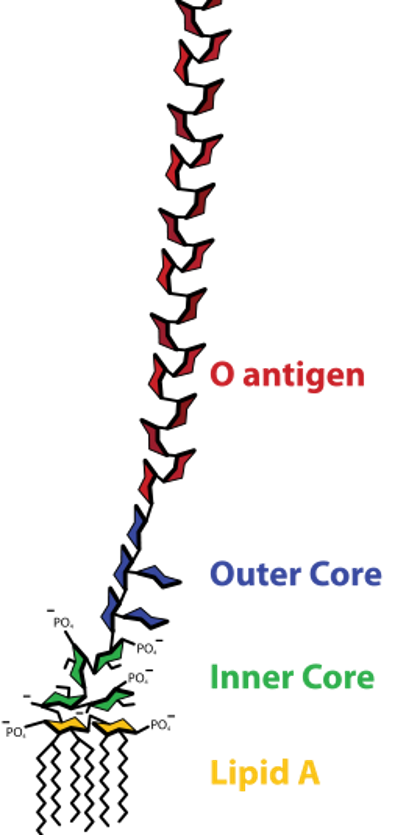
The LPS O-antigen helps bacteria evade complement because its elongated O-antigen chains prevent complement activation
How do pathogens resist phagocytosis?
Prevent effective contact with phagocyte e.g. biofilms, capsules or specific proteins
Affect phagocyte migration - S. pyogenes peptidase cleaves complement factor C5a
Destroy phagocytes - Using toxins
How do pathogens survive inside cells?
Intracellular life protects from e.g. phagocytes, complement, antibodies, some antibiotics
Some pathogens are phagocytosed but survive
survive phagolysosome
prevent formation of phagolysosome
destroy or escape from phagosome and live in cytosol
Some pathogens invade non-phagocytic cells
How do pathogens evade the host antibody response?
They bind host proteins, making them appear less foreign. E.g. S. pyogenes M protein.
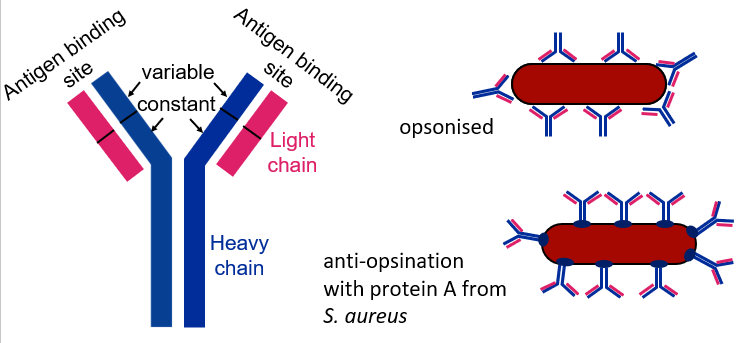
They also produce surface proteins which bind antibodies in the wrong orientation, preventing effective opsoninsation, e.g. S. aureus and S. pyogenes
Opsonisation vs Anti-opsonisation
What are the effects of microbial products?
They can cause host damage, induce inflammation, aid invasion, acquire nutrients and evade immune responses.
What are exotoxins, endotoxins and toxoids?
Exotoxins are actively secreted; endotoxins are structural and released during lysis; toxoids are inactive/low-activity toxins used in vaccines (e.g. tetanus).
How are exotoxins transmitted?
Ingestion of pre-formed exotoxin
food poisoning (e.g. botulinum toxin)
Colonisation followed by exotoxin production
infection of tissue followed by toxin production
damage can be local or toxin can spread though e.g. blood
What are the main characteristics of bacterial exotoxins?
Usually proteins and therefore heat-labile. They can be extremely potent, e.g. botulinum toxin.
What are the four main types of exotoxin and their effects?
Neurotoxins → nervous system → paralysis/respiratory failure
Enterotoxins → GI tract → diarrhoea/vomiting
Cytotoxins → cell damage → necrosis/organ failure
Superantigens → massive T-cell activation → fever/shock
What are superantigens?
Produced by e.g. staphylococci, eg toxic shock syndrome toxin (TSST) and several other enterotoxins
Much higher proportion of T cells respond as compared to normal antigens
Corrupts immune system, leading to massive non-specific inflammatory response, tissue damage, and multi-organ failure
What is endotoxin and what are its effects?
Lipid A of LPS in Gram-negative bacteria; heat-stable and released during lysis.
Causes fever (pyrogenic), activates complement/clotting and can cause toxic shock.
Antibiotic treatment may lead to the release of LPS
How do bacteria regulate the expression of virulence factors?
They sense environmental conditions and alter gene expression.
Early: produce adhesins.
Later: produce exotoxins and reduce adhesin expression to evade host defence.
What is quorum sensing and how does it work?
It is cell–cell communication using an autoinducer (AI).
As cell density increases, the autoinducer accumulates and binds an R protein, activating transcription of specific genes.
There is a high concentration of autoinducers only at high cell density
Biofilms and quorum sensing
In biofilms there is a high cell density; biofilm formation often leads to expression of virulence factors through quorum sensing
So how is virulence regulated?
Environmental signals
Quorum sensing