PSYCH 201 Exam 2
 Call Kai
 Learn
 Practice Test
 Spaced Repetition
 Match
 Flashcards
 Knowt Play
1/93

There's no tags or description
Looks like no tags are added yet.
94 Terms
What is it called that the right side of the cortex is connected to the left side of the body and vice versa?
Contralateral Connection (e.g. damage to the right motor cortex = paralysis on the left side)

What are the jobs of the left and right hemispheres?
Asymmetry of Higher Functions:
Left = language (interpreter)
Right = spacial information
What is the area that is cut in split brain patients called?
The corpus callosum
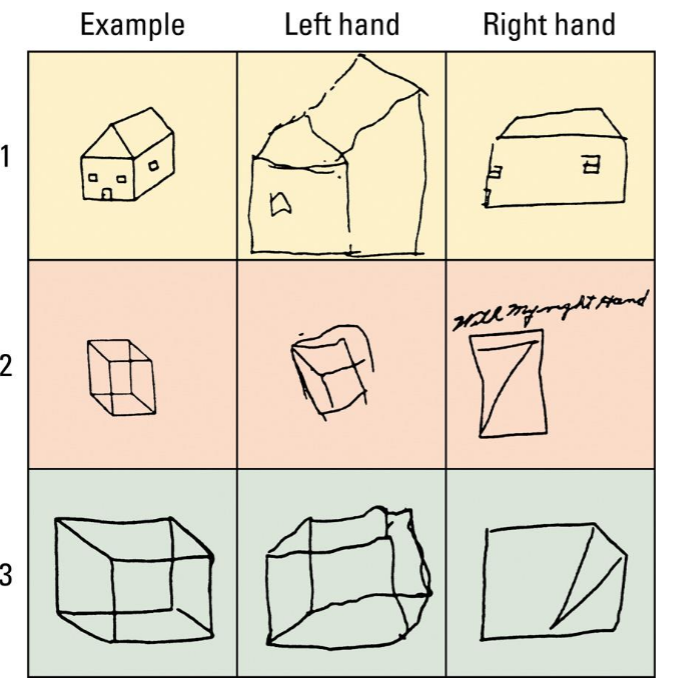
If a split brain person is right handed, which hand will be better at copying geometric figures?
Their left hand! No matter the handedness, the left hand is controlled by the right hemisphere which is responsible for spacial perception. Thus, it will produce the better drawing.
What are the three senses that act as additions to the typical five?
Vision, hearing, touch, taste, smell and…
Vestibular sense (balance)
Kinesthesis (limb position & movement)
Somatosensation (touch, temperature, pain)
What is the difference between sensation, perception, and transduction?
Sensation: initial coding of messages from the senses
Perception: interpretation of those messages
Transduction: the conversion of energy from a stimulus to neural responses (accomplished by sensory receptors)
What is the conversion of energy from a stimulus to neural responses called?
Transduction
How is transduction accomplished?
By sensory receptors
What is the representation of the stimulus in the pattern of action potentials?
Sensory coding
What is the rate law?
The idea that a stronger stimulus will require a faster rate of action potentials.
The doctrine of specific nerve energies suggests that tones of different pitch will be represented by ____________.
Different forms of energy AKA the firing of action potentials in different auditory neurons
Which two parts of the eye focus images onto the back of the eye, where the sensitive cells of the retina (photoreceptors) respond to light?
The cornea and the lens

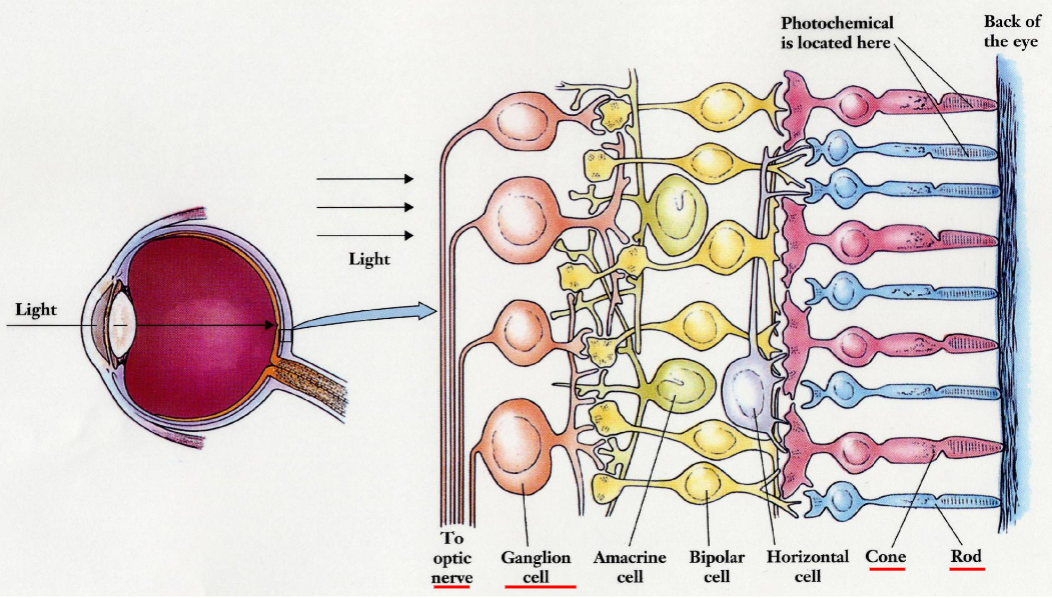
Which cells send messages out the optic nerve to the thalamus?
Retinal output cells (the retinal ganglion cells)
What is the area of the retina where the receptor cells (only cones!!!) are especially densely packed?
The fovea
(What you are looking directly at appears on the fovea so the best, most detailed vision will be found there)
Where is visual acuity (clarity) best in the eye?
The fovea
Where is the blind spot found in the eye?
Where the optical nerve leaves the eye, as there is no room for receptors.
What is the difference between rods and cones?
Cones = colors (and details) and concentrated inside the fovea
Rods = really dark out (night vision/very sensitive to light) and concentrated outside the fovea
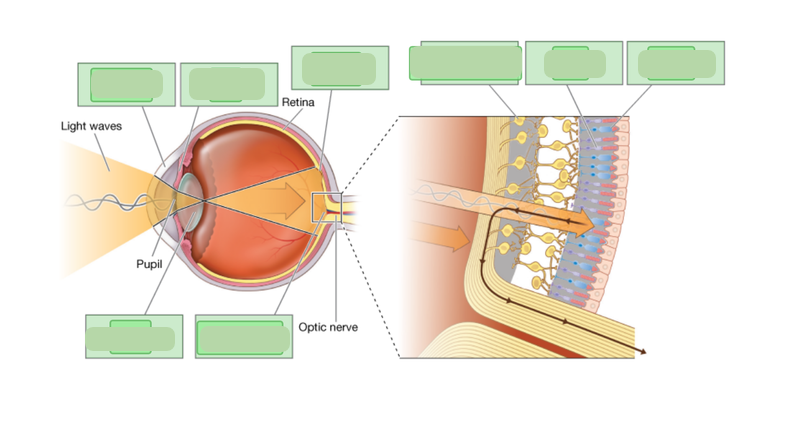
Identify these parts of the eye:

How many types of cones are there and what colors do they represent?
Three: Red, Green, and Blue
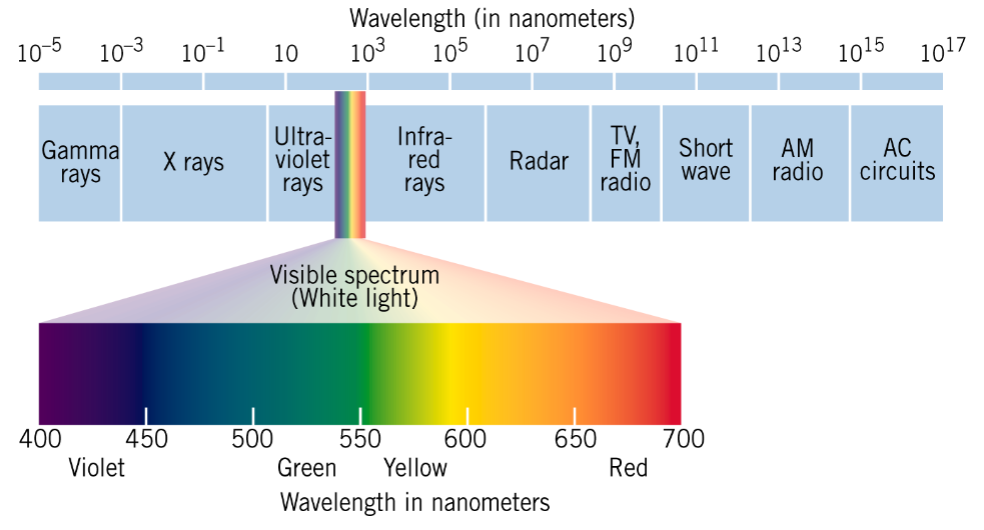
Does violet or red have a longer wavelength?
Violet is the shortest, red is the longest
What is the order of cells in the retina?
receptor cells => bipolar cells => ganglion cells
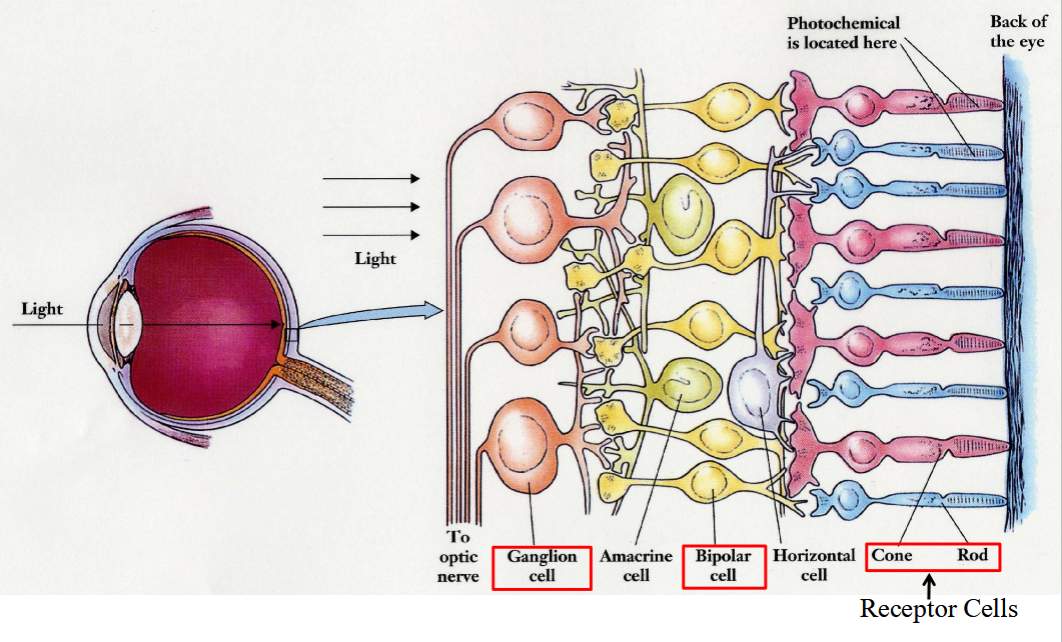
At dusk, a dim star that is clearly visible in the periphery of vision disappears when you turn your eyes to look directly at it with central vision (the fovea). What can account for this phenomenon?
The cones that reside in the fovea have only a weak sensitivity to dim light.
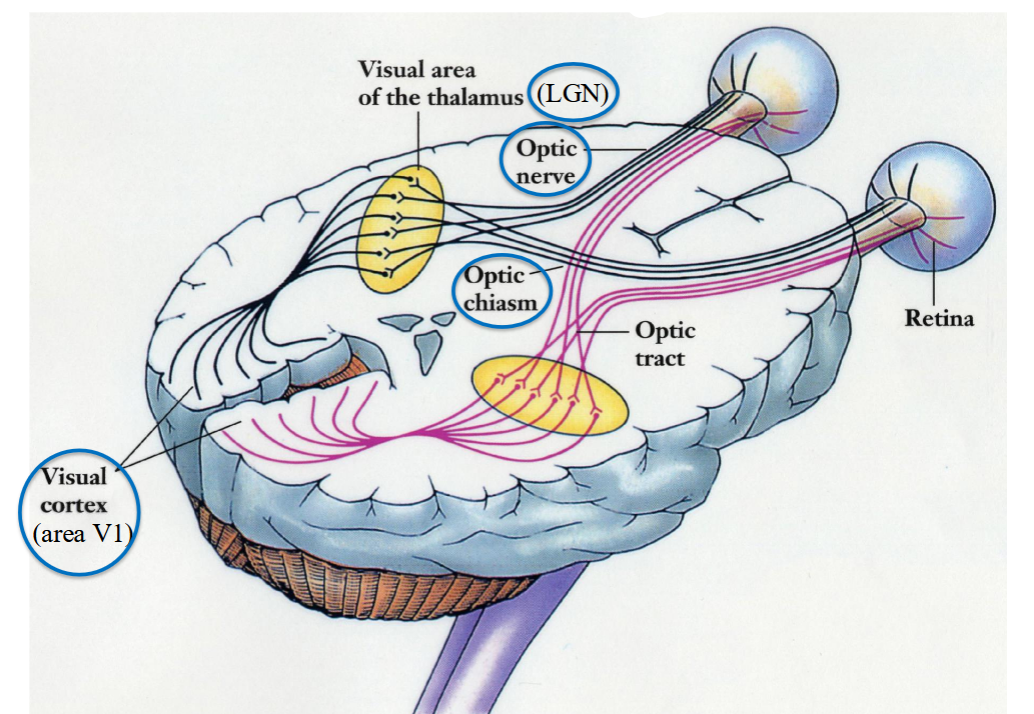
What is the visual area of the thalamus called?
The lateral geniculate nucleus (LGN)
What is the visual pathway?
Eye signals → Optic Nerve → Optic Chiasm → LGN → Primary Visual Cortex (V1)
Signals leave eye via the optic nerve.
At the optic chiasm, the nasal ganglion cell axons cross over to the other side of the brain; the temporal ganglion cell axons stay on same side of brain.
These fibers project to the lateral geniculate nucleus (LGN) of the thalamus then to the primary visual cortex (V1).
Therefore, neurons in left cortex get signals from the right side of the visual field and vice versa.
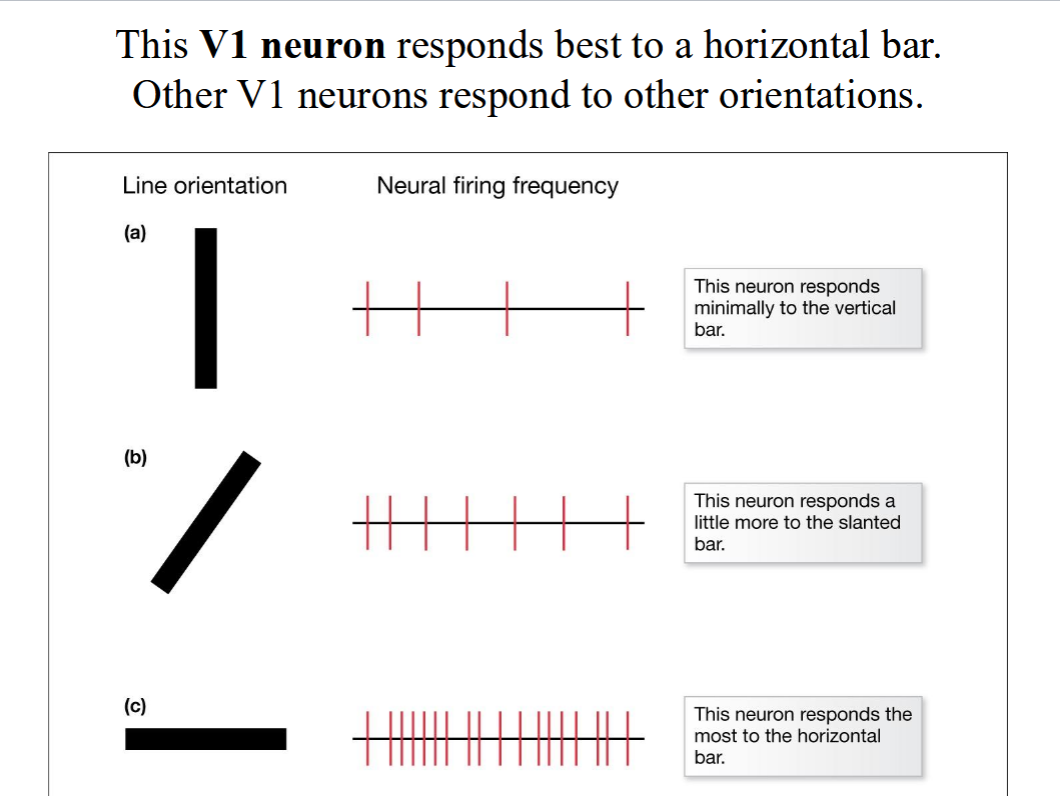
What do primary visual cortical neurons (area V1 of the cortex) respond well to?
Light or dark bars/edges of particular orientations (vs. spots of light like the cells in the retina and LGN).
As you proceed to higher stages in the visual system, cells respond to…
More complex visual features e.g. faces
What is the area that identifies faces in our brains called?
The fusiform face area (lesions here cause prosopagnosia)
A prosopagnosic would have problems doing what?
Recognizing faces
What are the two “streams” of processing in primate visual cortex?
The ventral/”what” pathway processes information concerning object/pattern identification and recognition (ends up in temporal lobe).
The dorsal/”where” pathway processes information about space (ends up in parietal lobe).
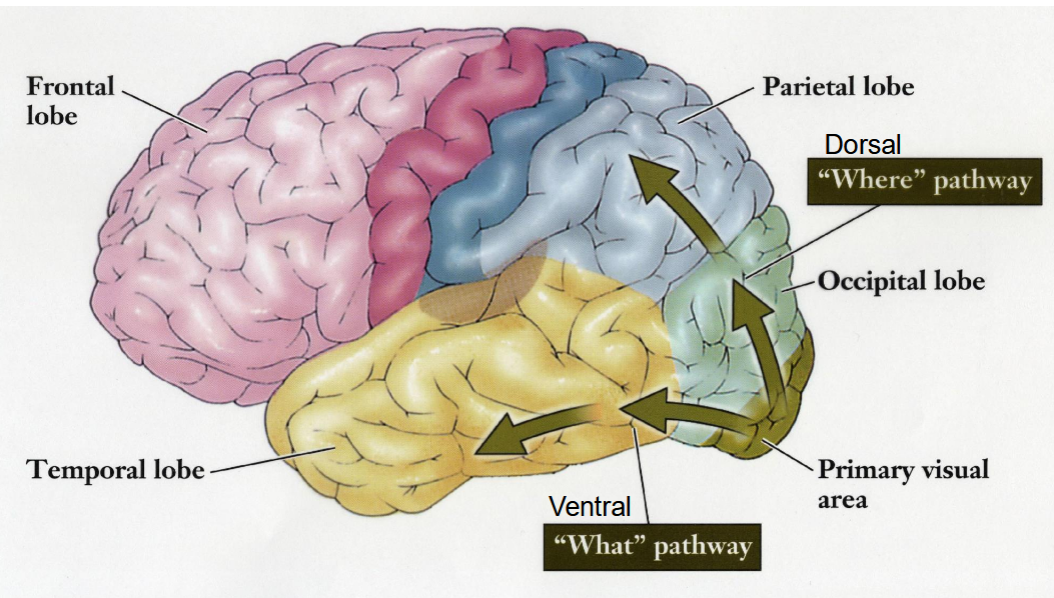
Which pathway is ventral vs which is dorsal?
“What” is ventral vs. “where” is dorsal”
What lobe does the “what” pathway end up in vs. the “where” pathway?
“What” ends up in the temporal lobe
“Where” ends up in the parietal lobe
What is evidence of functional specialization (“what” and “where” pathways)?
In monkeys:
Temporal cortex lesion (but not parietal) impairs object discrimination task.
Parietal cortex lesion (but not temporal) impairs object location discrimination task
In humans:
Damage to inferior temporal cortex causes Visual Agnosia--can see but can't organize or recognize what see. "Psychic blindness".
Damage to (right) parietal cortex causes Unilateral Neglect--perceive world but ignore or fail to attend to parts of world.

Damage to the parietal lobe leads to problems with what?
Spatial attention, localization, & reaching/grasping objects.
Damage to the temporal lobe leads to problems with what?
Identifying/recognizing objects
What is it called when you can see but can't organize or recognize what see?
Visual Agnosia
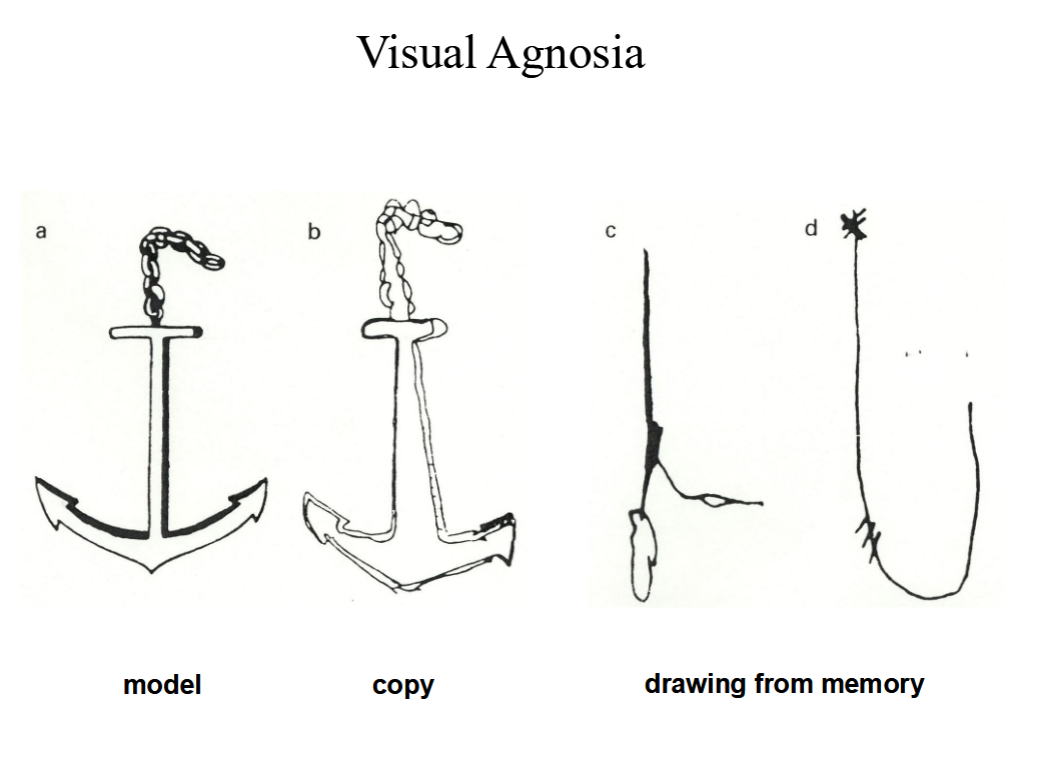
Damage to what region of the brain causes visual agnosia?
Damage to the inferior temporal cortex
What is it called when you can perceive the world but ignore or fail to attend to parts of world?
Unilateral Neglect

Damage to what region of the brain causes unilateral neglect?
Damage to (right) parietal cortex
What was so special about Patient DF?
“What” Pathway Damage
Carbon monoxide poisoning caused damage to her occipital cortex.
Seemed that she had lost ability to see (‘cortical blindness’)
Over next few days, she recovered her sense of color and visual acuity (could see hairs on hand) … but not form (can’t distinguish simple shapes, words, friends faces, drawings).
However … One day she reached out and picked a pencil out of experimenter’s hand… using a normal, skillful movement. She can act towards objects in the world, but cannot consciously identify them.
Conclude: Dorsal/“Where” stream is critical for guiding actions to object
What is it called to separate objects from each other or from a background via color?
Perceptual Segregation
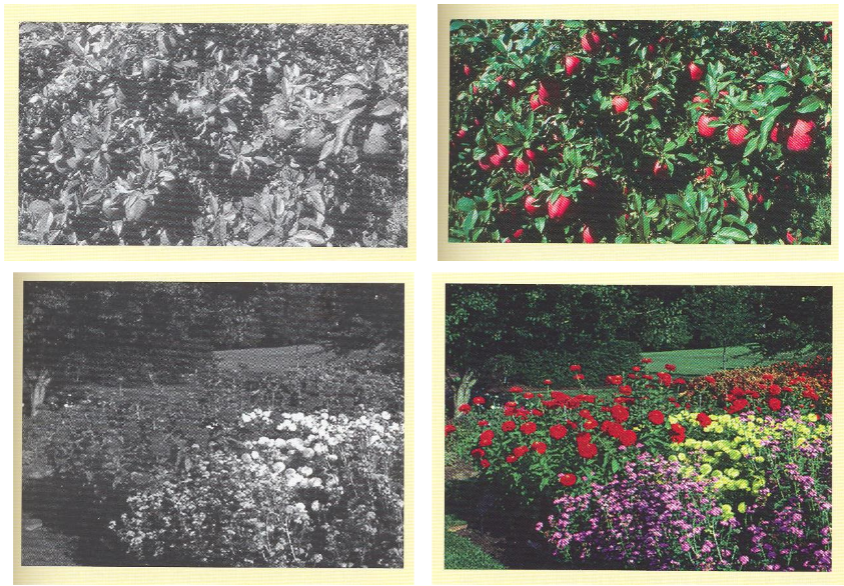
Do wavelengths of light have an intrinsic hue?
NO!
What does a light’s wavelength and amplitude correlate to in terms of color?
Wavelength = hue
Amplitude = brightness

What are the two types of color mixing?
Additive and subtractive color mixing
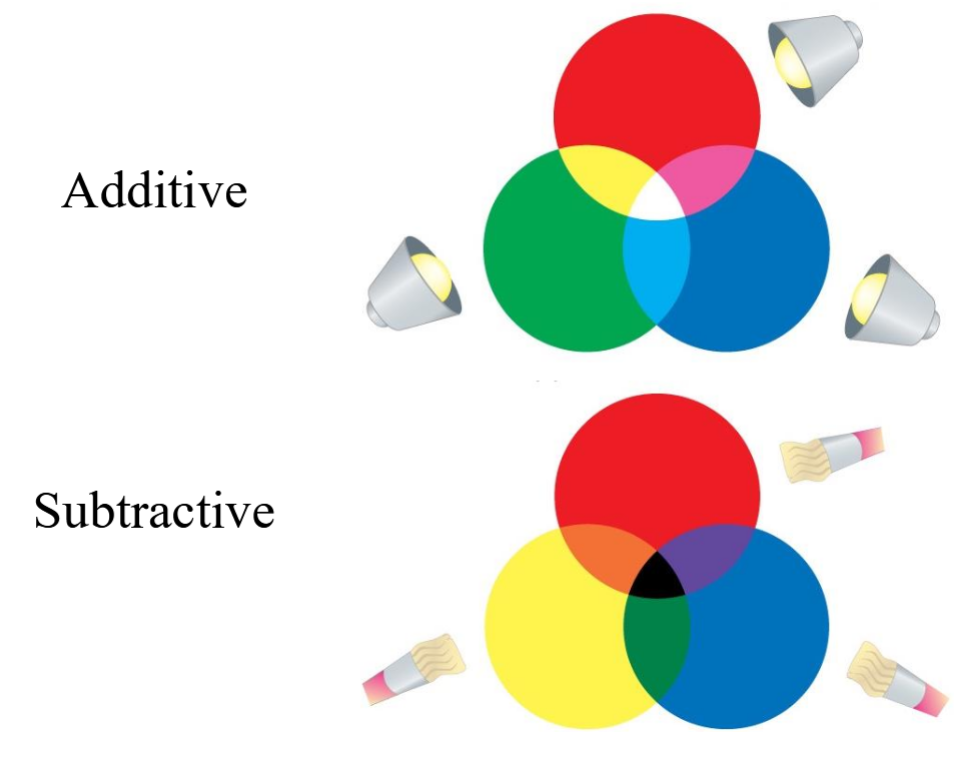
What is it called when you mix 2 pigments, and only those wavelengths absorbed by neither pigment (i.e., reflected by both) will be seen?
Subtractive Color Mixing (RYB = black)

What is it called when colored lights mix together?
Additive Color Mixing (RGB = white)

What is the theory of color vision that posited light of a particular wavelength stimulates 3 receptors to different degrees and that each wavelength, therefore is represented by a unique pattern of activity (different intensity) in the 3 receptors.
Trichromatic Theory AKA three primaries law of color
What is the theory of color vision that was proposed to explain perceptual phenomena in which the colors red/green and blue/yellow seemed to be paired with each other as opposites?
Opposing afterimages:
red → green afterimage
yellow → blue afterimage
Opponent-Process Theory

What did each theory of color vision prove we have in our eyes to see color?
Trichromatic: proved we have 3 cones for red, green, and blue light
Opponent-Process: proved we have +R center and -G surround retinal ganglion cells

What is the psychical stimulus that corresponds with audition?
Changes in air pressure over time.
What do amplitude and frequency correspond to in terms of audition?
Loudness and pitch respectively

The tuning of different parts of the basilar membrane in the cochlea to different frequencies of sound is referred to as what?
Place coding (continues from cochlea to A1 in cortex!)

What type of frequency will cause a maximal deflection that is closest to the base of the basilar membrane? What about the tip?
Base = high frequency
Tip = low frequency
What is the audition/hearing pathway?
Sound waves
Outer ear
Auditory canal to ear drum (vibrates)
Middle ear: where the hammer, anvil, and stirrup (ossicles) vibrate
Inner ear: oval window and cochlea where the basilar membrane vibrates at specific locations causing hair cells (the primary receptors) to respond
Auditory (chochlear) nerve
Thalamus
Primary auditory cortex (A1)
Higher auditory cortex (temporal lobe)
What is it called how humans use intensity & timing of sounds to locate where they are coming from? A sound is more intense and reaches the ear more quickly on the side of the head that it is located.
Auditory Localization
What is the psychical stimulus that corresponds with the haptic sense?
Mechanical pressure on skin (pressure, temperature, and pain)
What is the haptic pathway?
Receptors in skin
Spinal cord/brain stem
Thalamus
Somatosensory cortex
What are the two different kinds of pain fibers and what makes them different?
Fast fibers = mylenated
Slow fibers = not mylenated

What is the smell pathway?
Odorants (molecules in air)
Nasal cavity
Olfactory receptors in the olfactory epithelium
Olfactory bulb (brain center for smell)
Olfactory nerve
Prefrontal cortex & amygdala.
Prefrontal cortex: pleasantness/unpleasantness of smell
Amygdala: intensity of smell (amygdala is important for emotion & memory)

What is the only sense that does not go through the thalamus?
Smell!
What is the gustatory pathway?
Receptors in taste buds
Cranial nerve
Thalamus
Cortex (Insula + frontal lobe).
What are the 5 taste sensations?
Sweet, sour, salty, bitter, savory (umami).
What is psychophysics?
The study of the relationship between physical stimuli and psychological experience.
Who is associated with psychophysics?
Structuralists, who sought to understand perception by measuring responses to simple sensory stimuli.
What is it called when you can only detect something 50% of the time (the smallest possible stimulus you can detect)?
Absolute threshold
subthreshold < threshold < suprathreshold

What is the smallest difference in stimulus energy that can be discriminated between two stimuli?
Difference threshold AKA just-noticeable-difference (jnd)

What is Weber’s Law?
The just-noticeable-difference (jnd) is proportional to the magnitude of the original/standard stimulus (i.e., larger standard stimulus leads to larger jnd).
When trying to find the "just noticeable difference" for weights, the heavier the standard stimulus, the __________ the JND.
larger
What is it called when we perceive edges of the illusory shape even though there is no “sensation” driving these perceptions?
Illusory Contours

What is it called that the visual system automatically separates a scene into objects (figures) and background (ground)?
Figure-Ground Organization (the contour is typically perceived as belonging to the figure)
What are Gestalt grouping laws?
Proximity: The closer two figures are to each other, the more likely we are to group them and see them as part of the same object.
Similarity: We tend to group figures according to how closely they resemble each other, whether in shape, color, or orientation.
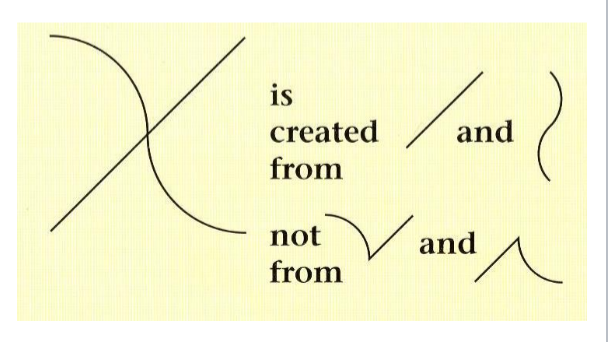
Good continuation: We tend to group together edges or contours that are smooth and continuous as opposed to those having abrupt or sharp edges.
Closure: We tend to complete figures that have gaps. The principles of good continuation and closure sometimes can result in seeing contours, shapes, and cues to depth when they do not exist, as is the case with illusory contours.
Common fate: We tend to see things that move together as belonging to the same group.
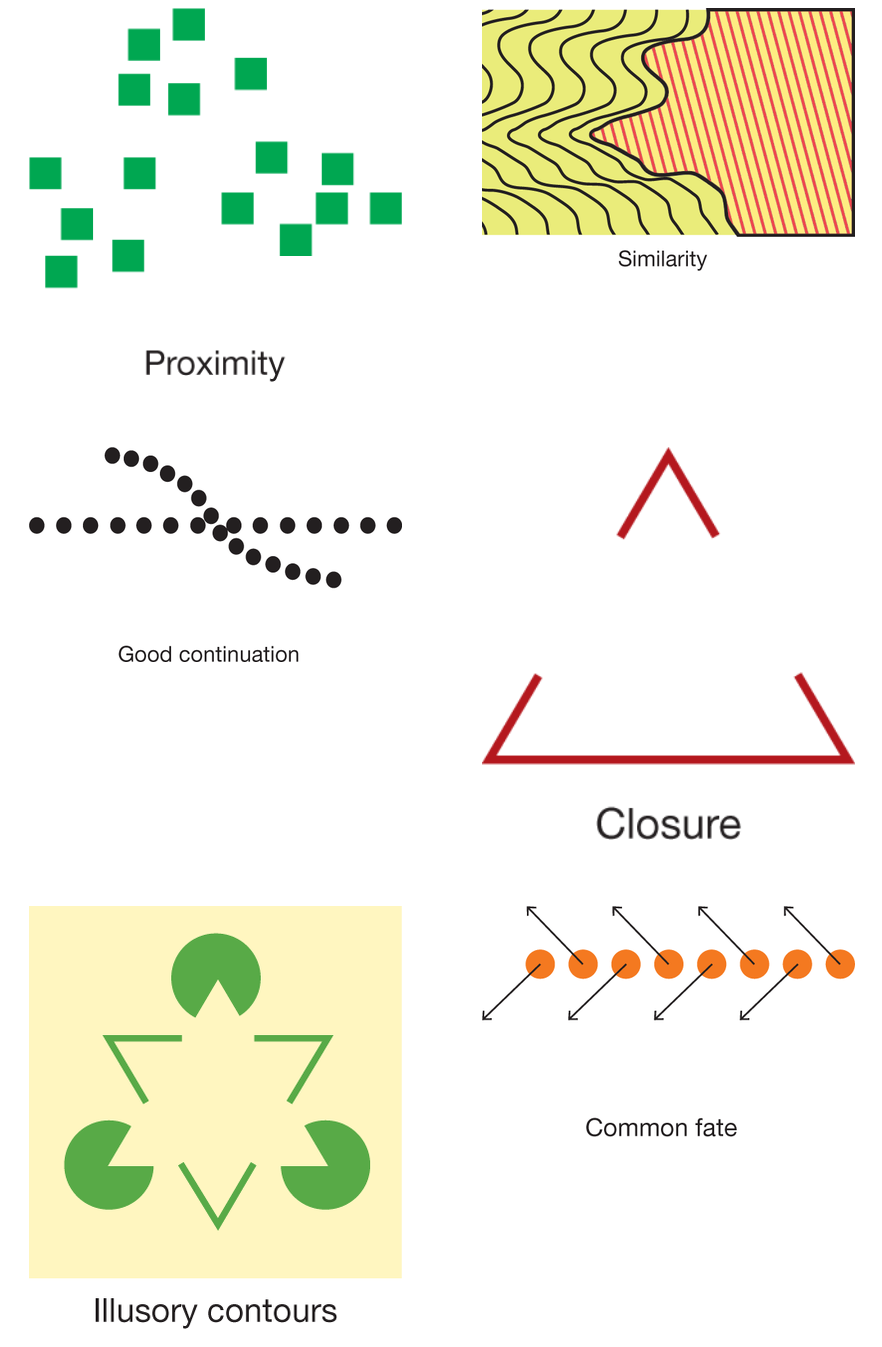
What is the Gestalt grouping law of proximity?
We tend to see stimulus elements that are near each other as part of the same object or group.

What is the Gestalt grouping law of similarity?
Elements that are similar tend to be grouped together.

What is the Gestalt grouping law of closure?
We tend to supply missing elements to close/complete a familiar figure.
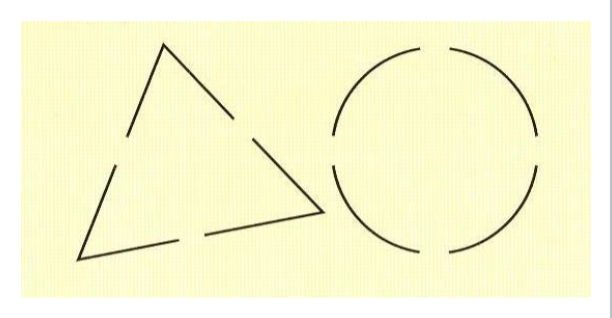
What is the Gestalt grouping law of continuity/good continuation?
We tend to see elements in ways that produce continuous lines with minimal change of direction.
What is the Gestalt grouping law of common movement/fate?
When elements are moving in the same direction at the same rate, we tend to see them as part of a single object.

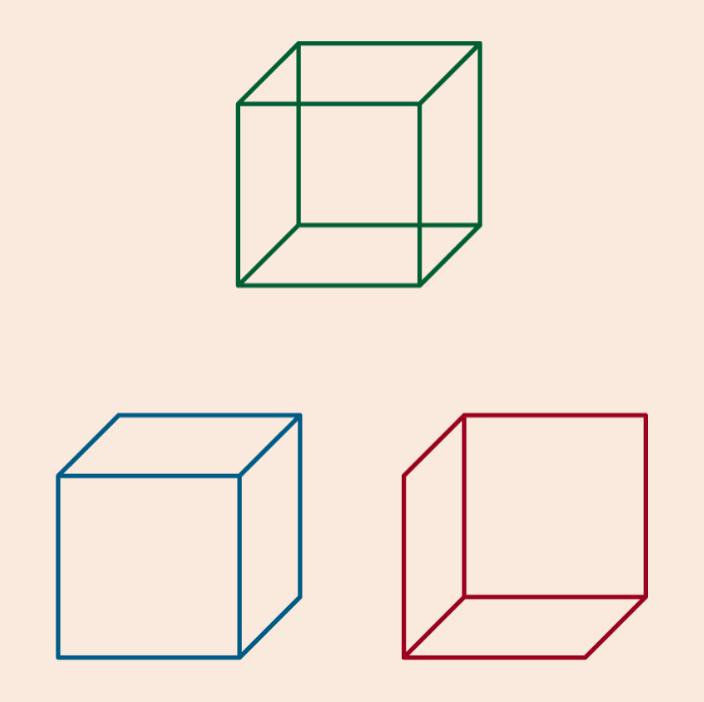
What does the Necker Cube demonstrate?
Multiple 3-D interpretations
What is the difference between binocular and monocular cues?
Binocular Cues: Require 2 eyes. Works for objects less than ~30 feet away.
includes: binocular (retinal) disparity; and eye convergence
Monocular Cues: can be used with a single eye.
includes: motion parallax; and various “pictorial cues”:
Shape-from-contour, shape-from-shading/lighting, linear perspective, texture gradients, relative image size, familiar size, elevation.
What is retina disparity and is it binocular or monocular?
Since the eyes are in different positions, they get different views of the world. The brain interprets the differences (or disparity) between the 2 retina images as depth. It is a binocular cue.

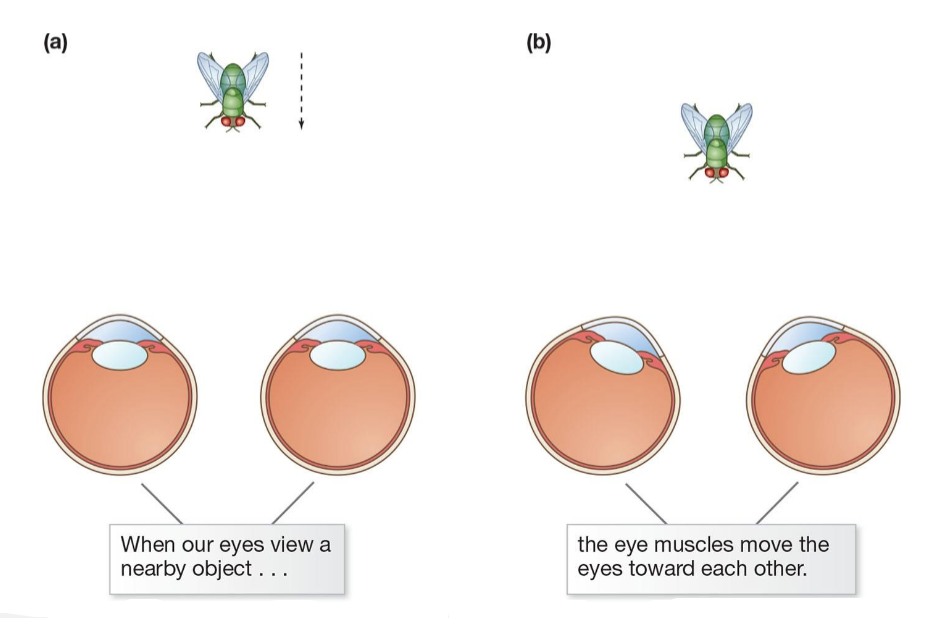
What is eye convergence and is it binocular or monocular?
As an object approaches, the eyes turn inwards. Used as a cue to perceived distance. It is a binocular cue.
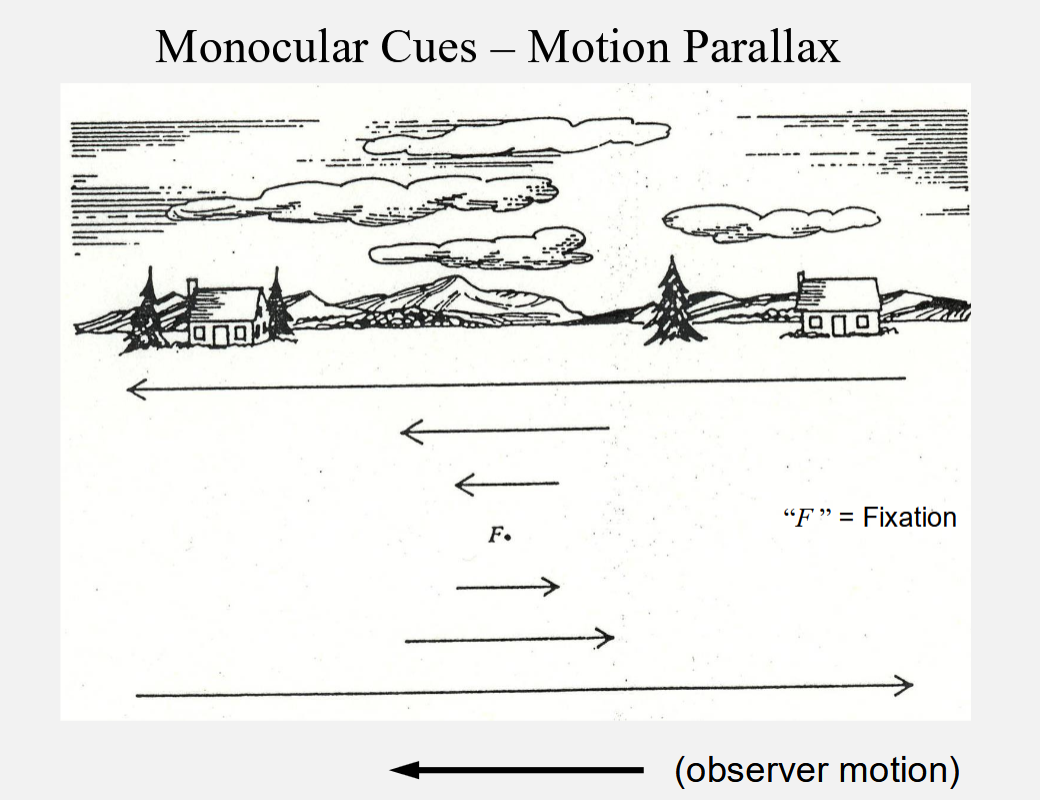
What is motion parallax and is it binocular or monocular?
As an observer moves, objects at different distances appear to move at different speeds across the retina. These differences provide a cue to depth:
Near objects appear to move in the direction opposite your movement.
The fixated object remains stationary.
Farther objects appear to move in the same direction as your movement.
It is a monocular cue.
What is structure from motion and is it binocular or monocular?
When an object moves in 3-D space (e.g., rotates), differences in the speed and direction of its moving parts provide cues to the object's 3-D shape and depth. It is a monocular cue.

What are pictorial cues and are they binocular or monocular?
Cues you could see in a work of art. They are monocular.
What are all the pictorial cues?
Shape-from-contour
Shape from shading/lighting
Linear perspective
Texture gradients
Relative image size
Familiar size
Elevation
What is the pictorial cue of shape from contour?
The way that contours (edges) intersect gives clues about an object’s 3D shape & depth.
T-junction (T): One surface is blocking (occluding) another.
Cross (+): Two contours pass over each other like crossed wires.
L- and Y-junctions: Usually indicate corners where surfaces meet.

What is the pictorial cue of shape from shading/lighting?
Surfaces that are facing a light source are brightest.
Surfaces facing away from the light are less bright and more shaded.
We interpret the pattern of shading as shape. Usually assume light source as coming from above.

What is the pictorial cue of linear perspective?
Physically parallel lines appear to converge in the distance. Greater convergence is interpreted as greater depth or distance.(e.g., roads, railroad tracks).

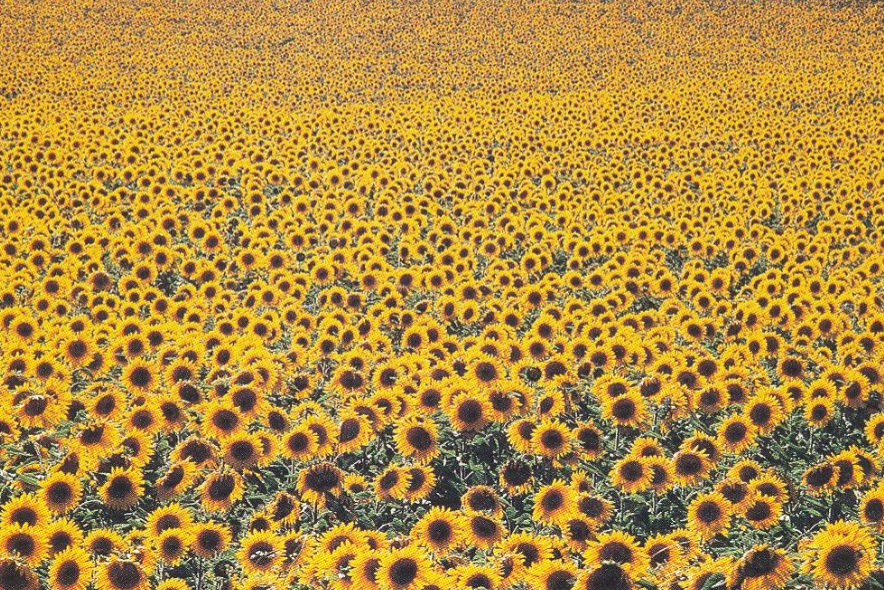
What is the pictorial cue of texture gradients?
The systematic decrease in the apparent size and spacing of texture elements with increasing distance. Areas with smaller, more closely spaced texture elements are perceived as more distant.
What is the pictorial cue of relative image size?
If two objects are known or assumed to be the same physical size, the one with the smaller retinal image is perceived as more distant.

What is the pictorial cue of familiar size?
Knowledge of an object's actual size helps us judge its distance; a familiar object that produces a smaller retinal image is perceived as farther away.

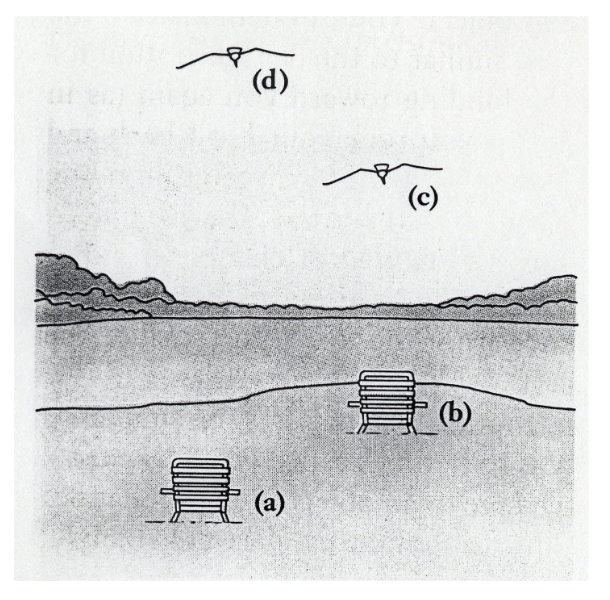
What is the pictorial cue of elevation?
Objects closer to the horizon in the visual field (b, c) are typically perceived as more distant than objects located farther from the horizon (a, d).
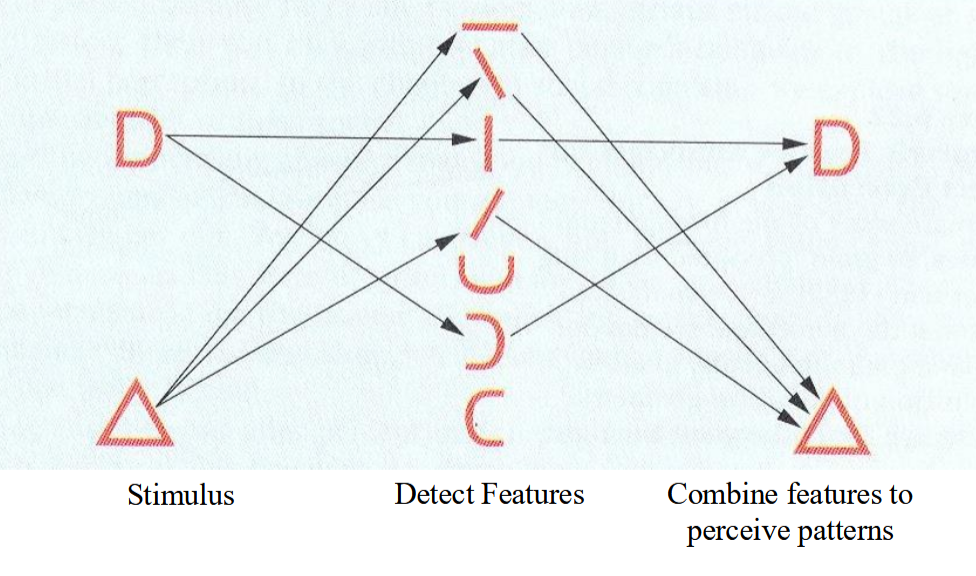
What is bottom-up processing?
Perception that is driven by information in the sensory input. It begins with simple features (e.g., lines, edges, and colors) and combines them to form a perception of the whole object.
What is top-down processing?
Perception that is guided by prior knowledge, expectations, and context. The brain uses existing information to help interpret and recognize sensory input.

What are context effects in terms of top-down processing?
Using knowledge from experience to help perceive input.
e.g. recognizing an ambiguous letter based on the word in which it appears

What are perceptual constancies?
That things are perceived as stable despite viewing conditions:
Lightness constancy
Shape constancy
Size constancy
perceived size = retinal image size x perceived distance
Sp = Sr x Dp