Problems in Equine Anesthesia: The Risks of General Anesthesia in the Horse
 Call Kai
 Learn
Learn Practice Test
 Spaced Repetition
 Match
Match Flashcards
 Knowt Play
1/33

There's no tags or description
Looks like no tags are added yet.
Name | Mastery | Learn | Test | Matching | Spaced | Call with Kai | Chat |
|---|
No analytics yet
Send a link to your students to track their progress
34 Terms
What are the main causes of equine mortality in the peioperative period?
• Confidential enquiry into perioperative equine fatalities (CEPEF)
- prospective observational study
- 41824 case records (35107 non-colic)
- 0.9% mortality at 7 days for non-colic* → new is 0.6% CEPEF-4
- 33% due to cardiovascular failure
- 32% attributable to fracture or myopathy
What are some of the problems with equine anesthesia?

Classify the most common problems into the most common period of anesthesia when they occur.

What are the main risk factors?
Cardiovascular, Respiratory, Neuro-Muscular & Skeletal
• ASA status: risk status for the anesthetic, purely to the drug (1, 2 - healthy) (3 to 5 - more and more compromised)
• Duration of anaesthetic
Longer = more at risk of adverse effects
• Pain level and therapy
Painful horse - affects recovery
• Temperament of individual horse
• Body size, condition and fitness
Bigger they are, bigger gravity gradient on horses and compression of muscles
• Breed associated problems
• Level of monitoring and degree of intervention by an experienced anaesthetist
What are some ways you can minimize risks of anesthesia in horses?
• Thorough physical examination of the horse
• Appropriate planning and preparation
• Treatment of disease or illness if possible
• Delay or reschedule non-urgent procedures
• Stabilisation of patient as much as possible
• Diligent and reactive monitoring of anaesthetic by experienced personnel
• Complete procedure in as short a time possible
• Provide best possible environment for recovery
What are the main cardiovascular complications to be aware of in equine anesthesia?
Heart disease
Hypovolaemia
Hypotension
• Reduction in mean arterial blood pressure
• Ideally 70-90 mmHg (concerning <60mmHg - this is the bottom of the barrel, you should be concerned when it drops close to this level)
• Common complication of inhalant anaesthesia
Cardiac Arrhythmias
• Auscultation and Electrocardiography - investigate them
• Normal Arrhythmias v Abnormal Arrhythmias
• Possible to get Arrhvthmias under anaesthesia - due to drugs or hypoxia or combination
Why do horses develop hypotension?

What is the significance of hypotension?
Reduced perfusion of organs
• including muscle, lungs, liver, kidney, brain
• Hypotension leads to increased risk of other complications
• Reduced Oxygen delivery to tissues
• Increased lactate build-up -due to anerobic metabolism which can alter tissue pH
• Equine post-anaesthetic myopathy (EPAM)
What are some ways we can measure blood pressure in equine patients?
Two ways
Non-invasive
• Cuff
• Oscillometric - is not always accurate, cannot cycle over 2 mins, vessel needs to recover, so no way to get continuous BP
• Tail or distal limb
• Ponies / Foals
• Advantages
Quick and easy
Low risk of harm
• Disadvantages
Less accurate
Not continuous
Invasive / Direct
• Place cannula in artery - is the preferred method in horses
Facial artery - less chance of causing injury
Metatarsal (or other) - tends to be avoided since post-operative sequestrums have developed
• Risks
Haemorrhage
Infection
Damage to periosteum
• Benefits
Accuracy and beat to beat recording and analysis
Permit sampling of arterial blood for gas analysis
Describe the arterial pressure waveform and what measurements it provides?
• Systolic, Diastolic, Mean pressure measurements
Might lose dicrotic notch if BP drops
• Pulse pressure - difference between systolic and diastolic
• Rate, relative duration of cardiac cycle (1/3 systole, 2/3 diastole)
• Myocardial Contractility
Angle of upstroke (red triangle) gives indication, if shallow → indicates decreased contractility
If steep → indicates contractility has increased, tries to counteract lack of volume to increase cardiac ouput
• Systemic vascular resistance
• Cardiac output
Area under the curve
• Relative volume status

How do we treat or correct hypotension?
• Depth of anaesthesia?
Can we turn the horse down?
• Hypovolaemia?
Crystalloids
Colloids
Hypertonic saline (7.2% NaCl)
• Pharmacological support
Dobutamine infusion - ^ contractility
Ephedrine - ^ contractility and ^ SVR
Phenylephrine - ^ SVR
What information can cardiac auscultation tell you in the horse?
• Physiological murmurs are relatively common
• Low grade over left heart base, soft (I or II), localized and labile (blue) - usually functional
Functional murmurs due to changes in blood flow
Pathological murmurs eg. valvular incompetency or septal defects usually louder towards apex, on either side (red)
If you hear anything abnormal - when should you reccomend electrocardiography?
What block is often common?
• 1° or 2° atrioventricular block is most common arrhythmia in horses
Intermittent low grade, high vagal tone and fitness
Persistent high grade, drug induced or disease
• Atrial fibrillation (atrial flutter, atrial tachycardia) - random noises out of nowhere
Large heart, ectopic electrical focus, increased automaticity (can be drug induced)
Can reduce cardiac output by significant amount
• Ventricular and junctional arrhythmias are abnormal in horses
If found = NOT normal
What is tachycardia and what defines that in horses?
• Heart rate higher than the expected range.
• Racehorse >40bpm or Small Pony > 60bpm.
• Foals and juvenile horses have higher HR.
• Tachyarrhythmias reduce cardiac output because it reduces the filling time
• Potential Reasons for Tachycardia
• Hypovolaemia?
• Hypoxaemia?
• Pain / Nociception?
• Drug induced?
What is bradycardia and what defines that in horses?
• Heart rate lower than the expected range.
• Resting HR varies with fitness and size.
• Racehorse <24bpm or Small Pony <30-35bpm
• Foals and juvenile horses depend on HR for Q - far more significant
• Bradycardia is precursor to asystole
• Potential Reasons for Bradycardia
• Hypertension?
• Нурохаетіа?
• Drug induced?
What is cardiac arrest and what are the first line procedures in horses?
Asystole
• Prevention is always better than cure.
• CPR almost always unsuccessful in large horses.
• Can be successful in foals and small ponies.
•Same basic principles as for all CPR.
• Stop administration of all anaesthetics
• Airway - ensure patent
• Breathing - Ventilate with 100% Oxygen
• Circulation - Chest compressions at 40 - 60 /minute
• Drugs - Atropine and adrenaline, possibly calcium if
PEA
• ECG - check for restoration of electrical activity
• Fluids - treat any fluid deficits to restore circulating volume
What are the main concerns in regard to respiratory problems in equine anesthesia?
Hypoventilation
Hypoxaemia
Acidosis
What are the effects of hypoventilation in equines?
If EtCO2 is high → hypoventilating, by definition, high levels life threatening due to the pH change where cells stop functioning
Side effect of hypoventilation is hypoxaemia - reduced uptake of oxygen into the blood

Why are horses prone to hypoventilation?
1) Anesthetic Agents
Decrease ventilatory drive
• Desensitise medullary and carotid body chemoreceptors - CO2 receptors tell you to breath more, but desensitized - no effect
• Reduced minute ventilation
• Respiratory acidosis
• Increased atelectasis and V/Q mismatch
• Hypoxemia over time
2) Positioning
"Horses are not designed to be turned upside down, it is the source of most of their anaesthetic problems"
Pushes the diaphragm forward in this position
What are the main features of hypercapnia?
• Hypercapnia is the failure to eliminate adequate carbon dioxide
• Measured value (capnography)
• Normal alveolar CO, approx. 40 mmHg (5.3 kilo-pascals) range is (35-45 mmHg) or 4.6-6.0
End-tidal measurement
Caused by: Hypoventilation
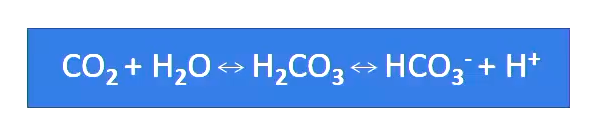
Why does hypercapnia result in changes to pH?
• Decreased alveolar elimination of CO2 causes an increase in arterial concentration (PaCO2)
This leads to the development of acidaemia (decrease pH)
Because the origin is inadequate ventilation it is termed a 'Respiratory acidosis'
How do we measure carbon dioxide?
• End-tidal : measured by sampling of airway gases (PACO2) Capnography
• Arterial : by rapid analysis of blood (PaCO2)
The wider the difference between the two, the greater the degree of ventilatory destress
What does capnography allow you to measure?
• Continuous measurement
• End tidal CO2
• Useful to identify hypoventilation and hyperventilation trends
• The integrity of the airway and anesthetic circuit
• When assessed with PaCO2, anatomic and alveolar dead space
• Changing metabolism, perfusion and cardiac output

How can you evaluate blood gas?
• Most accurate with fresh arterial blood samples
Three way stop-cock often used
• Much easier with arterial cannula in place
• Remove waste blood/saline and ensure no air in sample
• Mix with heparin (use pre-heparinised syringes)
• Process as soon as possible (Or place on ice to limit metabolism of RBCs)
What are the measured values obtained during blood gas analysis, what are the calculated values?
BE - Base excess (neutral or lacking in acid (positive), or lacking bicarb (negative)
Anion gap - diff. between positive and negative cations in blood

How do we treat hypoventilation?
• Depth of anaesthesia?
Can we turn it down? More often or not the answer is no - to keep anesthesia team safe or if you have already done so
• Provide IPPV (intermittent positive pressure ventilation)
What is hypoxaemia?
HYPO - too little
OX - oxygen
AEMIA - in the blood
Hypoxaemia can lead to: Not to be confused with HYPOXIA (tissues)
What are the five main causes of Hypoxaemia?
• Inadequate inspired oxygen
Rare in a hospital
• Impaired diffusion across alveoli
Certain respiratory conditions or smoke inhalation
Most common:
• Hypoventilation
→ frequent under anaesthesia
• VQ mismatch
→ frequent under anaesthesia
•Shunting of blood
→ occurs as result of V/Q mis-matching
What is a V/Q mismatch?
Horse in lateral recumbency, upper lung is very well ventilated, but the lower lung has less ventilation, and the other lung us over ventilated
Blood in bottom cannot exchange gas, but blood in the top can exchange gas, but there is not enough blood

What are the compensatory responses to a V/Q mismatch?
• P(A-a) O2 gradient
High V/Q mismatch
Low V/Q mismatch
Both increase P(A-a) 02 gradient
• Hypoxic Pulmonary Vasoconstriction (HPV)
Compensatory vascular response that shunts blood flow away from unventilated alveoli, redirects the blood to the alveoli that are ventilated
Reduces low V/Q mismatch (often due to atelectasis).
• Compensatory response is abolished by inhalant anaesthetics for horses anesthetized on a table
What are some methods we can do to prevent a V/Q mismatch?
• Positioning?
Lateral better than Dorsal, still get atelectasis
• IPPV from beginning?
• Air:Oxygen mixture for delivery gas?
If 100% oxygen - can get absorption atalectasis, if alveoli closes with O2, blood takes it all away, alveoli will eventually flatten and collapse
Lower FI O2, increased risk of Hypoxaemia?
Nitrogen 'inert' gas, provides 'scaffold' for alveoli and prevents collapse
But you are still supplying less amount of oxygen
Both methods tend to even out and are effective
Reduces absorption atalectasis
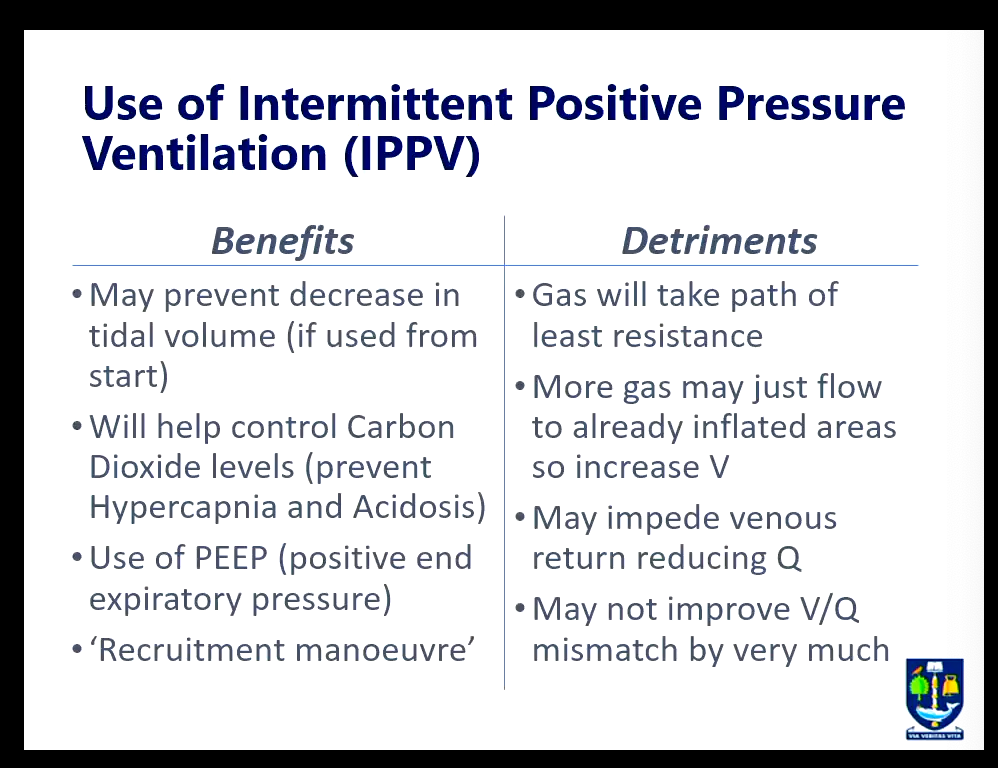
What are the benefits and detriments of IPPV?
PEEP** prevents alveoli closure or collapse
Recruitment manoeuvre - helps to “pop” open the alveoli again
What are some drugs which can help treat a V/Q mismatch?
• Bronchodilators
Salbutamol (inhaled)
Clenbuterol (IV)
• Also affect CV system (vasodilation)
• Sweating typical
• Correct administration technique needed with inhaled bronchodilators
Treatment for hypercapnia and hypoxaemia is…?
IPPV