Biochem Test 3
 Call Kai
 Learn
 Practice Test
 Spaced Repetition
 Match
 Flashcards
 Knowt Play
1/99

There's no tags or description
Looks like no tags are added yet.
100 Terms
Catabolism
Degradation of biomolecules cuts molecules down
-Exergonic and generates ATP
-Produces ATP, NADH, FADH2
-Starts with a high energy compound and ends with low energy compound
What are the generalizations about metabolism?
-Metabolic pathways are interconnected (Proteins into amino acids, Starch/Polysacchrides into glucose, fats into triaglycerols)
-Converge into common hubs/intermediates of pyruvate and acetyl coA to enter CAC and make NADH, FADH2 which go to the ETC to make ATP
-All pathways occur simultaneously and do not wait for each other
-Includes degradation and biosynthesis (how the biomolecule gets broken down for energy then built back up again when the cell needs it)
-Facilitated by enzymes
-Regulated
Anabolism
Biosynthesis of biomolecules
Consumes energy: endergonic
Uses ATP, NADH, and FADH2
Starts with a low energy compound and ends with a high energy compound
Glucose is
the only molecule that is freely transported through the blood
other molecules such as fatty acids, ketone bodies, and alanine all need carriers or special forms to travel between tissues
Not all metabolic processes occur
in all tissues. A compound made in one tissue may be needed by the whole body so it must be transported
In the liver
there is a process where glucose can be converted to glycogen or vice versa by using different enzymes to shut each pathway on or off
The liver makes ____ for other tissues
urea and ketone bodies
Metabolism occurs in
cellular compartments
Which metabolic processes occur in the cytosol?
Glycolysis, fatty acid biosynthesis, pentose phosphate pathway, and many reactions of gluconogenesis
Which metabolic pathways occur inside the mitochondria?
ETC, oxidative phosphorylation, fatty acid oxidation, and the Citric Acid Cycle
What does the lysosome do?
Enzymatic digestion using hydrolyses of cell components and ingested matter
Why do nearly all metabolic reactions require a catalyst?
-Greater Reaction Specificity —> Selective for single substrate
-Higher Reaction Rates
-Milder reaction conditions
-Capacity for regulation
What is the enzyme equivalent of how traditional chemical reaction rates are increased?
Heat → Lower Ea by stabilizing transition state
Greater Concentration of Reactants → Proximity/Orientation in active site
Acid/Base → Amino acid side chains of His, Asp, and Glu
What are the two types of complementarity the substrate can have to the enzyme?
Geometric Complimentarity and Electronic
Geometric Complementarity
Selective for substrate by size and shape
Electronic Complementarity
1.Hydrophobic Effect
2.Hydrogen bonding in active site and substrate
ion dipole bonds between active site and substrate
What does the hydrophobic effect consist of?
-Substrate displaces H20
-Increases entropy of H20 which is favorable
-no competition of H20 as a competing nucleophile that could cause wrong reaction or side product
Why is the increasing of water’s entropy favorable for the reaction?
When water’s entropy is increased after the substrate binds this ensures that the substrate binds and stay bound. This is equivalent to increasing the concentration of the reactant because the enzyme is able to pull the substrate in and hold the reacting groups in the right orientation so the local effective concentration is very high
Enzymes do not
change thermodynamics, they lower activation energy in order to increase the rate of reaction
Lowering the activation energy of a reaction is the equivalent to
adding heat to a reaction; for instance in serine protease stabilizing the tetrahedral intermediate using the oxyanion hole lowers transition state and less energy is required for the reaction to occur so it occurs faster
ΔG‡cat
how much the enzyme lowers the activation energy barrier to make the reaction faster
How is it possible for the same amino acid, Histidine, to have two different roles, an acid and base, in the RNAse enzyme?
The opposite roles Histidine plays is promoted by the environment it is in. For instance His 12 sits in a hydrophobic pocket so its neutral form is promoted and it can act as a base. However His 119 is surrounded by negatively charged residues so its protonated form is favored and it can act as an acid to donate its proton
What is acid/base catalysis in enzymes the equivalent to in chemical reactions?
Cells can’t add an acid or a base so side chains are able to supply/accept protons
Covalent Catalysis
Substrate is temporarily covalently bonded to the enzyme. Nucleophillic groups can catalyze reactions through the transient formation of covalent bonds with the substrate.
How does covalent catalysis help increase the rate of reaction?
Covalent catalysis stabilizes an unstable intermediate that without the enzyme water would have to attack the sugar in one energy costly step but with covalent catalysis
1.Asp 52 attacks the substrate forming a covalent intermediate
2.Water attacks which releases the product
Each step has a lower activation energy than the uncatalyzed reaction so the whole thing goes faster
Cofactors
Can be categorized in metal ions or coenzymes and they are “helper” compounds that assist enzymes with their functions
Metal Ions
Mg2+ which plays a role in stabilizing enzyme structure or directly in catalysis
Conenzymes
Organic molecules that can be split into prosthetic groups or cosubstrates
Cosubstrates
Are associated with the enzyme transiently not covalently and include NADH, FADH2, and ATP
Prosthetic Groups
Permanently associated with an enzyme often through a covalent bond an example is biotin
Oxireductase
Oxidation-Reduction Reactions (Redox)

Transferase
Transfer of functional groups (Can be a kinase or phosphatase)
Hydrolase
Hydrolysis=water does cleaving so H20 on reactant side
Lyase
Bond Cleavage (Cleaving without water)
Isomerase
Isomerization (moving around of functional groups)

Ligase
Bond Formation (Ligate)
Flux
Flow of metabolites through a pathway with a goal of keeping metabolites in one direction under control
ΔG > > 0
Endergonic and unfavorable
ΔG = 0
Reversible and at equilibrium
ΔG < < 0
Spontaneous and Exergonic (Irreversible single arrow forward)
What determines the direction of reactions with different ΔG?
Le Chatlier’s Principle: Increasing concentration causes reaction to occur to reestablish equilibrium
What implications does reactions functioning far from equilibrium (irreversible) have?
-Irreversible reactions confer directionality down the pathway by pushing metabolite from behind and pulling it forward in between a reversible step so metabolite is forced down pathway
-Commit metabolite to pathway and ensure metabolism occurs
-They are rate limiting reactions and thus potential control point for the pathway (regulation of enzyme activity)
How can an endergonic step proceed through a pathway?
It can be coupled to an exergonic highly favorable step.
How is enzyme activity controlled?
Short term: Allosteric control, covalent modification, substrate cycle
Long term: Genetic Control
Allosteric control
-Short term enzyme control
-activation or inhibition by small molecule
-NON COVALENT interaction
Covalent modification
-Short term enzyme control
-phosphorylation to activate or inactivate enzyme
-hormones
Substrate Cycle
-Sometimes want to reverse direction of metabolism
-Two metabolic pathways run simultaneously in opposite directions
Genetic Control
-Long Term Regulator of Enzyme Activity
-Controls how much enzyme is actually made by transcription
Allosteric inhibitors
stabilize the T state through feedback inhibition; after enough of product is made it can inhibit the enzyme, slow down metabolism, and decrease product
Allosteric activators
stabilize R state and act as an early metabolite that activates a later enzyme
Can one site activate and inactivate?
No; different sites cause different conformational changes
Substrate Cycle
For pathways such as gluconogenesis and glycolysis there are different enzymes at irreversible steps in the pathway but the same enzyme at reversible steps.
At irreversible steps since Delta G cannot be reversed they get their own enzyme which has a Delta G that is less than zero so when that pathway occurs it does so spontaneously. These enzymes can be shut on or off by covalent modification or allostery
For substrate cycling concentration decides _______ and enzyme regulation at ______ decides _______
For substrate cycling concentration decides direction at equilibrium steps and enzyme regulation at irreversible steps decides which pathway is on or off
Oxidizing one mole of fatty acid releases ___ times as much energy as one of glucose
3.4x
Why is energy released stepwise in metabolism rather than just one large burst?
One burst release is not useful; metabolism is stepwise so energy is captured in small packets
Stepwise release
Energy stored in ATP, NADH, FADH2, and acetyl coA instead of being lost as heat
Which molecules release their energy through hydrolysis and which molecules release their energy as electron carriers?
ATP and acetyl coA release their energy through hydrolysis
FADH2 and NADH releases energy as electron carriers
How many phosphoester bonds vs phosphoanhydride bonds does ATP have?
ATP has one phosphoester bond and two phosphoanhydride bonds
Which is the most common attack of water to break phosphate off of ATP?
Water typically attacks the gamma phosphate of ATP and breaks the weaker phosphoanhydride bonds because the gamma phosphate is the least hindered and this reaction releases ADP and one inorganic phosphate.
The attack on the beta phosphate of ATP is typically used when
the reaction needs to be coupled to even more energy because attacking the beta phosphate to make AMP and two inorganic phosphate releases more energy than attacking the gamma phosphate to make ADP
Why is the phosphoryl transfer in ATP so favorable?
-Resonance stabilization is greater in products because delocalization is no longer shared between two phosphates
-Electrostatic repulsion is reduced after hydrolysis because neighboring negative oxygens are no longer repelling each other
-Hydrolysis products are better solvated
ATP can transfer a phosphate to anything that has
a lower -ΔG than it
ATP can be created through
substrate level phosphorylation in which the molecules have a higher negative ΔG than it (Greater than 30.5)
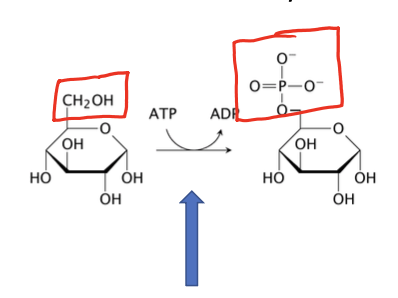
When glucose is converted to G6P why is the C6 phosphorylated?
Phosphate is added on the C6 because the primary alcohol is the most reactive and the least hindered
Why is the first step of glycolysis phosphorylation?
Phosphorylation traps glucose inside the cell since GLUT transporters only recognize free glucose to move out of the cell and negatively charged molecules cannot diffuse out of the cell membrane
The transfer of a phosphate onto glucose in the first step of glycolysis is coupled to
the hydrolysis of ATP (cosubstrate) to make overall reaction exergonic
What is used for hydrolysis instead of ATP for energy in some reactions and why?
Acetyl CoA because its thioester bond can be used for high energy and the thirster conserves ATP energy
NAD+
-Can accept two electrons at a time in the form of hydrides to bring to the ETC to regenerate ATP
-Can be derived from niacin and is a cosubstrate for many dehydrogenases
FAD
-Derived from Vitamin B2 and is a cosubstrate for many dehydrogenases
-Accepts one electron at a time in the form of hydrides
-quinone (oxidized) → semiquinone (one electron transferred) → hydroquinone (two electrons accepted)
-In semiquinoine radicals combine to make bond
Substrate level phosphorylation
Transfer of a phosphate from a high energy phosphorylated substrate to ADP to make ATP. The creation of ATP is endergonic so the substrate must have higher energy than this reaction to power it.
Donor ΔG must be more negative than ATP (more negative than 30.5)
Glycolysis spends ATP early then makes ____ to regenerate ATP
high energy compounds
NADH and FADH 2
donate electrons to the mitochondria in a series of redox reactions
The transfer of electrons from complex to complex in the ETC causes
many H+ to be pumped one side of the inner membrane to make a proton gradient
In order to re-establish equilibrium
H+ that build up on one side of mitochondrial membrane in the inter membrane space rush through ATP synthase to the inner mitochondrial membrane which enables it to create ATP.
What is stage 1 of glycolysis?
The energy investment phase where ATP is invested to make high energy compounds
What are the steps of the investment of energy phase in order?
Phosphorylation of Glucose by hexokinase into Glucose-6-Phosphate
Isomerization of Glucose-6-Phosphate into Fructose-6-Phosphate by Phosphoglucose isomerase
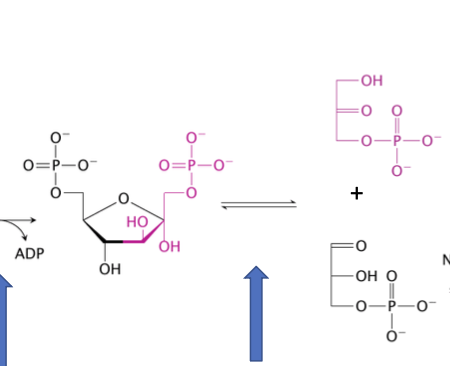
Phosphorylation of Fructose 6 Phosphate by PFK to make Fructose 1,6 Biphosphate
Cleavage of FBP by aldolase into DHAP and GAP
The isomerization of DHAP into GAP by Triose Phosphate Isomerase
Step 1 of glycolysis
Hexokinase phosphorylates the primary alcohol of the C6 of glucose

What are the substrates, cofactors/ cosubstrates, and products of Step 1?
Substrate: glucose
Cofactors: Mg2+, ATP (cosubstrate)
Products: G6P, ADP, H+
Is step 1 a control point?
Yes because it has a large negative ΔG (-27 kJ/mol) so it since its far from equilibrium it is irreversible and a control point
Why is the oxygen on the C6 of glucose phosphorylated?
It is a primary alcohol so it is the least sterically hindered and the most reactive.
Hexokinase is
nonspecific as it can phosphorylate D-glucose, D-mannose, and D-fructose the prefix “hexo” comes from the substrate
What does the kinase in hexokinase refer to?
ATP (the cosubstrate)
Mg2+ mediated phosphorylation
Magnesium neutralizes the negative charge of the oxygens on the phosphates of ATP so glucose can approach it\
Since Magnesium has a two plus charge it can neutralize two oxygens at the same time
How does Step 1 of glycolysis start?
The C6 OH of glucose is a nucleophile and appproaches ATP due to the neutralization of magnesium and it making ATP more electrophilic. The C6 OH then attacks the gamma phosphate of ATP because it is the most accessible
What kind of bond does Mg2+ make with the oxygens on the phosphate?
A non covalent bond with the oxygens.
Substrate binding to hexokinase induces
a conformational change of hexokinase with it clamping down on glucose like a baseball glove.
When the substrate binds to the active site of hexokinase
it excludes water from the active site (hydrophobic effect) which removes it as a competitive nucleophile that could fully hydrolyze the ATP cosubstrate.
How does the clamping of hexokinase on glucose increase the reaction rate of step 1?
The clamping makes sure water does not re-enter the active site
Brings the substrate and ATP close proximity and oriented so there is a higher effective concentration which increases the reaction rate
Which lab procedures does the conformational change of Hexokinase mimic?
Increasing the concentration of the reactants
Phosphoglucose Isomerase
Catalyzes the isomerization of G6P to F6P
What is step 2 of glycolysis?
Phosphoglucose isomerase catalyzes the isomerization of glucose 6 phosphate into fructose 6 phosphate
In step 2 of glycolysis what sugar changes and structure changes
The aldose (glucose) changes into a ketose (fructose) and a 6 membered ring turns into a 5 membered ring
How does the ring change in step 2 happen and which functional group switches?
Sugars are always in equilibrium between their linear and cyclic forms.
The ring opens to the linear form and the carbonyl moves from C1 to C2 and the ring closes as a 5 member ring.
Linear form: C1 → aldehyde turns into C2 ketone (F6P)
What are the steps of the phosphoglucose isomerase mechanism?
Acid catalyzed ring opening → base catalysis → case enediolate intermediate forms → acid catalysis → base catalyzed ring closure
What is step 3 of glycolysis?
Phosphpfructokinase phosphorylates primary alcohol C1 of F6P to make FBP
After Step 3 how many phosphates are there and where are they?
On FBP there are two phosphates, one on the C6-O and one on the C1-O
Step 3 is
far from equilibrium so it is irreversible and thus a control point
What is step 4 of glycolysis?
Aldolase cleaves FBP into DHAP and GAP by cleaving bond C3-C4
Which carbons of FBP are DHAP and which are GAP?
C1-C3 are DHAP (top half)
C4-C6 are GAP
What must FBP have in order for aldolase to cleave it?
A carbonyl at C2 and a hydroxyl at C4