Menstrual Disorders Pathophysiology and Pharmacology - Sharma
 Call Kai
 Learn
 Practice Test
 Spaced Repetition
 Match
 Flashcards
 Knowt Play
1/28

There's no tags or description
Looks like no tags are added yet.
29 Terms
Menorrhagia and Dysmenorrhea occur at time of
menstruation
PMS & PDD starts during
luteal phase
Menorrhagia
Heavy menstrual blood loss (>80 ml)
Prolonged menstrual bleeding (>7 days)
Menorrhagia: signs and symptoms
Fatigue and lightheadedness (due to anemia caused by blood loss),
orthostasis, tachycardia, and pallor (due to hypovolemia due to blood loss)
Menorrhagia: causes
hematological
uterine
endocrine
Hematological causes:
Von Willebrand’s Disease
Thrombocytopenia purpura
Hepatic Cirrhosis
Uterine causes:
Fibroids, adenomyosis, polyps, cancer
Endocrine causes:
Hypothyroidism (rare)
Menorrhagia: drug therapy
NSAIDs
COC
Levonorgestrel-releasing IUD
GnRH agonists
Tranexamic acid (TXA)
Menorrhagia: drug therapy
NSAIDs
Mefenamic acid, ibuprofen, naproxen
inhibit COX enzyme → reduce uterine prostaglandins → reduce uterine inflammation and contractions → reduced bleeding
Menorrhagia: drug therapy
COC
estrogen inhibits FSH & LH to inhibit follicle development, progesterone induces cell differentiation → reduced prostaglandins → reduced bleeding
Menorrhagia: drug therapy
Levonorgestrel-releasing IUD
inhibition of endometrial proliferation → endometrial atrophy → reduced bleeding
Menorrhagia: drug therapy
GnRH agonists
binds to GnRH receptors → release of FSH and LH
continuous stimulation of receptors cause internalization → shuts down FSH and LH release (shuts down menstruation)
Tranexamic acid (TXA)
antifibrinolytic drug (facilitates clotting and reducing bleeding)
synthetic analog of lysine and acts as plasmin blocker
reversible binder
Dysmenorrhea:
pelvic pain occuring w/ —
symptoms last —
onset or just prior to menstruation
1 - 3 days
Dysmenorrhea:
primary
secondary
Primary dysmenorrhea: Pain in the setting of normal pelvic anatomy and physiology
Due to low estrogen and progesterone → prostaglandins and leukotrienes → pain :(
Secondary dysmenorrhea: some pelvic pathology
Causes:
Cervical stenosis
Endometriosis
Pelvic infections, pelvic congestion syndrome
Uterine or cervical polyps, uterine fibroids,
Genital tract outflow obstructions, and pelvic adhesions
Dysmenorrhea: drug therapy
NSAIDs (naproxen and ibuprofen):
inhibit synthesis of prostaglandins
COC
inhibit proliferation of endometrial tissue
Depot medroxyprogesterone
inhibition of generation of prostaglandins and leukotrienes
Levonorgestrel releasing IUD
inhibition of generation of prostaglandins and leukotrienes
Premenstrual Syndrome (PMS)
Premenstrual dysphoric disorder (PMDD)
severity

PMS symptoms
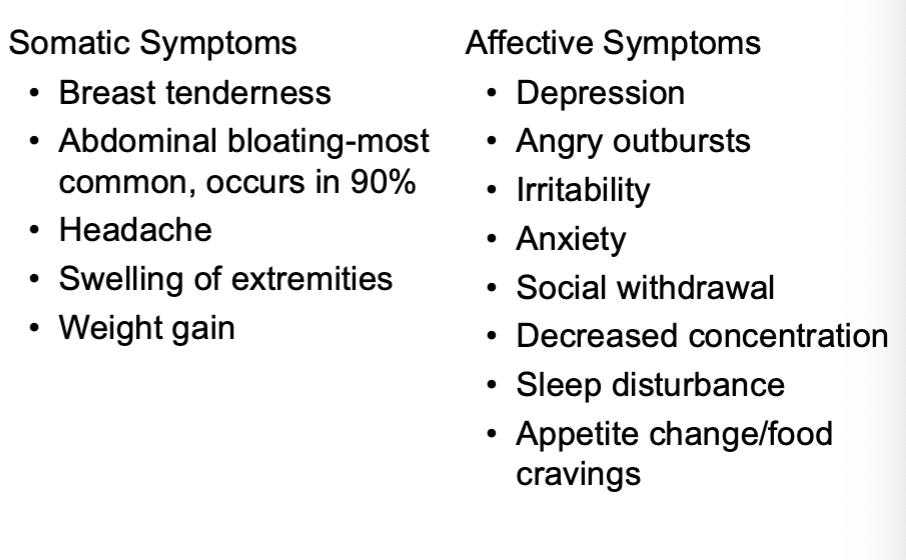
PMDD symptoms
mood swings
irritability
depressed
anxiety
decreased interest
difficulty concentrating
lethargy
change in appetite,
hypersomnia or insomnia
ovewhelmed
breast tenderness, joint/muscle pain, bloating, weight gain
PMDD pathogenesis
never occur —
interconnected theories
Never occur before menarche, during pregnancy or after menopause,
interconnected theories
Genetic susceptibility or high sensitivity of certain brain structures/functions to hormonal changes
Allopregnanolone, a progesterone metabolite is strongly implicated in the pathogenesis of PMDD. It binds to GABA receptors which, in turn, interferes with the function of neurons containing serotonin
neurotransmitter
Estrogen interferes with the synthesis, metabolism and, autoreceptor-mediated release of serotonin
PMS management
nonpharm
lifestyle changes
nutritional supplements
Non-pharmacological Approaches
Supportive therapy
Lifestyle changes
Frequent exercise
Dietary modifications
Nutritional supplements
Magnesium sulfate 360 mg/d, Calcium 1200 mg/d, Vitamin E 400 IU/d, Vitamin B6 100 mg/d
PMS, PMDD: drug therapy
NSAIDs
Anti-depressants – related to mood symptoms
SSRIs (Citalopram, Escitalopram, Fluoxetine or Sertraline)
Buspirone
Spironolactone - bloating
Bromocriptine -mastalgia (breast pain)
Ovulation suppression
CHCs
GnRH agonists (e.g. Lupron) to suppress ovulation
polyendocrine metabolic ovarian syndrome (PMOS)
Clinical or biochemical hyperandrogenism
High free or bound testosterone
High androstenedione
Acne, male pattern baldness, hirsutism
PMOS causes
Increased levels or activity of CYP17, 17-βHSD leading to increased testosterone synthesis
Insulin resistance and hyperinsulinemia
Hyperinsulinemia increases testosterone synthesis and decreases sex hormone binding protein synthesis, thus increasing levels of free circulating testosterone
Obesity
Promotes insulin resistance, hyperinsulinemia, and adipocyte-mediated formation of androgens
PMOS: pathophysiology
increased pulse frequency GnRH
increased LH → increased testosterone, theca cells → hyperandrogenism (acne, hirsutism, baldness)
reduced FSH → reduced estrogen → follicuologenesis inhibiton and no ovulation → no corpus lutem, lack of progesterone
accumulation of follicles containing unreleased ova leading to
polycystic appearance of ovaries and oligo- or amenorrhea
PMOS management
lifestyle changes
add metformin ± myoinositol along with add, managment for following conditions
hirsutism → shaving, laser, OCP, androgen receptor blockers
menstrual dysfunction → progesterone or combined OCP
acne → topicals ± antibiotics, isotretinoin (if severe)
infertility → Clomifene citrate and/or gonatrophins, surgery, in vitro fertilization

endometriosis
Presence of endometrial tissue outside the uterus in the peritoneum
Genetic predisposition
endometriosis:
retrograde flow theory
Retrograde flow of menstrual fluid and endometrial tissue through fallopian tubes into peritoneal cavity
endometriosis:
colomic metaplasia theory
Residual embryonic cells of the Wolffian or Mullerian ducts persist and develop into endometrial tissue that respond to estrogen
or mesenchymal cells transdifferentiate into endometrial cells - the transdifferentiation is thought to be mediated by autoimmune factors
endometriosis:
endometrial tissue responds to —
endometrial tissue bleeds just like —
intraperitoneal blood causes —
Endometrial tissue responds to cyclic estrogen concentration varying during the menstrual cycle
Endometrial tissue bleeds just like uterine endometrium when hormone levels drop
Intraperitoneal blood causes influx of WBCs initiating a perpetual cycle of inflammation, ROS formation and lipid peroxidation and scar formation