class 14 RNAi
 Call Kai
 Learn
 Practice Test
 Spaced Repetition
 Match
 Flashcards
 Knowt Play
1/9

There's no tags or description
Looks like no tags are added yet.
10 Terms
where do siRNAs come from
usually exogenous dsRNA
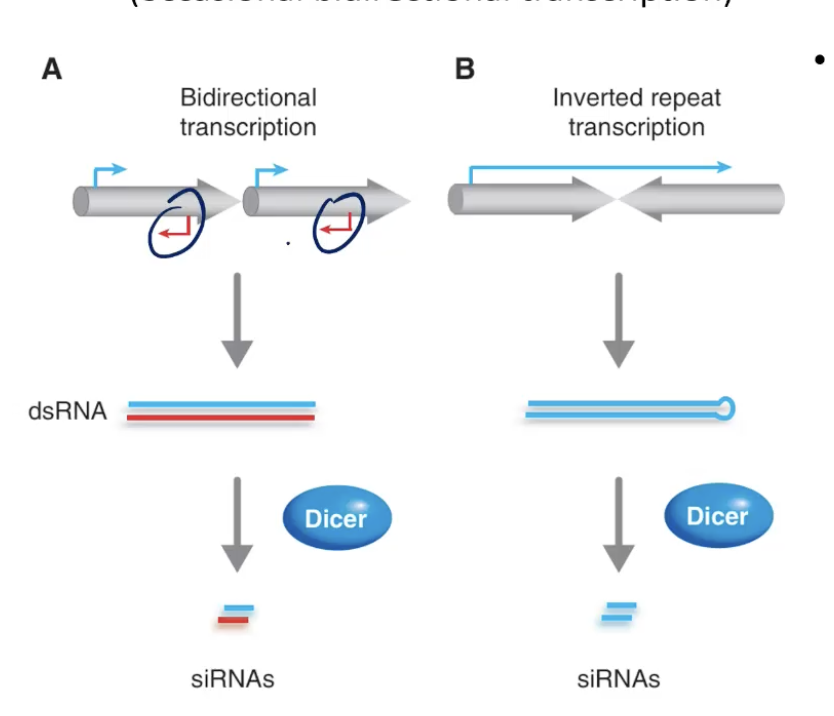
but, can also derive from double transcription of endogenous DNA sequences, transposons are common
siRNA processing
no DROSHA, just DICER.
cut into 20-25 bp pieces
forms si si* double stranded complexes (fully complementary) that are then similarly sorted by argonautes.
siRISC
fully complementary binding to mRNA
the RISC itself splices the mRNA
mechanism of action for siRNAs
direct mRNA cleavage
also heterochromatin formation
endo-siRNAs
endogenous
target transposable elements
transposons can have antisense transcripts/promoters that allows for bidirectional transcription.
cells use endosiRNAs to defend from transposons
can also have a stretch of DNA in series that have inverted repeates that when directly transcibed can form RNA moleculees that direcly base pair internally.
viral origin siRNAs
when the cell recognizes an RNA virus has invaded, it can develop its own siRNA against that virus to neutralize it.
why can miRISCs not cleave but siRISC can
there are for Agos, only 2 can do cleavage.
siRISCs are only made of Ago2, which miRISC can hae any of the 4
even if an miRISC has an Ago2, still can’t cleave bc. it is not an exact sequence match like in an siRISC
why is dsRNAi more potent than ssRNAi
because the dsRNA that you itnroduce is already a double stranded complemetn of your sequence of itnerest, can be directly DICEd and immediately done. apprently can be more efficient.
what region of mRNA do siRNAs bind to
anything
this is in contrast to miRNAs, only 3’ UTRs
how do siRNAs regulate transcriptional regulation
centrometere has dh and dg genes that can be transcribed to form dsRNAs that can bind to a nucelar version of RISC, which then base pair with complementary dh or dg target locus, to trigger heterochromatin formaiton at centromeres.