Virology- Exam #1
 Call Kai
 Learn
 Practice Test
 Spaced Repetition
 Match
 Flashcards
 Knowt Play
1/168

There's no tags or description
Looks like no tags are added yet.
169 Terms
Which term is used to describe the viral nucleic acid genome enclosed within a protein coat?
a. nucleocapsid
b. protomer
c. envelope
d. capsomer
e. capsid
a. nucleocapsid
The interaction or attachment of naked viruses with their host cells is mediated by:
a. host cells encoded glycoproteins
b. the polysaccharide layer
c. capsid proteins
d. virally encoded glycoproteins
c. capsid proteins
Which shape would you expect a poxvirus to exhibit?
a. helical
b. complex
c. spherical
d. pleomorphic
b. complex
From which organism was the Mimivirus originally isolated from?
a. Legionella bacteria
b. Green algae
c. Amoeba
d. Insects
e. Tobacco leaves
c. Amoeba
Which of the following is a trait that differs between viruses and virophages?
a. residence within amoeba
b. genome type (DNA vs. RNA)
c. capsid shape
d. genome size
d. genome size
Which viral genome is transcribed into mRNAs by a DNA-dependent RNA polymerase?
a. dsRNA
b. +ssRNA
c. dsDNA
d. +ssRNA
c. dsDNA
What does a multipartite virus have multiples of that some other viruses do not?
a. capsid protein subunits
b. capsid protein types
c. nucleic acid molecules
d. genomes
e. capsids
c. nucleic acid molecules
One nucleotide strand of DNA molecule has the base sequence illustrated below:
5′-ATTGCTACGG-3′
Give the base sequence of the complementary DNA nucleotide strand.
5′-CCGTAGCAAT-3′
If the sequence of one strand of a DNA molecule was 5′ ATGGCAT 3′, the complementary strand sequence would be
3′ TACCGTA 5′
The following diagram represents DNA that is part of the RNA-coding sequence of a transcription unit. The bottom strand is the template strand. Give the sequence found on the RNA molecule transcribed from this DNA and identify the 5′ and 3′ ends of the RNA.
5′–ATAGGCGATGCCA–3′
3'-TATCCGCTACGGT-5'
5′–AUAGGCGAUGCCA–3′
This is the coding sequence of DNA. What is the corresponding mRNA?
5' CGTACGTATGCT 3
5' CGUACGUAUGCU 3'
MS Eukaryotes...
a. are monocistronic
b. are polycistronic
c. produce only one protein types per mRNA
d. often produce multiple protein types per mRNA
a. are monocistronic and c. produce only one protein types per mRNA
What is the function of the spliceosome?
a. Removal of exons and joining of introns
b. Removal of poly(A) tail
c. Removal of the 5’ cap
d. removal of introns and joining of exons
e. removal of the 5’ cap, poly(A) tail and introns
d. removal of introns and joining of exons
The calcitonin gene can encode either the hormone calcitonin or a protein called calcitonin-gene-related peptide depending on which 3′ cleavage site is used. In the thyroid gland, cleavage and polyadenylation occurs after the fourth exon leading to calcitonin production. However in the brain, the exact same transcript is cleaved after the sixth exon yielding calcitonin-gene-related peptide. This is an example of
a. multiple capping
b. alternative RNA processing
c. polyadenylation
d. environmental influence
e. mutation
b. alternative RNA processing
Which of the following BEST describes alternative splicing?
a. A pre-mRNA with two or more cleavage and polyadenylation sites present ultimately leads to the formation of several different proteins from the same gene sequence.
b. Spontaneous mutations can occur within the pre-mRNA that ultimately lead to the formation of several different proteins from the same gene sequence.
c. Under certain conditions, only portions of the gene are transcribed, which yield variant pre-mRNA transcripts that ultimately lead to the formation of several different proteins from the same gene sequence.
d. A single pre-mRNA can be spliced in multiple ways that ultimately lead to the formation of several different proteins from the same gene sequence.
e. Every other exon is alternately deleted and ligated to generate a functional and mature mRNA for translation.
d. A single pre-mRNA can be spliced in multiple ways that ultimately lead to the formation of several different proteins from the same gene sequence.
What would be the result of deleting the 5′ cap from a eukaryotic pre-mRNA?
a. Transcription would continue past the end of the gene-coding sequence, resulting in a longer pre-mRNA transcript.
b. Translation would continue past the end of the gene-coding sequence, resulting in a longer pre-mRNA transcript.
c. Transcription would not occur, as the transcription factors would not be able to bind to the promoter.
d. Translation would not occur, as the ribosome would not be able to bind to the pre-mRNA transcript.
e. Replication would not occur, as DNA polymerase would not be able to bind to the DNA at the origin of replication
d. Translation would not occur, as the ribosome would not be able to bind to the pre-mRNA transcript.
A geneticist induces a mutation in a cell line growing in the laboratory. The mutation occurred in one of the genes that encodes proteins that participate in making the poly(A) tail of eukaryotic mRNA. What will the immediate effect of this mutation be on RNA molecules in the cultured cells?
a. The cellular nuclease would degrade mRNA more quickly in the cytoplasm.
b. Longer than normal proteins would be produced inside the cell.
c. The defect from the mutation would not affect the cell at all.
d. A large number of mRNA would have stalled ribosomes attached to them.
e. There would be unusually high amount of protein degradation occurring in the cytoplasm.
a. The cellular nuclease would degrade mRNA more quickly in the cytoplasm.
For the gene shown below, which would certainly contain at least part of the 5′ untranslated region? Each E refers to an exon, each i refers to an intron, and the numbers identify which is which.
DNA
5' E1, i1, E2, i2, E3, i3, E4, i4, E5 3'
mRNA encoded by this DNA:
5' E1, E2, E3, E4 E5 3'
a. intron 1
b. intron 4
c. exon 1
d. exon 2
e. exon 5
c. exon 1
For the gene shown below, which would certainly contain at least part of the 3′ untranslated region? Each E refers to an exon, each i refers to an intron, and the numbers identify which is which.
DNA
5' E1, i1, E2, i2, E3, i3, E4, i4, E5 3'
mRNA encoded by this DNA:
5' E1, E2, E3, E4 E5 3'
a. intron 1
b. intron 4
c. exon 1
d. exon 2
e. exon 5
e. exon 5
The reading frame of a nucleotide sequence is established by
a. a promoter sequence.
b. a start codon.
c. an initiation factor
d. the varying length of reading frame.
e. the universality of codon system.
f. a transcriptional start site.
b. a start codon.
A nontemplate strand of DNA has the following base sequence. What amino acid sequence will most likely be encoded by this sequence?
5′-ATGATACTAAGGCCC-3′
Met-Ile-Leu-Arg-Pro
An mRNA looks like this.
5'-AUGACC-3'
The last amino acid added was Methionine. The next amino acid added to the growing polypeptide chain will be
Threonine
In translation, the template sequence is read through in which direction?
5’ → 3’
The main purpose of the early viral genes that are expressed is to
a. synthesize viral envelope
b. to uncoat the virus
c. to cause disease
d. take over the host machinery
e. make the protein coat
d. take over the host machinery
The term tissue tropism is most closely related to...
a. viral isolation
b. genome type
c. viral transmission
d. host range
d. host range
Why do cells (often) retain cellular receptors? Cellular receptors...
a. ...are inserted by viruses
b. …help viruses enter the cell
c. ...have functions that aren't related to viruses
d. ...are encoded by viruses
c. ...have functions that aren't related to viruses
When present, receptors are found...
a. Always on the inside of the virion
b. Always on the outside of the virion
c. Always on the inside of the cell
d. Either on the inside or outside of the cell
e. Always on the outside of the cell
e. Always on the outside of the cell
Low pH is most often required for uncoating in viruses that...
a. have DNA genomes
b. have RNA genomes
c. enter without endosomes
d. enter in endosomes
d. enter in endosomes
A DNA virus that uses the host's replication machinery...
a. may replicate only in the cytoplasm
b. may replicate only in the nucleus
c. may replicate in the cytoplasm or the nucleus
b. may replicate only in the nucleus
Monopartite viruses have...
a. only one genome, rather than two identical copies
b. only one nucleic acid molecule, which may be single or double-stranded
c. single stranded genomes, whether RNA or DNA
d. only one capsid, rather than two linked capsids in the same envelope
b. only one nucleic acid molecule, which may be single or double-stranded
Which MUST have a nucleic acid polymerase in its virion?
a. +ssRNA viruses
b. -ssRNA viruses
c. ssDNA viruses
d. dsDNA viruses
b. -ssRNA viruses
Which of the following types of viruses always has a genome that goes through both RNA and DNA forms at some point in its life cycle?
a. +ssRNA
b. -ssRNA
c. dsDNA
d. ssDNA
e. Retroviruses
e. Retroviruses
Which is always produced as a part of every viral life cycle?
a. DNA
b. +ssRNA
c. -ssRNA
b. +ssRNA
Which is more damaging to the cell?
a. budding
b. lysis
c. both are equally damaging
b. lysis
Cells do not contain _______________ that can be used for viral replication.
a. DNA-dependent DNA polymerase
b. DNA-dependent RNA polymerase
c. RNA-depdendent DNA polymerase
d. RNA-dependent RNA polymerase
c. RNA-depdendent DNA polymerase and
d. RNA-dependent RNA polymerase
What did Edward Jenner inject into his test subjects in an attempt to induce immunity against the smallpox virus?
a. Heat-killed smallpox virus
b. Infectious fluid from a cowpox pustule
c. Smallpox DNA
d. Dried nervous tissue from infected cows
b. Infectious fluid from a cowpox pustule
Which of the following is an example of direct transmission?
a. Bite from an infected mosquito
b. Touching a contaminated doorknob
c. Sexual contact with an infected individual
d. Ingestion of contaminated water
c. Sexual contact with an infected individual
Which of the following is considered the most contagious viral disease in humans?
a. polio
b. influenza
c. SARS
d. Measles
e. SARS-CoV-2
d. Measles
A group of viruses believed to have evolved from a common ancestor is known as a:
a. family
b. clade
c. species
d. sibling
b. clade
ACE-2 is the cellular receptor for SARS-CoV-2. This molecule probably...
a. evolved to allow the virus entry.
b. is on the surface of the virus.
c. is in the interior of the virus.
d. has a normal function unrelated to viral infections.
d. has a normal function unrelated to viral infections.
The largest viruses known are...
a. larger than any free-living bacteria.
b. larger than some free-living bacteria.
c. larger than all free-living bacteria.
b. larger than some free-living bacteria.
The genetic material of viruses can be... (Choose ALL that apply)
a. ssDNA
b. dsDNA
c. ssRNA
d. dsRNA
all of the above
Which has been suggested as a method of controlling human disease?
a. virophages
b. virocins
c. viropaths
d. bacteriophages
d. bacteriophages
Which of the following might be a fomite? (Choose ALL that apply)
a. handshakes
b. airborne sneeze droplets
c. pencils
d. eyes
e. mouths
f. mosquitos
c. pencils
Which is a common cause of viral pathogenesis? Choose ALL that apply.
a. cell destruction
b. apoptosis
c. immune response
d. inhibition of normal cellular functions
all of the above
What are the characteristics of life?
metabolism
capable of reproduction
adapt to their environment
change behaviors/physiology when the environment changes
evolution
take in energy
basic unit of life = cell
What is a virus?
genomic material and protein capsid (not always DNA genomes- sometimes RNA)
What are the characteristics of a virus?
not always DNA genomes- often RNA
need a host cell to reproduce = obligate intracellular parasite
may have envelopes
not cells / acellular
virion = forms when not in cell
alive when infecting a cell (not when a virion)
What was the original (not today’s) definition of a virus?
something that is infectious and not filterable (0.2-0.3 μm filters); not filterable = really small
pass through membranes that trap bacteria
What was the first virus described?
the plant virus Tobacco Mosaic Virus (TMV)
1898- called them contagium vivum fluidum
What is an example of a virus that disproved the original definition of a virus?
mimivirus because bigger than expected! (aka filterable)
0.75 μm! Captured in filters and bigger than many bacteria!
infects amoeba after they try to eat it
there are viruses of mimiviruses!
What is a virophage?
“virus eater” = viruses that infect viruses
What are bacteriophages?
viruses of bacteria
discovered early 20th century
plaque assays allowed study
How were animal viruses detected back in the day?
transmission electron microscope (1930s)
modified plaque assay (1950s)
What are shared attributes of viruses?
genetic material
DNA or RNA, ss or ds
sometimes sufficient for infection
protein capsid
(often) viral envelope
surrounds the rest of the virus
easily destroyed
dependence on host
uses host’s ribosomes to construct new virions
host factors: proteins a host needs for the virus to replicate properly
receptor-binding proteins
= recognize & attach to host
receptors: molecules on the surface of the host cell
typically, glycoproteins or glycolipids on cell surface
receptors & host factors → host range & tissue tropism
tissue tropism: which tissues in a body a virus can affect
Describe the Lytic Phage Life Cycle.
lytic: break apart
1. attachment
2. penetration- virus inserts DNA into cell
3. biosynthesis (factory construction)- making biological components for new genomes
4. maturation- start actually producing new virions
5. lysis (release)- lyse the host

Why do viruses matter?
phage therapy = can be used to treat bacterial infections
can be used to produce vaccines
they make people sick (ex: cancer)
study evolution
drive host evolution
they evolve fast, so can overcome our immune responses
economic issues
important to ecosystems
human infections
maintain diversity
cause sex?
What are some examples of why human infections are why viruses matter?
165,000 deaths/year from measles alone
26.8% prevalence HPV in women → cancer
Describe COVID-19.
caused by coronavirus called SARS-CoV-2 (Severe Acute Respiratory Syndrome- Coronavirus-2)
COVID-19 is the disease; like the relationship between HIV and AIDS)
Describe coronaviruses.
cause some colds
contained outbreaks
ex: SARS-CoV, which started in China and was contained
ex: MERS-CoV (Middle East Respiratory Syndrome)
Describe smallpox.
appeared 10,000 BC
pustules- blinded, disfigured, killed (15-45%)
epidemics associated with decline of roman empire
1763: Siege of Fort Pitt
used smallpox to kill most of the tribe
surrounded by native americans
Describe the steps leading to the smallpox vaccination.
survivors of smallpox immune
from 400 BC, (sometimes) survivors nursed the sick
variolation: inoculation of healthy individuals with material from a smallpox pustule
introduced to America by Ohesimus, a slave
continental army inoculated by George Washington’s disease
cowpox: didn’t cause death but did cause resistance to smallpox
counts as a vaccine

Describe the prevalence of smallpox today.
smallpox eradicated
stocks in Moscow, Atlanta (Centers for Disease Control)
should we destroy them?
2017- horsepox (a relative) made from scratch from DNA for 100K in 6 months
smallpox genome is published
What can phage therapy be used for?
MRSA = Methicillin-resistant staphylococcus aureus
What do viruses have to do with bacteriophages and marine ecology?
15-25x more than bacteria in fresh or seawater (103 total)
nutrient cycling
kill bacteria, release nutrients
Do viruses maintain diversity within or between species? HOW?
both!
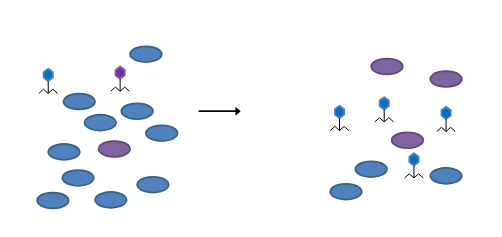
How do viruses (possibly) cause sex?
sex is costly, because males are a waste of resources
2-fold cost of sex
sex creates variation
but why is this important?
Red Queen Hypothesis: we are constantly coevolving with pathogens, may favor sex to ensure some individuals have higher fitness combinations (which can then spread)
compared to other adaptive challenges, those posed by pathogens are strong and constantly changing, because pathogens evolve quickly
no progress
no generically better organisms
but CONSTANT selection for change (because constant evolutionary mismatch)

Describe viral evolution.
quick
evolution: allele frequency change in a population over time
reproduction is very fast compared to us
under strong selection to infect (stronger than that of hosts to resist)
large populations → lots of mutations (some of which are adaptive) and selection is strong relative to genetic drift
occurs even within body
tissue tropism (ex: HIV → AIDS)
drug resistance
What are phylogenies?
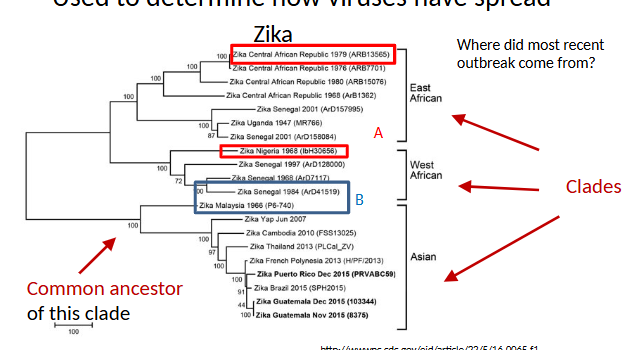
phylogenies: used to determine how viruses have spread
clade: common ancestor of a group and all of its descendants
common ancestor
trace back to most common ancestor
further back = more distantly related
pic: red is more closely related than blue
Why/how are some virus genes similar to ours?
viruses acquire and donate genes from/to hosts
swap genes with each other as well
homologs: genes that are similar due to shared ancestry
Where did viruses come from?
unclear!
may have arisen many times over tree of life
some evidence that many of the RNA viruses have a viral common ancestor, perhaps holdover from early RNA-world life
non-viral obligate intracellular parasite loses genes
ex: Wolbachia
infects insects, might be used to prevent spread of mosquito-borne diseases
Do viruses aim to kill their host?
no!
What is a reservoir?
source of pathogen
may be a human body
many pathogens have animals as reservoir (ex: typically rabies is transmitted from animals to humans)
What are the steps of transmission / pathogenesis?
portal of exit
mode of transmission
portal of entry
new host
pathogenesis
What is the portal of exit?
virus leaving host
exit through:
mouth
nose
blood
sex
urine
feces
What is a mode of transmission?
virus getting to new host
fomites: inorganic object that has virus on it (ex: table)
direct contact
food
sewage
direct vs. indirect (intermediate agent)
includes vector: we will define as invertebrate carriers of disease
What is the portal of entry?
getting in new host
nose / mouth (mucous membranes)
cut;skin / break in skin
skin
top layer of cells are dead = can never be infected by a virus
needle
animal claws
eyes
What is required of the new host of a virus once the virus has entered?
new host must be susceptible!
susceptible: at risk of getting disease
“susceptible” individuals vary in how likely they are to get sick AND how likely to sustain large amounts of viral reproduction
factors:
age- old or young more vulnerable
immunocompromised
pregnancy
diseases (ex: AIDS)
allergies
genetic conditions
genetic differences in susceptibility to specific diseases
whether or not you’re vaccinated (vaccine = decreases susceptibility)
prior exposed (decreases susceptibility in most cases, but can increase in certain cases)
What is pathogenesis?
pathogenesis: when a pathogen causes disease
mechanisms:
apoptosis: triggered cell death
as cell defense
manipulated by virus
response from body
autoimmune response: misdirected, self-inflicted response
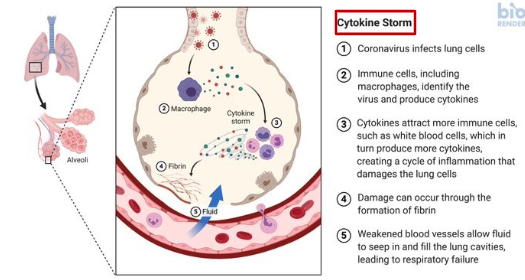
cytokine storm: cytokines cause inflammation and recruit white blood cells; too much release harms healthy tissue
method of propagation
sneezing, vomiting (increase transmission of virus affecting you)
How does SARS-CoV-2 make us sick?
destroy some cells directly
immune response too aggressive and poorly targeted
Describe the basics of nucleic acids (DNA and RNA).
antiparallel
complementary strands: bases are complementary
RNA usually single stranded
in viruses, sometimes double stranded
bases
DNA: A-T, G-C
RNA: A-U, G-C

What is the central dogma?
shows relationship between DNA, RNA, and protein
replication: DNA used as a template to make new DNA using DNA=dependent DNA polymerase (DNAP)
in viruses, could have RNA-dependent DNAP
transcription: using one nucleic acid to make another
translation: making protein using mRNA as template
requires ribosomes and RNA-dependent protein polymerase
note: focusing on eukaryotes

What is a template?
nucleic acid guide that determines the new nucleic acid or amino acid sequence
What is DNAP used for?
making DNA
Describe cell DNA-Dependent DNAPs.
in nucleus (where new DNA is made)
only in dividing cells
overall, Hi-Fi (1/109 error rate)
high fidelity, relatively low mutation rate
Describe eukaryotic gene expression. What is gene expression?
happens in particular places
gene expression: making proteins from the information in a gene
Where does transcription processing occur?
in nucleus
Where does translation processing occur?
in cytoplasm (where ribosomes are) because mRNA → protein
Describe transcription (what proteins are required, what part of mRNA is transcribed, and how much of our genome is transcribed?)
DNA-dependent RNAPs
error prone (1/104 bases)- no heritable mutation
mutation = makes a different mRNA, which may result in some malfunctional proteins
many cellular RNAPs, but RNAP II makes pre-mRNA in eukaryotes
certain DNA sequences determine transcription start site (core promoter) and transcription stop site (terminator)
most of our genome is not transcribed
only parts that are are those with core promoter and terminator
more regulation than this, too
Describe elongation (in transcription). What is the difference between the template and nontemplate strands of DNA?
one strand of DNA is template, other looks like the mRNA
template strand = noncoding strand
strand that is used by DNA-dependent RNAP to make RNA
template strand looks nothing like the mRNA we’re going to end up with
nontemplate strand = coding strand = RNA-like strand
Transcript = RNA made by transcription
RNA matches coding strand almost exactly (difference = RNA has U instead of T)

What is post-transcriptional modification? Where in the cell does it occur?
required for translation
initial transcript from transcription is called “pre-mRNA” - isn’t yet mRNA
happens in the nucleus
turned into mRNA
What modifications are made during post-transcriptional modiciation?
addition of 5’ cap
addition of poly(A) tail
splicing
What is the 5’ cap and it’s role in post-transcriptional modification?
addition of 5’ cap
added @5’ end of the pre-mRNA
“front” of mRNA
add altered guanine nucleotide to 5’ end
covalent bond = strong, permanent bond
primary function: required for translation (in eukaryotes)
ribosome initially binds here, moves downstream
downstream: in the direction transcription and translation occurs
core promoter is “upstream” of where transcription occurs
ribosome moves downstream until it reaches a signal that tells it to start translating
also important to mRNA stability
no 5’ cap = degraded by enzymes
Describe the role of the poly(A) tail in post-transcriptional modification.
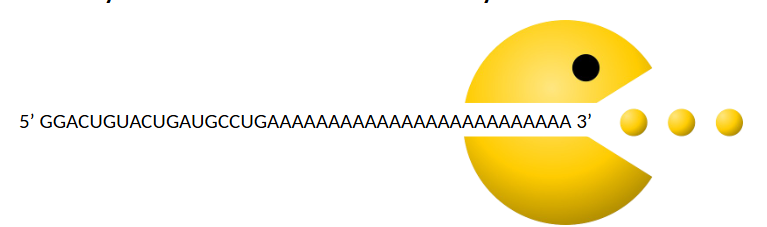
large number of adenine (A) nucleotides added to 3’ end
“tail” of mRNA
50-250 A added at 3’ end
no template
primary function: mRNA stability
how does it keep mRNA stable?
cytoplasm is filled with exoribonucleases = enzymes that destroy RNA strands from the outside (one of the ends)
when sufficient tail removed, RNA quickly destroyed but polyA tail takes a while to be removed due to binding proteins
exoribonucleases defend cell against foreign, intruding viruses
Describe the role of splicing in post-transcriptional modification.
regions of pre-mRNA are removed and then pre-mRNA spliced back together
exons and introns
exons = expressed portions of DNA or pre-mRNA
introns = intervening portions; removed by splicing
result: DNA sequence may not correspond with final protein
in picture: mRNA is much smaller than original DNA sequence might suggest

Describe alternative splicing.
when parts of the same pre-mRNA is spliced differently, they can result in different proteins
cells use this to make proteins with some parts that are shared, others different
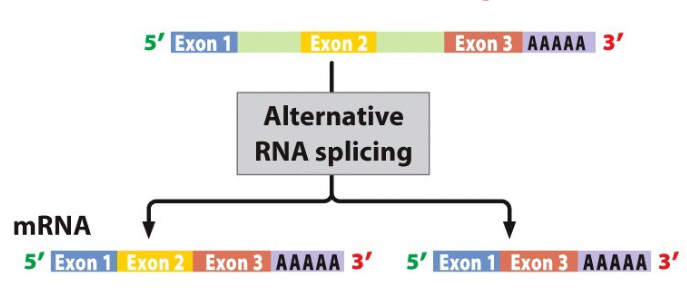
Describe the regions of an mRNA strand after post-transcriptional modification. What does it mean to be monocistronic?
UTR = untranslated regions
before start codon and after stop codon
monocistronic = each mRNA encodes only one protein

Describe the genetic code.
RNA is translated into polypeptide according to genetic code
codon = 3 base pair sequence
each encodes a single amino acid
amino acids joined by peptide bonds
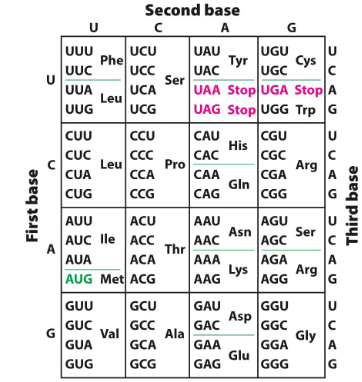
What are the steps of translation?
translation at start codon
elongation
stops at stop codon
Describe the first step of translation.
first step is initiation at start codon
requires 5’ cap
many eukaryotic translation initiation factors (eIFs)
ribosome scans to (usually) the first AUG, starts there
Kozak consensus sequence surrounding AUG is important
consensus sequence = “average” sequence
