Biochem Exam #2
 Call Kai
 Learn
Learn Practice Test
 Spaced Repetition
 Match
Match Flashcards
 Knowt Play
1/65

There's no tags or description
Looks like no tags are added yet.
Name | Mastery | Learn | Test | Matching | Spaced | Call with Kai | Chat |
|---|
No analytics yet
Send a link to your students to track their progress
66 Terms
Local _____ structures fold first. In these, ______ play an important role. Longer range interactions follow. In these, _______ plays a significant role. Then, the process continues until the entire polypeptide folds.
secondary ; ionic interactions ; hydrophobic effect
Free-energy funnel: Unfolded states have a (high/low) degree of conformational entropy, meaning (high/low) free energy. Therefore, the protein is (unstable/stable) with a (high/low) ΔG.
high ; high ; unstable ; high

Final folded/native state of a protein:
(high/low) ΔG?
(high/low) entropy?
low ; low
What are the 2 types of chaperone proteins?
Hsp70
Chaperonins
What does the Hsp70 chaperone protein do?
Binds to the hydrophobic regions on nascent (not fully synthesized) proteins and binds to misfolded nascent peptides to correct their misfolding.
What do the Chaperonins chaperone proteins do?
Fix misfolded mature proteins by fully encapsulating the protein to repair its misfolding.
What diseases can misfolded proteins lead to?
Alzheimer’s
Parkinson’s
Prion diseases (mad cow and Creutzfeldt-Jakob disease)
The healthy functional proteins tend to be (water-soluble/insoluble). The harmful functional proteins tend to be (water-soluble/insoluble).
water-soluble ; insoluble
Why do harmful functional proteins tend to be insoluble in water?
Because misfolding flips the protein inside out, exposing its hydrophobic interior.
A harmful functional protein, specifically a _____, infects any protein it comes in contact with in a cascading effect, which further causes the progression of the disease.
prion
What is the first protein to have its structure determined via X-ray crystallography?
Myoglobin
Myoglobin has a ______ structure. It has _____ subunit(s).
tertiary ; one (1 subunit → binds to 1 O2)
Both myoglobin and hemoglobin reversibly bind to _____. Therefore, they are both perfect models for studying _____.
O2 ; protein function
What protein is a tetramer of myoglobin-like subunits?
Hemoglobin (4 subunits → each subunit binds to 1 O2)
What organic molecule is a protein-bound prosthetic group found in both myoglobin and hemoglobin?
Heme
What structure does heme have?
A protoporphyrin ring structure with a bound Fe2+ atom
4 nitrogens
Fe3+ does not bind to O2

How many coordination (covalent) bonds does Iron (Fe2+) form?
6
In a regular covalent bond, each atom brings one electron. In a coordination bond, the other molecule brings both electrons (bc Fe2+ is electrophilic)
Iron (Fe2+) forms ____ coordination bonds to nitrogen atoms in the flat porphyrin ring (heme) and ____ perpendicular coordination bonds to the porphyrin.
4 ; 2

Putting it together, hemoglobin has ____ subunits, each with a heme porphyrin ring (with a Fe2+ in the center). Since Fe2+ forms ____ coordination bonds, with 1 of those reserved for binding to O2, hemoglobin as a whole reversibly binds to a total of ____ O2 molecules.
4 ; 6 ; 4
Of the 2 perpendicular bonds that Fe2+ forms, one of them is reserved for binding O2. The other is occupied by a ______ of a ______ (proximal/distal) His residue.
side-chain nitrogen ; highly conserved ; proximal

Differences between Proximal vs Distal Histidine
Proximal Histidine (His F8) | Distal Histidine (His E7) | |
|---|---|---|
Position | Directly below/closer to the heme iron | Above/farther from the heme iron on the opposite side |
Iron Interaction | Forms a direct covalent coordination bond with Fe²⁺ | Does not bond directly to the iron atom (helps O2 bind to Fe2+ in heme) |
Interaction | Anchors the heme group inside the protein pocket | Forms hydrogen bonds with bound O₂ to stabilize it |

Globins are a family of ______ proteins. Most function in O2 _____ or _____.
oxygen-binding ; transport ; storage
Globins have a highly conserved _______ structure (1 subunit), with ____ α-helical segments connected by bends (globin ____).
tertiary ; 8 ; fold

Hemoglobin has a ______ structure.
quaternary (think about it: made up of 4 subunits - myoglobin 4x)
What is a Globin motif(fold)?
helices connected by loops or turns
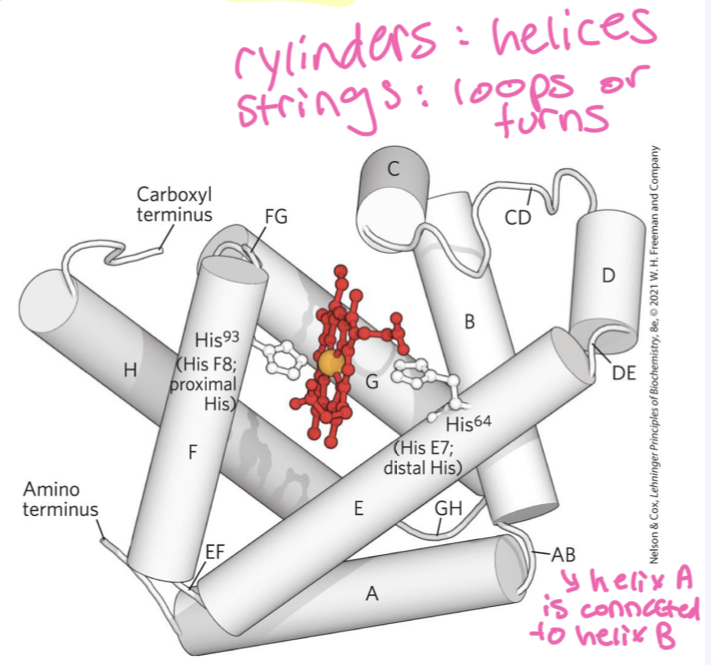
What are the 4 types of globins found in humans and mammals?
Myoglobin (monomeric)
Hemoglobin (tetrameric)
Neuroglobin (monomeric)
Cytoglobin (monomeric)
What is the difference between myoglobin and hemoglobin in terms of function?
Myoglobin: facilitates O2 diffusion in muscle tissue
Hemoglobin: responsible for O2 transport in the bloodstream
How many residues does myoglobin have and how many molecules of heme? How many helices does myoglobin have?
153 residues
1 molecule of heme
8 α-helices (labeled A through H)
______ is the link between heme and myoglobin.
Proximal His (His F8)
Proximal His (His F8) is the ______ residue from the amino acid terminal end of myoglobin.
93rd
In myoglobin, His F8 is the ____ residue in the F helix specifically.
8th
Protein (P) - Ligand (L) interactions are _______.
reversible
In P-L interactions, what is Y?
Fraction of binding sites that are bound
never reaches 1
What is KD?
Dissociation constant (in mol/L or M) → equilibrium constant for the release of ligand
KA = 1/KD, therefore we use KD bc it is easier to use M than M-1
[L] (x-axis) at which half of the available ligand-binding sites are occupied, Y = 0.5 (y-axis), corresponds to _____.
KD
Y = 0.5 → KD on graph

lower KD = (higher/lower) ligand binding affinity
higher
In the graph showing the binding of O2 to Myoglobin, Y = 0.5 (y-axis) corresponds to _____ on the pO2 (kPa) x-axis.
P50
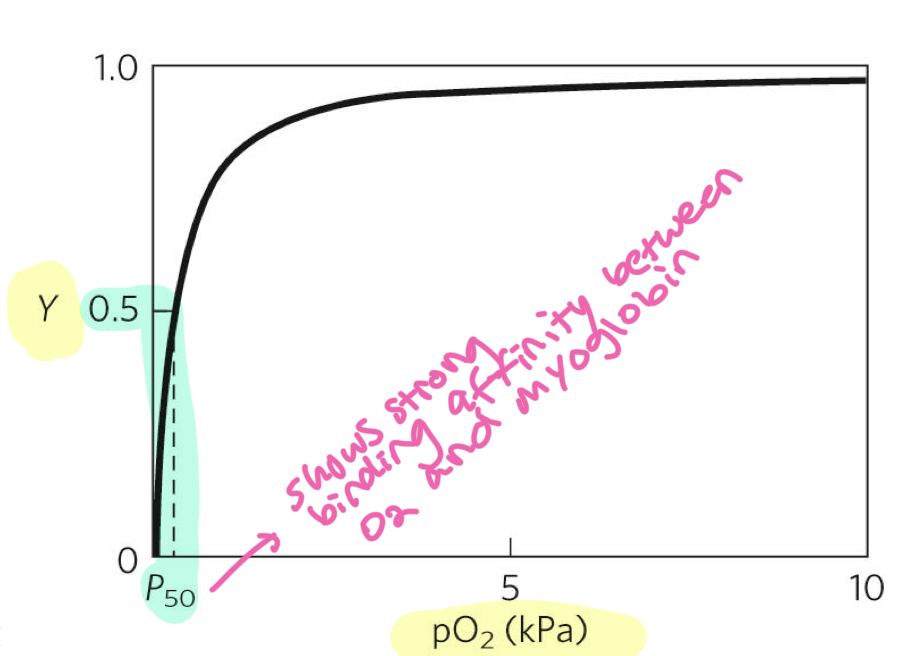
P50 is the oxygen equivalent of KD (same concept, just diff name bc it is a gas)
Myoglobin’s Distal His E7 (increases/decreases) heme’s affinity for O2.
increases
Distal His E7 acts as a ______ in myoglobin by ______ to control ligand access to the heme pocket.
gate ; rotating
The "pocket" refers to the heme pocket (also called the ligand-binding pocket), which is a deep, ______ cavity inside the myoglobin or hemoglobin protein structure where the oxygen-binding heme group
hydrophobic

Adult hemoglobin has 2 globin types: ______ and ______. How many residues are in each?
Two α chains (141 residues each)
Two β chains (146 residues each)
Important note: Alpha/beta chains are just names of the hemoglobin subunits, and both hemoglobin chains are all α-helix with no β-sheets.

Proteins with very different amino acid sequences can fold into _____ 3D shape.
the same
Similar structure can arise from different sequences, and it’s the structure that determines function. Different sequence doesn’t automatically mean different function, as long as the fold is preserved.
What are the 2 conformations of hemoglobin?
R-state and T-state
R-state (relaxed) = O2 has a higher/lower affinity for hemoglobin
higher
T-state (tense) = O2 has a higher/lower affinity for hemoglobin
lower
Deoxyhemoglobin is the oxygen-free form of hemoglobin. What conformation is Deoxyhemoglobin in?
T-state
What is the T-state stabilized by?
A greater number of ion pairs (ionic bonds within and between its subunits), many of which lie in the α1β2 and α2β1 interface
ionic interaction between Lys and His
T = tense = more/less ion pairs = tightly locked. R = relaxed = more/less ion pairs = loose and ready for oxygen.
more ; less
During the T → R transition, there is no longer an ionic interaction between ____ and ____. The ____ and ____ subunits begin to rotate: Pocket is _____ and _____ rotates toward the center but is no longer in ion pair → structural change → functional change (can bind to O2 now).
Lys ; His ; α ; β ; narrowed ; His C3
Is the pocket more narrow in the T or R state?
R state
In the T-state, how is the porphyrin ring of heme affected?
The porphyrin ring is puckered (nonplanar) because Fe²⁺ is pulled out of the plane of the ring toward the proximal histidine (His F8).
In the R-state, how is the porphyrin ring of heme affected?
The porphyrin ring becomes planar when O2 binds, causing a shift in the position of the proximal histidine (His F8) and other residues in helix F.
This conformational change helps stabilize the R-state, which has a higher affinity for O2
Cooperative binding in hemoglobin is where oxygen binding to one site increases/decreases the affinity of the remaining sites, making it easier/harder for more oxygen to attach (domino effect).
increases ; easier
Hemoglobin has a ______ binding curve for oxygen.
hybrid sigmoid (S-shaped)

What is an allosteric protein? What is an example?
Binding of a ligand to one site affects the binding properties of another site on the same protein
Hemoglobin
What are modulators? What is an example?
Ligands that bind to an allosteric protein to induce a conformational change
Oxygen
What are the 2 types of modulators? Explain each.
Homotropic: ligand and modulator are identical
Heterotropic: ligand and modulator are not the same molecule
Which molecule is a homotropic modulator of oxygen binding to hemoglobin?
Oxygen
Why? Bc modulator = ligand
What are the 2 models that suggest mechanisms for cooperative binding? Briefly define each.
MWC model/concerted model (all or nothing): all four subunits change conformation simultaneously → ligand binds more tightly to the R-state
Sequential model (domino effect): subunits change conformation one at a time and each change increases the O2 affinity of neighboring subunits, progressively favoring the R-state.
In the sequential model, hemoglobin can have a mixture of T-like and R-like subunits, whereas the MWC model does not allow this.
Explain how hemoglobin is a hybrid between the 2 models that suggest mechanisms for cooperative binding.
The initial binding of O2 to hemoglobin begins with the sequential model because when O2 binds to the first subunit, only one subunit conformational change occurs (still in T-state)
When two or more O2 bind to the protein → R-state
It ends with the concerted model after 2 or more O2 bind to the 2nd/3rd subunit where they undergo a concerted conformational change → R-state