First half of chapter 5: Membrane Transport
 Call Kai
 Learn
Learn Practice Test
 Spaced Repetition
 Match
Match Flashcards
 Knowt Play
1/62

There's no tags or description
Looks like no tags are added yet.
Name | Mastery | Learn | Test | Matching | Spaced | Call with Kai | Chat |
|---|
No analytics yet
Send a link to your students to track their progress
63 Terms
Describe the plasma membrane structure
Structure– FluidMosaic Model
i. Lipids (bilayer)
ii. Carbohydrates (for recognition, adhesion, fluidity)
iii. Proteins (recognition, adhesion, TRANSPORT)
1. Integral
2. peripheral
Describe plasma membrane function
Selective permeability
How does the plasma membrane structure support its function
Through transport proteins:
1. channels (examples: aquaporins, ion channels)
2. Carriers (confirmational changes)
How does the plasma membrane preform its function through passive transport
Diffusion:
Osmosis(for water)
Facilitated diffusion (channels and carrier proteins)
What are the 4 types of osmosis
tonicity, isotonic, hypertonic, hypotonic
How does the plasma membrane preform its function through active transport
Ion pumps(sodium potassium, proton)
Co-transport (harness concentration of one thing to move something else)
Bulk transport(vesicles): exocytosis, endocytosis
What does it mean that the plasma membrane is a fluid mosiac model
its movable and maintains integrity
What can affect fluidity of the plasma membrane
temperature, lipid concentration (how packed together they are can make more or less fluid)
Variations in lipid composition of cell membranes of many
species appear to be adaptations to….
specific environmental conditions
Ability to change the lipid compositions in response to
temperature changes has evolved in organisms that live…
where temperatures vary
How do cells recognize each other
by binding to surface molecules, often containing carbohydrates, on the extracellular surface of the plasma membrane
Membrane carbohydrates may be covalently bonded to…
lipds (glycolipids) and proteins (glycoproteins)
Carbohydrates on the external side of the plasma
membrane vary among…
species, individuals, and even
cell types in an individual
What do integral proteins do
penetrate the hydrophobic interior of the lipid bilayer
Integral membranes span the _______ and are called ____________ proteins
membrane, transmembrane
What do the hydrophobic regions of integral proteins consist of?
one or more stretches of nonpolar amino acids, often
coiled into α helices
Where are peripheral proteins
loosely bound to the surface of the membrane
What are the six major functions of membrane proteins
Transport
Enzymatic activity
Signal transduction
Cell-cell recognition
Intercellular joining
Attachment to the cytoskeleton and extracellular matrix (EC
M)
What molecules can dissolve in the lipid bilayer of the membrane and cross it easily
Hydrophobic (nonpolar)
What molecules have a harder time crossing the membrane
polar molecules, water, sugar, ions
Transport proteins allow for what
passage of hydrophilic substances across the membrane
What are channel proteins
Transport proteins with a hydrophilic channel that certain molecules or ions can
use as a tunnel
What are aquaporins
Channel protein that facilitate the passage of water
What do carrier proteins do
Transport proteins that bind to molecules and change shape to shuttle them across the membrane (think of a revolving door)
What is a transport protein specific to?
The substance it moves
Diffusion is the tendency for molecules to
spread out evenly into the available space
Although each molecule moves randomly, diffusion of a population of molecules may be…
directional
At dynamic equilibrium, how many molecules cross the membrane?
as many molecules cross the membrane in one direction as in the other
Substances diffuse down their ___________ __________, from where it is more concentrated to where it is less concentrated
concentration gradient
Substances are affected and unaffected by which concentration gradients
Substances move down their own concentration gradient,
unaffected by concentration gradients of other
substances
The diffusion of a substance across a biological
membrane is passive transport because…
no energy is
expended by the cell to make it happen
What is osmosis
the diffusion of free water across a selectively permeable membrane
How does water diffuse across a membrane
from the region of lower solute concentration to the region of higher solute
concentration until the solute concentration is equal on both sides
What are characteristics of molecules that can easily go through the plasma membrane
small and nonpolar
What are characteristics of molecules that cannot easily go through the plasma membrane
large and/or polar
What does it mean if an animal cell is hypotonic
solute is less concentrated outside so H2O moves in, causing cell to lyse

What does it mean if an animal cell is isotonic
Solute is the same in and out, considered normal for animal cells

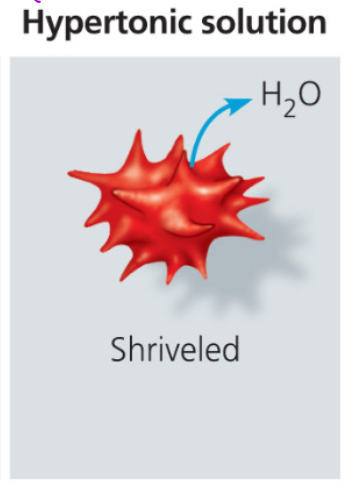
What does it mean if an animal cell is hypertonic
solute more on outside, h2o leaves cell, shriveling it up
What is tonicity
ability of surrounding solution to cause gain or lose water in the cell
What does it mean if a plant cell is hypotonic
h2o moves in causing cell to be turgid/firm, this is the normal state
What does it mean if a plant cell is isotonic
solute is the same inside and out causing flaccidity of the cell, this is ok but not ideal
What does it mean if a plant cell is plasmolyzed
h2o is coming out,the inside of the cell shrivels up. This is not good
In facilitated difussion what speeds up the passive movement of specific molecules across the plasma membrane
transport proteins
what do channel proteins provide
corridors that allow a specific molecule or ion to cross the membrane
what do channel proteins include
aquaporins, for facilitated diffusion of water
Ion channels, that open or close in response to a stimulus (gated channels)
How does active transport move substances
across membranes against their concentration gradients
What does active transport allow for
allows cells to maintain concentration gradients that differ from their surroundings
What does active transport require
energy, usually in the form of ATP
How does the sodium potassium pump work (6 steps)

What is membrane potential
the voltage across a membrane (difference in electric)
What is voltage created by
differences in the distribution of anions and cations across a membrane
What drives the diffusion of ions across a membrane
two combined forces, collectively called the electrochemical gradient
What are the two combined forces that make up the electrochemical gradient
a chemical force (the ion’s concentration gradient)
An electrical force (the effect of the membrane potential on the ion’s movement)
When does cotransport occur
when a transport protein can couple the “downhill” diffusion of a solute to the “uphill” transport of a second solute against its electrochemical gradien
What do plant cells use to drive active transport of nutrients into the cell
the gradient of hydrogen ions generated by proton pumps
How do large molecules, sush as polysaccharides and proteins cross the membrane
in bulk by means of vesicles
What does bulk transport require
energy
What are the 5 types of bulk transport
Exocytosis
Endocytosis
Phagocytosis (“cellular eating”)
Pinocytosis (“cellular drinking”)
Receptor-mediated endocytosis
What do human cells use receptor-mediated endocytosis to do
to take in cholesterol for membrane synthesis and the synthesis of other steroids
cholesterol travels in particles called
low-density lipoproteins (LDLs)
n the inherited disease familial hypercholesterolemia,what is defective or missing?
LDL receptors
In hypercholesterolemia, cholesterol accumulated in the blood, contributing to what
atherosclerosis