biomolecular exam 2
 Call Kai
 Learn
 Practice Test
 Spaced Repetition
 Match
 Flashcards
 Knowt Play
1/39

There's no tags or description
Looks like no tags are added yet.
Name | Mastery | Learn | Test | Matching | Spaced | Call with Kai | Chat |
|---|
No analytics yet
Send a link to your students to track their progress
40 Terms
Amino acids
proteins, Peptide bonds
Nucleotides
Nucleic acids phosphodiester bond
Monosaccharaides
glycosidic bond carbs
fatty acids
lipids ester bonds
epimer
diastereomer at only one chiral center
anomers
only differ at the new chiral center formed when a sugar closes into a ring
acid vs base
acid donate h and base accepts h
pKa
tells how stron an acid holds proton lower pka = stronger acid when ph = pka 5050 protonated vs deprotonatedz
zwitterion
carries botha + and - chanrge and ios over neutralexer
exergonic vs endergonic
releases free energy deltaG<0 spontanteous
needs energy deltaG>0 not spontaneouse
entropy
disorder freedom of molecule ie resonance and stuff
redox
oxidation redox moving electronsme
metabolism
all chemical reactions in a cell
catabolism= breaking, oxidative, releases energy
Anabolism = building, reductive, requires energy
what is the citric acid cycle with metabolism
it is amphibolic so both and it is the central metabolic pathway
redox
oxidation is loss of electrons and reducction is gain of electrons
oxidizing and reducing reactions

what does deltaG<0 mean
it is exergonic
what does deltaG>0 mean
endergenic
what is coupling
when the cell makes an endergonic reactiopn happen by linking it to an exergonic one so the overall deltaG is negative
do enzymes help with endergonic reactions
no they only help with physical/kinetic barriers
what is reaction rate based on
activation energy
does a spontaneous reaction mean that its fast
no
is making atp endergonic or exer
endergonic and adp is exergonic

what gives more enrgy carbs or fats
fats because the carbons are ina higly reduced form
what is activation in metabolism
coverting a metabolite into a more reactive form so a later step can proceed
ATP
immediate energy currency transfers its terminal phosphate through phosphorylation
NAD+/NADH
carries electrons such as hydride from catabolism to the ETC
FAD/FADH2
same as nad but tighet bound
NADPH
the electron donor for biosynthesis ( fatty acids) and antioxidant defense, made by the pentose phospjate pathway
coenzyme a
carries acyl groups as thioesters acetyl coa
GTP/UTP
like ATP for specific jobs
Carbohydrates
CHO, CnH2nOn and n= 3-8,
naming carbohydrates
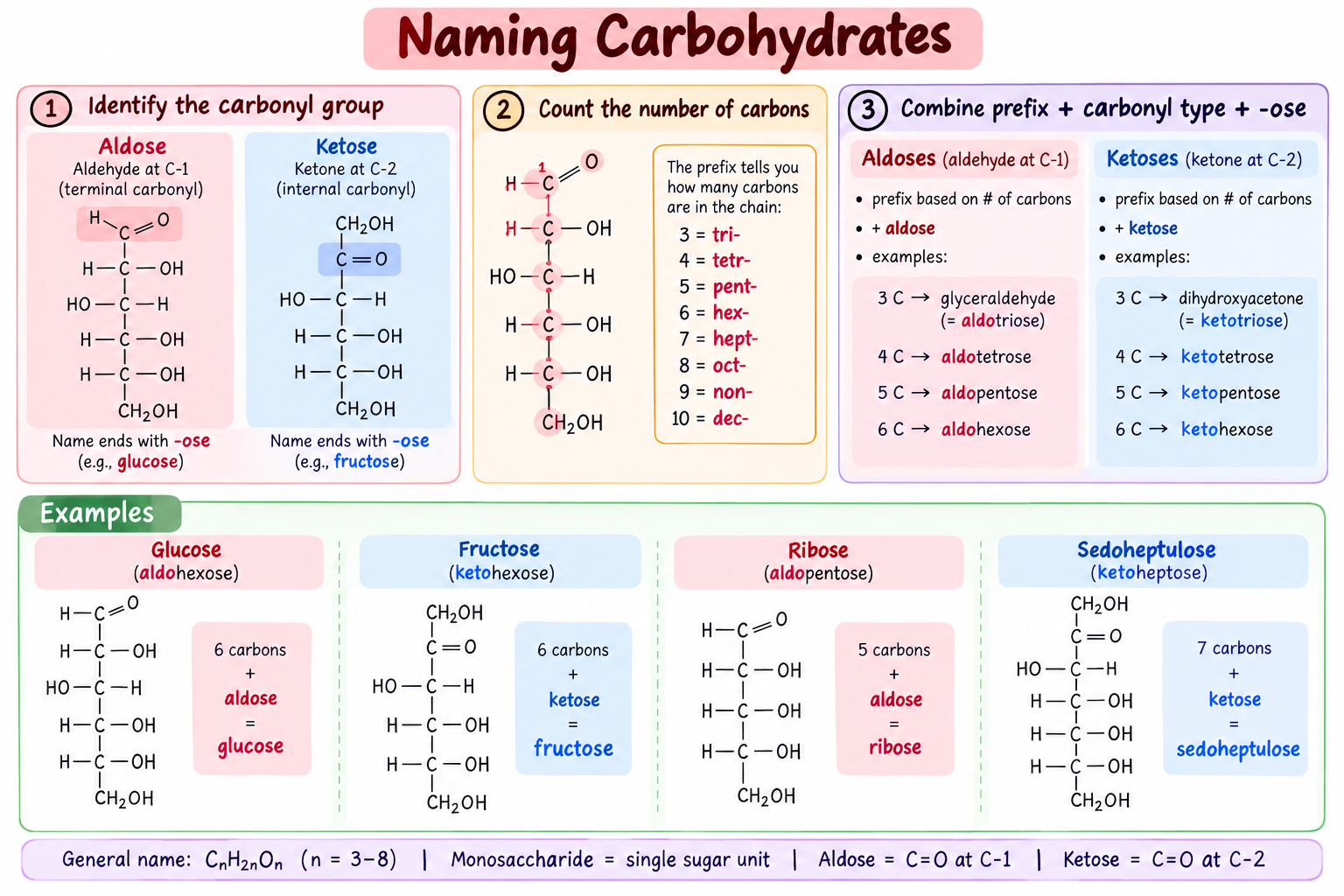
fischer projection
flattened sugar shows most oxidized carbon (aldehyde/ketone) at top
D = right and L = left

Hemiketal
ring product of ketone oh on c5 attacks c2 ketone
hemicatial
oh on c5 attacks c1 aldehyde aldehyde ring product
alpha anomeric
trans to terminal
beta anomeric
cis to terminal
What are the 8 monosaccharides cells need
D-glucose, D-galactose, D-mannose, D-xylose, L-fucose (6-deoxy-L-galactose), N-acetylglucosamine (GlcNAc), N-acetylgalactosamine (GalNAc), N-acetylneuraminic (sialic) acid (Neu5Ac/NANA)