11c — Taxonomy + Declarative vs Nondeclarative
 Call Kai
 Learn
 Practice Test
 Spaced Repetition
 Match
 Flashcards
 Knowt Play
1/16

There's no tags or description
Looks like no tags are added yet.
17 Terms

What is the taxonomy of memory systems? [Figure: taxonomy-memory-systems.jpeg]
A hierarchy dividing memory into short-term/working memory and long-term memory, with long-term memory split into declarative (explicit) and nondeclarative (implicit) memory.
What is declarative memory?
Conscious, explicit memory that you declare into consciousness — an event, an episode, or a fact.
What is nondeclarative memory?
Implicit, non-conscious memory shown by changes in performance from prior experience, without conscious recollection.
What is the double dissociation between STM syndrome and amnesic syndrome?
STM patients are impaired on short-term but intact on long-term memory, while amnesics are impaired on long-term but intact on short-term memory.

How do amnesic patients perform on the Brown-Peterson task? [Figure: amnesic-brown-peterson.jpeg]
Normally: their rate of forgetting over 30 seconds matches healthy controls, unlike PV, who forgets almost immediately when rehearsal is prevented.

What do the primacy and recency effects reflect? [Figure: serial-position-curve.png]
Primacy reflects long-term memory (early items are deeply encoded), while recency reflects short-term memory (the last items are still in the short-term store).
What does the STM/LTM comparison establish about amnesia?
The impairment is specifically in long-term memory, with short-term memory intact.
What are the types of nondeclarative memory?
Skill learning (motor, perceptual, and cognitive), priming, and classical conditioning.
What brain systems support the different nondeclarative memories?
Basal ganglia for skill learning, neocortex for priming, and cerebellum for classical conditioning.
What does declarative memory require that nondeclarative memory does not?
A bound, unitary representation that can be brought into consciousness.
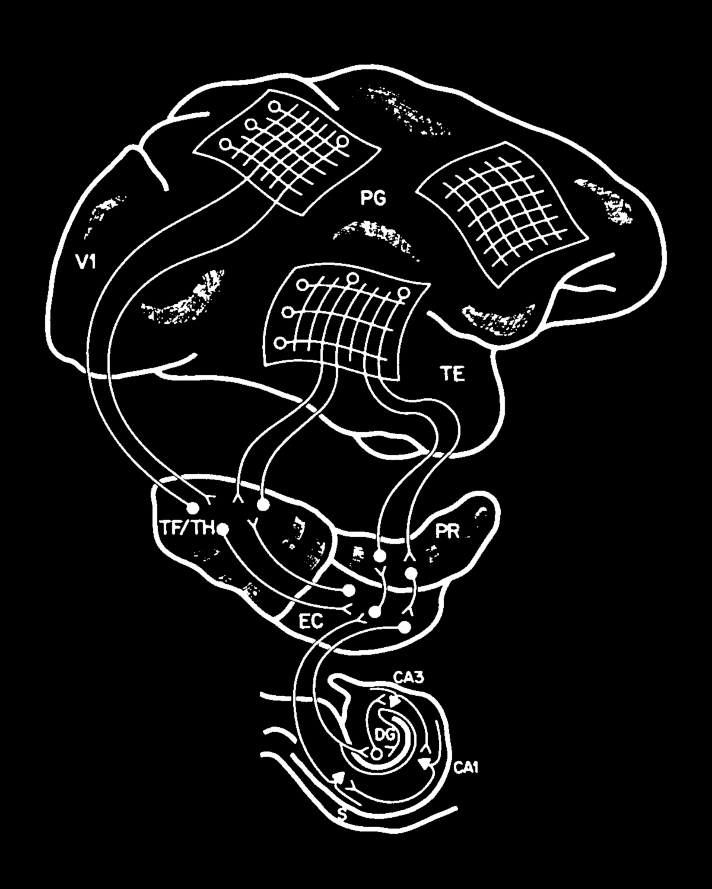
What is the medial temporal lobe system? [Figure: mtl-system-diagram.png]
The hippocampus plus the adjacent entorhinal, perirhinal, and parahippocampal cortices.
How does information flow into the hippocampus?
Neocortex → perirhinal and parahippocampal cortex → entorhinal cortex → hippocampus, then back out to the neocortex.
What is the MTL system's job in the standard model?
Binding information processed in different cortical areas into a single unified representation that can be declared into consciousness.
How does nondeclarative memory work differently?
It reflects changes within the processing systems themselves (e.g., basal ganglia, neocortex, cerebellum) rather than a bound representation.
Which parts of the taxonomy are impaired vs intact in amnesia?
Declarative memory is impaired, while all forms of nondeclarative memory — skills, priming, and conditioning — are intact.
Why was the declarative/nondeclarative distinction not obvious before H.M.?
In healthy people the hippocampus is almost always active laying down traces, so only amnesic patients revealed that it is needed only for conscious memory.
What is still unclear about the amnesic syndrome?
The exact nature of the memory impairment and what the hippocampus actually does in memory are still not fully cle