Blood, Lymphatic, and Immune System: Key Concepts and Functions
 Call Kai
 Learn
Learn Practice Test
 Spaced Repetition
 Match
Match Flashcards
 Knowt Play
1/66

There's no tags or description
Looks like no tags are added yet.
Name | Mastery | Learn | Test | Matching | Spaced | Call with Kai | Chat |
|---|
No analytics yet
Send a link to your students to track their progress
67 Terms
What are the main functions of blood?
Distribution of nutrients, oxygen, carbon dioxide, hormones, and waste products; regulation of body temperature, pH, and blood volume; and defense through clotting agents, white blood cells, and antibodies.
What is the composition of blood plasma?
90% water, 8% proteins (albumin, antibodies, fibrinogen, prothrombin), and 2% hormones, electrolytes, and nutrients.
What is hematocrit?
The ratio of the volume of red blood cells to the total volume of blood.
What are the formed elements of blood?
Red blood cells (erythrocytes), white blood cells (leukocytes), and platelets (thrombocytes).
Where are formed elements of blood produced?
In hematopoietic tissue found in red bone marrow.
What regulates erythropoiesis?
Erythropoietin (EPO) hormone levels in the blood, primarily produced by the kidneys.
What is the lifespan of red blood cells?
Approximately 120 days.
What is the structure of red blood cells?
Biconcave disks with a tough and flexible plasma membrane, allowing deformation to pass through capillaries.
What is hemoglobin and its function?
A protein in red blood cells that binds oxygen and carbon dioxide; each hemoglobin molecule can bind up to four oxygen molecules.

What are the types of white blood cells?
Granulocytes (neutrophils, eosinophils, basophils) and agranulocytes (lymphocytes and monocytes).

What is the normal range for white blood cell count?
5000 to 10,000 cells per mm³ of blood.
What is leukopenia?
An abnormally low white blood cell count, below 5000 cells per mm³ of blood.
What is the role of neutrophils?
The most common type of white blood cell, primarily involved in fighting bacterial infections.
What do eosinophils target?
Parasites and parasitic worms, and they are also involved in allergic reactions.

What is the function of basophils?
Related to mast cells, they secrete histamine and heparin.
What are monocytes and their function?
The largest type of white blood cell, aggressive phagocytes that develop into macrophages in tissues.
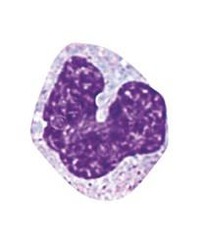
What are the roles of B and T lymphocytes?
B lymphocytes are involved in antibody production, while T lymphocytes directly attack bacteria and cancer cells.
What is the pH range of blood?
Slightly alkaline, between 7.35 and 7.45.
What is the average blood volume in adults?
About 5 liters.
What is the viscosity of blood compared to water?
Blood is denser and 5 times more viscous than water.
What initiates the release of erythropoietin (EPO)?
Detection of low blood oxygen levels by receptor cells in the kidneys.
What are the two types of leukocytes?
Granular leukocytes (neutrophils, eosinophils, basophils) and agranular leukocytes (lymphocytes, monocytes).
What is the primary role of platelets?
To aid in blood clotting.
What are the immature forms of cells called?
Blasts
What are the mature forms of cells called?
Cytes
What type of cells do myeloblasts form?
Granular leukocytes
Name three organs of the lymphatic system.
Lymph vessels, lymph nodes, tonsils
What is the function of the thymus gland?
Stores T-cell lymphocytes for immune processes

What does the spleen do?
Cleans defective cells from blood, stores platelets and white blood cells (WBCs)

Where is red bone marrow found in adults?
In the axial skeleton, shoulders, and pelvic girdles
What are the three primary functions of the lymphoid system?
Drains excess interstitial fluid, maintains blood volume, transports dietary lipids
What are the components involved in immune responses within the lymphoid system?
Antigens, B cells, antibodies, T cells
What is the role of primary lymphoid organs?
Generate lymphocytes from immature progenitor cells
What is the function of bone marrow in the lymphoid system?
Creates T cell stem cells and produces and matures B cells
What happens to baby T cells after leaving the bone marrow?
They travel to the thymus to develop and mature
What is the primary function of the thymus?
Most active during neonatal to pre-adolescent phases, begins to atrophy at puberty
What does the spleen produce?
Immune cells to fight antigens and filter out aging blood cells
What are lymph nodes?
Organized collections of lymphoid tissue that filter lymph as it circulates back to blood

What are the four elements of the lymphoid system?
Lymph plasma, lymphatic vessels, structures and organs containing lymphocytes, red bone marrow
Describe the sequence of fluid flow in the lymphatic system.
Blood capillaries → interstitial spaces → lymphatic capillaries → lymphatic vessels → lymphatic trunks or ducts → junction of internal jugular and subclavian veins
What is lymphedema?
An accumulation of lymph in the tissues caused by congenital abnormality, injury, blockage, or infection/inflammation of lymph vessels
What are lymphatic capillaries?
Small vessels that collect lymph from tissues

What are the main lymphatic trunks?
Lumbar trunks, intestinal trunk, bronchomediastinal trunks, subclavian trunks, jugular trunks, thoracic duct, right lymphatic duct
How is lymph plasma formed?
Most components of blood plasma filter through capillary walls to form interstitial fluid, which drains into lymphatic vessels and becomes lymph plasma
What happens to proteins that leave blood plasma?
They cannot return directly to blood by diffusion but can move through more permeable lymphatic capillaries into lymph plasma
What are mucosa-associated lymphatic tissues (MALT)?
Lymphoid nodules including aggregated lymphoid follicles (Peyer's patches) and tonsils
What is the primary function of the immune system?
To maintain physical health by combating harmful agents.
What are the two general types of immunity?
Innate (nonspecific) immunity and Adaptive (specific) immunity.
What is the first line of defense in the innate immune response?
Physical barriers such as skin and mucous membranes.
What are some chemical barriers in the innate immune response?
Sweat, stomach acid, and lysozymes (found in tears).
What characterizes the inflammatory response?
It is red, hot (including fever), swollen, and painful.
What type of immune cells are neutrophils?
The most abundant immune cells (60-70%) that act as phagocytes.
What is the role of eosinophils in the immune system?
They fight multicellular parasites and some bacteria, making up about 1-3% of WBCs.
What do monocytes differentiate into?
Macrophages and monocyte-derived dendritic cells.
What is the role of macrophages in the immune system?
They engulf and digest pathogens and initiate adaptive immunity by presenting antigens.
What do dendritic cells do?
They boost immune responses by presenting antigens to other immune cells.
What are natural killer cells?
Cytotoxic lymphocytes that kill defective cells without prior activation.
What is the complement system?
A system of proteins that enhances the ability of antibodies and phagocytic cells to clear pathogens.
How does the adaptive immune response differ from the innate response?
It learns and responds to specific pathogens, forming memory cells for future protection.
What are the two types of lymphocytes involved in the adaptive immune response?
B lymphocytes and T lymphocytes.
Where do B lymphocytes mature?
In the red bone marrow.
Where do T lymphocytes mature?
In the thymus, located in the mediastinum.
What is the function of helper T cells?
They are activated by antigen-presenting cells and help stimulate other immune cells.
What do cytotoxic T cells do?
They directly attack and destroy pathogens after being stimulated by helper T cells.
What happens to B cells upon activation?
They enlarge and become plasma cells that produce antibodies.
What is the role of memory cells in the immune system?
They remember previous encounters with antigens to provide a rapid response to future infections.
How do memory B cells differ from memory T cells?
Memory B cells are clones of activated B cells, while memory T cells are antigen-specific T cells that respond quickly upon re-exposure.