Chapter 8: Explaining Tastes: The Importance of Altruism and Other Non-egoistic Behaviour
 Call Kai
 Learn
 Practice Test
 Spaced Repetition
 Match
 Flashcards
 Knowt Play
1/98

There's no tags or description
Looks like no tags are added yet.
99 Terms
Main microeconomic assumption
People are rational
Ie consumers want to maximise utility, have clear preferences, have perfect info
2 definitions of rationality
Present aim standard
Self-interest standard
Present aim standard rationality
Rational if you efficiently pursue whatever goals/preferences you currently have, regardless of whether they make sense.
Ie goal = selfdestructive behaviour → pursue it in the most efficient way
Aims are not questioned (even if rly stupid)
Self-interest standard rationality
Rational if acts align with their own narrow material interests.
Ignores motives like altruism
Which standard does traditional rational choice theory vs economists IRL use?
Traditional rational choice theory: present-aim standard (preferences aren’t questioned)
Economists: self-interest standard
Criticism of present-aim standard
Any behaviour can be explained by inventing a preference for it, making the model unfalsifiable
Model explains everything → explains nothing

Why is self-interest an incomplete model of behaviour?
People have other motives / preferences:
Altruism
Public spirit
Fairness
Why does the self-interest model predict abt voting for elections + why?
People won’t vote
Bc has an opportunity cost (time + effort)
+ probability of one vote changing the election outcome is v small.
→ expected material benefit is virtually zero.
Why do people vote despite this?
Voting can provide utility (regardless of outcome)
Eg if preference for public spirit
→ incorporate non-self-interested preferences into the rational choice model

What determines whether Mary votes? | Whether the utility benefit of voting exceeds its opportunity cost. |

Can monetary incentives can influence behaviour even when people have non-self-interested preferences?
Yes
Australia = higher voter turnout → don’t vote = pay a fine
Altruism
Valuing another person's wellbeing, even at a personal cost
Getting satisfaction from improving someone else's wellbeing
How does the rational choice model incorporate altruism
Allows people to care about other people's income.
How are altruistic preferences represented?
Indifference curves over own income and another person's income.

What is the optimal income transfer condition? | MRS = 1, equal to the absolute slope of the budget constraint. |
When will an altruistic person give money? | When their MRS exceeds the cost of transferring money. |
What is a corner solution in the giving example? | Giving nothing because the person doesn't value transferring money enough. |
If Franny values both her own income and Zooey's income, what do her indifference curves look like?
Downward sloping (-ve slope): she is willing to sacrifice her own income to increase Zooey's.
Diminishing MRS: the more income she has, the more she is willing to give up to help Zooey.

Franny example:
Franny initially has €50,000.
Zooey has €10,000.
Franny values both her own income and Zooey's income
Should Franny give some of her income to Zooey?
First draw budget constraint (slope -1)
Slope = -1 = costs Franny $1 to give Zooey an additional $1
Optimal point is when BC is tangent to IC (slope of MRS = slope of IC = 1 (in this eg)
If MRS > 1 → willing to sacrifice more than €1 for Zooey's extra €1 → give money.
Franny keeps all her income = point A = MRS>1
If MRS = 1 → optimal transfer (point C)
If MRS < 1 (slope of BC)→ doesn't want to give money.
Franny gives €19,000, leaving herself €31,000.
NOTE: Corner solution: If Franny initially has less money than Zooey, she may give nothing because her MRS is below 1 (cant give negative money)
What is a corner solution in the giving example? | Giving nothing because the person doesn't value transferring money enough. |


When will an altruistic person give money?
MRS > cost of transferring money
What is the ultimatum game?
One person proposes a split; the other accepts or rejects it. Rejection means neither receives anything.
What does the self-interest model predict in the ultimatum game?
Allocator will propose an unfair split ($90 vs $10)
Reciever will accept bc a small amt is better than nothing

Why might someone reject an unfair offer?
The disutility of unfairness outweighs the small material / financial gain
Rejecting gives greater utility (despite lower material wealth)
Cares abt final wealth AND fairness of split

How does fairness affect the allocator?
They may offer a fairer split to avoid rejection
So both allocator + reciever benefit
Limits of fairness in the ultimatum game?
People are less likely to reject unfair offers when the absolute financial gain is very large
Eg is split is $9000 vs $1000 → unfair split, but large absolute gain
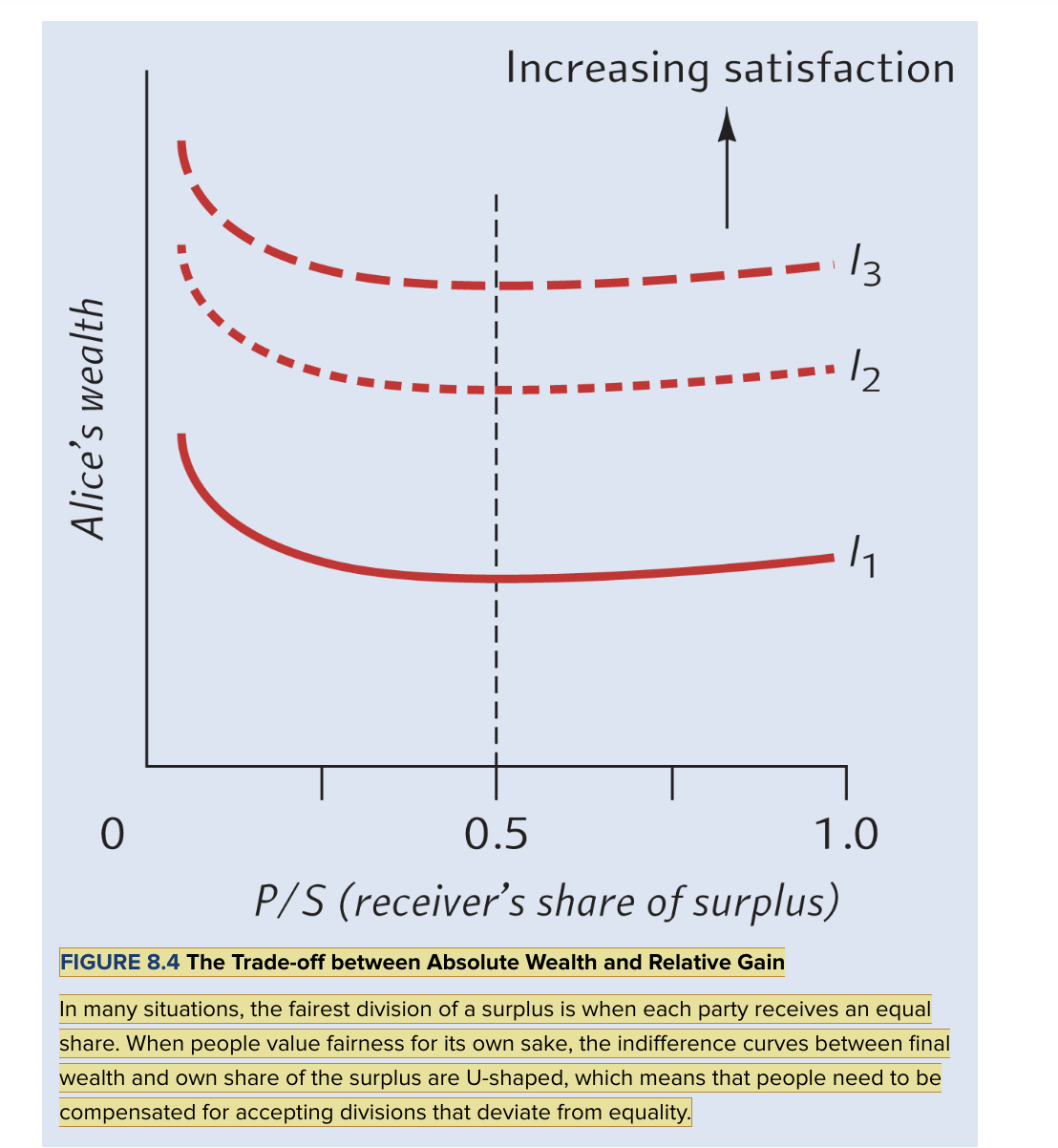
What does this graph show?
People care abt FAIRNESS


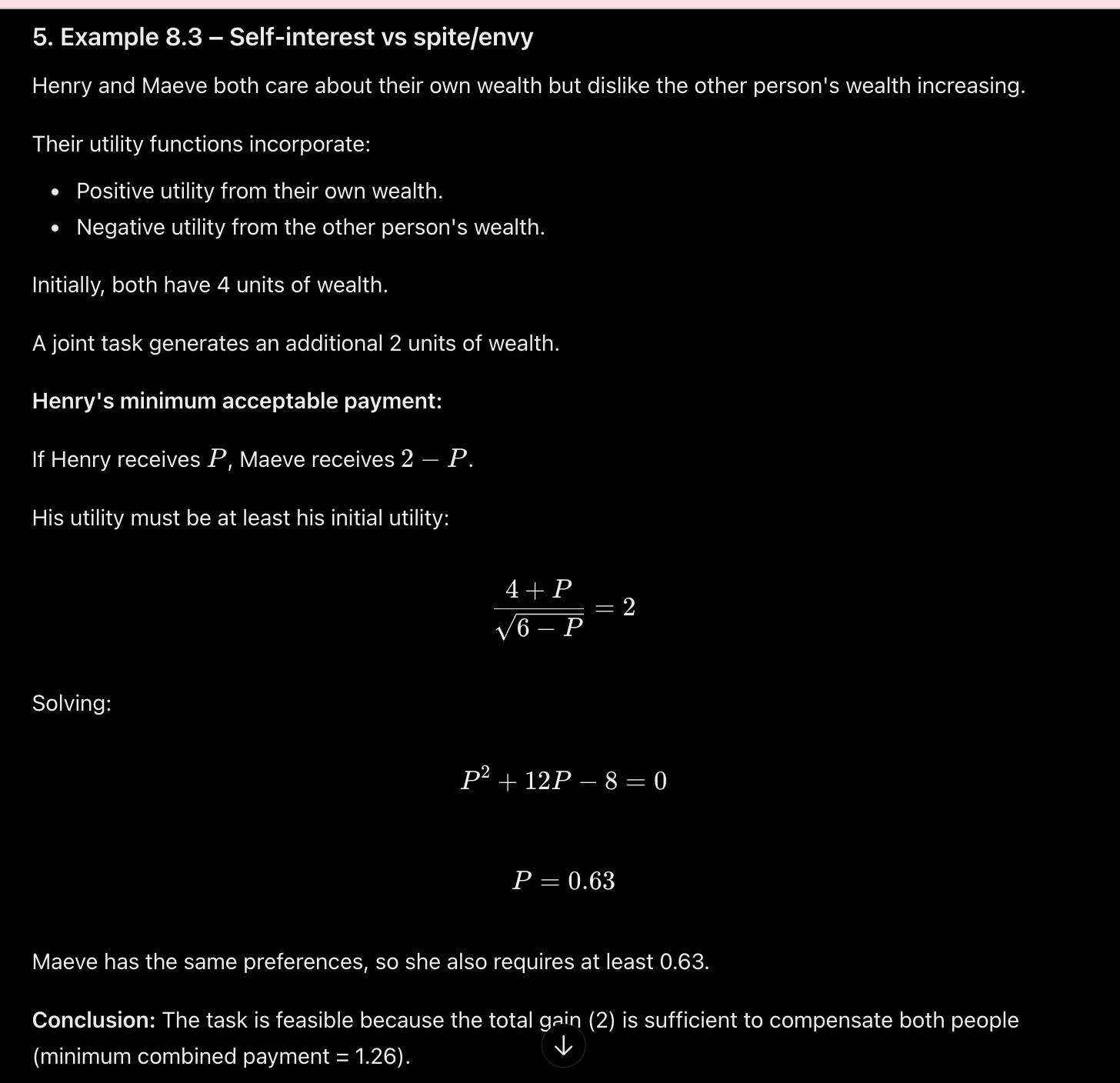
Does the rational choice model mean that people are selfish?
Not necessarily
Can explain a wide range of behaviours as long as we account for people's preferences
What problem does the ultimatum game show?
Commitment / signalling