Cell Communication and Signaling Review Set
 Call Kai
 Learn
 Practice Test
 Spaced Repetition
 Match
 Flashcards
 Knowt Play
1/22

There's no tags or description
Looks like no tags are added yet.
23 Terms
Cell surface interactions
They begin at the plasma membrane!
Most cells excrete a cross-linked network of long filaments (which protect against stretching forces) embedded in a stiff ground substance (which protect against compression forces)
In plant cells, primary and secondary cell walls are excreted out of the cell
In animal cells, the extracellular matrix is excreted out of the cell

Extracellular matrix (ECM)
Helps animal cells stick together → if cells aren't anchored properly, they die (or lead to cancer...)
Made of several proteins and glycoproteins such as:
- *Integrins*: transmembrane proteins that link ECM to cytoskeleton
- Laminins: bind integrins to ECM
- Proteoglycans: absorb water and act as ground substance
- Collagen: provides fibrous structure

Middle lamella
A type of adjacent-cell interaction where gelatinous proteins *stick* the primary cell walls of adjacent plant cells together

plasmodesmata
A type of adjacent-cell interaction between plant cells
Physical connections / *channels* between plant cell walls that allow for continuous cytosol, plasma membrane, and smooth ER between plant cells

Tight junctions
A type of adjacent-cell interaction between animal cells
Specialized transmembrane proteins between adjacent animal cells' plasma membranes that work to *seal cells together* to form a barrier (restricting the movement of substances in the space between cells)

Gap junctions
A type of adjacent-cell interaction between animal cells
Membrane channel proteins of adjacent cells line up to connect the cytosol for the *transport of materials between cells*

desmosomes
A type of adjacent-cell interaction between animal cells
*Cadherins* and other proteins linked to intermediate filaments *connect the cytoskeletons of adjacent cells* (anchor cells to each other)

Notch signaling
Type of *adjacent-cell* contact signaling in which the sending cell (ligand-presenting) has its ligand protruding from the plasma membrane; this ligand is recognized by Notch receptors on adjacent cells
--> Ligand recognition by Notch receptor leads to NICD (Notch Intracellular Domain) going to nucleus and affecting gene expression
Helps communicate cell fate and identity, especially during embryonic development

Distant cell communication
Typically done in three steps: signal reception, signal processing, and signal response

Signal reception
Requires signal receptors (found on the surface of cells) and signal molecules (aka ligands)

Signal receptors
Transmembrane proteins that can bind to particular signaling molecules (each receptor has specificity) and that can trigger a cellular response by changing in shape and activity
Are dynamic (can change in number and ability) and can be blocked by pharmaceuticals
*Each type of receptor is found only on certain cell types (not all cells will react to a ligand like insulin because not all cells will have the appropriate receptor)*
Signal molecules
Aka ligands
Molecules that bind to receptors on the surface of cells to trigger a response or communicate some message
*Can be lipid-soluble (steroids, gases) or lipid-insoluble (proteins, polar compounds)*
Can be neurotransmitters (nervous system) or hormones (in bodily fluids to act on distant target cells)
Lipid-soluble signal processing
Steroid hormones and other nonpolar signaling molecules are able to diffuse through the plasma membrane and bind to a *cytosolic* or transmembrane signal receptor
→ typically affect gene expression and therefore what proteins are produced to affect shape or function of the cell
→ do NOT require amplification or transduction
Ex. glucocorticoid receptor with cortisol (signal)

Lipid-insoluble signal processing
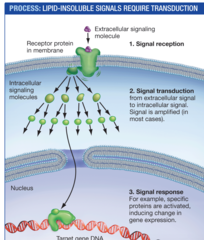
Those ligands unable to pass through the plasma membrane cannot participate in intracellular activities; therefore, they require *signal transduction*
- Binds to transmembrane signal receptor (GPCRs, RTKs, ligand-gated ion channels)
- Can affect both cytosolic protein activity and gene expression
- Can be *amplified* (increase the number of intracellular signals) and *diversified* (when one signal creates many different responses)
Signal transduction
When an extracellular signal is changed to a different form inside the cell, usually done for *lipid-insoluble signals*
Transmembrane signal receptor (GPCRs, RTKs, ligand-gated ion channels, or *Notch* receptors) start signal transduction

G-protein-coupled receptors (GPCRs)
Receptors that have G protein (peripheral membrane proteins that are activated by GTP binding) attached to affect cellular activity
Signal transduction through GPCRs:
1. Signaling molecule binds to receptor
2. Receptor's activation causes G protein to exchange GDP for GTP → G protein then migrates across the plasma membrane
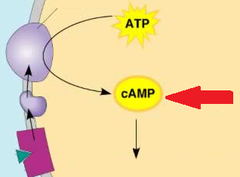
3. Activated G protein then activates an enzyme (like adenylate cyclase OR phospholipase C) to produce *second messengers*

Second messengers
Nonprotein signaling molecules that relay message of hormone or other extracellular signal
Ex. cAMP, cGMP, Ca^2+ ions
- Effective because they are small, can be produced in large quantities, and diffuse rapidly
- Second messengers often activate kinases to phosphorylate many proteins at once (*amplification!*)
Receptor tyrosine kinases (RTKs)
Receptors that phosphorylate themselves after binding to a signaling molecule
Signal transduction through RTKs:
1. Signal binds to RTK, causing dimerization and self-phosphorylation at tyrosine residues
2. Bridging proteins connect the phosphorylated RTKs with Ras proteins (small G proteins) that then exchange GDP for GTP
3. Ras proteins trigger a *phosphorylation cascade*
Ex. Mitogen (the signal for cell division) triggers Ras-MAP (mitogen-activated protein) kinases

Phosphorylation cascade
A series of enzyme-catalyzed phosphorylation reactions using subsequent kinases phosphorylating each other
Each stage has more kinases than the previous in a cascade, a sign of *amplification*

Ligand-gated ion channels
Receptor that acts as a gate when ligand binds to change the receptor's shape
1. Binding of ligand changes receptor shape
2. Receptor opens, allowing passage of ions into the cell
3. Channel closes when ligand dissociates from receptor

crosstalk
Interactions among signaling pathways, triggered by different signals that modify a cellular response
Examples:
- One pathway may inhibit a second pathway
- One pathway may stimulate a second pathway
- Having multiple steps in a pathway allows for many points / opportunities for regulation

Signal deactivation
Signals can be deactivated in the following ways:
1. GTP hydrolysis - deactivates G proteins
2. Phosphatases - remove phosphate groups in kinases during phosphorylation cascades (RTKs)
3. Phosphodiesterases - cleave phosphodiester bonds in cAMP and cGMP (second messengers) (GPCRs)
Quorum sensing
Unicellular organisms sense population density by detecting signaling molecules secreted by other cells
Creates biofilms and bioluminescence
