4 Fusion and Correspondence
 Call Kai
 Learn
Learn Practice Test
 Spaced Repetition
 Match
Match Flashcards
 Knowt Play
1/104

There's no tags or description
Looks like no tags are added yet.
Name | Mastery | Learn | Test | Matching | Spaced | Call with Kai | Chat |
|---|
No analytics yet
Send a link to your students to track their progress
105 Terms
What is the Hierarchic Arrangement of BV System? Mention its components.
→ artificial concept, matches the neurologic arrangement of the visual system
Sensory
Integrative
Motor

What is the most fundamental vs least fundamental part of the Hierarchic Arrangement of BV System?
Most fundamental = Sensory
Least fundamental = Motor
Define Sensory process.
anatomic, physiologic and psychologic activities involved in the collection and transmission of visual info to the cortex
Define Integrative process.
activities involved in the fusion of the 2 cortical images to form a single binocular percept of visual space
Why should anomalies of the Integrative process be manipulated with caution?
b/c eliminating them can’t be easily reversed
List and define 4 main Anomalies of Integrative Processes.
Suppression – lack or inability of perception of normally visible objects in all or part of the FOV in one eye, due to cortical inhibition
Anomalous retinal correspondence – fovea of two eyes not aligned for a common visual direction
Horror fusionalis– can’t obtain fusion or superimposition of haploscopically presented targets
Aniseikonia – relative difference in image size between both eyes
Define Motor process.
activities necessary to properly align eyes at various distances and directions of gaze
How are motor anomalies approached?
→ treated last (usually after treating sensory and integrative issues)
common and have a significant effect on visual comfort and performance
List and describe the 4 Anomalies of Motor Processes.
Vergence dysfunction – e.g. esophoria, exophoria, vertical phoria, convergence insufficiency
Strabismus – crossing of the eyes arising congenitally or due to trauma, surgery, tumor
Nystagmus – rhythmic oscillation of the eyes, beyond normal fixational or endgaze movements
What is the most commonly diagnosed binocular anomality?
Vergence dysfunction
What does deficits in the sensory process cause?
deficiencies in either or both of the remaining system
List and define the 5 Anomalies of Sensory Processes.
Ametropia – refractive condition where far point is not at infinity (Myopia, Hyperopia, Astig)
Amblyopia – ↓ VA not correctable with best refraction
Eccentric fixation – amblyope doesn’t use central foveal area for fixation under monocular conditions
Accommodative dysfunction – poor amplitude, ↓ facility, fatigue, spasm
Disease (e.g., ptosis, keratoconus, media opacities, retinal or visual pathway disease)
Define Binocular Fusion.
→ process by which 2 images, one from each eye, give rise to a unified percept of one single object
separating 2 eyes doesn’t tell us about the process or limits to fusing 2 images
How is Binocular Fusion classified?
All 3 degrees of fusion are needed to fully benefit from binocular vision
Grade 1: Simultaneous perception
Grade 2: Flat fusion
Grade 3: Fusion with stereopsis. (highest level of BV function)
Draw out the table for Degrees of Binocular Fusion.
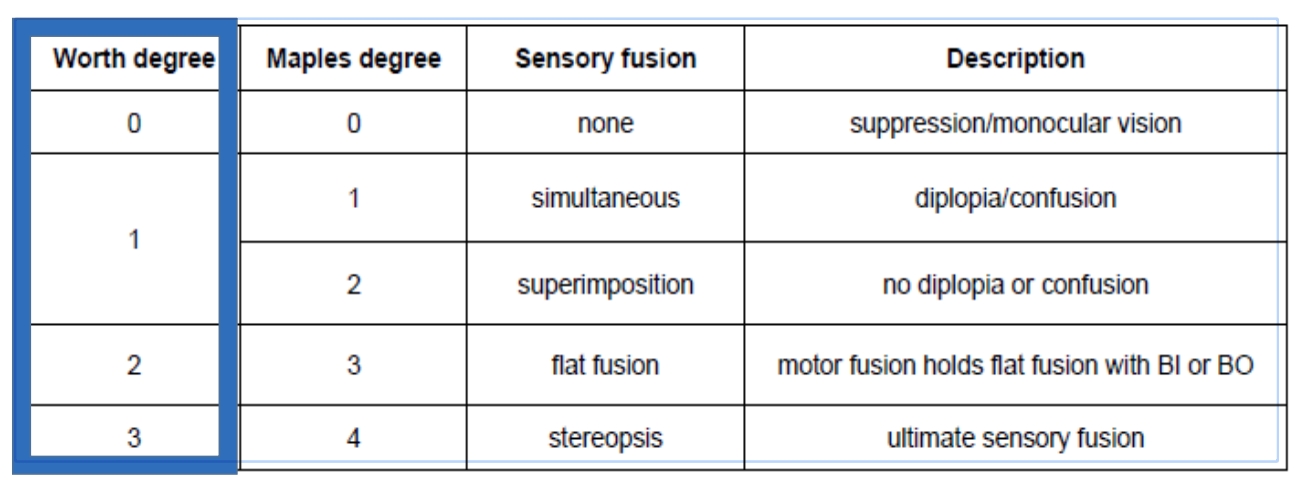
What is Simultaneous Perception?
→ Simultaneous view of 2 disparate, dichoptically-viewed DISSIMILAR images
Dichoptic: viewing a separate and independent field by each eye
e.g., A = OS, B = OD
No context for Fusion
Diplopia and/or Confusion
tested with Major Amblyoscope

What is Super Imposition?
→ Superimposition of 2 disparate, dichoptically-viewed DISSIMILAR images (e.g. A = OS, B = OD), shared context
❌ TRUE Fusion
❌ diplopia or confusion
❌ frame or object to serve as fusion lock

What is Flat Fusion?
→ Represents 2 dichoptically-viewed images with SIMILAR + DISIMILAR features combined into a single percept
involves binocular summation, binocular correspondence and Fusion without depth (2D)
✅ True fusion (fusion lock)
❌ Stereopsis (no depth)

What is Stereopsis?
→ Binocular 3D depth perception derived from SIMILAR, dichoptically-viewed images to OD and OS
Stimulation of non-corresponding points that are fairly close together → small retinal disparity gives rise to stereopsis

What is the highest level of binocular visual function?
Stereopsis
Define Fusion.
→ process of cohesively merging the 2 images (one from each eye)
unifying visual excitations from the corresponding retinal images into a single visual percept
Where does fusion occur?
always a central process (occurs in visual cortex)
Define Motor Fusion.
→ uses Vergence eye movements (reflex) to position the eyes so that corresponding points are super imposed
physical ability to align the eyes in such a manner that sensory fusion can be maintained
Stimulus: retinal disparity outside Panum’s area, causing the eyes to move in opposite directions (vergence)
e.g., Convergence or divergence

What is motor fusion exclusively the function of?
extrafoveal retinal periphery
Why are strabismic pt not able to achieve motor fusion?
due to to their inability to place the images of the object on the fovea of each eye
What is impairments of BV in strabismic pt caused by?
Visual Stress
Pathology
Trauma
Drugs
Fatigue
Define Sensory Fusion.
→ neurophysiological and psychological process by which the visual cortex –”combines the superimposed views from each eye into single percept”
ability to appreciate 2 similar images and interpret them as one
requires strict similarity between the 2 monocular images
can be present without convergence or divergence (motor fusion)
e.g., slit lamp with parallel optics

For sensory fusion to occur, the images must be… (List 3).
Located on the corresponding retinal areas
Presented simultaneously
Similar in Size, Brightness & Sharpness

What can disrupt sensory fusion?
→ Dissimilarities b/w the 2 retinal images can disrupt sensory fusion
Anisometropia
Visual differences caused by amblyopia
Absence of motor fusion
When there’s disruption to the sensory fusion, what does the visual system resort to?
Suppression or anomalous correspondence to form the percept of unified world
Define Suppresion.
❌ sensory fusion
e.g, Strabismic patient who suppresses has inadequate motor and sensory fusion
Define Anomalous correspondence.
✅ sensory fusion
poor motor fusion
e.g., Strabismic patient who compensates by anomalous correspondence
What does the Worth-4-dot test assess?
Fusion + Suppression + Diplopia
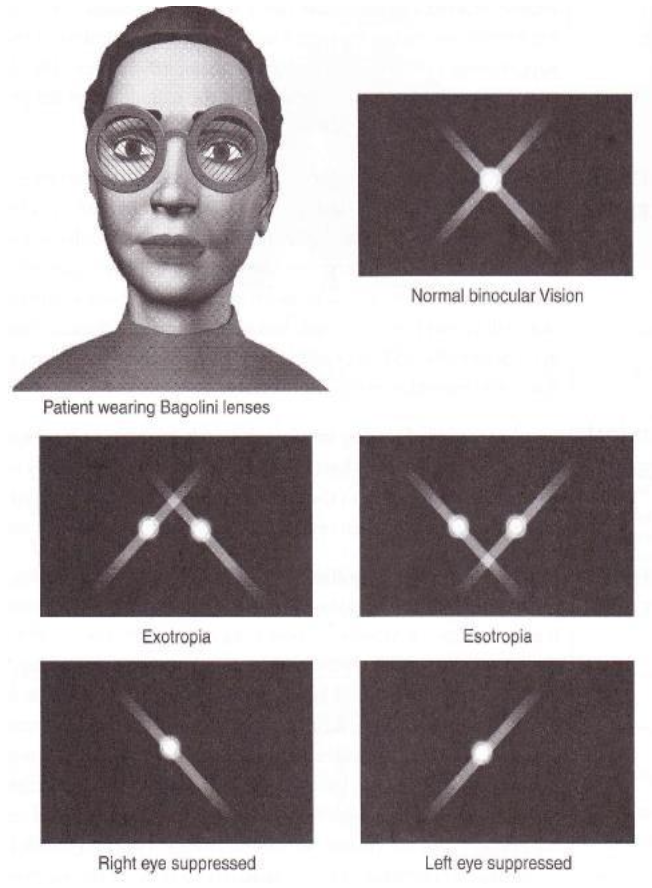
What does the Bagolini Striated Lens Tes assess?
Fusion + Suppression
Normal - see an X
Strabismus– streaks don’t cross at the central points
Suppression– only 1 streak is seen
What is the Stereopsis Test (Local & Global?
3rd degree of Fusion

List the 2 theories on how sensory fusion is possibly accomplished.
Alternation or suppression theory
Fusion theory – we can attend to similar images in both eyes at the same time
Define Alternation or suppression theory.
→ only one of the monocular images reaches consciousness at a time
assumes “fusion” occurs due to rapid alternation of Right and Left eye views
dissimilar images seen independently by right and left eyes (dichoptic view)

What is Binocular rivalry?
Perception alternates b/w different images presented to each eye
What is the Alternation or Suppression Theory proven to be?
False
e.g., rxn time experiment -where a flash of light superimposed on only one or other eye’s image (sine wave grating) → short rxn time irrespective of the eye stimulated
Under what circumstances does Alternation or Suppression not occur vs occur?
Does not occur - under natural viewing conditions with similar images in both eyes (as we can experience stereopsis)
Can occur (True )- under Artificial viewing conditions (e.g., experiment) → Binocular Rivalry, but takes a long time to switch attention from one eye’s image to other
What is the Suppression Theory?
→ suggests higher-level access to information from only one eye at a time
irregular pattern suggests local rivalry*

What is the Fusion theory?
→ “Similar images in the right and left eye can be processed simultaneously”
processing is not successive, as in the alternating theory
occurs under natural viewing conditions
but not under ALL viewing conditions
What is the Fusion Theory proven to be?
True
What are the 2 minor exceptions of Fusion Theory?
Binocular rivalry does occur with dissimilar images to each eye
Fusion = rule with similar monocular images
Rivalry = rule with dissimilar images
Even though we combine the 2 eyes info, the visual system still has some access to uncombined monocular info so that it can detect the small differences b/w the 2 eyes’ images (that gives us binocular disparity/stereopsis)
What is Panum’s Fusional Area (PFA)?
→ region in visual space over which we perceive single vision
range of horizontal retinal disparities around the horopter within which a stimulus is perceived as single
narrow band around the horopter
represents an area on one retina that can fuse with a corresponding region (not a single point) on the other retina
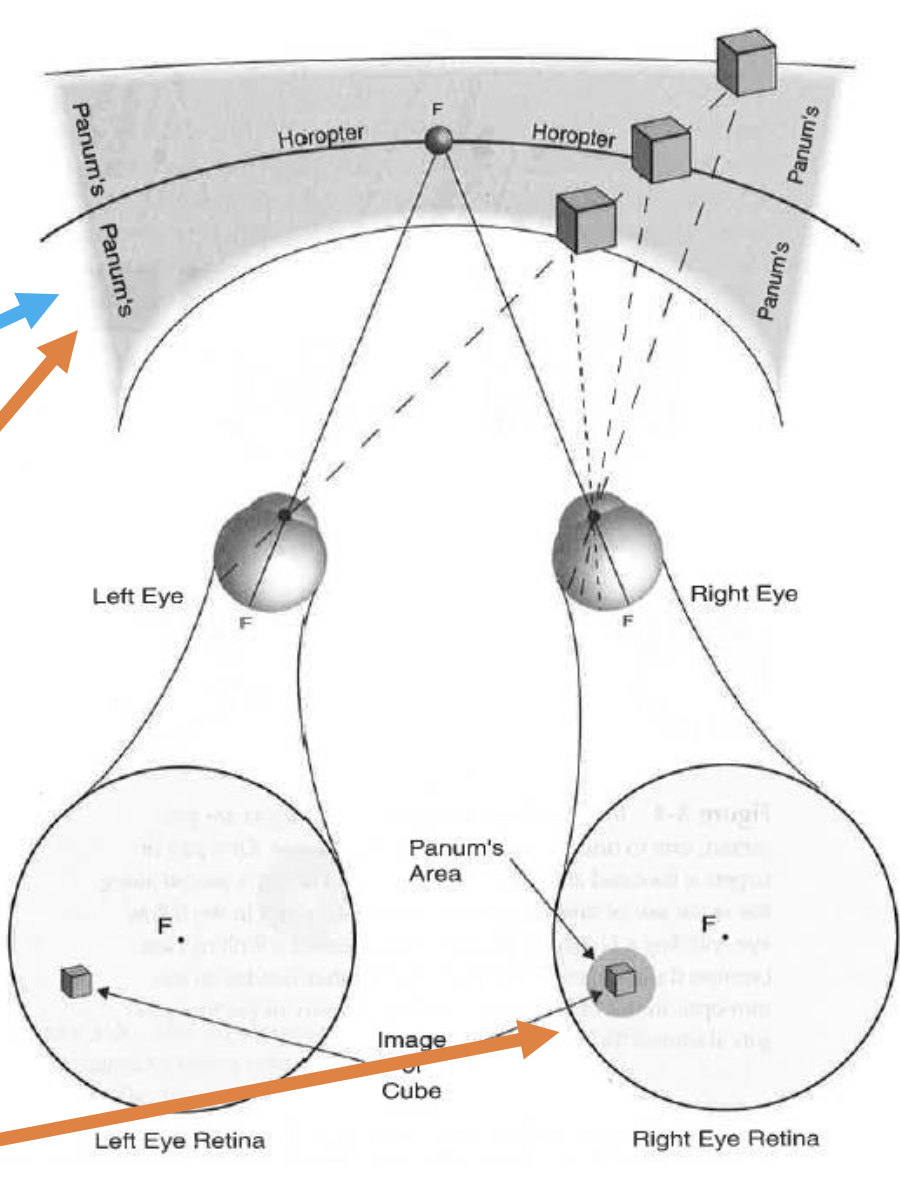
Define Horopter.
line or locus of points in space whose images fall on corresponding retinal areas of OD/OS
What does Panum’s area demonstrate about fusion and visual direction?
→ Fusion is not synonymous with identical visual direction
Images can be fused and seen as single despite having slightly different visual directions in the two eyes

How does Panum’s area help maintain single vision during fixation?
→ allows some imprecision or drift in eye movements without causing diplopia
e.g., can accommodate the uncorrelated microdrifts and tremors of the 2 eyes during fixation
How does Panum’s area reduce the adverse effects of fixation disparity?
allows fusion and single vision despite a small monocular misalignment of the eyes (fixation disparity)
What is required for an object to be perceived as single?
only need to fall within Panum’s fusional area to be fused and perceived as single (don’t need identical visual directions)
What can differences in visual direction within Panum’s area produce?
depth perception (stereopsis)
What is Panum’s Limiting Case (PLC)?
→ minimum conditions to perceive stereopsis made up of 3 lines (1 line for 1 eye, 2 lines for other eye)
called “Limiting Case” b/c 3 targets is the min number needed to see stereopsis and removing any one abolishes depth
can be tested vertically and horizontally


What happens when a target reaches the border of Panum’s fusional area (PFA)?
target becomes diplopicabout 50% of the time at the border of the PFA

How does the shape of Panum’s fusional area differ horizontally vs. vertically?
3–6× larger horizontally than vertically
is elliptical, partly b/c eye movements are more limited vertically
What is the size of Panum’s fusional area at the fovea?
5–20 arcmin
How does Panum’s fusional area change with eccentricity?
PFA increases with increasing eccentricity from the fovea
beyond 5° from the fovea, it’s 6–7% of the angle of eccentricity
What effect does target exposure duration have on Panum’s fusional area?
duration of target exposure alters PFA size
Why is the effect of target orientation on PFA difficult to quantify?
due to cyclorotation of eyes + unequal retinal and horizontal disparity along the target length
How do changes in luminance or contrast affect Panum’s fusional area?
no effect
How does tolerance for aniseikonia differ between the central and peripheral retina?
More aniseikonia is tolerated peripherally than centrally
What happens when aniseikonia is present centrally?
similar or smaller image-size difference centrally → loss of binocular fusion, making central suppression more likely than peripheral suppression (e.g., in strabismus)
How are targets used during VT to train fusion on PFA?
Larger, low-spatial-frequency targets are used in the periphery first b/c the PFA is largest there
As fusional abilities improve, smaller foveal targets are introduced

List 3 factors that can affect the size of PFA.
Strabismus
Small-angle strabismus (cause large PFA)
ARC (cause abnormally large PFA)
What’s unique about your dominant eye?
activates large portion of striate cortex than the non-dominant eye
differ at distance and near (e.g., OD at near, OS at distance)
Define Utrocular discrimination.
ability to identify the stimulated eye under binocular condition
Can people with normal binocular vision perform utrocular discrimination?
No - even when cues such as target shift and contrast differences are controlled, people with normal binocular vision are unable to determine which eye was stimulated
So, once combined into a single percept, Is each eye’s monocular information lost?
Monocular info lost to conscious perception
may be used internally by the visual system without our awareness
Define Dichoptic (bi-ocular). What’s a benefit to this?
→ similar or dissimilar info presented independently to each eye, while still achieving a single, unified percept
(+) help identify which eye is suppressing info and allow clinicians to adjust stimulus strength b/w the eyes to treat amblyopia under binocular viewing conditions.
What does heterophoria represent?
fusional vergence demand
What type of fusional vergence compensates for esophoria vs exophoria?
Esophoria - NFV
Exophoria - PFV
What is heterophoria?
latent ocular misalignment that’s successfully compensated by fusional vergence, allowing single binocular vision
What happens when heterophoria can’t be compensated?
strabismus - b/c they eyes can’t achieve adequate motor fusion
What is Fixation Disparity?
→ small error in vergence (purposeful) prevents image of fixation target from falling on corresponding retinal points
FD of more than few minutes of arc → indicator of BV problems
larger FD = more symptomatic the pt
can be used to help vergence movement system compensate
for heterophoria

How is Fixation Disparity measured?
→ measured clinically at distance or at nearpoint with simple targets (2 parts)
Some binocularly visible details that serve as a binocular fusion lock
2 monocularly seen nonius lines (via polaroid filters)

Define Nonius lines.
→ used for precision measurements (similar to fine lines of vernier caliper)
offset of lines is measured when binocular fusion is induced
How can you measure Fixation Disparity?
Wesson disparometer
fixation disparity card that’s tested with polarized glasses/lenses
Sheedy disparometer
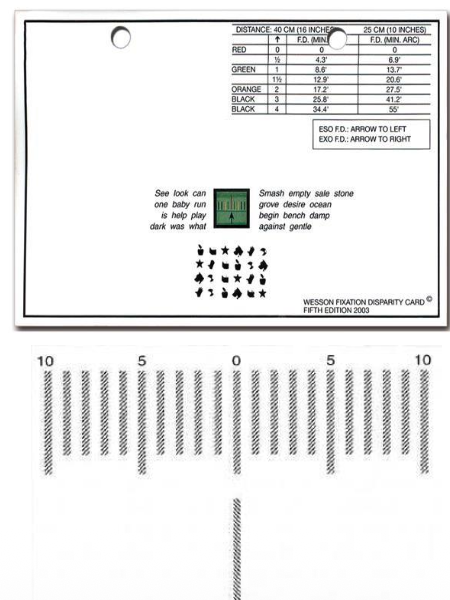
What is the Forced Vergence Fixation Disparity Curve (FVFDC) used for?
→ uses prism-induced changes in fixation disparity to assess the relationship b/w vergence demand and fixation disparity
predict how a pt may respond to prism or other vergence stresses, inducing PFV or NFV
What is the Type 1 FVFDC curve?
Curve obtained by 60% (near) and 70% (distance) of people
Symmetric
Gradual change in fixation disparity (with addition of prism) except at extremes
steeper central slope of the FD curve = pt will more likely be symptomatic of BV problems

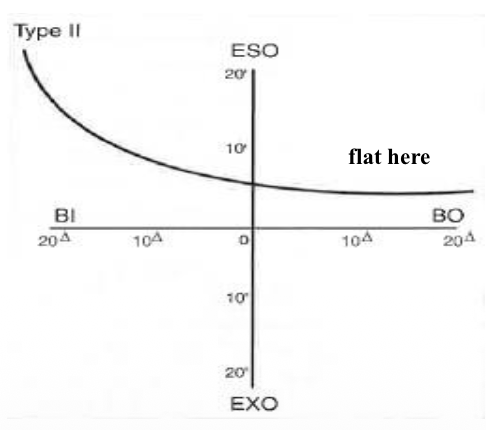
What is the Type 2 FVFDC curve?
25% people at distance and near
Represent intolerance of forced divergence
Corresponds with esophoria (intolerance to divergence)
Flat on BO side
What is the Type 3 FVFDC curve?
10% of people at near and 0% at distance
assoc with high exophoria (intolerance to convergence)
Flat on BI side

What is the Type 4 FVFDC curve?
5% people at distance and near
Flat at BO & BI
Rare-exhibits little change in Fixation disparity
assoc with aniseikonia and sensory fusion problems

What type of FVFDC is this graph?

Type 1
What type of FVFDC is this graph?

Type 2
What type of FVFDC is this graph?
What type of FVFDC is this graph?

Type 3
What type of FVFDC is this graph?
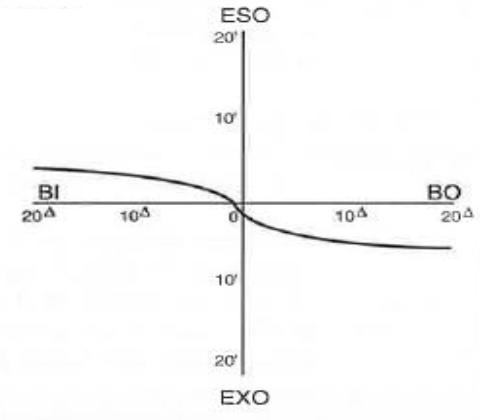
Type 4
What type of phenomenon is correspondence?
cortical
What is ARC?
→ adaptation of the visual system to ocular misalignment
allows binocular vision as an alternative to suppression or binocular confusion
cortical phenomenon assessed as a retinal misalignment

What test can be used to assess ARC?
Hering-Bielschowsky After Image Test
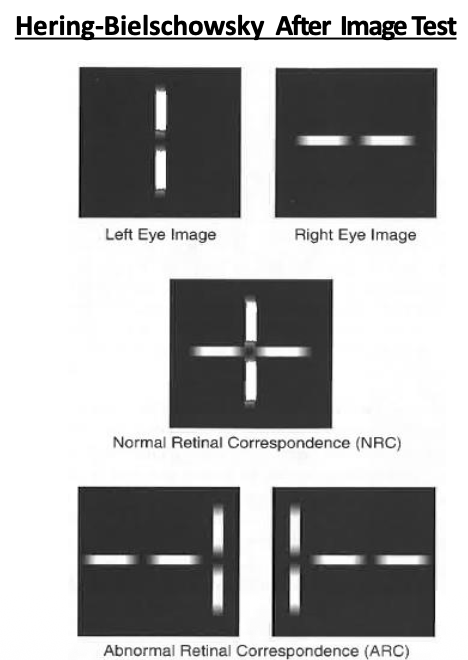
Define Harmonious ARC (HARC).
shift in corresponding retinal points MATCHES angle of strabismic deviation
Define Unharmonious (paradoxical) ARC.
imprecise shifting of corresponding retinal points
Define Eccentric fixation.
off-foveal point in the retina of the deviating strabismic eye is used for fixation under monocular AND binocular conditions
List 2 subjective angle tests to measure Strabismus.
Maddox Rod test
Hess-Lancaster Test
Amblyoscope?
When OD = Maddox rod, OS = None. What does it mean when the line is to the left vs right?
Line is to left = Exophoria or tropia
Line is to right = Esophoria or tropia
What is the Hess-Lancaster Test consist of?
→ Red-green anaglyphic glasses for binocular dissociation
pt superimposes red and green annuli → orthophoric pt

List 1 Objective angle tests to measure Strabismus.
Cover test
Define Angle of anomaly.
Difference between the subjective and objective strabismus angle measurement

List the 3 theories of ARC.
Sensory theory
Motor theory
Abnormal disparity vergence stimulus detection