Lec 5 - Do we even need immune cells?
 Call Kai
 Learn
Learn Practice Test
 Spaced Repetition
 Match
Match Flashcards
 Knowt Play
1/68

There's no tags or description
Looks like no tags are added yet.
Name | Mastery | Learn | Test | Matching | Spaced | Call with Kai | Chat |
|---|
No analytics yet
Send a link to your students to track their progress
69 Terms
What is the job of our immune system? In one word.
Hint: equilibrium, balance, _____________
Homeostasis!
Recall why the skin is an inhospitable environment:
it has no receptors for attachment
very low water content
dead cells (husks of keratin) of the stratum corneum don’t allow viral replication duh (viruses need alive host cell machinery to replicate)
….

Therefore the skin is a NEAR PERFECT wall separating outside and inside unless…
….unless the skin is damaged or cut of course
What are our mucosal membranes? Name 6.
Ocular mucosa
gastrointestinal mucosa
respiratory mucosa
mammary glands
urogenital mucosa
sweat glands

T/F: Mucosal membranes are diverse and specialized to their function.
Give me an example of the mouth (buccal like “buccal fat”) mucosa
true!
for example, buccal mucosa in mouth looks similar to skin but is intended to absorb abrasions while eating

T/F: Mucosal membranes are diverse and specialized to their function.
Give me an example of the intestinal mucosa
true!
rem. the intestines bunch up in a way to maximize surface area to absorb nutrient

T/F: Many layers of epithelial cells separate the outside of the intestine from the inside.
FALSE!
only one layer of epithelial cells exists for intestinal lining. think about why!! it maximizes absorption.
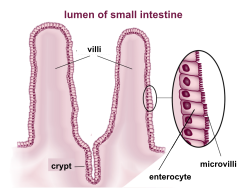
T/F: Mucosal membranes are diverse and specialized to their function.
Give me an example of the lung (alveoli) mucosa
true!
again only one very thin layer of specialized epithelial cells exists for alveoli to maximize gas exchange

Most mucosal membranes have thick mucus. What does mucus do?
mucus acts as a lube, traps pathogens, keeps pathogens away from epithelial cells, and provides a niche for commensal (gut) microbes

What does commensal mean?
it kinda means symbiotic but a neutral version:
Commensal = a relationship between two living things where one organism benefits and the other is neither helped nor harmed.
Is all mucus green?
no! only when we’re sick do we produce mucins that are thick and green. otherwise we produce clear regular mucins.

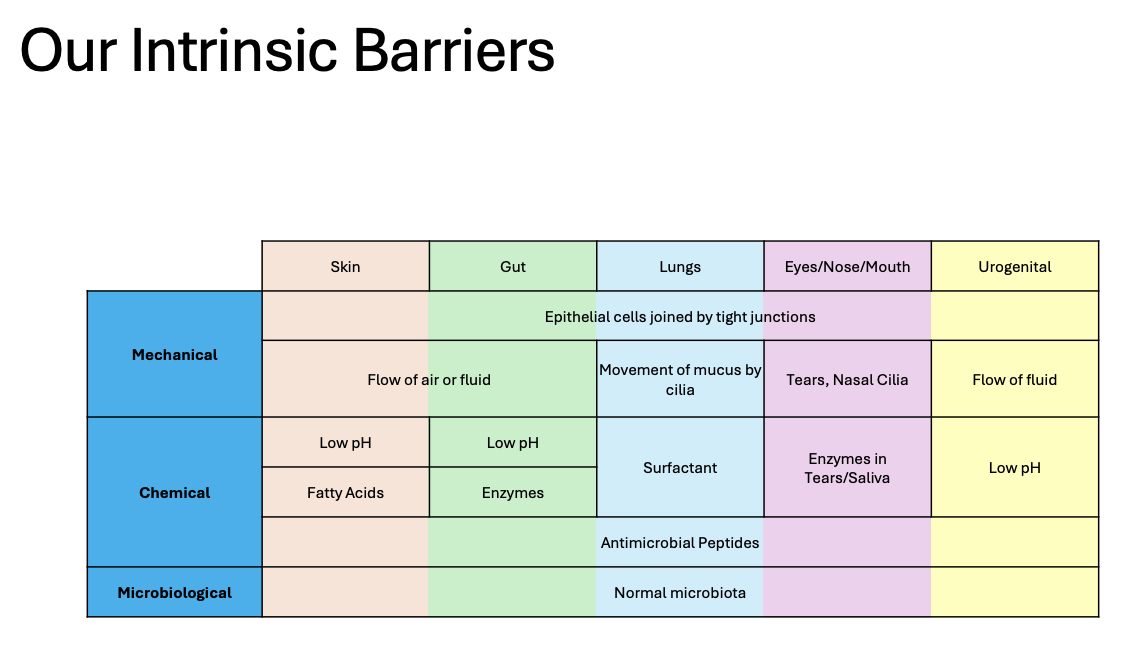
Summary of our intrinsic barriers:
….
First, we’ll talk about our microbiome.
The microbiological barrier IS our…
The microbiological barrier IS our microbiome!
What is the microbiome?
the healthy bacteria that coat most of our surfaces

How does the microbiome protect us? 3 things
competition
crowding
antimicrobials

Our bacteria has evolved WITH us and likes the things we like. they’ve adapted to live in the environment of our tissues.
Pathogens struggle to compete to live in the ____ of our tissues due to the food sources we make.
Pathogens struggle to compete to live in the pH of our tissues due to the food sources we make.
What are biofilms?
thin sticky layers of bacteria with ECM that form a community
Our microbiome contains tons of antimicrobials. This is essential bacteria fighting each other using…
using proteins (enzymes, peptides) and lipids (fatty acids) that they evolved to be competitive!

But then don’t antimicrobials kill commensal bacteria too?
no our proteins that destroy other bacteria kill the bad ones while sparing commensals!
Our relationship with microbes is commensal/symbiotic. How?
We give them:
They give us:
We give them a home and food.
They digest some of our more complex food for us, provide immune defense, and create substances to regulate our mood and functions.

T/F: We digest our own food ourselves entirely
partially false! microbes digest stuff that’s harder to breakdown that WE on our own cannot.
T/F: Different tissues have different microbiomes.
true!

The vaginal tract is dominated by what bacteria?
lactobacilli!
What does lactobacillus do for our vaginal tract?
it helps acidify the environment to be hostile to other bacteria!
Microbial dysbiosis is associated with diseases. What is dysbiosis?
dysbiosis = the improper composition of bacteria or improper diversity
ex. if your vaginal microbiome is diverse (it’s not supposed to be)
Dysbiosis can predispose you to infection. Why?
cuz poorer barrier function —> more likely to get infected!
Dysbiosis is associated with many diseases such as IBD, IBS, obesity, diabetes, autoimmunity, allergy, asthma, cardiovascular disease, cancer, pregnancy complications, mood disorders and more!
However we need more research to confirm whether this dysbiosis is [______ or ________] to the disease.
However we need more research to confirm whether this dysbiosis is CAUSAL to or RESULTING from the disease.
Next we’ll discuss our mechanical barriers.
How our our epithelial cells connected?
via tight junctions!
T/F: Tight junctions only exist in tissues that require a leak proof seal.
true!
If you have malfunctioning tight junctions —> you are more ….
If you have malfunctioning tight junctions —> you are more predisposed to infection!
i.e., weak tight junctions allow paracellular pathogen entry

Another mechanical mechanism is removing attached infected cells. What is it?
shedding skin (epithelium)!

We shed approx 10-____ billion cells per day
We shed approx 10-100 billion cells per day
fun fact: a lot of our SHIT is dead cells
Another mechanical mechanism is flow and movement removing pathogens. What is it?
well in our intestines is called peristalsis which is the muscular movement of the intestine to push things through.
air flow along our skin blows pathogens off
tears from our eyes washes out pathogens before they can attach

Another mechanical mechanism is violently expelling out pathogens and other toxic materials. What is it?
sneezing/coughing for respiratory tract
vomiting (emesis) for digestive tract
How to remember that vomiting = emesis?
think emetophobia!

Another mechanical mechanism is getting our mucus out of our airways. What is it?
Cilia beating our mucus up to our throat through wave like movements!
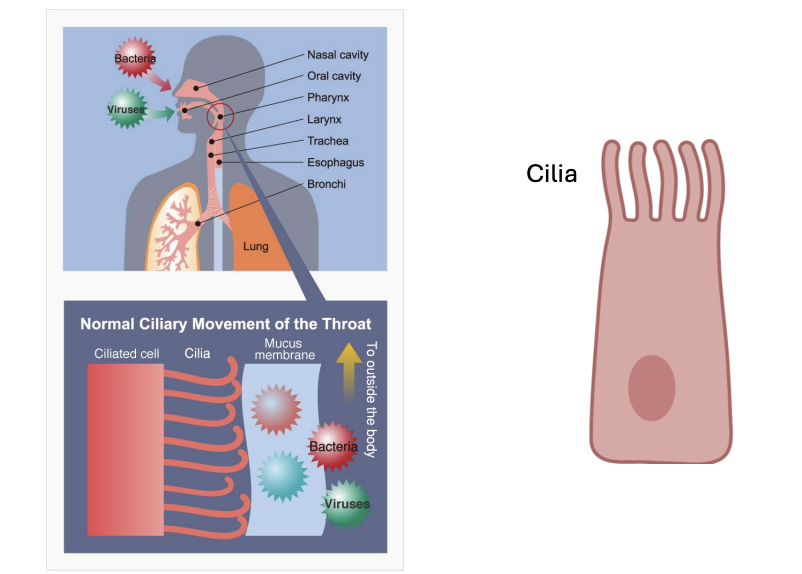
After our cilia brings pathogens to the throat, what happens?
pathogens then get swallowed and degraded by stomach acid!
Next we’ll talk about our chemical barriers. Chemical barriers are WHAT?
chemical barriers are MOLECULES that are produced by various body systems that damage or destroy pathogens/toxins while supporting our commensal microbiome!

How do chemical barriers protect us?
kill pathogens by disrupting their membranes
inhibit growth of pathogens thru their metabolism
destroy and denature proteins, toxins, etc
support the growth of the commensal microbiome
Many barrier tissues have a low pH, such as the skin (pH ~5), stomach (pH 1.5-3.5), and….
…and vaginal tract (pH 3.8-4.5)!

Low pH protecting us is good. Why? Low pH disrupts protein folding by interrupting bonds. Why is this bad?
Rem. low pH floods the environment with an excess of free protons (H+)
denatured proteins can longer bind their targets.
it goes from a neutral pH protein whose receptor has high affinity binding to a very acidic pH protein whose receptor is capable of no binding.

Disrupting proteins impacts their function rendering pathogens inert!
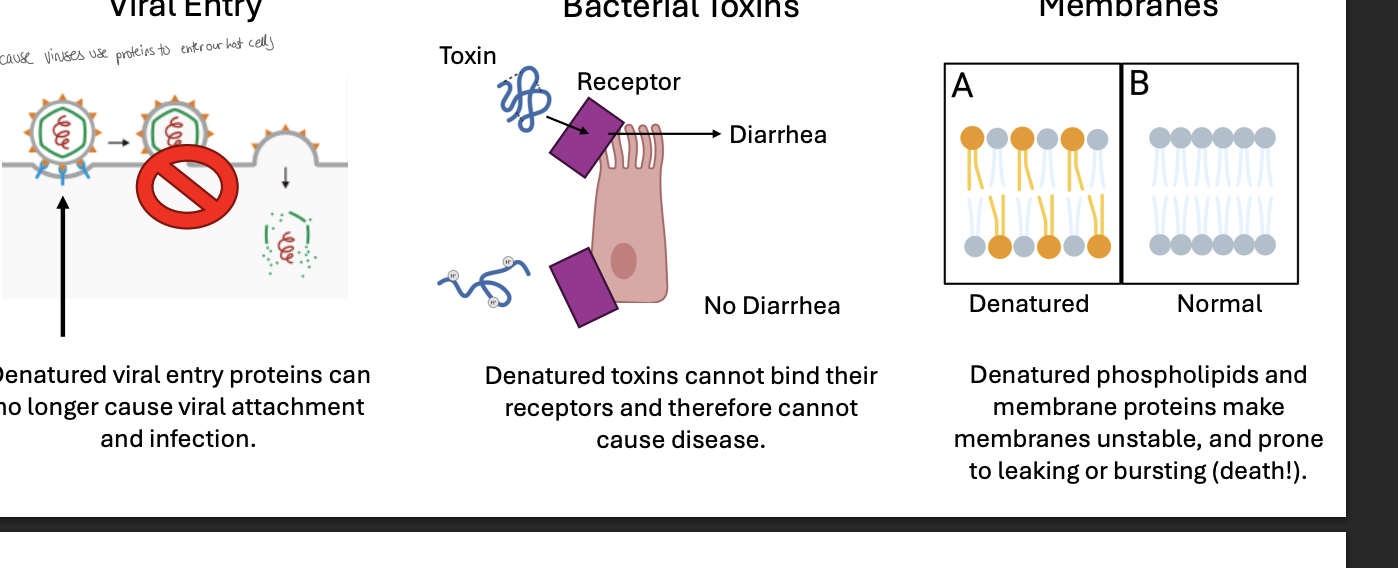
Denatured viral proteins can no longer cause viral attachment and infection
Denatured toxins cannot bind their receptors and therefore cannot cause disease
Denatured phospholipids and membrane proteins make membranes unstable and prone to leaking or bursting (death!!!)
Molecules produced by other systems have similar effects. What do surfactants in the lungs do?
surfactants reduce surface tension so alveoli can inflate! why is it bad for alveoli to be deflated?
well duh a collapsed lung means no oxygen in!
immune wise, surfactants also potently denature proteins and interrupt membranes
Molecules produced by other systems have similar effects. What do digestive enzymes (pepsin) in the stomach do?
they cleave food proteins for digestion and immune wise it destroys proteins so they cannot function.
Molecules produced by other systems have similar effects. What do lysozymes in the tears do?
they break down debris, lower surface tension, and also immune wise destroys proteins so that they cannot function.
T/F: Antimicrobial peptides (AMPs) are produced at all barriers for defense.
true!
What are AMPs?
antimicrobial peptides! they are short (~30 amino acids long) peptides that are VERY positively charged (cationic)
T/F: AMPs are anionic
false! AMPs are cationic.
What is the benefit of AMPs being very positive?
Hint: they need to bind to bacteria
AMPs (positive) bind to bacteria (negative).
Why are our cells protected then?
well our cells aren’t as negatively charged
What are the 2 types of AMPs?
Defensins
Cathelicidins

Humans only have one cathelicidin. What is it?
LL-37
Cathelicidin LL-37, the only one produced by humans, is always produce where and by what?
by epithelial cells at ALL barriers!
Defensins are numerous. Some are ALWAYS produced, while others…
Defensins are numerous. Some are ALWAYS produced, while others are induced by an inflammatory response to infection.
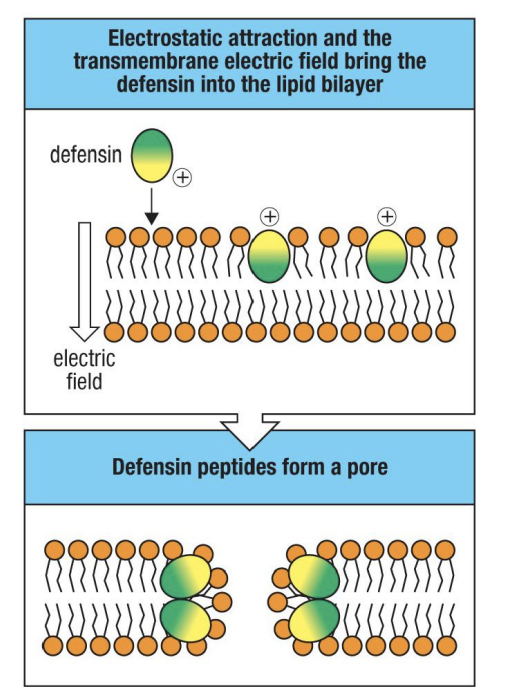
Antimicrobial peptides kill by what mechanism?
they directly form pores to make everything leak out of the cell!
—> no membrane polarization = no ion transfer = no energy —> catastrophic lysis of the cell!

Similar to acidity, AMPs denature proteins where a protein with no AMP has high affinity binding, whereas lots of AMP leads to binding!
….

So our commensals (good bacteria) can live in our environment (low pH; adapted to surive against degradation by enzymes, surfactants, and AMPs; and adapted to metabolize food sources available like fatty acids and glycogen) — but pathogens CANNOT.
yay!
So our commensals (good bacteria) can live in our environment (low pH; adapted to surive against degradation by enzymes, surfactants, and AMPs; and adapted to metabolize food sources available like fatty acids and glycogen) — but pathogens CANNOT.
BUT THEN HOW COME PATHOGENS DO INFECT US?
cuz pathogens have evolved to break thru our barriers!

If a pathogen bypasses our primary barrier, what is our second barrier?
Hint: it’s a system, not really a one physical thing
the complement cascade!
The actual complement cascade is a very complex system but Dr. Koenig won’t make us memorize that…
How does he want us to think of the complement cascade instead?
the complement cascade is a chain rxn of blood proteins that help body fight infection.
it IS our humoral innate immune system!

The liver is constantly producing ____________ proteins and releasing them into the blood. From the blood, they go into tissues.
complement proteins! easy to remember that it’s part of the complement cascade system!

What are zymogens? Complement proteins are zymogens.
zymogens are pre-proteins. they need to CLEAVED to be functional.
Zymogens are pre-proteins. They need to be cleaved to be functional.
So the protein C3 is inert, but it can enzymatically cleave into ____ and _____ to become functional.
So the protein C3 is inert, but it can enzymatically cleave into C3a and C3b to become functional.

What enzyme cleaves complement proteins (what’s it called)?
Some of the cleaved complement proteins are enzymes, which can cleave other complement proteins. This IS a cascade in itself.
convertases!

Why is the complement cascade being a cascade beneficial?
cuz massive cascades AMPLIFY a signal!

What are the 3 functions of the complement cascade?
recruitment (acts thru receptors to recruit macrophages and neutrophils to site of infection (inflammation)
opsonization (coats pathogens so they’re readily sensed by our immune sys to be killed)
kills (forms a membrane attack complex, which is just a pore, that kills pathogens by bursting open their cell

What is the order of actions of the complement cascade?
Hint: 3 pathways that are activated in order
Alternative pathway
Lectin pathway
Classical pathway
Mnemonic: always, lace is classy!

What does the alernative pathway do?
surface of the pathogen cleaves the complement

What does the lectin pathway do?
the mannose binding lectin (MBL) detects glycans on the surface of the pathogen that we DON’T have, then cleaves complement.
this requires the recruitment of MBL

What does the classical pathway do?
antibodies produced by the adaptive immune response bind to the pathogen and THEN cleave complement.
this requires the activation of the adaptive immune response, meaning it’s most effective but takes DAYS!
