POS 3113 Pre-Finals Reviewer [Module 5-6]
 Call Kai
 Learn
 Practice Test
 Spaced Repetition
 Match
 Flashcards
 Knowt Play
1/142

There's no tags or description
Looks like no tags are added yet.
143 Terms
Power
It is a central concept in Political Science.
Power
It is arguably the single most important organizing concept in social and political theory’ (Balls, 1992)
Political Analysis
It is defined as the analysis of the nature, exercise, and distribution of power (Dahl 1963; Duverger 1964/66; Lasswell 1936/50; M. Weber 1919/46; and, for a more recent view, Goodin and Klingemann 1996)
Power
It sets the parameters of Political Analysis.
Power
It specifies the sphere of the political.
highly contested
The main characteristic of political analysis. The field of political analysis is, by the very political nature of its subject matter, ______________, then within that field the concept of power is more _____________ than most.
Power Relations
This is often neglected.
However important the analysis of power to the conduct of political science, they suggest, the political domain cannot and should not be held coextensive with that of power itself.
Tendency: delineated definition of the political as the arena of government as distinct from the practice or exercise of power
Influence
This refers to the outcome of an attempt to change someone’s behavior or attitude.
Power
This refers to the means by which the influence is accomplished (A capacity that A has to influence the behavior of B, so that B acts in accordance with A’s wishes).
Politics
The pursuit of self-interest in an organization to protect or further either individual or organizational goals.
Rational Persuasion, Emotional Appeals, Exchange, Norms
Enumerate the 4 Influence Tactics in the exercise of Power
Rational Persuasion
Identify the Influence Tactics in the exercise of Power: Use of logic
Emotional Appeals
Identify the Influence Tactics in the exercise of Power: Use of values, loyalty, fear
Exchange
Identify the Influence Tactics in the exercise of Power: Use of rewards
Norms
Identify the Influence Tactics in the exercise of Power: Use of traditions, policies
Legitimate Power, Reward Power, Coercive Power
Enumerate the 3 Position Power
Legitimate Power
Identify What Position Power: Power derived from a person’s position of authority in an organization
Reward Power
Identify What Position Power: Power derived form the ability to provide positive outcomes
Coercive Power
Identify What Position Power: Power derived from the ability to administer punishments
Information Power, Expert Power, Referent Power
Enumerate the 3 Individual Power
Information Power
Identify What Individual Power: Power derived access to information that is important to others in the organization
Expert Power
Identify What Individual Power: Power derived from an individual’s superior skills or abilities in an area values by the organization
Referent Power
Identify What Individual Power: Power derived from the extent to which an individual is well liked and admired by others.
Coercive Power, Reward Power, Legitimate Power, Information Power
Enumerate the 4 Formal Power (Bases of Power)
Expert Power, Referent Power, Charismatic Power
Enumerate the 3 Personal Power (Bases of Power)
Power Tactics
These are ways in which individuals translate power bases into specific actions such as the following:
Legitimacy
Rational persuasion
Inspirational appeals
Consultation
Exchange
Personal appeals
Ingratiation
Pressure
Coalitions
Legitimacy
Rational persuasion
Inspirational appeals
Consultation
Exchange
Personal appeals
Ingratiation
Pressure
Coalitions
Enumerate the 9 Power Tactics
Political Tactics
Controlling access to information
Building a favorable impression
Building a support base—Politics as the art of clout or gathering debts owed
Blaming and attacking others
Networking
Dependency
This is the key to power.
"The greater B’s ___________ on A, the greater the power A has over B"
Importance, Scarcity, Non-substitutability
Enumerate the 3 Concepts that Creates Dependency
Coalition
An informal group bound together by the active pursuit of a single issue. They seek to maximize their size = “strength” in numbers.
Alliance
A formal agreement between two or more states for mutual support in case of war. Formed between two or more countries to counter a common adversary, i.e. strong states enter into this to counter other strong states i.e., they enter into this to maintain balance of power.
Political Action
This occurs when:
When scarce resources are at stake
When there are conflicting interests
When uncertainly or ambiguity exists
Gain or greed
Role conflict
Competition
Organizational culture
Enumerate the 4 Causes of Unethical Choices
Tactics promote purely selfish interests
Political activity respects rights of stakeholders
Activity meets standards of fairness
Enumerate the 3 Concepts Covered Here under Ethical Guidelines

Positive Power or Induction
On Power: This refers to an ability to initiate activity.
Negative Power or Resistance
On Power: This refers to an ability to stop some activity.
Socrates
He believes that true power comes with the control and order of one's body and soul—the discipline to act justly, live virtuously, and not need anything.
Plato
He agues that in a system in which everyone has a right to rule all sorts of selfish people who care nothing for the people but are only motivated by their own personal desires are able to attain power. He concludes that democracy risks bringing dictators, tyrants, and demagogues to power.
Aristotle
He believes that power as a source for change and rest and that powers order the physical world insofar as it is a world of changing things subject to causation.
Plato
He said: “And so tyranny naturally arises out of democracy, and the most aggravated form of tyranny and slaverly out of the most extreme form of liberty.”
Aristotelian Typology
What do you call this?
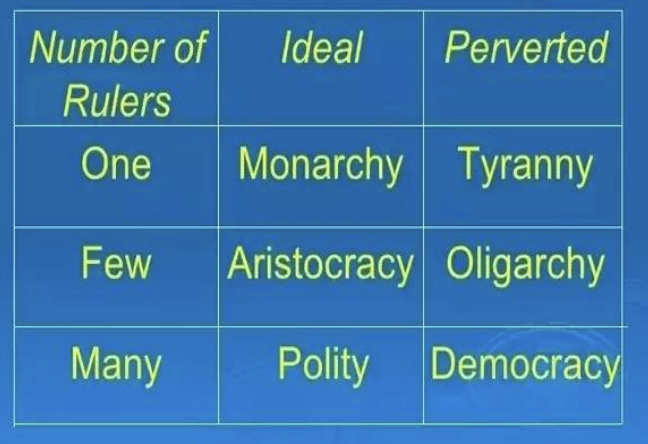
Max Weber
He influentially argued that state power consisted in a ‘monopoly of the legitimate use of physical force’.
Thomas Hobbes
the English philosopher and original theorist of state power, saw the essence of power as state sovereignty. He thought that at its best and purest power would be exercised from the singular position of sovereignty. He called it ‘The Leviathan’
Robert Dahl
He defined: “A has power over B to the extent that he can get B to do something that B would not otherwise do.”
Robert Dahl
He argued that his definition could be used to compare the power of political actors in a given sphere—for instance, the influence of different U.S. senators on questions of foreign policy.
Steven Lukes
Critics, such as the social theorist __________, argued that Dahl’s definition failed to capture other important dimensions of power, such as the capacity of an actor to shape the norms and values held by others.
Steven Lukes
Generic Definition of Power: “A exercises power over B when A affects B in a manner contrary to B's interests.”
Who said that this definition is too generic?
Steven Lukes
He constructed a Three-Dimensional Account of Power
Three Faces of Power
The basic principle is that the power and consequent effectiveness of a group is based on three distinct aspects.
Issue, Agenda, Manipulation
Enumerate the 'Three Faces of Power' (also called the 'three dimensions of power') by Steven Lukes
Issue
The first face (or dimension), as proposed by such theorists as Dahl, presents power as a 'relation among people'.
It is the ability of one person to achieve compliance by others who change how they behave as a result of the power being exerted. It can be seen in systems of ruling elites, where few people have significant power.
As such, power is direct, with identification of an issue and a singular response to this. It is, in essence, about making decisions.
Issue
3 Faces of Power: In governmental power, this can be seen when the government makes a decision, typically through lawmaking, that requires obedience by the broader population. Such decisions may be debated openly with opportunity for consultation and challenge along the way. Despite this openness, the focus is still on decision.
Issue
3 Faces of Power: This can be seen as an 'open face', where it is clear who is making the decision and why they are making it. As this can be seen, it is more likely to be trusted and consequently obeyed with little question.
Agenda
3 Faces of Power: In governmental power, this can be seen in decisions made 'behind closed doors' and in the 'corridors of power', where who is deciding and why is seldom clear. In such contexts, power is held not only by elected officials but also by the whisperers and assistants who set up meetings, shape agendas and write the minutes.
Agenda
3 Faces of Power: This can be seen as a 'secretive face', where it is not clear who is making the decision. This can lead to problems as other people suspect that there are corrupt elements to the choice, such as those based on political agendas and personal gain
Agenda
The second face, as proposed by theorists such as Bachrach and Baratz, adds the more subtle system of power, where decision is made within a complex system.
In this situation, power is not just about making decisions, but also about setting the agenda that leads to decisions.
In other words, if you can control the context within which decisions are made, then you can influence those decisions.
Manipulation
Lukes adds a third face, that of even more subtle aspect of ____________ the psychology of anyone and everyone affected. This can be seen as similar to the Marxist view of ideological power, where the ability to control what people think of as being 'right' can lead to acceptance of biased decisions without question.
Manipulation in Government
3 Faces of Power: In governmental power, this appears in propaganda, spin and crafting of speeches that are deliberately designed to change minds before the decision is announced. For example if legislation against trade unions is planned, then a provocative rhetoric of how these unions cause problems may be started some time beforehand. Any union action then plays directly into the government's hands.
Manipulation
3 Faces of Power: This can be seen as a 'deceptive face', where trickery and psychological methods are the primary tool in shifting values and changing what people consider to be important. The problem with this method is that when it is discovered, it can lead to a sharp loss in trust and consequent betrayal effects.
Jurgen Habermas
He focused on the Communicative Concepts of Power. He said that communication through language necessarily involves the raising of ‘validity-claims’ (distinguished as ‘truth’, ‘rightness’ and ‘sincerity’), the status of which, when contested, can ultimately only be resolved through discussion.
validity-claims
Jurgen Habermas said that communication through language necessarily involves the raising of ‘_____________’ (distinguished as ‘truth’, ‘rightness’ and ‘sincerity’), the status of which, when contested, can ultimately only be resolved through discussion.
truth, rightness, sincerity
Enumerate the 3 Concepts: Jurgen Habermas said that communication through language necessarily involves the raising of ‘validity-claims’ (distinguished as ‘____’, ‘________’ and ‘_______’), the status of which, when contested, can ultimately only be resolved through discussion.
Jurgen Habermas
He further contends that speakers of a language possess an implicit knowledge of the conditions under which such discussion would produce an objectively correct result, and these he has spelled out in terms of the features of an egalitarian ‘ideal speech situation’. Communicative rationality refers to the capacity to engage in argumentation under conditions approximating to this ideal situation (‘discourse’, in his terminology), with the aim of achieving consensus
ideal speech situation
Jurgen Habermas further contends that speakers of a language possess an implicit knowledge of the conditions under which such discussion would produce an objectively correct result, and these he has spelled out in terms of the features of an egalitarian ‘__________________’.
Communicative rationality
Jurgen Habermas on Power: This refers to the capacity to engage in argumentation under conditions approximating to this ideal situation (‘discourse’, in Habermas’ terminology), with the aim of achieving consensus. He relies on this concept to argue that democratic forms of social organization express more than simply the preferences of a particular cultural and political tradition.
discourse
Jurgen Habermas on Power: This refers to the capacity to engage in argumentation under conditions approximating to this ideal situation (‘____________’, in Habermas’ terminology), with the aim of achieving consensus.
Jurgen Habermas
In his view, we cannot even understand a speech-act without taking a stance towards the validity-claim it raises, and this stance in turn anticipates the unconstrained discussion which would resolve the status of the claim.
Michel Foucault
His view is that power is everywhere.
Influential in shaping understandings of power, leading away from the analysis of actors who use power as an instrument of coercion, and even away from the discreet structures in which those actors operate, toward the idea that ‘power is everywhere’, diffused and embodied in discourse, knowledge and ‘regimes of truth’
Michel Foucault
He challenges the idea that power is wielded by people or groups by way of ‘episodic’ or ‘sovereign’ acts of domination or coercion, seeing it instead as dispersed and pervasive.
‘Power is everywhere’ and ‘comes from everywhere’ so in this sense is neither an agency nor a structure. Instead it is a kind of ‘metapower’ or ‘regime of truth’ that pervades society, and which is in constant flux and negotiation. He uses the term ‘power/knowledge’ to signify that power is constituted through accepted forms of knowledge, scientific understanding and ‘truth’
metapower, regime of truth
Michel Foucault believes that power is a kinda of _____________ or _____________(2 answers) that pervades society, and which is in constant flux and negotiation.
power/knowledge
Foucault uses the term ‘____________’ to signify that power is constituted through accepted forms of knowledge, scientific understanding and ‘truth’
Truth
Michel Foucault said that it is a thing of this world that is produced only by virtue of multiple forms of constraint. And it induces regular effects of power. He states that each society has a regime of this, their general politics of this.
general politics and regimes of truth
Michel Foucault on Power: These ‘__________’ and ‘___________’ are the result of scientific discourse and institutions, and are reinforced (and redefined) constantly through the education system, the media, and the flux of political and economic ideologies.
Battle for Truth
The ‘battle for truth’ is not for some absolute truth that can be discovered and accepted, but is a battle about ‘the rules according to which the true and false are separated and specific effects of power are attached to the true’… a battle about ‘the status of truth and the economic and political role it plays’.
Foucault-Habermas Debate
This is a dispute concerning whether Michel Foucault’s ideas of "power analytics" and “genealogy” or Jurgen Habermas’ ideas of “communicative rationality” and “discourse ethics” provide a better critique of the nature of power in society.
power analytics and genealogy
In the Foucault-Habermas Debate, what are the 2 ideas of Michel Foucault?
communicative rationality and discourse ethics
In the Foucault-Habermas Debate, what are the 2 ideas of Jurgen Habermas?
power
reason
ethics
modernity
democracy
civil society
social action
Enumerate the 7 Concepts: In the Foucault-Habermas Debate, it compares and evaluates the central ideas of Habermas and Foucault as they pertain to questions of?
Decision-Making, Agenda Setting, Preference Shaping
Enumerate the 3 Faces of Power in the ‘Faces of Power Controversy’
Conflict in the Faces of Power Controversy
Identify what Faces of Power (The Faces of Power Controversy):
A has power over B to the extent that she can ‘get B to do something that B would not otherwise do’ (1957: 201) and, crucially, where there is an overt conflict of interests (here assumed synonymous with preferences) between the actors involved.
Thus, by virtue of A’s power, B not only modifies her behavior, but does so in full knowledge that her modified behavior is contrary to her own genuine interests.
Faces of Power
Identify what Faces of Power (The Faces of Power Controversy):
Premise: Power, they argued, is Janus-faced, its complex nature merely obscured by a narrow concentration on the decision-making process. For power is also exercised in what they, rather cryptically termed, ‘non-decision making’.
Janus-faced
Under the face of power ‘Agenda-Setting,’ power they argued is ____________, its complex nature merely obscured by a narrow concentration on the decision-making process.
Decision
Identify what Faces of Power (The Faces of Power Controversy):
Premise: To restrict the use of the term ‘power’ to situations in which actual and observable conflict is present, he argues, is arbitrary, unrealistic and myopic.
Power as decision-making
Power as agenda-setting
Power as preference-shaping
Enumerate the Three-Dimensional Conception of Power
Steven Lukes
He said: analysis of power on the distinction between real and perceived interests, i.e. the notion of power as a subversion of real interests
critique
To identify a power relationship is to engage in _______. This is not to apply a scientific principle or analytical technique but to compare real practices to an idealized (often utopian) alternative.
positive conception of power
Negative or Positive Conception of Power: Power of as opposed to power over
negative conception of power
Negative or Positive Conception of Power: power over as opposed to power of
context-shaping
Redefining Power: Power then is about ____________, about the capacity of actors to redefine the parameters of what is socially, politically and economically possible for others.
Michel Foucault
He said: “In human relations . . . power is always present . . . these relationships of power are changeable relations, i.e., they can modify themselves, they are not given once and for all . . . The thought that there could be a state of communication which would be such that the games of truth could circulate freely, without obstacles, without constraint and without coercive effects, seems to me to be utopian. It is being blind to the fact that relations of power are not something bad in themselves, from which one must free one’s self. I don’t believe there can be a society without relations of power.”
Discipline
It is a series of techniques by which the body's operations can be controlled.
Discipline
It worked by coercing and arranging the individual's movements and his experience of space and time. This is achieved by devices such as timetables and military drills, and the process of exercise. Through this, individuals are created out of a mass.
hierarchical observation
normalizing judgment
examination
Enumerate the 3 Elements of Disciplinary Power
Observation and Gaze
Enumerate the 2 Key Instruments of Power
Bentham's Panopticon
Disciplinary power is exemplified by this, which means a building that shows how individuals can be supervised and controlled efficiently. Institutions modeled on the this begin to spread throughout society.
Prison
It aims both to deprive the individual of his freedom and to reform him.
penitentiary
It combines the prison with the workshop and the hospital.
delinquent
The penitentiary replaces the prisoner with the ___________
delinquent
The __________ is created as a response to changes in popular illegality, in order to marginalize and control popular behavior.