1340: Ch.12 Oxygen Transport and Calculations
 Call Kai
 Learn
 Practice Test
 Spaced Repetition
 Match
 Flashcards
 Knowt Play
1/108

There's no tags or description
Looks like no tags are added yet.
109 Terms
What is the goal of every breath taken?
Deliver O2 to tissues and remove CO2
What are the 3 steps of oxygen transport?
1. Lungs load O2
2. Blood and hemoglobin transport it
3. Tissues use O2 for metabolism
What happens if one of the steps of oxygen transport fails?
Hypoxia
Oxygen comprises __% of the atmosphere.
21
Tissues use ___mL of O2/min and produce ___mL of CO2/min
250; 200
What are the 2 forms that O2 moves through the blood?
1. Bound to Hb (98-99%)
2. Dissolved in plasma (1-2%)
What does Henry's Law state?
The amount of gas that dissolves in a liquid is directly proportional to its partial pressure
What does the amount of O2 that is dissolved in plasma depend on?
PaO2
What is the O2 solubility coefficient?
0.003 mL O2/ 100 mL blood (per mmHg)
Remember: "mL O2/100 mL blood" is a unit of measurement, not a math problem to solve
What does the O2 solubility coefficient determine?
The PaO2 value on an ABG
What is the formula for the amount of O2 dissolved in plasma?
PaO2 x 0.003
What is Hemoglobin (Hb)?
A protein inside RBCs specialized to carry O2 and CO2
What does each Hb molecule have?
- 4 Heme groups (each with an iron atom that binds 1 O2 molecule)
- 4 globin chains (2 alpha and 2 beta)
Each Hb molecule can carry up to how many O2 molecules?
4
O2 binding is reversible, what does this allow?
Picking up in the lungs and releasing in the tissues
What shows the relationship between PaO2 and SaO2?
Oxyhemoglobin Dissociation Curve
Why does normal O2 delivery depend far more on Hb and SaO2 than PaO2?
Because Hb carries almost all the O2
1 red blood cell equals how many hemoglobin molecules?
270-300 million
What are the norma Hb levels for men and women?
Men: 13.8 - 17.2 g/dL
Women: 12.1 - 15.1 g/dL
What is Hb considered when all 4 Heme groups bind with O2 molecules?
100% saturated
What is Hb bound to O2 called?
Oxyhemoglobin
What is Hb not bound to O2 called?
Deoxyhemoglobin
What is the amount of O2 bound to Hb directly related to?
The partial pressure of O2
What are the characteristics of Adult Hemoglobin (HbA)?
- normal type in healthy adults
- carries O2 efficiently and reversibly
What are the characteristics of Fetal Hemoglobin (HbF)?
- found in newborns
- has a higher affinity for O2 than adult hemoglobin
- helps pull O2 from mom's blood across the placenta
- gradually replaced by adult hemoglobin during 1st year
What are the characteristics of Hemoglobin S (HbS)?
- sickle cell mutation
- low O2 cause the molecules to stick together causing the RBC to have a sickle shape
- poor O2 delivery
- clots
- pain crises
What are the characteristics of Methemoglobin (MetHb)?
- iron is oxidized
- can't bind O2 which causes functional anemia
- caused by drugs/chemicals (e.g. nitrates, nitric oxide)
How much O2 does each gram of Hb bind when fully saturated?
1.34 mL of O2
What is the formula for the total amount of O2 bound to Hb?
Hb x 1.34 x SaO2
The amount of O2 that blood can carry depends on what 2 components?
1. O2 bound to Hb
2. O2 dissolved in plasma
What are the normal values for Hb, SaO2, and PaO2?
Hb: 15 g/dL
SaO2: 97-100%
PaO2: 80-100 mmHg
What is the formula for the total O2 content of arterial blood (CaO2)?
CaO2 = (Hb x 1.34 x SaO2) + (PaO2 x 0.003)
What is the typical CaO2?
20 mL O2/100 mL blood
What does the Oxyhemoglobin Dissociation Curve (OHDC) show?
The relationship between PaO2 and SaO2
The S-shape (sigmoid) on the OHDC is due to __.
cooperative binding
How does cooperative binding happen?
- Each O2 molecule that binds makes it easier for the next one to bind
- Once the first O2 molecule is released, the rest unload more easily
What does the steep, lower portion on the OHDC represent?
- O2 unloading zone
-it illustrates O2 binding with the Hb and the subsequent increase in arterial O2 levels
-as the PO2 increases, more O2 is able to bind to Hb and the slope rises quickly from 0 to 60 mmHg
- Allows efficient O2 delivery to tissues
What does the flat, top portion on the OHDC represent?
- O2 loading zone
- the curve flattens out at pressures greater than 60 mmHg because Hb is 90% saturated at 60 mmHg
- the curve remains relatively flat from 60 to 100 mmHg because the O2 content of the blood does not change much even though the PO2 may increase a lot
- protects against mild hypoxemia (saturation stays high)
When does the OHDC shift right or left?
When the Hb's affinity for O2 changes
What is P50?
- The point where saturation of O2 is 50%
When is P50 achieved if there is a left shift?
< 27 mmHg
What happens to Hb's affinity for O2 with a left shift and what does it mean?
It increases; O2 binds tightly so there is less of it released to tissues
What are the causes of a left shift?
• decreased CO₂
• decreased temperature (hypothermia)
• increased pH (alkalosis)
• decreased 2,3-BPG
• Fetal Hb, COHb, MetHb
What are the results of a left shift?
easier loading and poor unloading which causes a risk of tissue hypoxia
When is P50 achieved if there is a right shift?
> 27 mmHg
What happens to Hb's affinity for O2 with a right shift and what does it mean?
It decreases; O2 unloads more easily to tissues
What are the causes of a right shift?
• increased CO₂ (hypercapnia)
• increased temperature (fever, exercise)
• decreased pH (acidosis)
• increased 2,3-BPG (rom hypoxia or anemia)
What are the results of a right shift?
Easier O2 delivery but harder loading
Right and Left Shifts Chart (pic)

Right and Left Shifts Graph (pic)

Hb Affinity Factors Chart (pic)

What is venous oxygen content (CvO2)?
The total amount of O₂ remaining in 100 mL of venous blood after passing through tissues (i.e. how much O2 the tissues didn't use)
What is SvO2?
The mixed venous O2 saturation (normal is 75%)
What is PvO2?
The partial pressure of O2 in venous blood (normal is 40 mmHg)
What is the formula for CvO2?
CvO2 = (Hb x 1.34 x SvO2) + (PvO2 x 0.003)
What is normal CvO2?
15 mL O2/100 mL blood
What does a CvO2 less than the normal 15 mL O2/100 mL blood mean?
There is more O2 being consumed by tissue
What is arteriovenous O2 content difference (C(a-v)O2)?
The difference between the arterial and venous O2 content
What does arteriovenous O2 content difference (C(a-v)O2) show?
How much O2 the tissues extract
What is the equation for arteriovenous O2 content difference (C(a-v)O2)?
(C(a-v)O2) = CaO2 - CvO2
What is normal arteriovenous O2 content difference (C(a-v)O2)?
4-5 mL O2/100 mL of blood
What does a high arteriovenous O2 content difference (C(a-v)O2) mean?
Tissues are extracting more O₂ from the blood due to increased O₂ demand or decreased O₂ delivery
What does a low arteriovenous O2 content difference (C(a-v)O2) mean?
Tissues are extracting less O₂ from the blood due to decreased O₂ demand or increased O₂ delivery
What is O2 delivery (DO₂)?
The amount of O2 delivered to body tissues each minute (i.e. how much O2 reaches the tissues)
What is the equation for oxygen delivery (DO₂)?
DO₂ = CaO2 x Cardiac Output x 10
What is normal oxygen delivery (DO₂)?
1000 mL O2/min
What are the 3 variables that oxygen delivery (DO₂) depends on?
• Hemoglobin (how much O2 can be carried)
• SaO₂/PaO₂ (how full the Hb is)
• Cardiac Output (CO) (how fast the blood moves the Hb)
What happens if any one of the 3 oxygen delivery (DO₂) variables decreases?
Tissue O2 delivery drops
What is oxygen extraction ratio (O₂ER)?
The percentage of oxygen removed by tissues from the blood as it passes through (i.e. how much O2 the tissues actually use)
What is the equation for oxygen extraction ratio (O₂ER)?
O₂ER = 𝐶𝑎𝑂2−𝐶𝑣𝑂2/𝐶𝑎𝑂2
What is the normal oxygen extraction ratio (O₂ER)?
25% (tissue extract about 1/4 of the O2 delivered)
What does increased oxygen extraction ratio (O₂ER) mean?
Tissues are pulling out more O2 because delivery is decreased or demand is increased
What are 4 conditions where increased oxygen extraction ratio (O₂ER) is seen?
1. Anemia
2. Hypoxia
3. Low cardiac output
4. Shock
What does decreased oxygen extraction ratio (O₂ER) mean?
The tissues are not using O2 effectively because even though delivery is adequate, uptake is impaired
What are 3 conditions where decreased oxygen extraction ratio (O₂ER) is seen?
1. Cyanide poisoning
2. Sepsis
3. Shunting
What are the 5 oxygen equations and what does each one calculate?
• CaO₂ → How much O₂ leaves the lungs
• CvO₂ → How much O₂ returns unused
• C(a-v)O₂ → How much O₂ tissues extracted
• DO₂ → How much O₂ was delivered per minute
• O₂ER → What percent of the O₂ delivered was used
What is the goal of all 5 O2 values?
Balance O2 delivery and O2 use
When one of the O2 factors determined by one of the equations fails, what happens?
Tissue hypoxia and organ dysfunction
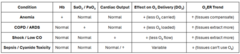
Calculations Summary (pic)

Clinical Patterns (pic)
What are the 4 steps of carbon monoxide (CO) poisoning?
1. CO binds to the iron on hemoglobin (200x stronger than O2)
2. carboxyhemoglobin (COHb) is formed
3. This prevents O2 from attaching and causes a left shift in the oxyhemoglobin curve
4. This results in Hb that holds O2 tightly but won't release it to tissues
What are the 4 reasons that carbon monoxide (CO) poisoning is dangerous?
1. SpO₂ appears normal (pulse ox can't tell COHb from O₂Hb)
2. PaO₂ appears normal (O₂ dissolved in plasma is unchanged)
3. CaO₂ and tissue O₂ delivery drop sharply
4. Patient may be pink and "oxygenated," yet severely hypoxic
What are the 3 common causes of carbon monoxide (CO) poisoning?
1. Faulty heaters
2. Running engines in enclosed areas
3. Smoke inhalation
What are the 2 treatments for carbon monoxide (CO) poisoning?
1. 100% O2 (displaces CO from Hb)
2. Hyperbaric O2 for sever cases (speeds up dissociation)
Carbon Monoxide Chart (pic)

What is the main waste product of metabolism?
CO2
What is too much CO2 called?
Acidosis
What is too little CO2 called?
Alkalosis
Respiratory therapists regulate CO2 every time we adjust a __ or __.
ventilator; oxygen device
What is CO2 composed of?
A carbon atom covalently double bonded to 2 oxygen atoms
CO2 is a by-product of what 2 processes?
1. Fermentation
2. Cellular respiration
What are the 3 main forms that CO2 is transported in?
1. Dissolved in plasma (5%)
2. As carbamino compounds (20%)
3. As bicarbonate (75%)
What protein does CO2 mainly bind to?
Hemoglobin; when it binds it is represented as HbCO2
Is HbCO2 reversible?
Yes
What is the reaction that maintains acid-base balance?
The Carbonic Acid-Bicarbonate System
What is the reversible formula for the Carbonic Acid-Bicarbonate System?
CO2 + H2O ←→ H2CO3 ←→ H + HCO3
What are the 4 steps of the Carbonic Acid-Bicarbonate System
1. Carbon dioxide (CO₂) combines with water (H₂O) to form carbonic acid (H₂CO₃).
2. Carbonic acid quickly breaks down into hydrogen ions (H⁺) and bicarbonate (HCO₃⁻).
3. This reaction happens rapidly inside RBCs because of carbonic anhydrase enzyme
4. The system is reversible and maintains a stable blood pH (7.35-7.45)
Why is most CO2 carried as bicarbonate (HCO3)?
because it's a safe, soluble way to transport acid without changing blood pH too quickly
What are the 2 steps of the Chloride Shift (Hamburger Shift)?
1. As CO2 enters the RBC, the bicarbonate ion (HCO₃⁻) leaves the RBC and enters the plasma
2. To keep the electrical charge balanced, a chloride
ion (Cl⁻) moves into the RBC
What does the Chloride Shift prevent?
The RBC from becoming too negatively charged as bicarbonate leaves which allows continuous CO2 transport without disrupting the cell's neutrality