HCIS 1105 10/6-10/22
 Call Kai
 Learn
 Practice Test
 Spaced Repetition
 Match
 Flashcards
 Knowt Play
1/106

There's no tags or description
Looks like no tags are added yet.
107 Terms
Lipids
Fats and oils made of carbon, hydrogen, and oxygen… hydrophobia (does not dissolve in water)… in food it carries flavor, aroma, helps you feel full
Energy: 9 kcal/g… stored as adipose (fat) tissue (nearly unlimited energy)
Cell membrane: phospholipids form the outer layer of every cell
Raw materials: Made into hormones, vitamin D, and bile
Vitamin carriers: vitamins A,D,E,K need fat to be absorbed
Protection and warmth: cushions organs and insulates against cold
Can’t get rid of fat cells, only shrink
Fatty acids: building blocks
Chain length: most food fats have 16-18 carbons, usually an even number
Double bonds: the number of double bonds decides saturated, mono- or polyunsaturated
Omega end: count from the methyl end to the first double bond: omega-3, omega-6
Saturated vs monounsaturated vs polyunsaturated fatty acids
Saturated - monounsaturated - polyunsaturated
Double bonds: none - 1 - 2+
At room temp.: usually solid (straight chains packed tight) - usually liquid - liquid (kinked chains)
Common sources: butter, cheese, fatty meat, coconut/palm oil - olive/canola oil, avocado, peanuts, and most nuts - fish, walnuts, seeds, soybean, corn/sunflower oil
Health note: too much raises LDL colesterol - helpfull when it replaces saturated fat - includes essential omega 3 and 6

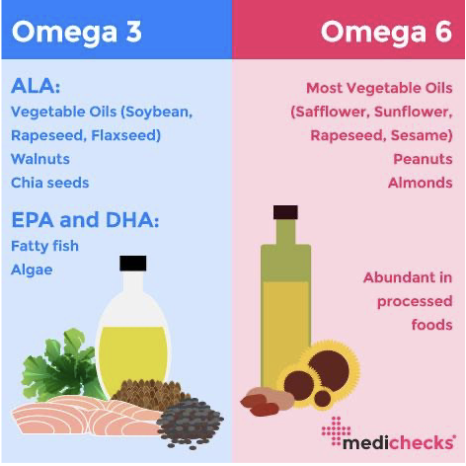
Essential fats: omega 3 and omega 6
Essential: body cannot make it, so it must come from food
Omega 3 fats:
ALA- walnuts, flax, chia, soybean, and canola oil
EPA and DHA: salmon, sardines, trout, mackerel
Omega 6 fats:
Linoleic acid: soybean, corn/sunflower oil, nuts, seeds
Most people already get plenty
Food fats are mixtures
Foods will have different amounts of saturated, monosaturated, polyunsaturated

Triglycerides: how fat is stored and carried
The main form of fat in food and in your body… energy-dense storage in fat cells (adipose tissue)… carried in blood by lipoproteins; the blood level appears on lipid profile… extra calories from any source (sugar, starch, alcohol, fat) can be stored as triglycerides

Phospholipids
2 fatty acids + a phosphate heat… mix with water and fat; they build every cell membrane… lecithin (egg, yolk, soybeans) is a food emulsifier

Sterols (including cholesterol)
Cholesterol: made by your liver; found only in animal food… needed for hormones, vit D, and bile… for most ppl, saturated fat raises LDL more than food cholesterol does
Trans fat
Trans fat forms when liquid oil is partially hydrogenated (hydrogen is added) to make it solid and shelf-stable… industrial trans fat raises LDL, lowers HDL, and raises heart disease risk… the FDA phased out partially hydrogenated oils in US foods… a label can say 0g of trans fats if it is under 0.5g per serving (have to check ingredients)

Fat digestion and absorption
1.) mouth has a little fat digestion… fat floats and slows stomach from emptying, making full feeling
2.) the small intestine has bile from gallbladder breaks fat into tiny droplets (emulsification)
3.) pancreatic lipase splits triglycerides into fatty acids and monoglycerides
4.) fat enters intestinal cells and is repackaged to travel through the body
short/medium chain fatty acids → absorbed into blood → liver first
long chain fatty acids → rebuilt into triglycerides → chylomicrons → lymph → blood (bypass the liver initally)

Lipoproteins: how fat travels in blood

Reading a lipid profile

What pushed triglycerides up?
Diet and lifestyle drivers: extra overall calories, added sugars, refined carbohydrates, alcohol, inactivity an d extra weight
Other contributors: type 2 diabetes/insulin resistance, low thyroid/kidney disease, some medicines, genetics
2025-2030 dietary guidlines regarding fat

2025-2030 changes and stayed the same
Same: saturated fats stay under 10% of calories, fats are essential/don’t eliminate, olive oil and unsaturated sources encouraged, added sugars and sodium limit
New: diary (full fat with no added sugars compared to fat free or low fat before), butter and beef tallow as other options in cooking (experts disagree: studies show butter and beef tallow raise LDL more than olive oil), added sugar has no recommended amount (stay under 10g per meal)
Saturated-fat math
Chose unsaturated fats more (olive oil, sunflower seeds, mixed nuts, avocado, salmon) and saturated fats less (butter, bacon, potato chips, cheese, steak)

Mediterranean style eating

‘Low fat’ isn’t automatically healthy
less fat > flavor replaces with sugar, starch, or salt > calories typically about the same > still highly processed
Label check: serving size and calories, saturated fat % of daily value (5% or less is low, 20% or more is high) added sugars and sodium, ingredient list (look out for partially hydrogenated oil or sugar near the top)
Protein
Large molecules made of amino acids that perform many essential functions in the body
Functions: build and repair tissues, support the immune systems, regulate body processes (how your body uses energy)

Chemist view of protein
Proteins contain: carbon, hydrogen, oxygen, nitrogen… amino acids (carbon, hydrogen, amino group, acid group, side group or side chain)

How do amino acids build proteins?
Peptide bonds (link the amino acids)
Strands of amino acids do not remain straight (have coils and folds)
Side chain electrical charge (activation)

Condensation of 2 atoms to form a dipeptide
Need water and two amino acids (***)

Protein digestion
Starts in the stomach and small intestine (duodenum)
3 main enzymes break down food proteins into polypeptides: pepsin (secreted by stomach), trypsin and chymotrypsin (secreted by pancreas into small intestine which break into amino acids, which are absorbed)

Dipeptides
Two amino acids together
Protein bioavalibility
AKA how much of protein is digested, absorbed, and used in the body (important for building and repairing body tissues)
Animal proteins=high bioavailability
Plant proteins=lower bioavailability

Functions of body protein (8 listed)
Structure, enzymes, hormones, antibodies, fluid balance, acid-base balance, channels/pumps, and transport
Functions of body protein: structure and movement
The protein that make up your muscles, skin, bones, tendons, etc
Collagen stengthens skin, joints, and blood vessels
Functions of body protein: repair and recovery
Protein turnover, breakdown-recovery-synthesis, the body needs protein daily to build new cells
Functions of body protein: gene expression and enzymes
Protein helps turn genes on/off and act as enzymes for metabolism
Affects how body responds to meds, break down food, or fight illness
Enzymes deficiencies (like PKU) requires strict dietary protein control
Function of body proteins: building
Builds enzymes, hormones, channels, neurotransmitters messages, and antibodies (antibodies: destroy one specific invader… each antibody is made to recognize and destroy one specific invader like a virus or bacteria)
Functions of body protein: maintaining acid-base balance
The body needs to keep blood pH in a very tight range (~7.35-7.45)
Proteins buffer the blood… acidosis (too much acid in blood) and alkalosis (too much base in blood)
Blood clotting: proteins clot blood to prevent bleeding
Functions of body protein: transportation
Transport substances
Hemoglobin (in red blood cells) carriers oxygen in blood
Lipoproteins

Nitrogen balance
Protein has nitrogen and balancing that is having an equal protein intake and outtake… this will show if the body is building or breaking down tissue… when nitrogen intake and outtake or equal=nitrogen equilibrium
Need positive balance (more in than out)= growth, pregnancy, healing
Need negative balance (more out than in)= starvations, burns, severe illness
Protein recommendation
The protein RDA for adults is 0.8g/kg body weight minimum (10-35% of total energy intake)
Athletes protein intake
Eat ~6g of protein and ~35g of carbs before exercise
Eat ~20g protein snack/bev with adequate carbs to repqir/stimulate muscle proteins and replenish muscle glycogen stores after exercise (within 30mins)
Practice question: calculate the recommended daily protein intake of a 5’11’’ 185lb male
Lower limit: 67g (convert to kg and multiply by .8)
Upper limit 100g (convert to kg and multiply by 1.2)
How many different types of amino acids are there?
20 (on exam)
How many essential amino acids are there?
9 (means body cant produce so needs from food)
Histidine, isoleucine, leucine, lysine, methionine, phenylalanine, threonine, tryptophan, and valine

Complete proteins
Meat, fish, egg, dairy (have all 9)
Complementary proteins
Two or more proteins foods that in combination have all 9 essential amino acids (like rice and beans)
Conditionally essential amino acids
Amino acids that become essential when sick
Arginine, cysteine, glutamine, tyrosine
Protein supplements
Science shows they do not improve performance and they are not effective for weight loss
Shouldn’t be only source
Effects of protein
Protein energy malnutrition… marasmus ad kwashiorkor
Heart disease: animal-protein intake, homocysteine levels (coffee’s role), arginine levels
Cancer, adult bone loss, weight control, kidney disease
Vitamin
Any group of organic compounds which are essential for normal growth and nutrition and are required in small quantities in the diet because they cannot be synthesized by the body
Fat soluble: A,E,D,K (absorbed/transported/stored with fats)
Vitamin A
Major functions: supports vision (night blindness), strengthens the immune system, helps maintain healthy skin, mucous membranes
Found in: animal foods=liver eggs (preformed vitamin A-retinol) plants=caorrots, sweet potatoes (provitamin A-beta carotene)
Deficiency: can cause night blindness, severe deficiency (xerophthalmia=eye damage)
At risk: in developing countries caused by poverty and lack of access to rich food sources
Vitamin E (alpha-tocopherol)
Function: major antioxidant- protects cells from damage caused by free radicals, helps support the immune system
Food sources: found in nuts, seeds, vegetable oils, green leafy vegetables
Deficiency: can cause nerve or muscle damage (especially in people with fat-malabsorption)
Toxicity: rare, but high dose from supplements can interfere with blood clotting
Vitamin K
Blood and bone health
Function: need to help clot blood (makes clotting proteins like prothrombin), helps with bone health by activating bone-building proteins
Food sources: leafy greens (K1)= spinach, broccoli… fermented/animal foods (K2)= cheese, natto, liver
Deficiency: may cause bleeding/bruising, may affect bone strength over time, newborns recieve a vit. k shot at birth to prevent bleeding
Vitamin D (calciferol)
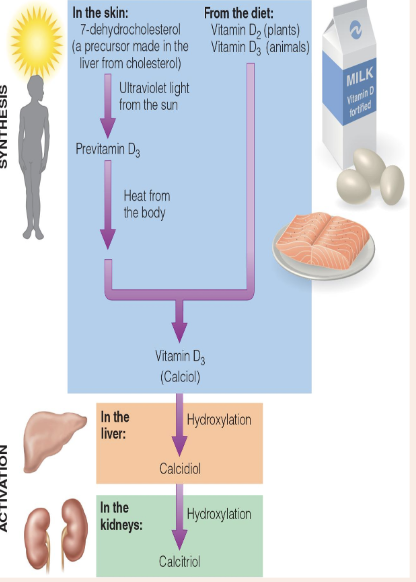
Function: made from ultraviolet rays from the sunshine on the skin… helps the body absorb calcium from strong bones and teeth…supports muscle function, immune health, and inflammation control
Food sources: (D3=animal, D2=plants) fatty fish (salmon, tuna, mackerel), fortified milk/cereal, egg yolks, liver, mushrooms
Deficiency leads to: rickets/osteoprorosis, muscle cramps and weak bones
Water soluble vitamins
Dissolve in water, absorption, transport, excretion out of body (excess), sources, food, supplement, cooking loss in preparation (try to keep in original state)
Need regular intake; B vitamins work as coenzymes for energy metabolism
Need daily vs fat-soluble that can be stored
Toxicity is mostly from supplements (for example the niacin flush)
Examples: C, B1, B2, B3, B6, B9, B12
Fat soluble vitamins
Don’t need daily because they can be stored
Absorbed, transported and stored with fats, stored in the liver and fat tissue
Not easily excreted, so they can build up (toxicity risk, especially from supplements)
Examples: A,E,D,K
Deficiency is more likely with fat malabsorption
Vitamin C as a cofactor
Cofactor in collagen formation: matrix for bone and tooth formation, conversion of proline to hydroxyproline
Cofactor in other reactions: hydroxylation of carnitine (fatty acid metabolism), conversion of trytophan to serotonin, conversion of tyrosine to norepinephrine, making hormones
Collagen supplements contain amino acids, vit. c, biotin, or zinc (research shows no harm)
Roles of vitamin c
Vitamin c protects cells and tissues from these unstable molecules that can cause oxidative stress, which plays a role in disease development (prevention and treatment of common cold… slight but consistant shortening of cold duration… deactivates histamine)
Stress increased vit. C needs (adrenal glands release vit. C and hormones into blood)
Body recycles vit. C to keep reserve of antioxidants
Vit. C enhances the absorption of iron by preventing its oxidation
Vitamin C intake (mg/d)
10mg prevents overt symptoms of scurvy… UL for vit. c is 2000 mg/day… smoking increases need… vit. c can be destroyed by heat and light… foods at peak ripeness eaten raw contain the most vit. c
Vitamin c in selected foods
Fruits/vegs are the best sources
Citrus (oranges, kiwi, lemon, grapefruit), bell peppers, strawberries, tomatoes, cruciferous vegetables (broccoli, brussel sprouts, cabbage, cauliflower), white potatoes
Vit C deficiency
Fatigue, malaise
Iron-deficiency anemia due to decreased absorption of non-heme iron
Notable signs of deficiency: gums bleed easily around teeth, capillaries under skin break spontaneously
Scurvy (resulting from loss of collagen weakening connective tissue)… skin spots caused by bleeding and bruising from broken blood vessels… swelling or bleeding gums and eventual loss of teeth… hair loss… delayed healing… sudden death from massive internal bleeding
Vitamin B
Vitamin B works in unison with each other
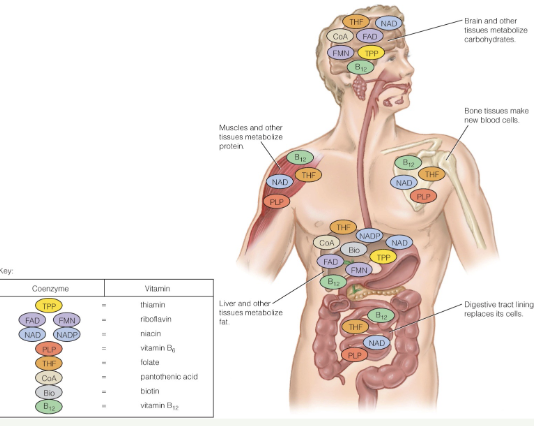
Function as part of coenzymes (combines with enzyme to activate it, coenzyme shape)
Role in metabolism (help the body use the energy-yeilding nutrients for energy)
Cell multiplication
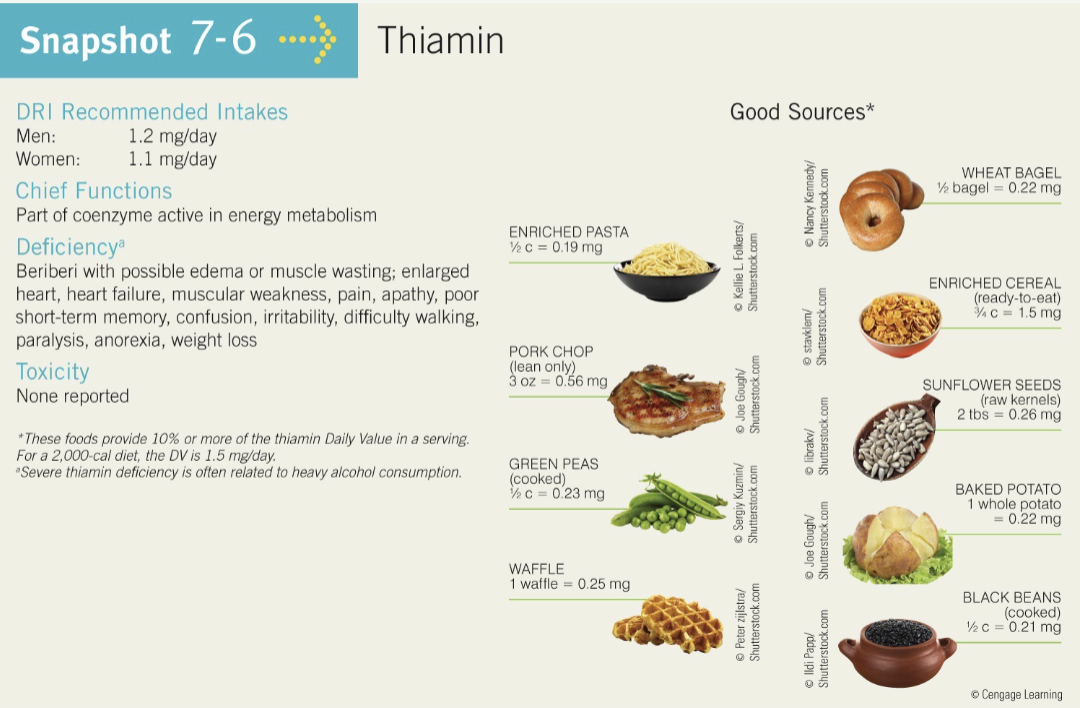
Thiamin (vit. b1)
Function: energy metabolism of all cells, nerve cell membranes
Deficiency: beriberi (forms), alcohol abuse (will have low thiamin)
DRI recommendation (food sources): pork chops, peas, waffles, enriched pasta, wheat bagel, potato, black beans
Riboflavin (vit. b2)
Function: part of coenzyme active in energy metabolism
Deficiencies: every cell affected, isolated deficiencies are rare, cracked mouth
Sources: milk, yogurt, pork chop, cottage cheese, spinach

Niacin (vit. b3)
Function: participates in energy metabolism
Deficiency: pellagra, characterized by flaky skin rash when exposed to sun, mental depression, apathy, fatigue, loss of memory, bright red/black tounge
Sources: red meat, poultry, fish, brown rice, nuts, bananas

Folate (vit. b4)
Function: needed to make DNA and RNA (important for rapidly growing cells), help convert vit. b12 into its active form, essential during pregnancy to prevent birth defects (neural tube defects), helps lower homocysteine (linked to heart disease)
Food sources: leafy greens, fortified grains, supplements
Deficiency: megaloblastic anemia (larger immature RBC)=weakness, taigue, difficulty concentrating, mouth sores…
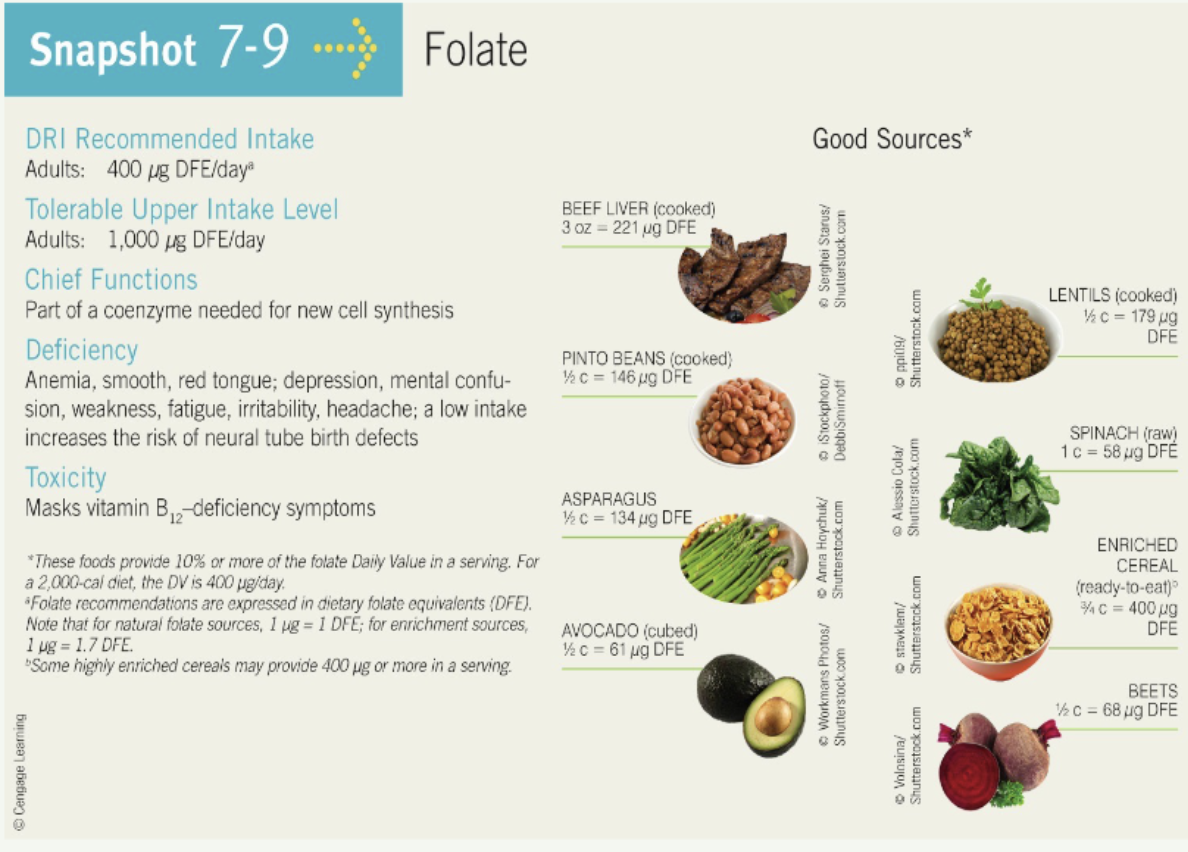
Folate deficiency
Signs of deficiency: megaloblastic anemia (larger immature RBC), weakness/fatigue, difficulty concentrating, mouth sores
Neutral tube defects (spina bifida): supplement use during pregnancy (1 month before conception through 1st trimester), fortified grain products

Cobalamin (vit. b12)
Functions: work with folate to make DNA and RBC, helps nerves healthy
Sources: animals-based foods and fortified foods
Deficiency: Megaloblastic anemia, nerve damage (ex: memory loss, numbers, poor coordination)
At risk: vegans, older adults, and people with pernicious anemia (may take years to show up)

Pyridoxine (vit. b6)
Functions: part of coenzyme needed in amino acid and fatty acid metabolism, helps convert tryptophan to niacin and to serotonin, helps make hemoglobin for RBC
Deficiency: anemia, depression, confusion, convulsions, dermal issues
Toxicity: depression, fatigue, impaired memory, irritability, headaches, nerve damage, etc

Choline
Essential nutrient (commonly grouped with B vti.)… can be manufactured from methionine in the body
Functions: used to make lecithin and acetylcholine (neurotransmitter helping with muscle contraction, pain responses, brain functions like memory)
Metabolized in the liver, breaks down cholesterol
Food sources: meat, fish, poultry, dairy, eggs
Deficiency rare: can lead to muscle damage or NAFL
Toxicity: low blood pressure, excessive sweating, nausea, fishy body odor
Why take supplements?

Why shouldn’t you take supplements?
Food rarely causes nutrient imbalances or toxicities (supplement user likely to have excessive intakes), supplement contamination/safety, life-threatening misinformation, false sense of security, whole food are best for nutrients
Clue board: fat soluble vitamins

Clue board: water soluble vitamins

A student lives on white rice and chips and almost never eats fruit or vegetables. Her gums bleed when she brushes, and small bruises keep appearing. What vitamin deficiency does she have?
Vitamin C deficiency (Bleeding gums and easy bruising point to weak collagen and fragile capillaries (scurvy signs). Fix: peppers, citrus, strawberries.)
A strict vegan has been very tired lately and has tingling in his hands. Labs show large, immature red blood cells. What vitamin deficiency does he have?
Vitamin B12 deficiency (Megaloblastic anemia plus nerve symptoms, in a vegan. B12 comes from animal or fortified foods.)
A student takes a high-dose vitamin D supplement every day plus extra calcium. Now he has nausea, muscle weakness and constant thirst. What vitamin deficiency does he have?
Vitamin D toxicity (Too much vitamin D raises calcium (hypercalcemia): nausea, weakness, thirst. Extra calcium adds kidney stone risk.)
Water basics
Makes up about 60% of an adults body weight… about 20% of our water consumption comes from food… total water AI: 2.7 L/day for women, 3.7 L/day for men… kidneys regulate blood volume… water lost via urine, lungs (breathing), sweat, feces… maintains fluid balance, electrolyte balance (attracts water), acid/base balance (regulation by buffer system) and blood pressure…
How do kidneys work?
Have tons of arteries (renal arteries) that go into nephrons that sift through the blood using 2 parts: a glomerulus and tubule
Glomerulus: only allows certain things like vitamins and minerals into tubule
Tubule: detect if ingredients are needed in body, if so absorbs amount needed to circulate in blood again (renal vein)… will redirect waste and unneeded ingredients as waste (ureter) to bladder with unneeded water
High water level: some released with urine
Low water level: release some back in blood= less in urine
Main role of kidneys
Dispose of waste products and turn into urine
All blood in body filters through kidneys 20-25 times a day
Activate vit. D to secrete a hormone called renin (to raise blood pressue) and erythropoietin (to produce red blood cells)
All functions of kidneys
Balance fluid, detect waste in blood, know when to release vitamins, minerals, and hormones you need to stay alive
Electrolytes location in relation to cells
Outside: Na+, Cl-, Ca2+… inside: K+, Mg2+, Phosphate, sulfate… (Na+/K+ pump: 3 Na out, 2 K in)
Water follows sodium: sodium decided how much fluid stay s outside cells, so it drives blood volume and BP
Charges=electrolytes:" their movement carriers nerve signals and muscle contractions
Minerals
Inorganic elements that are not destroyed by heat, air, acid, or mixing
Some food contain binders that block mineral absorption: phytates (grains), oxalates (spinach, rhubarb), tannins (tea, coffee)
Supplements or high intake of one mineral can affect others (ex: when sodium intake is high, more calcium is lost in urine)
Absorption blockers and solutions: p one
Phytates-
Found in: whole grains, legumes, nuts, seeds
Binds: calcium, iron, zinc, magnesium
Kitchen fix: soak, sprout, ferment, or cook (all lower phytate)
Absorption blockers and solutions: o one
Oxalates-
Found: spinach, swiss chard, rhubarb, beets, almonds
Binds: calcium (spinach clacium=5% absorbed vs =30% from milk)
Kitchen fix: boil or blanch and discard water… pair with calcium food… matters for kidney stone history
Absorption blockers and solutions: t one
Tannins-
Found in: tea, coffee, red wine, cocoa
Binds: non-heme (plant) iron
Kitchen fix: drink tea or coffee between meal, not with… add vit. c to the meal
Sodium (Na)
Roles in body: main positive ion outside cells (in blood and body fluids)… it controls fluid balance by keeping the right amount of water outside cells… helps maintain body’s acid-base balance (ph)… needed for nerve signals and movement
Sodium travels freely in the blood
Kidneys filter out and recycle what is needed
Sodium in foods
High: microwave meals, canned soup, pizza, bread
Low: vegetables and fruits
Frequency and portion matter
Sodium recommendations
Sodium deficiency happens when the body loses too much sodium through sweat and urine
High sodium is correlated with high blood pressure (CDRR= 2300 mg/day while AI= 1500 mg/day)… average sodium intake in US is 3400mg… type of salt had the greatest effect on blood pressure
DASH helps lower sodium and heart healthy
Sodium connection to bone loss
High sodium=bone loss risk… high salt intake is linked to increased calcium excretion and long term intake increases risk of osteoporosis
Potassium helps protect bones… DASH diet recommendation… processed foods have most sodium while fresh foods have least
Hyponatremia
Sodium is diluted: too much water relative to sodium (<135)
Common causes: drinking lots of plain water, vomiting/diarrhea, heavy sweating
Signs: headache, nausea, confusion cramps, weakness, seizures, and even coma
Hypernatremia
Too little water relative to sodium (>145)
Common causes: not enough water or no access (older adults, infants)… fever, large urine losses… too much sodium, like IV saline or tube feeding
Signs: thirst, dry mucous membrane, restless, irritable, confusion, seizure (severe)sNote: a salty diet is not hypernatremia… it is a blood-test problem of too little water
Chloride (Cl)
Essential nutrient
Role: major anion of extracellular fluids… moves passively across membranes… associates with sodium and potassium… helps maintain fluid and electrolyte balance… part of stomach acid=digestion
Potassium (K+)
Principal intracellular cation
Role: helps maintain fluid and electrolyte balance… helps keep heart beating and muscles moving
Potassium intakes
Potassium is abundant in all cells… processing food can destroy potassium so best source is fresh foods… diets low in potassium raise blood pressure… high potassium and low salt diets can correct or prevent hypertension… AI= 2600 mg for women 3400 mg for men
High potassium foods
Acorn squash, baked potato, banana, soybean tomato juice, 2% milk, orange
Hypokalemia
Serum potassium too low (<3.5)
Common causes: loop or thiazide diuretics… vomiting/diarrhea/laxative misuse… very poor intake
Sings: weakness/fatigue/cramps, constipation, palpitations/arrythmia
Hyperkalemia
Serum potassium too high (>5.0)
Common causes: kidney disease/injury… ACE inhibitors, ARBs, K-sparing diuretics… K supplements, salt substitutes (KCL)
Signs: weakness/tingling, slow or irregular heartbeat, cardiac arrest (severe)
Calcium (Ca)
Builds and stores in bones/teeth… bones act as calcium bank (store and release calcium daily)… calcium helps keep bones strong and prevents bone loss
Other roles: helps muscles contract, helps nerves send signals, majority of body’s calcium
Calcium recommendations
Hormones maintain blood concentration regardless of dietary intake
When intake is low bones suffer
Recommendations sert high enoguh to acommodate for average 30% absorption rate (1300mg for adolescents, 1000mg for adults to age 50, 1200 for women over 50 and everyone over 70)
Calcium sources
Milk, sesame seeds, chia seeds, almonds, tofu, greens
Calcium in bones
Peak bone mass is achieved by late 20s (reaching peak bone mass means denser bones protect against age related bone loss and fracturing)
Osteopenia=low bone mass… bone lass start 30-40yo (women may lose up to 20% of their bone mass 6-8 yrs after menopause)
Osteoporosis= porous and fragile bones

Supplements (Ca)
Calcium from foods support health better than supplements
Various forms (calcium carbonate, citrate, gluconate, lactate, malate, or phosphate) some made from bone meal, oyster shell, or dolomite
Smaller does absorbed better than large doses
Total calcium: 2500mg/day for 19-50 and 2000mg/day for over 50
Phosphorus (P)
Second most abundant mineral in body… most stores in bones/teeth
Roles: part of DNA and RNA, helps cells grow and repair, involved in E metabolism, acts as a buffer, helps move fats (lipids) around the body, part of cell membranes and fat transport system
Phosphorus intakes
Deficiencies are unlikely, best sources are protein rich foods, UL= 4000mg/ RDS=700mg, toxicity is rare
Magnesium (Mg)
Over half of the body magnesium is in the bones… bones act as storage reservoir to help keep blood levels normal
Roles: helps build and maintain strong bones, needed for energy metabolism (helps the body use food for energy), support nerve function, assits with muscle contraction (including the heart)