AphA content
 Call Kai
 Learn
 Practice Test
 Spaced Repetition
 Match
 Flashcards
 Knowt Play
1/97

There's no tags or description
Looks like no tags are added yet.
98 Terms
Examples of Active Immunity
infection with chickenpox and influenza vaccine
Examples of Passive Immunity
antibodies in breast milk, antivenom injection, and immune globulin infusion
Live vaccines
MMR, Varicella, Rotavirus, MMRV, Live attenuated influenza, Oral Typhoid Capsules, Yellow fever
Inactivated Vaccines
Flu, covid, rsv, pneumoccoal, hep a and b, meingococcal, Tdap, polio, zoster, HPV, typhoid injection, chikungunya
Can you separate injection sites
Yes by 1 inch
Minimum interval of 2 inactivated vaccines
No minimum
Minimum interval for inactivated and live vaccines
No minimum
2 live vaccines, if not simultaneous minimum interval
28 day minimum interval
Minimum interval for inactivated vaccines and antibodies
No minimum
Minimum interval for live vaccines followed by blood products
2 weeks
Minimum interval for blood product given before live vaccine
Minimum interval varies
Minimum interval live vaccine followed by PPD skin test
28 day minimum
PPD skin test followed by live vaccine minimum interval
Administer vaccine after PPD skin test has been read
ACIP grace period for vaccines
On time is within 4 days of the minimum interval; some states do not allow a grace period
Do live vaccines have a grace period
No
Universal contraindication for all vaccines
Severe allergy to a vaccine or vaccine component following a previous dose
Temporary contraindications
Pregnancy and immunosuppression
False contraindications
minor illness, allergies to products not in the vaccine, allergies that are not immediate and life threatening, pregnancy in the household, breastfeeding, premature birth
Vaccine Recommendation Process
FDA Approval, ACIP Recommendation, CDC Director Approval
Intended Audience of AAP
Pediatric health care providers
ACOG intended audience
OB/GYN and women’s health providers
AAFP intended audience
Family medicine and primary care providers
ACP Intended Audience
Internal medicine and adult primary care providers
ISDA intended audience
Infectious disease specialists and clinicians
Standard dose, unadjuvanted inactivated (IIV3)
-Fluarix,FluLaval,Fluzone,Alfuria
-Egg based manufacturing process that has been used for more than 70 years
-Candidate vaccine strain grown in fertilized chicken eggs and incubated to replicate
Cell Culture-based inactivated (ccIIV3)
-Flucelvax
-candidate vaccine strain grown in mammalian cells
Adjuvants inactivated (aIIV3)
-fluad
-uses egg based methods, after the virus is harvested and split into surface proteins it is blended with an oil in water adjuvant which boosts immunity
High dose inactivated (HD-IIV3)
-fluzone high dose
-uses egg based method with four times the antigen
Recombinant (RIV3)
Flu
flublok
do not require the use of a candidate vaccine virus for production
virus gene that contains the genetic instructions for making the HA which is then combined with baculovirus, a virus that infects inveterbrates
Live attenuated influenza vaccine (LAIV3)
Flumist
Use egg-based methods where weakened live viruses are injected in fertilized chicken eggs and incubated to replicate
Strains are genetically modified to be cold adapted temperature sensitive
Did the child receive > 2 doses of trivalent or quadrivalent vaccine before July 1, 2026? No or Unknown
2 doses of 2026-27 influenza vaccine (administered >4 weeks apart)
Contraindication for flu
severe hypersensitivity to a component
LAIV contraindications
pregnancy, immunocompromised, HIV infection, asplenia, complement disorders, children <5 years with recurrent wheezing, asthma, drug interactions (aspirin, salicylates, antivirals targeting influenza virus)
Influenza Injection site
pain,erthema, tenderness, swelling, itching, soreness,brusing
Flu systemic symptoms
H/A, fatigue, irritability, lose of appetite, muscle ache, joint ache, abnormal crying, vomiting, diarrhea, syncope
Flu uncommon symptoms
anaphylaxis, Guillain-barre syndrome, febrile seizures
Flu Nasal Symptoms
runny nose, nasal congestion
Flumist
-use within 12 hours outside of refrigerator
-children <18 years should not self administer
Children and Adolescents Recommendations
-Age appropriate routine annual influenza vaccination is recommended for all persons aged 6 months through 18 years of age who do not have contraindications
-HD-II3 and aLL3 influenza vaccine as acceptable options for influenza vaccination of solid organ transplant recipients aged 18 years receiving immunosuppressive medication regimens without a preference over other age appropriate IIV3s or RIV3
recommendation for flu >65 years
high dose inactivated
recommendations for flu for 19-64 years solid organ transplant patients receiving immunosuppressive medication regimens
no specific recommendation
Vaccination during July and August not recommended for most groups except:
-pregnant persons in the third trimester
-children <9 years who need 2 doses in one season
-concern that vaccination later in the season might not be possible
For most persons who need only 1 dose of influenza vaccine for the season
September and October
PPSV
-different polysaccharides from different serotypes as the antigen
-immune response is T cell independent
PCV
-polysaccharides for different serotypes attached to a carrier protein
-T0cell dependent response that produces memory B cells and reduces carriage of the bacteria in the respiratory tract
PPSV23
Pneumovax
PPSV23 approved age recommendation
50 years and older
> 2 years of age at risk for pneumococcal disease
PC15
VAXNEUVANCE
PCV15 Approved Age Indication
6 weeks of age and older
PCV20
prevent 20
PCV20 Approved Age Indication
6 weeks of age and older
PCV21
Capvaxive
PCV21 Approved Age Indication
18 years and older
Children 2-17 years who have completed a PCV vaccine series and have at least one medical condition
Pneumococcal Vaccine Precatuion
Immune suppressing therapies could reduce efficacy
Pneumococcal Vaccine Contraindication
severe hypersensitivity to a component
PCV Vaccine- Injection Site
tenderness, redness, swelling, pain, induration, limited arm movement
PCV Vaccines- Systemic
irritability decreased, changes in sleep pattern, headache, muscle pain, joint pain, vomiting, chills, rash, syncope
PCV Vaccine and PPSV Vaccine- Uncommon
Anaphylaxis
PPSV Vaccine- Injection Site
pain, soreness, tenderness, swelling, induration, erythema
PPSV Vaccine- Systemic
headaches asthenia, fatigue, muscle ache
Pneumococcal Vaccine Recommendations- Children
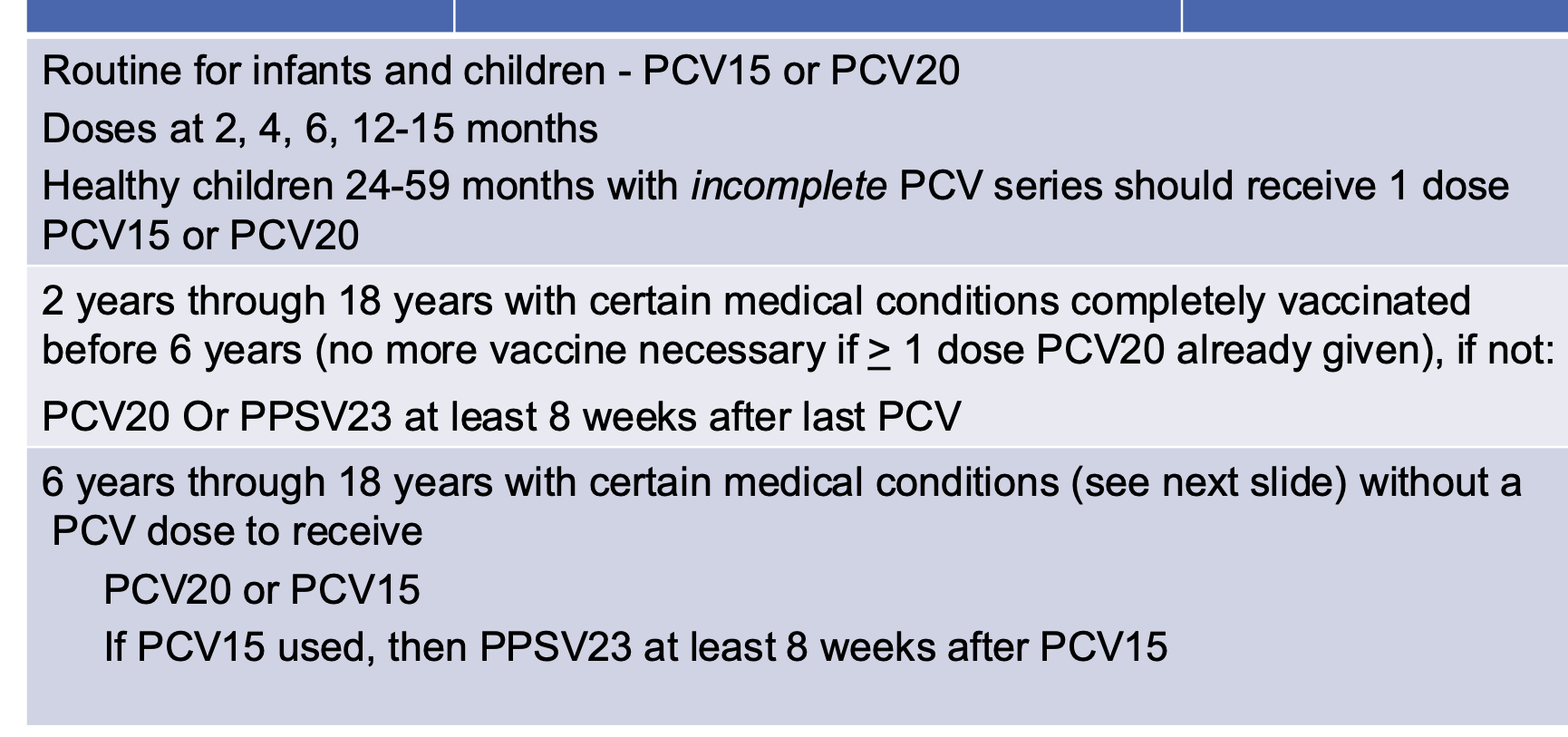
Pneumococcal Vaccine Recommendation-Adults > 50 years
Single dose of PCV15 followed >1 year later by a single dose of PPSV23 or Single dose of PCV20 or Single dose of PCV21
Pneumococcal Vaccine Recommendation-Adults 19-64 years with certain medical conditions
Single dose of PCV15 followed >1 year later by a single dose of PPSV23 or Single dose of PCV20 or Single dose of PCV21
RSV mAb
-Antibodies circulate in the bloodstream and recognize and attach to the RSV virus if encountered, leading to elimination of the virus
-Provides passive immunization for immediate protection and lasts for about 5 months
Protein-Based RSV
-Recombinant protein vaccines that contain the perfusion form of the F protein found on the surface of the RSV virus
RSV mRNA
-mRNA that encodes the perfusion form of the RSV F glycoprotein
-mRNA vaccine temporarily enables some of the vaccine recipients own cells to produce the perfusion form of the RSV F protein, causing the immune system to respond by generating antibodies to it
mAB RSV vaccines
Nirsevimab and Clesrovimab
Nirsevimab age approved indication
Neonates and infants born during or entering their first RSV season. Children up to 24 months of age who remain vulnerable to severe RSV disease through their second RSV season
Clesrovimab Approved Age Indication
Neonates and infants who are born during or entering their first RSV season
Nirsevimab mAb Recommendation
-Infants <8 months of age born during or entering their first RSV season if:
Pregnant parent did not receive RSV vaccine during this pregnancy
Pregnant parent’s RSV vaccine status is unknown, OR
Infant was born <14 days after the pregnant parent’s RSV vaccination
Born during RSV season; Administer 1 dose nirsevimab within 1 week of birth, ideally during the birth hospitalization
Born outside of RSV season: Administer 1 dose nirsevimab shortly before or during the RSV season
RSV mAb Contraindication
severe hypersensitivity to a component
RSV mAb Injection Site
Pain, induration, edema, swelling
RSV mAb Systemic
maculopapular rash
RSV mAb Uncommon
anaphylaxis
RSV Vaccine you should give to pregnant patient
Abrysvo
Adjuvanted RSVPreF3
Arexy
Arexy approved age indication
18 years and older
Bivalent RSVpreF
Abrysvo
Abrysvo Approved Age Indication
-18 years and older
-32 through 36 weeks weeks gestational age of pregnancy
Nucleoside modified mRNA encoding the RSV F glycoprotein stabilized in pre F protein mRNA-1345
mRESVIA
mRESVIA Approved Age Indication
18 years and older
RSV Vaccine Safety- Protein Vaccines
Injection Site- Pain
Systemic- tiredness, headaches, muscle pain, joint pain, fever, chills
Uncommon- Anaphylaxis, Guillain-Barre Syndrome
RSV Vaccine Safety- mRNA Vaccine
Injection Site- pain, underarm swelling and tenderness
Systemic- fatigue, tiredness, headache, nausea, muscle pain, joint pain, chills
Uncommon-anaplylaxis
RSV Vaccine Recommendation-Adult
-All adults aged >75 years
-Adults 50-74 years who are at increased risk of severe RSV disease receive a single dose of RSV vaccine
Older Adults Correct RSV Product
Abrysvo, Arexvy, mResvia
mRNA COVID vaccine
Lipid nanoparticle formulated, nucleoside modified mRNA vaccines encoding the perfusion spike glycoprotein of SARS CoV2
Protein-based COVID Vaccine
-Contain pieces of the virus that causes COVID 19
-Contains an adjuvant
mRNA Covid 19 Vaccines
COMINARTY, SPIKEVAX,mNEXSPIKE
Protein-based Covid Vaccine
NUVAXOVID
Cominarty Age Approved Indication
-5 years to 64 years of age with at least one condition that puts them at that puts them at high risk for severe outcomes from COVID-19
-All adults 65 years and older
SPIKEVAX Age Approved Indication
-6 months to 64 years of age with at least one condition that puts them at that puts them at high risk for severe outcomes from COVID-19
-All adults 65 years and older
mNEXSPIKE Age Approved Indication
-12 to 64 years of age with at least one condition that puts them at that puts them at high risk for severe outcomes from COVID-19
-All adults 65 years and older
NUVAXOVID Age Approved Indication
-Ages 12-64 years with at least one underlying condition that puts them at high risk for severe outcomes COVID-19
-All adults ages 65 years and older
COVID 19 Vaccine Safety mRNA Vaccines
-Injection Site: pain, swelling, auxiliary swelling, redness
-Systemic: fatigue, headache, muscle pain, chills, joint pain, N/V, fever, syncope
-Uncommon: Anaphylaxis, myocarditis, pericarditis, Guillain-Barre Syndrome
COVID 19 Vaccine Safety Protein-Based Vaccines
-Injection Site: pain, tenderness, redness, swelling
-Systemic: Fatigue, malaise, muscle pain, headache, joint pain, N/V, fever, syncope
-Uncommon: Anaphylaxis, myocarditis, pericarditis, Guillain Barre Syndrome
Covid 19 Vaccine Recommendation Ages 6 months-18 years
No recommendation
Covid 19 Vaccine Recommendation Adults Age 19-64 years
AAFP one or two more doses
Covid 19 Vaccine Recommendation Adults Age >65 years
AAFP two or more doses