Drafting Practice Questions
 Call Kai
 Learn
Learn Practice Test
 Spaced Repetition
 Match
Match Flashcards
 Knowt Play
1/1436

There's no tags or description
Looks like no tags are added yet.
Name | Mastery | Learn | Test | Matching | Spaced | Call with Kai | Chat |
|---|
No analytics yet
Send a link to your students to track their progress
1437 Terms
Which gland or organ is not strictly classified as an endocrine gland?
pancreas
Which of the following does not influence the responsiveness of a target cell to a hormone?
the temperature of the tissue
Which of the following is not a true statement?
most hormone systems function under a positive feedback system
Down regulation of receptors makes a target cell less responsive to a hormone.
True
Which statement is correct regarding the relationship between the hypothalamus and pituitary gland?
the hypothalamus secretes releasing and inhibiting hormones that influence the pituitary gland
Which of the following is an effect of the thyroid hormones?
increases oxygen consumption
Which of the following is a true statement?
insulin increases glycogenesis and lipogenesis
Which of the following is a true statement in reference to melatonin?
1. it is secreted by the pineal gland
2. it is stimulated by sunlight
3. it is a derivative of serotonin
4. it is part of the hypothalamus
1 and 3 are correct
The two major systems that act together to coordinate functions of all body systems are the:
nervous and endocrine systems
Which one of the following hormones is NOT a steroid hormone?
human growth hormone
Which hormone lowers blood glucose level?
insulin
The fight or flight response is initiated by the
hypothalamus
Most water soluble hormones must be attached to a transport protein in order to be circulated.
False
Where is ADH made?
hypothalamus
Ventricular muscle is relaxed
during ventricular diastole
approximately half of the cardiac cycle
during atrial systole
all of the above
all of the above
Which labeled blood vessel in the figure is an artery carrying deoxygenated blood?
E

Towards the end of ventricular systole when ventricular blood pressure exceeds aortic blood pressure
semilunar valves open
Blood leaving the left ventricle passes through which of the following structures?
Aortic semilunar valve
Which valve below prevents blood from flowing back into the right ventricle?
Pulmonary semilunar valve
What of the following chambers of the heart contain deoxygenated blood?
Right atrium and right ventricle
Semilunar valves function to prevent blood from flowing back into the
ventricles during ventricular diastole
Which term refers to the period of time during a cardiac cycle when contraction of a chamber occurs and pressure within the chamber rises?
systole

Which labeled structure in the figure acts as the natural pacemaker of the heart?
A
—
A = Sinoatrial (SA) node
B = Atrioventricular node
C = Atrioventricular bundle
D = Right and Left bundle branches
E = Purkinje fibers
Cardiac output is the volume of blood ejected from the _____ ventricle into the _____ each minute.
left or right, aorta or pulmonary trunk
Which of the following selections lists conditions that would lead to increased stroke volume?
increased preload, decreased afterload, increased contractility
The atria receive blood from all of the following except:
pulmonary veins
superior vena cava
coronary sinus
inferior vena cava
all of these choices supply blood to the atria
all of these choices supply blood to the atria
In comparison to a sedentary individual, a well-trained athlete will usually have all the following characteristics EXCEPT
a higher resting cardiac output.
An electrocardiogram can help determine all of the following except:
a cause of chest pain if a heart attack has occurred
if the heart has enlarged
if the conduction pathway is functioning normally
all of these choices can be determined during an ECG
all of these choices can be determined during an ECG
The first sound heard in a stethoscope during the cardiac cycle is the
closing of the AV valves
Which wave is matched correctly with the heart's activity?
S-T segment - the ventricles are depolarized
What occurs after the QRS phase of the ECG?
the ventricles contract.
The visceral layer of the serous pericardium:
is the outer layer of the heart
Which of the following is the correct pathway of blood starting at the right atrium?
right atrium, right ventricle, pulmonary trunk, pulmonary veins, left atrium, left ventricle, aorta
Which of the following statements is NOT correct?
The walls of the atria are thicker because the atria receive blood under pressure.

Which is not a feature of the capillaries?
connect arterioles to veins
The largest blood reservoir when the body is at rest is found in the
veins
Which is a true statement?
an example of a muscular artery is the brachial artery
Elastic arteries function as
pressure reservoirs.

Identify the structure shown in the diagram
tunica media
The tunica media of an artery is comprised of
1. smooth muscle cells.
2. connective tissue.
3. epithelial cells.
1 and 2
In the metarterioles, smooth muscle tissue helps to regulate
1. the amount of blood flowing into the capillaries.
2. vascular resistance.
3. exchange of substances in the capillary beds.
1 and 2
While you are at rest, the greatest quantity of blood will be found in the
systemic veins and venules.
Which of the following is not a transport mechanism used during capillary exchange?
Phagocytosis
Large proteins and red blood cells can pass
through intercellular clefts in sinusoids.
Which statement is true about capillary exchange?
substances pass through the capillaries via fenestrations
Which layer of the arterial wall is responsible for vasoconstriction?
tunica media
Which statement is true of capillary exchange?
blood hydrostatic pressure is lower at the venous end of a capillary
Which layer of the arterial wall is primarily composed of elastic and collagen fibers?
tunica externa
In resting individuals, which vessels serve as a large blood reservoir from which blood can be quickly diverted to other vessels as needed?
Veins and venules
The alternate route of blood flow to a body part through an anastomosis is called
collateral circulation.
Edema is caused by a decrease in the
blood colloidal osmotic pressure
Which of the following characteristics of blood depends mostly on the ratio of RBCs to plasma volume?
blood viscosity

Which of the labeled layers in the diagram of the arterial wall consists mainly of elastic fibers and smooth muscle fibers?
B
—
A (Tunica interna – Endothelium)
B (Tunica media – Smooth muscle)
C (Tunica externa)

Which of the labeled layers in the diagram of the arterial wall is composed of a simple squamous epithelium, a basement membrane and a layer of elastic tissue?
A
—
A (Tunica interna – Endothelium)
B (Tunica media – Smooth muscle)
C (Tunica externa)
Which structure contains glands which secrete an alkaline mucus that helps neutralize the acidic chyme?
duodenum
Gastrin
1. stimulates secretion of large amounts of gastric juice.
2. strengthens contraction of the lower esophageal sphincter.
3. secretion is stimulated by low pH and inhibited by high pH.
1 and 2 are correct
Cytotoxic T cells may kill infected target cells by
1. inducing apoptosis in the target cell.
2. creating channels in the target cell membrane.
3. releasing antibodies which coat the target cells.
1 and 2 are correct
Which anti-microbial substances reduce viral replication (in uninfected cells)?
Interferons
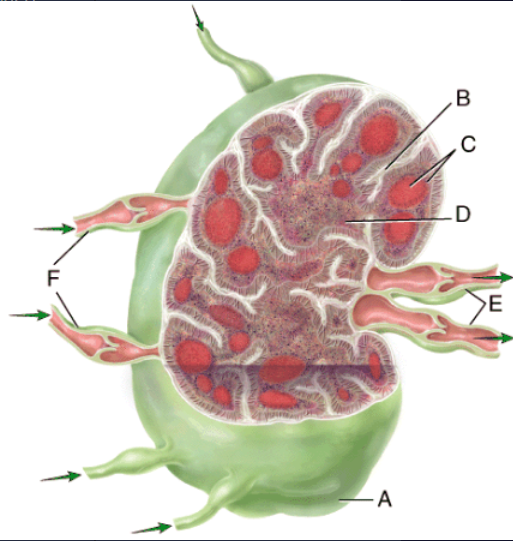
Which region includes B cells, follicular dendritic cells and macrophages?
C
—
A = Capsule
B = Trabecula
C = Lymphatic nodule
D = Medulla
E = Efferent lymphatic vessels
F = Afferent lymphatic vessel
Which class of cells includes macrophages, B cells and dendritic cells?
Antigen presenting cells
Which type of adaptive immunity will result from mother-to-baby IgA transfer via breast feeding?
naturally acquired passive immunity
Which class of antibodies is mainly found in sweat, tears, breast milk and GI secretions?
IgA
Which of the following is a small hormone that can stimulate or inhibit many normal cell functions?
Cytokine
Which type of adaptive immunity will result from intravenous injection of immunoglobulins?
artificially acquired passive immunity
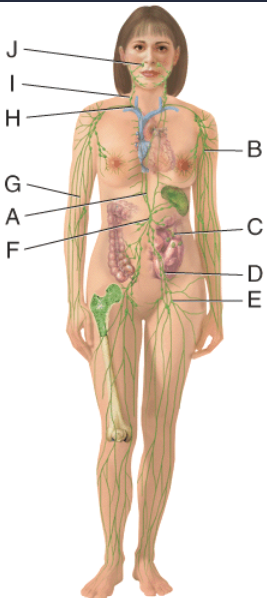
Which structure in the figure is the main duct for the return of lymph to the blood?
A
—
A (Thoracic duct)
B (Axillary node)
C (Aggregated lymphatic nodule)
D (Iliac node)
E (Inguinal node)
F (Cisterna chyli)
G (Lymphatic vessel)
H (Right lymphatic duct)*
I (Cervical node)
J (Palatine Tonsil)
Which of the following is considered to be a modified respiratory movement?
1. coughing
2. Valsalva maneuver
3. costal breathing
1 and 2 are correct
Surfactant lowers the surface tension of alveolar fluid; it is produced by
type II alveolar cells.
Exhalation begins when the
inspiratory muscles relax.
Which of the following tissues lines the oropharynx?
nonkeratinized stratified squamous epitheliu
All of the following cause a increase in lung volume during inspiration, except
relaxation of the diaphragm muscles.
Which structure is located anterior to the esophagus and carries air to the bronchi?
Trachea
Which of the following is the primary gas exchange site?
Alveolus
Which of the below tissues forms the exchange surfaces of the alveolus?
simple squamous epithelium
Exhalation begins when
Inspiratory muscles relax
Which of the following is the sum of the residual and the expiratory reserve volume?
Functional residual capacity
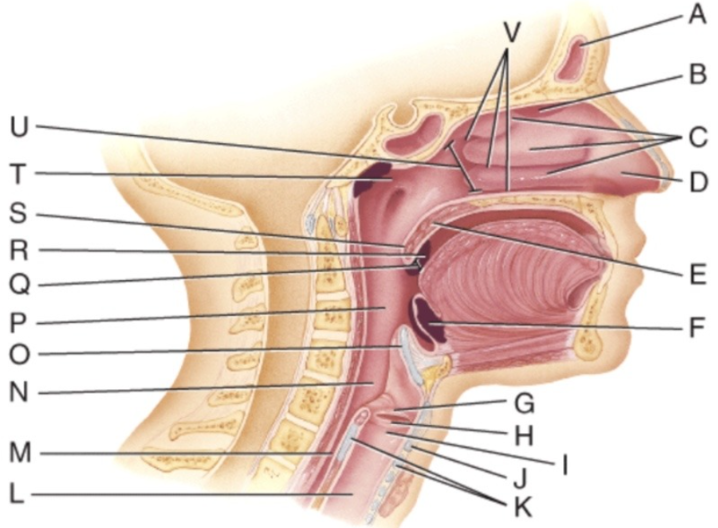
Where is the larynx?
I
—
A – Frontal sinus
B – Olfactory epithelium
C – Nasal conchae
D – External naris
E – Soft palate
F – Lingual tonsil
G – Vestibular fold
H – Vocal fold
I – Larynx
J – Thyroid cartilage
K – Cricoid cartilage
L – Trachea
M – Esophagus
N – Laryngopharynx
O – Epiglottis
P – Oropharynx
Q – Fauces
R – Palatine tonsil
S – Uvula
T – Nasopharyx
U – Internal naris
V – Nasal meatuses
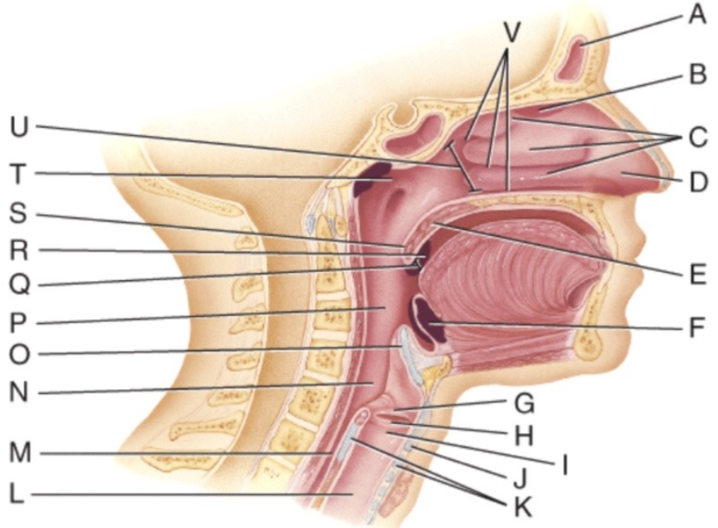
Where is the soft palate?
E
—
A – Frontal sinus
B – Olfactory epithelium
C – Nasal conchae
D – External naris
E – Soft palate
F – Lingual tonsil
G – Vestibular fold
H – Vocal fold
I – Larynx
J – Thyroid cartilage
K – Cricoid cartilage
L – Trachea
M – Esophagus
N – Laryngopharynx
O – Epiglottis
P – Oropharynx
Q – Fauces
R – Palatine tonsil
S – Uvula
T – Nasopharyx
U – Internal naris
V – Nasal meatuses


Where are the olfactory receptors found?
B
—
A – Frontal sinus
B – Olfactory epithelium
C – Nasal conchae
D – External naris
E – Soft palate
F – Lingual tonsil
G – Vestibular fold
H – Vocal fold
I – Larynx
J – Thyroid cartilage
K – Cricoid cartilage
L – Trachea
M – Esophagus
N – Laryngopharynx
O – Epiglottis
P – Oropharynx
Q – Fauces
R – Palatine tonsil
S – Uvula
T – Nasopharyx
U – Internal naris
V – Nasal meatuses
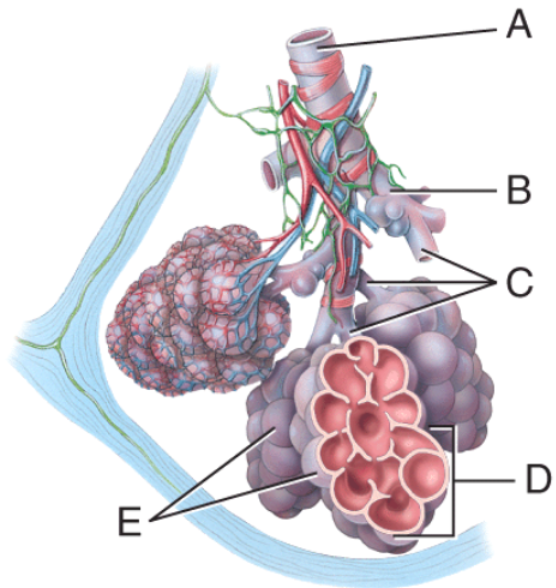
Which letter represents the primary gas exchange structure?
E
—
A – Terminal bronchiole
B – Respiratory bronchiole
C – Alveolar ducts
D – Alveolar sac
E – Alveoli
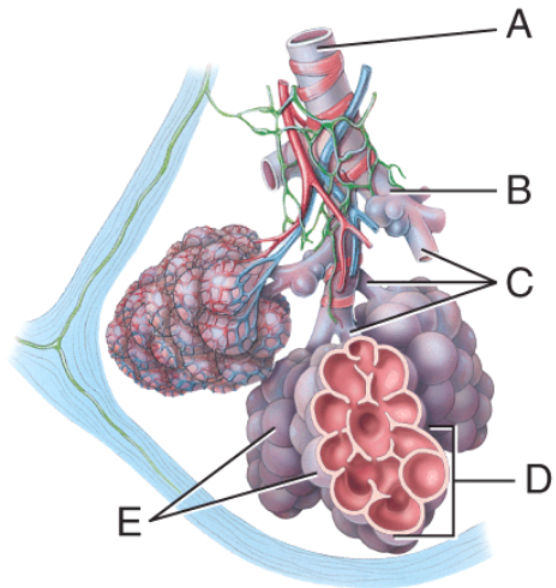
What is line C pointing to?
Alveolar ducts
—
A – Terminal bronchiole
B – Respiratory bronchiole
C – Alveolar ducts
D – Alveolar sac
E – Alveoli

Where is the terminal bronchiole?
A
—
A – Terminal bronchiole
B – Respiratory bronchiole
C – Alveolar ducts
D – Alveolar sac
E – Alveoli

Which cells are the main sites of gas exchange?
C
—
A (Type II alveolar cell)
B (Respiratory membrane)
C (Type I alveolar cell)
D (Alveolar macrophage)
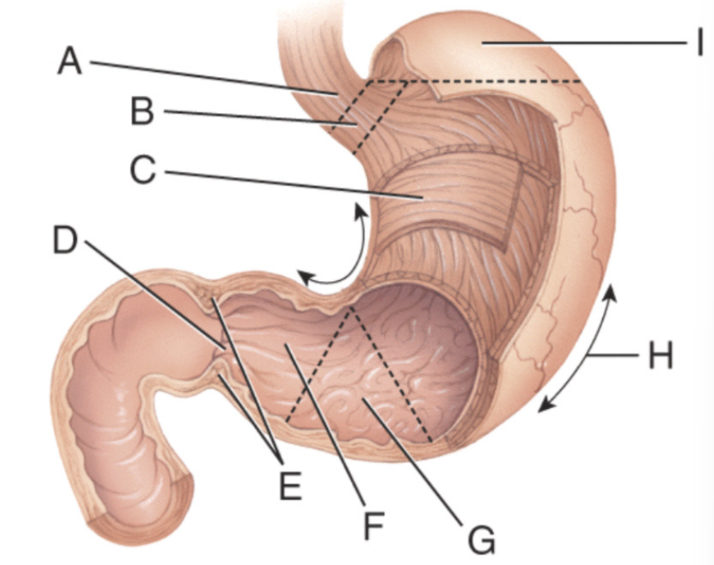
Which of the indicated structures contains glands which secrete an alkaline mucus that helps neutralize the acidic chyme?
duodenum
—
A - Lower esophageal sphincter
B - Cardia
C - Body
D - Pylorus
E - Pyloric sphincter
F - Pyloric canal
G - Pyloric antrum
H - Greater curvature
I - Fundus

Gastrin
1. stimulates secretion of large amounts of gastric juice.
2. strengthens contraction of the lower esophageal sphincter.
3. secretion is stimulated by low pH and inhibited by high pH
1 and 2 are correct
The enterogastric reflex
is stimulated by the presence of chyme in the duodenum.
Pepsinogen is converted into pepsin due to
low pH
_________ stimulates increased secretion of pancreatic juice that is rich in bicarbonate ions.
Secretin
The highly permeable blood capillaries of the liver are called
hepatic sinusoids.
Lipases can be found in
the mouth.
the stomach.
the small intestines.
all of these.
all of these.
The major hormones that control digestion are
Gastrin, secretin, and cholecystokinin.
Which cells secrete hydrochloric acid?
Parietal cells
Which of the following breaks down large peptides into smaller peptides?
chymotrypsin.
elastase.
trypsin.
all of these.
all of these
Which of the following is NOT a function of the liver?
Protein metabolism
Storage of bilirubin
Storage of vitamins
Phagocytosis
Conversion of carbohydrates
Storage of bilirubin
The liver is_______to the diaphragm and occupies most of the_______hypochondriac region of the_______cavity.
Inferior; right; abdomniopelvic
All of the following are brush border enzymes except
alpha-dextrinase.
lactase.
sucrase.
amylase.
amylase
Which small intestine cells secrete lysozyme?
Paneth cells
Which hormone functions to counteract the effect of gastric acid in the small intestine?
Secretin
Pancreatic juice contains all of the following except
chymotrypsin
carboxypeptidase.
pepsin.
trypsin.
pepsin.

What is line B pointing to?
Fundus
—
A - Lower esophageal sphincter
B - Cardia
C - Body
D - Pylorus
E - Pyloric sphincter
F - Pyloric canal
G - Pyloric antrum
H - Greater curvature
I - Fundus

What is the arrow pointing to?
Gastric pit
—
A (Surface mucous cell – secretes mucus)
B (Mucous neck cell – secretes mucus)
C (Parietal cell – secretes hydrochloric acid and intrinsic factor)
D (Chief cell – secretes pepsinogen and gastric lipase)
E (Enteroendocrine cell – secretes the hormone gastrin)
F (Gastric pit)
G (Gastric glands)