Neuromuscular disorders
 Call Kai
 Learn
 Practice Test
 Spaced Repetition
 Match
 Flashcards
 Knowt Play
1/68

There's no tags or description
Looks like no tags are added yet.
69 Terms
Where can neuromuscular diseases be localised to?
Peripheral n. / neuropathy
N-M junction / junctionopathy
Muscle / myopathy
How do you identify a neuromuscular problem? What caveat should you be aware of?
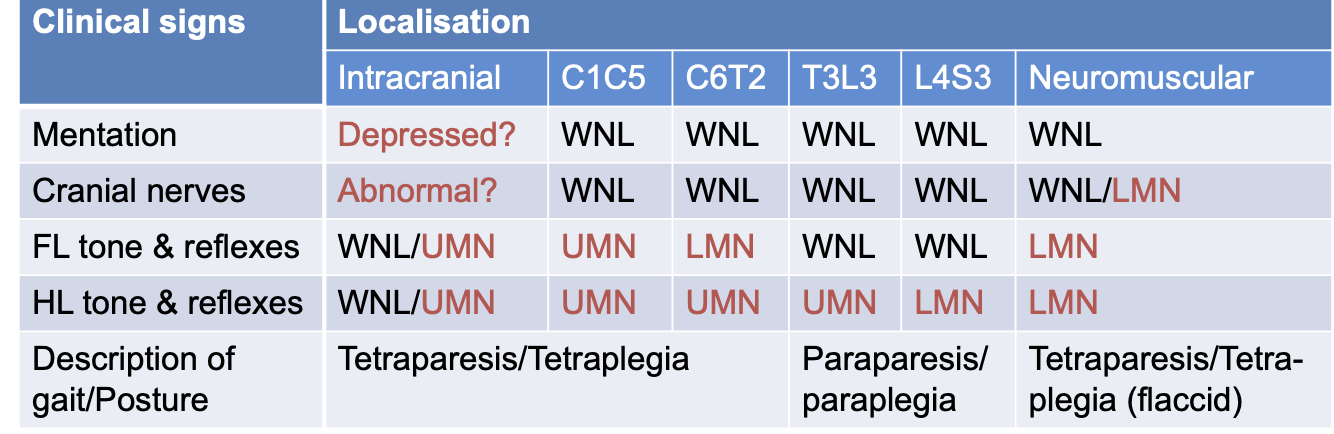
The LMN reflexes are decreased
Caveats: multiple lesions, spinal shock
What are the non-specific signs of generalised neuromuscular disease?
Tetraparesis & exercise intolerance/collapse
Stiff-stilted gait with reduced stride length, bunny hopping, may fatigue
Narrow based-stance
Tremors/fasciculations
Regurg / altered oesophageal motility
Myalgia (m. pain)
check triceps / hamstrings to identify
Dysphonia —> change in voice
Reduced reflexes & tone
Muscle atrophy
What are the hallmarks of a lower motorneuron problem?
RAT'
Reduced/ absent reflexes
Muscle atrophy
Reduced tone
What does a typical neuromuscular gait look like?
Short strided
Appears stiff/lame
Difficulty supporting weight
Bunny hopping
Sensation/proprioception is usually normal
If distal polyneuropathy → very plantar & palmar gait
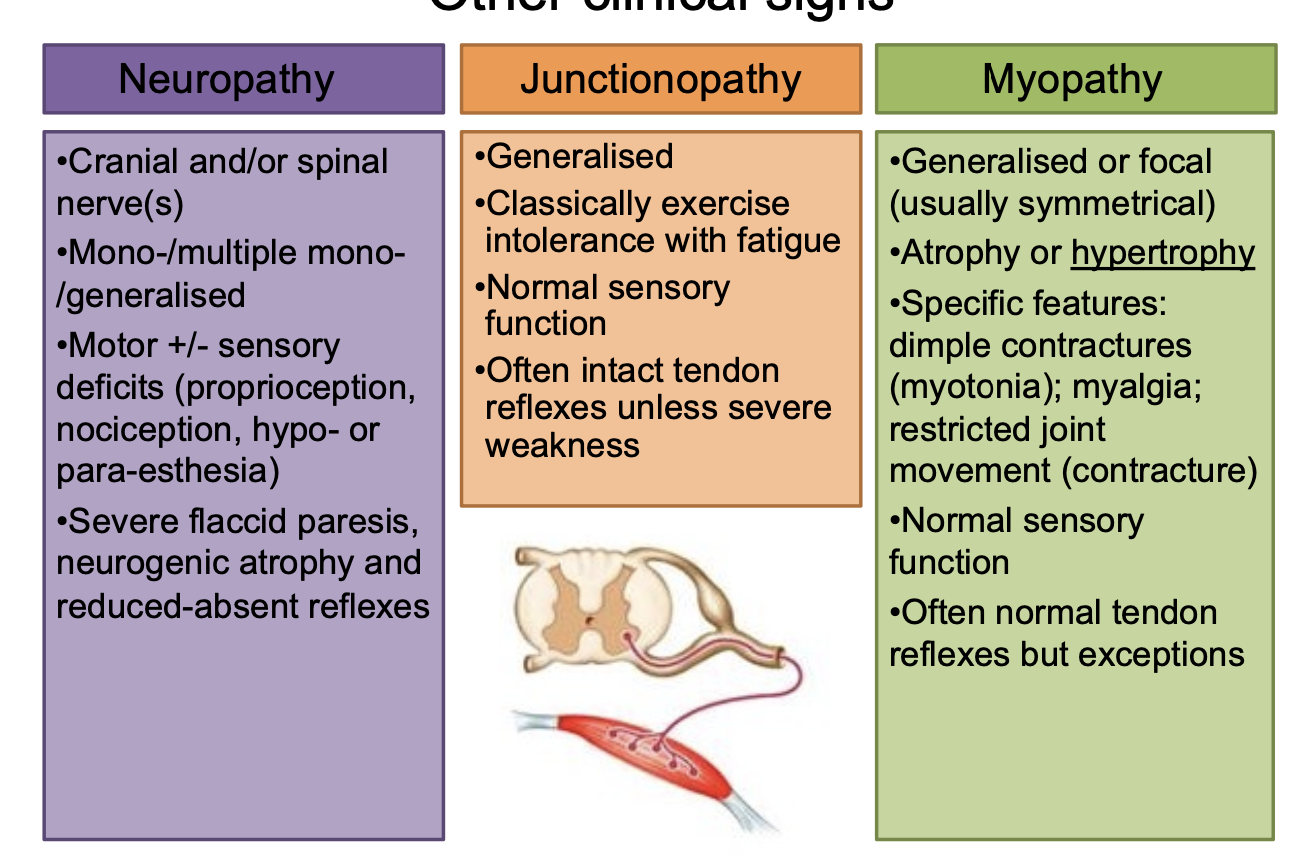
What signs can help you differentiate between neuropathy, junctionapathy and myopathy?
Junctionopathy or myopathy are motor
Paresis vs plegia
Paresis = reduced voluntary movement
Plegia = absent voluntary movement
Compare how gait, postural reactions, reflexes, muscle atrophy and muscle tone differ between UMN and LMN dysfunction

What are your differentials for acute onset generalised neuromucsular problems?
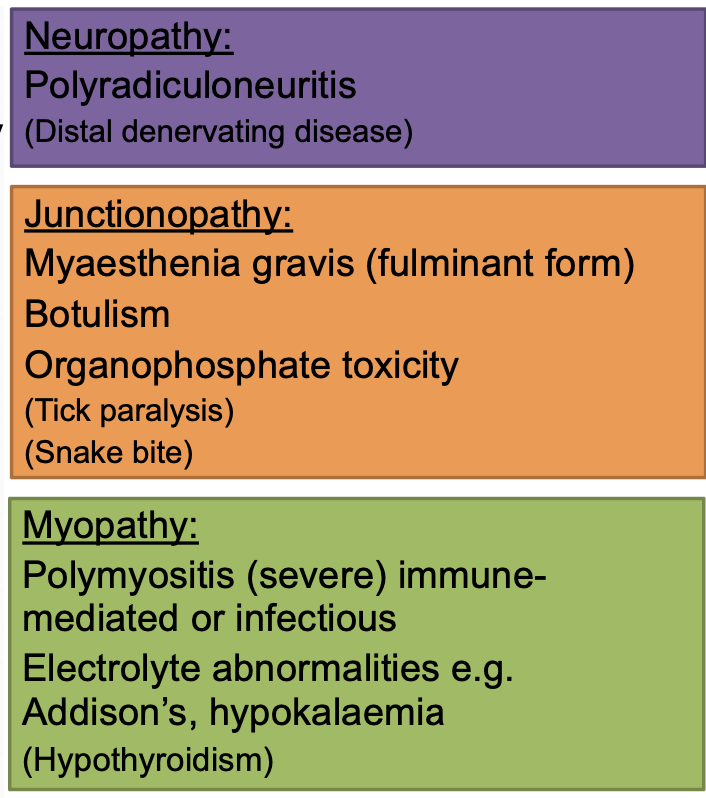
What are your differentials for chronic progressive neuromucsular problems?

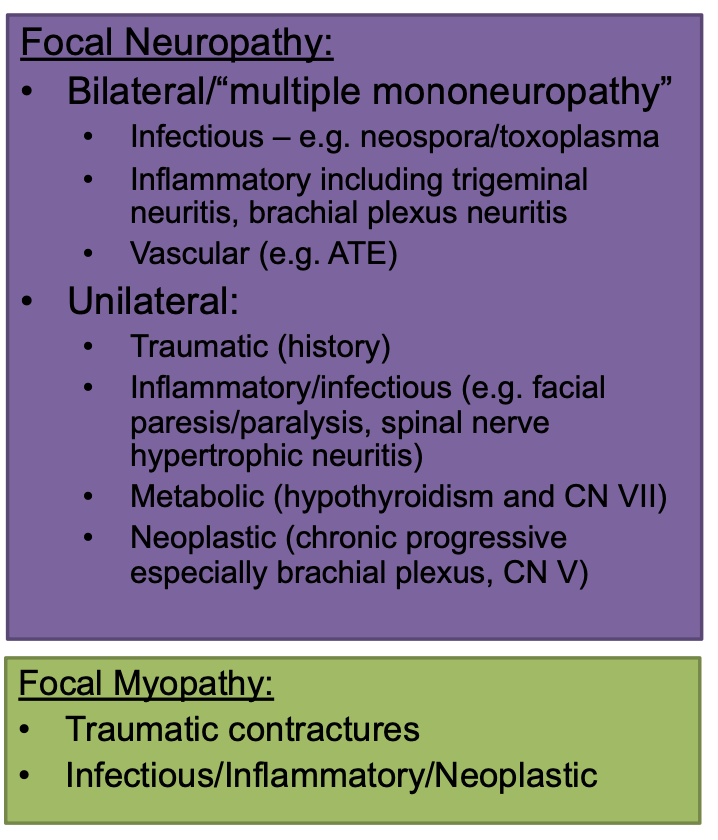
What are your differentials for localised neuromucsular problems?
What initial testing would you do for a neuromuscular patient?
Haematology
Biochem
Electrolytes —> K+, Ca2+, Na+
Glucose
Cholsterol
CK (incr = m. cell membrane damage e.g. myositis)
Urinalysis
Myoglobinuria = m. damage —> can damage the kidneys
Check rads (conscious)
Megaoesophagus
Aspiration pneumonia
Abdo imaging / staging
Endocrine tests (T4 / TSH, ACTH stim)
serology & / or PCR for IDs
dx specific auto-abs
lactate & pyruvate (exercise testing for mitochondrial dysfunction)
genetic testing
CSF —> n. roots in subarachnoid space
What is the purpose of electrodiagnostic testing?
Definitive evidence of dysfunction
Localisation (nerve/muscle, proximal/distal) prior to biopsy
Extent & severity
Prognosis / tx monitoring
What electrodiagnostic tests can you perform?
Electromyography (normal muscle silent under GA)
extracellular recordings from myofibres
Nerve conduction studies
How do you process a muscle/ nerve biopsy?
Formalin fixed
Preferably also submit fresh samples for cryosections
Which muscle & location should you biopsy?
Affected (EMG / imaging can help)
Area where fibres in single direction
Distant from tendons & aponeuroses
Disease requirements (e.g. congenital myasthenia gravis biopsy motor point)
What are some common muscle biopsy locations in the limbs?

What is a common location for nerve biopsy?
Common peroneal nerve
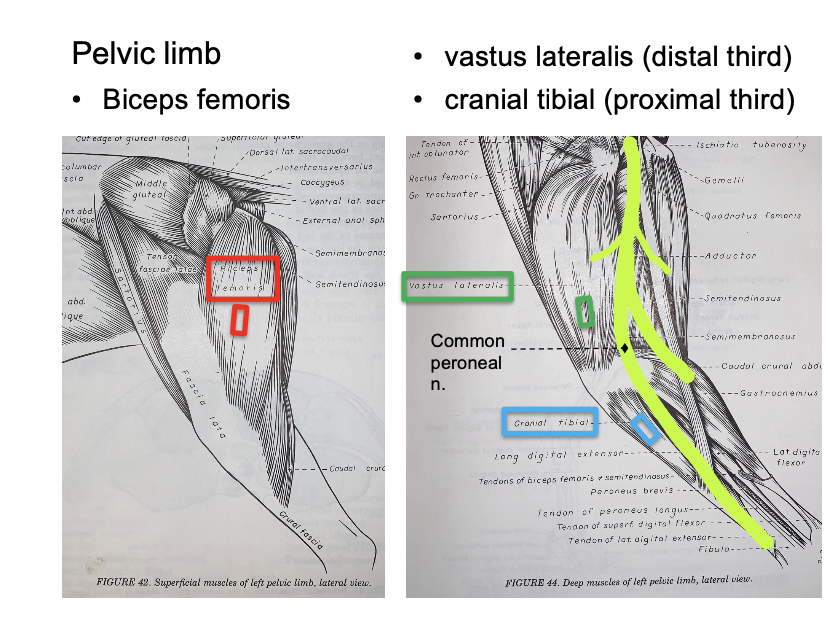
How do you perfrom a m. biopsy?
incise skin & fascia
isolate sample for biopsy 0.5-1cm wide, 1-2cm long
grab & incise @ one end, lift, incise the other end

How do you perform a masticatory m. biopsy?
Identify temporal muscle dorsal to zygomatic arch
Has white & shiny aponeurosis
Frontalis muscle very thin & temporalis thick normally
If severe atrophy of temporalis ID can be challenging so make sure get down to bone

What are the different ways you can biopsy nerve?
M. biopsy —> denervation changes & intrafascicular n. branches
Fascicular n. biopsy —> axon structure & density, myelin sheath thickness & integrity, schwaan cells, support tissues, infiltrates
specialist lab required
What is polyradiculoneuritis? What are the causes?
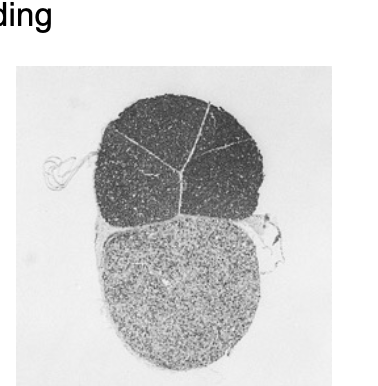
Inflam of nerves & roots (dogs > cats)
Idiopathic / vaccine (rabies) / contact w/ racoons
Ass. w/ ampylobacter & raw feeding
Predisp in bengal cats
Demyelination (axon damage in severe forms)
What is the most common location of polyradiculoneuritis?
Ventral spinal roots
Usually pure motor deficits
What are the signs of polyradiculoneuritis?
CN unaffected other than mild facial paresis
No megaoesophagus
No sensory deficitis
Acute onset (rapidly progressing)
Tetra/paresis → non ambulatory, tetraparesis/plegia
Flaccid, markedly reduced motor function (incr absent reflexes)
Can affect resp muscles —> monitor ventilation (poss hypoventilation)
How is polyradiculoneuritis diagnosed?
C/S & hx
Electrophysiology & CSF analysis
electrophysiology —> shows innervation, problems with n. & location of problem with n.
incr protein in CSF sample
What is the natural disease progression of polyradiculoneuritis?
Inflam of short duration
Recovery depends on severity of damage
Remyelination over days-wks
More prolonged if axonal damage
How do you treat polyradiculonerutis?
Mainly supportive
no steroids! —> incr m. atrophy, incr. risk of lung problems & pressure sores
Recum care
Physio
May have to consider ventilatory support
Human IV Ig —> may shorten time to ambulation (£££)
What is the prognosis of polyradiculonerutis?
Fair (guarded if resp dysfunction)
What is myasthenia gravis?
“Grave m. weakness” due to reduced neuro-muscular transmission
Congenital —> genetic defect
What causes myasthenia gravis? What forms exist?
Acquired —> immune-mediated
Abs target nACh receptors on postsynaptic membrane → receptor blockade +/- endplate destruction
Some cases seronegative
Can be paraneoplastic
Generalised (most common), focal & acute fulminating forms
What tumours cause paraneoplastic myastehnia gravis in cats?
Thymoma
How do the different forms of MG present in dogs?
Generalised (most common)
Fulminant: acute onset, rapidly progressive)
Focal (~40%): facial, pharyngeal, laryngeal, megaoesophagus
NB. Megaoesophagus in ~90% of cases → regurg & aspiration pneumonia
What breeds are predisposed to MG in cats?
Abyssinians
How do the different forms of MG present in cats?
Generalised in 90%
Mega oesophagus less likely than dog (15%)
Cranial mediastinal mass (thymoma)
Can be due to thiourylene medication for hyperthyroidism
How is MG diagnosed?
Clin signs
nAChR Ab test = gold standard
Response to cholinesterase inhibitor (edrophonium / neostigmine)
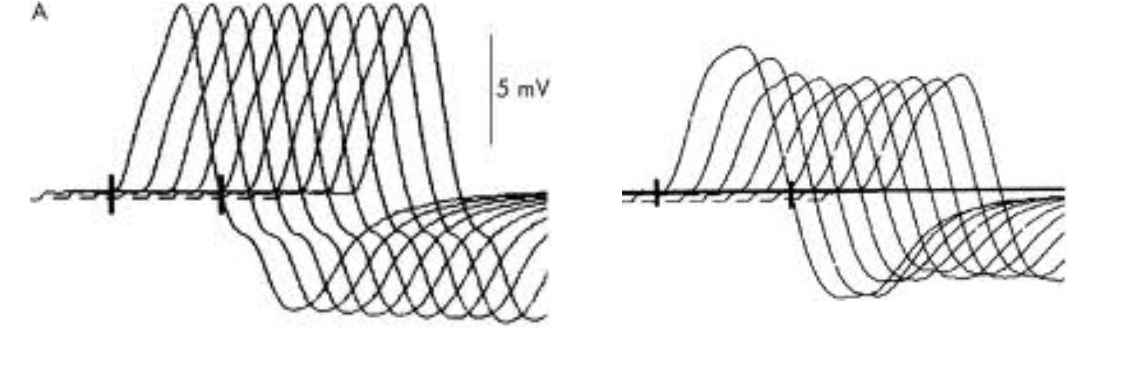
Electrodiagnostic tests (repetitive n. stimualtion —> shows m. & n. stimulation blunted as get fatigued
What is the risk w/ response to cholinesterase inhibitor tests?
Cholinergic crisis:
Bradycardia
Salivation
Miosis
Dyspnoea
Tremors (esp in cats have atropine on stand-by!)
How is MG treated?
Anticholinesterase (dogs more tolerant than cats)
Pyridostigmine PO / neostigmine IM
Cats more tolerant of steroids than dogs
Immunosuppression
Pros & cons?
Thmectomy in case of thymoma
Supportive —> postural feeding for megaoesophagus
What is the prognosis of myaesthenia gravis?
Guarded-poor (particularly if fulminant form, aspiration pneumonia)
Self-limiting in some dogs
What causes botulism?
Exotoxin produced by Cl. botulinum
ingestion of contaminated food esp animal carcasses —> rare in dogs & cats
Toxin absorbed from gut
Acts to block vesicle fusion w/ presynaptic membrane & ACh release
What are the clinical signs of botulism?
(Rare in dogs and cats)
Junctionopathy
Acute onset rapid preogressive tetraparesis
CNs affected (jaw tone, facial paralysis, gag reflex, megaoesophagus)
Resp muscles
Dysautonomia
Urinary dysfunction
GI dysmotility
Mydriasis
Red tear production
How is botulism diagnosed?
C/S
Electrophysiology
Demonstrate exposure toxin (feed/ faeces) / serology (retrospective exposure)
How is botulism treated?
Supportive care
Bladder management
Recum care
Megaoesphagus management
Physiotherapy
(anti-toxin available but usually too late)
What is the prognosis of botulism?
Depends on severity of clin signs —> generally poor if impaired ventilation / aspiration pneumonia
What are the different types of myositis?

What is immune mediated polymyositis?
Autoimmune condition usually idiopathic, may be associated with other immune diseases or neoplasia
More common in dogs than cats, particularly large breeds —> Newfoundland, Boxer, GSD, Labrador, Golden retriever
What are the clinical signs of immune mediated polymyositis?
Variable —> acute / chronic onset
Pyrexia, stiffness, non-ambulatory tetraparesis, reluctance to move, lowered head carriage, myalgia, m. swelling
Generalised weakness, m. atrophy, exercise intolerance, fatigue
+/- oesophageal involvement —> regurgitation
“Overlap syndrome” —> immune mediated polymyositis & Masticatory Muscle Myositis
How is IM polymyositis diagnosed?
Haem & biochem —> inflam leucogram, elevated CK/AST (acute typically +++)
Electrodiagnostics —> marked EMG abnormalities, normal MNCV
Muscle biopsy for diagnosis
Rule out infectious diseases and tumours
How is IM polymyositis treated?
Prednisolone ± other immunosuppressives
Monitor —> may relapse
CK, clin signs, m. imaging, repeat biospsy
What can cause infectious myositis?
Neospora caninum/ Toxoplasma gondii i.e. protozoal
What are the clinical signs of neosporosis in puppies?
Radiculoneuritis & polymyositis
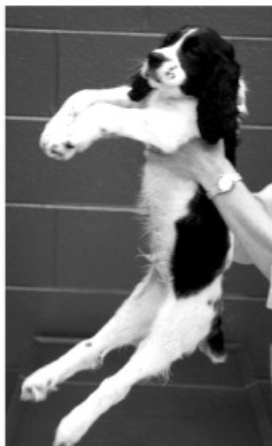
Pelvic limb hyperextension (usually starts in one limb & progresses to other)
Asc. paralysis of pelvic limbs w/ muscle contracture & arthrogryposis
How is neosporosis diagnosed?
Clinical signs, CK/AST, EMG, biopsy
SEROLOGY
PCR on CSF, blood
How is neosporosis treated?
Clindamycin/TMPS + pyrimethamine
poor prog w/ contractures
What causes masticatory myositis (only dogs)?
Abs to 2M myosin isoform
Juvenile form in CKCS
What are the clinical signs of masticatory myositis?
Can be acute/chronic
Swollen / painful masticatory m., exophthalmos
Trismus (pain/fibrosis), masticatory m. atrophy
How is masticatory myostitis diagnosed?
Imaging (muscles + TMJ)
CK (may be normal / slightly elevated)
2M abs
EMG
Biopsy temporal muscles

How is masticatory myositis treated?
Prednisolone +/- other IM drugs
Physiotherapy
What is trigeminal neuritis?
Inflam throughout trigem nerves incl ganglia bilaterally
Demyelination>axon degeneration
Dogs > cats
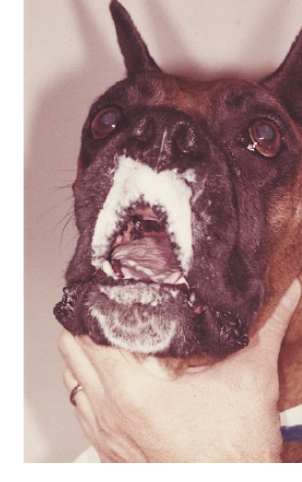
What are the clinical signs of trigeminal neuritis?
Acute onset paresis/plegia of masticatory muscles dropped jaw
Normal gag, tongue tone & movements
(Horner’s or facial paresis can be seen)
Sensory deficits in ~30% of cases
Masticatory m. atrophy
How is trigeminal neuritis diagnosed & treated?
MRI —> swollen, inflamed nerves
CSF
Tx
Resolves usually within 3 wks
Supportive care
What can cause unilateral temporal muscle atrophy?
Trigem n. sheath tumour
Other neoplasia
Infectious / inflam, idiopathic, traumatic
less common than bilat m. atrophy
What are the clinical signs of unilateral temporal m. atrophy?
Neurogenic atrophy of masticatory muscles, otherwise may be normal at onset
May be abnormal sensation (face rubbing, absent palpebral and corneal reflexes)
Progression to involve other CN & brainstem functions if neoplastic
How is unilateral temporal muscle atrophy diagnosed and treated?
Diag —> MRI
Tx —> trigem n. sheath tumour = radiotherpy predisolone (palliative)
What are the different classes of traumatic neuropathies?
Neuropraxia —> temporary nerve damage but no disurption of the nerve or myelin sheath.
Prognosis GOOD, recovery fast
Axonotmesis —> Disruption of axon but intact basal lamina and myelin sheath.
Prognosis is variable- recovery slow.
Neurotmesis —> Partial or complete trasection of nerve
Prognosis= poor
Give some examples of traumatic neuropathies?
Brachial plexus avulsion
Cradial/ caudal/ complete
Brachial plexus tumour
Tail pull injury
What are the signs of brachial plexus avulsion?
Monoparesis
Cutaneous trunci absent ipsilaterally
Horner’s syndrome
poor prog w/ loss of nociception
What are the features and signs of brachial plexus tumours?
Most intrinsic
Peripheral nerve sheath tumour
Chronic progressive thoracic limb lameness, pain, m. atrophy
Neuro deficites
Partial/complete plexus involvement
Monoparesis-plegia
Progression to myelopathy
Palpable mass
How are brachial plexus tumours diagnosed?
Electrodiagnostics
Imaging
plain spinal rads
U/S useful if mass distal
CT
MRI = modality of choice
How are brachial plexus tumours treated?
Prognosis?
Surgery (if diag is definitive)
Poor prog if spinal involvement
What are the signs of feline tail pull injury?
Tail motor & sensory function abnormalities
Paraparesis (resolves)
Urinary retention
