TERMS
 Call Kai
 Learn
Learn Practice Test
 Spaced Repetition
 Match
Match Flashcards
 Knowt Play
1/27

Earn XP
Description and Tags
EASY TO LOOK AT, KNOWLEDGE IS KEY
Name | Mastery | Learn | Test | Matching | Spaced | Call with Kai | Chat |
|---|
No analytics yet
Send a link to your students to track their progress
28 Terms
What is internal rotation?
Rotation of a bone toward the body's midline around its long axis. Image is just an example of rotation in the joints.
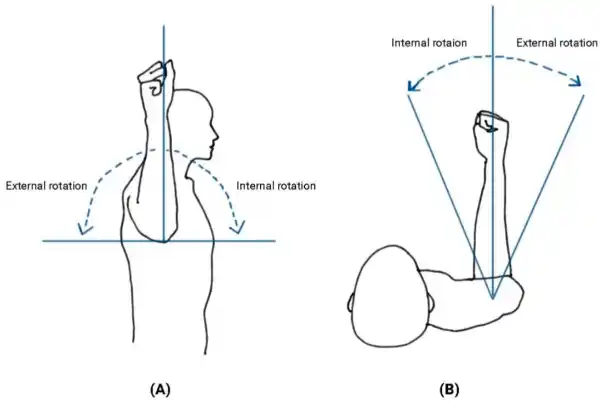
What is external rotation?
Rotation of a bone away from the body's midline. Image is just an example of external rotation.

What is an isometric contraction?
Muscle tension without a visible change in muscle length or joint angle. Example: Runners lunge, Carriage pull in or a hold
What is spinal flexion?
A movement that bends the spine forward, reducing the angle between vertebral segments. Example: Kneeling crunch
What is a posterior pelvic tilt?
The pelvis rotates backward, bringing the pubic bone toward the rib cage. “tucked pelvic”, person to the left.

What is the rotator cuff? and why is it important?
Four muscles that stabilize the shoulder joint and help rotate the humerus (upper part of the arm). An intact, functioning rotator cuff coordinates with the deltoid and scapular muscles to control the humeral head during movement.
For example, when pressing overhead, the shoulder can elevate while maintaining coordinated joint stability and comfortable motion.
What is the transverse abdominis?
The deepest broad abdominal muscle, contributing to trunk support and pressure control.
What is diaphragmatic breathing?
Breathing driven by diaphragm contraction, with expansion of the lower rib cage. Different from stomach breathing, and important when you are training the core.
What is mind-muscle connection?
Consciously directing attention toward the muscle working during an exercise.
What is the role of the pelvic floor?
Supports pelvic organs and contributes to continence and pressure management.
What is progressive overload?
Gradually increasing training demand as the body adapts. Important to educate your clients about this. “Mainly” we do more spring load
What is shoulder shrug compensation?
Unnecessary shoulder elevation during a task, sometimes reflecting load or control demands. Commonly happening with poor shoulder blade control. First fix their form and make sure the clients are aware of proper alignment and movement, secondly change the spring tension
What is pelvic drop?
One side of the pelvis lowering relative to the other during a movement.
What are anterior muscles?
Muscles located on the front of the body. Examples include the quadriceps, pectorals, abdominals and hip flexors.
What are posterior muscles?
Muscles located on the back of the body. Examples include the glutes, hamstrings, latissimus dorsi and back extensors.
A client feels lower-back discomfort during a glute exercise, what can be the possible reasons?
1: Excessive lumbar extension - arching the lower back instead of extending through the hip. 2. Poor control of the rib cage connection to waist. 3. Using more resistance or range of motion than they can comfortably control. 4. Using the upper body extensively and keeping the joint locked (to much movement in the upper body vs lower body)
Feeling hip flexors instead of abs during core work.
Depending on the set up / movement. Ex: Knee strap crunch: cue them to use flexion in the spine to engage cone and control. Soul train: Cue them to use rotation in the trunk instead of focusing on the leg movement. Super crunch: cue them to stay low in the upperbody and use the top handlebar.
Front-of-hip pinching during a lunge
Possible explanation: Deep hip flexion, stance position or individual hip sensitivity may contribute.
Modification: Reduce depth, adjust stance and avoid the pinching position.
New position: depending on the muscle demand focus in your class: place them in a laying down leg press or squat.
What is a neutral spine?
Back: A spinal position that maintains the natural curves of the neck, upper back, and lower back without excessive rounding or arching. It helps distribute load and maintain stability during movement.
Megaformer coaching cue: "Keep your spine long, your ribs aligned with your pelvis, and avoid excessively arching or rounding your back."
What does it mean to compensate during an exercise?
Using an alternative movement strategy that may reduce emphasis on the intended muscles.
What is the difference between abduction and adduction?
Abduction moves a body part away from the midline. Adduction brings it toward the midline.
What is an example of hip abduction vs. adduction on the Megaformer?
Abduction: moving the leg outward. (skater) Adduction: drawing the leg inward toward the body's midline. (giant jlo carriage pull in)
How should you correct a client who is compensating?
Identify the movement issue (so call scanning), give one clear actionable cue, and reassess. Modify the exercise if needed.
Why should instructors avoid giving too many cues at once?
Too much information can overwhelm the client. Prioritize one cue that improves the most important movement issue.
Why is exercise sequencing important?
Grouping related muscle demands helps build targeted fatigue instead of constantly switching between unrelated muscles.
What is the difference between anterior and posterior programming?
Anterior emphasis targets front-body muscles such as chest and quads. Posterior emphasis targets back-body muscles such as lats and glutes.
What is the difference between an internal and external coaching cue?
Internal: 'Engage your glutes.' External: 'Push the working foot hard to the machine to press yourself thru the movement and not dragging' Both can be useful depending on the goal.
What should an instructor prioritize when correcting alignment? Important coaching info:
Focus on the most relevant movement issue, provide one clear, actionable cue, and assess whether the client's control or comfort improves. If verbal cueing is not effective, consider a gentle, controlled hands-on correction, always with the client's consent. Demonstration is also an effective coaching technique, particularly when visual guidance helps the client better understand the movement and proper alignment.