Prescribing and Dispensing: Responsibilities and Controlled Drugs
 Call Kai
 Learn
Learn Practice Test
 Spaced Repetition
 Match
Match Flashcards
 Knowt Play
1/32

There's no tags or description
Looks like no tags are added yet.
Name | Mastery | Learn | Test | Matching | Spaced | Call with Kai | Chat |
|---|
No analytics yet
Send a link to your students to track their progress
33 Terms
What drugs can the dispensary supply?
• Can only supply vet medicines from premises registered with RCVS (VPP)
• Regular inspections assess compliance with legislation
RCVS inspect premises for Practice Standards Scheme (PSS)
VMD inspect non-PSS premises
• Aspects considered
Security
Prescription and supply of medicines
Storage of medicines
Health & safety
Record keeping
Controlled drugs
**Veterinary Practice Premises.
It refers to any physical location—such as a veterinary clinic, hospital, or surgery base—that is officially registered with the RCVS to legally store, prescribe, and supply controlled or prescription-only veterinary medicines.
What piece of legislation governs the use of potentially hazardous substances?
Control of Substances Hazardous to Health (COSHH)
Required to perform risk assessments - who is at risk, what risks are, what happens if something happens
Produce Standard Operating Procedures (SOPs) - spillages
Personal Protective Equipment (PPE)
Manual Handling
What happens if the dispensary is inspected and the report identifies areas that need improvement?
• Deficiencies classified as minor, major or critical
— Critical:
Significant risk to human/animal health or the environment
Significant deviation from VMR
• Enforcement:
Improvement notices - sets out what needs to change and the timescale to change it
Seizure notices - can prosecute or seize documentation
Prosecution & removal from register of VPP - can remove you, preventing you from dispensing drugs
Describe the features of the mobile dispensary.
What problems might they have and what guidance should be adhered to?
Problems associated with keeping drugs in vehicles
- Temperature
Min-max thermometer
Data logger preferred
Portable refrigeration unit
- Public access -
- Stock rotation - make sure using old bottles before new, not using expired contents
- Drug waste - facilities to dispose waste
Remove drugs from vehicles when not in use
What issues does the mobile dispensary being “public access” pose?
• Vehicle is a "public place"
CDs, firearms etc. are not deemed to be secure in a locked vehicle - if someone breaks in - you can be liable for prosecution
• A lockable bag, box or case or a lockable glove compartment is acceptable for transport but not "long term" storage
Long term storage —> is long term storage, so drugs cannot be left overnight
• Vehicles require a "fixed" lockable box or safe to meet safe custody requirements
Bolted to the floor or chassis (metal cable)
It what cases can medications be mailed?
• Prescription medicines may be sent via Royal Mail
• Check current details on Prohibited Goods using Royal Mail website
• CDs should NOT be sent through the post
• In exceptional circumstances use recorded delivery or 'signed for' courier delivery
Document it was necessary
When a suspected adverse drug reaction occurs you can do what…?
What can you report?
• Report problems with animal medicines to the VMD in the UK
- On-line via website
- Improves safe & effective use of veterinary medicines

What are the three main pieces of legislation defining drug use in veterinary medicine?
1. Misuse of Drugs Act 1971
• Controls availability of drugs considered "dangerous or otherwise harmful"
• Defines unlawful activities with respect to CD
• Vets can prescribe, administer or supply CD in the course of their work
2. Misuse of Drugs (Safe Custody) Regs 1973
• Describes the requirements for storage
3. Misuse of Drugs Regulations 2001 - most important for day to day use of drugs
• Governs use of CDs in (veterinary) medicine
How are controlled drugs classified?
• Drugs controlled under MoD Act 1971 are divided into Classes
• Classes are used to define penalties for illegal possession/use

MoD regulations divide CDs into schedules 1-5, how is this done?
- Scheduling depends on therapeutic benefit vs harm
Schedule 1 risk of harm >> benefit
Schedule 5 risk of harm << benefit
- Dictates the degree to which drug use is regulated
Schedule dictates the day-to-day use of how you handle it, store it, dispose of it
Describe the Schedule 1 CDs.
• Greatest potential harm - cannot be used in vet med or human med
• No significant therapeutic value
• Most strictly controlled
E.g. Cannabis, lysergic acid diethylamide (LSD)
Can cannabis and cannabis-based products be used for medicinal use?
Cannabis - unchanged (Schedule 1) cannot be used for medicinal use
HOWEVER:
Cannabinoids derived from cannabis
Tetrahydrocannabinol (THC)
Cannabidiol (CBD)
If pure, this is NOT a controlled drug
• Rescheduling in November 2018 allows some products to be prescribed
• Indications:
Chronic pain
Resistant forms of epilepsy
Chemotherapy-related nausea and vomiting
• Non-medicinal synthetic cannabinoids remain in Schedule 1
Describe the Schedule 2 CDs.
Must be stored in a fixed locked receptacle (safe custody)
Additional information required on prescriptions
Prescriptions valid for only 28 days
Use must be recorded in a register, signed by vet
Destruction must be authorised & witnessed - for out of date drugs, must be done in a specific way
Invoices must be retained for a minimum of two years
• Examples include:
Pethidine
Morphine
Methadone
Fentanyl
Quinalbarbitone
Ketamine
Why has Quinalbarbitone been exempt from safe custody requirements of Schedule 2 CDs?
EXCEPTIONS:
• Quinalbarbitone
Exempt from safe custody requirements, suspected for transport in cars to euthanize a horse
Does not have to be done in LAW but RCVS recommends you store it safely
Describe the Schedule 3 CDs.
• Additional information required on prescriptions
• Prescriptions valid for only 28 days
• Invoices must be retained for a minimum of two years
• Examples:
Pentobarbitone
Phenobarbitone
Midazolam
Buprenorphine
Tramadol
Gabapentin
Why has Buprenorphine been subjected to safe custody in Schedule 3?
EXCEPTIONS:
• Buprenorphine is a Schedule 3 CD in all respects, except ...
- It is NOT exempt from safe custody requirements and should be stored in a fixed locked receptacle, unlike other schedule 3 CDs
Describe the Schedule 4 CDs.
• Prescriptions valid for only 28 days
• Invoices must be retained for a minimum of two years
• Examples:
- Part 1: benzodiazepines (except midazolam - Schedule 3)
- Part 2: anabolic and androgenic steroids
Describe the Schedule 5 CDs.
Invoices must be retained for a minimum of two years
Examples: preparations containing low concentrations of controlled drugs, including codeine and morphine
Summarize the schedules.
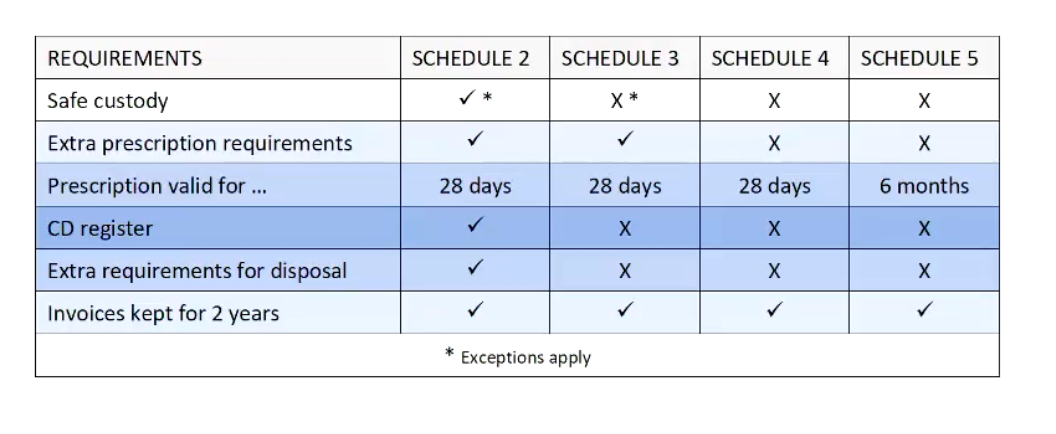
What are SOPs for CDs recommended to cover?
Standard Operating Procedures (SOPs) recommended to cover the following:
• Who has access to CDs
• Where CDs are stored
• How to dispense CDs
• How to destroy & dispose of CDs
• What records need to be kept
• Who to alert and what to do if complications arise
Describe what “safe csutody” or a CD cabinet must be.
Misuse of Drugs (Safe Custody) Regulations 1973
• Must be bolted to wall or floor
• Preferably double locked
• Must be locked when not in use
• Lock must be different to any other lock on ward
• Keys must only be available to authorised members of staff
• Cupboard should be reserved solely for the storage of CDs

Who can be a “keyholder” for a CD cabinet?
• Any responsible person within the practice
• Good practice would suggest a VS or qualified VN
• Acceptable to have multiple keyholders identified
• Not acceptable to allow unknown persons access to the CD cabinet
**Important that it is a person you know and can vouch for, and someone you can trust.
What are the general prescription requirements?
**There are additional requirements for controlled drugs.
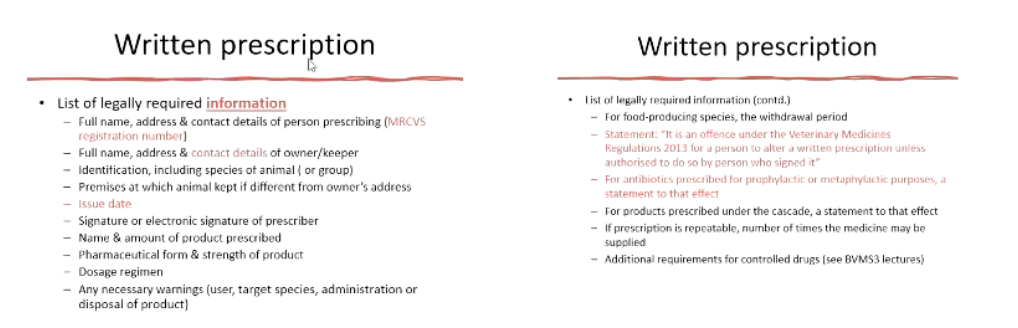
What are the additional requirements for controlled drug prescriptions?
Schedule 2 & 3 CD prescriptions must also include:
• Declaration that CD is prescribed for an animal or herd under the veterinarian's care (Under MY care - you are taking responsibility)
• Amount of product prescribed in both words & numbers
For example: Twenty (20) capsules
• Dose to be administered and the route (take as directed or take as required is not acceptable)
List the controlled drug prescription details.
• Can be hand-written; typed or computerised BUT for Schedule 2 & 3 drugs it must be signed IN INK by the prescriber
• It is an offence to supply a controlled drug against a faxed or emailed prescription (but the drug can be prepared for issue)
• Prescriptions for Schedule 2, 3 & 4 are only valid for 28 days
• Repeats on the same prescription are NOT allowed for Schedule 2 & 3
• Only 28 days worth of medication should be prescribed (unless long-term meds)
Computer generated prescriptions are considered 'good practice' as they generate an easy to follow audit trail
What forms can the CDs register be?
• Bound or electronic
• Individual sections for each CD
• Record receipt (Info that needs to be included)
Date, name & address of supplier & amount
Running balance
Signed by VS or VN
• Record supply
Date, name, & address of patient (Or case number) & amount
Running balance
Prescribers MRCVS number
Signed by VS
• Auditable
• Kept for 2 years (minimum)
Why is checking the balance so important?
What happens if you find an error?
• Check & sign at regular intervals
• E.g. in SAH, balance is checked at least once daily
• Aim to identify discrepancies ASAP as easier to deal with
• Good practice for 2 people to initial balance
• Errors should NOT be obliterated with tippex, crossed or scrubbed out
• Incorrect entries must be readable
• Bracket error & asterix*
• Use footnote to record reason for error
• On a new line, write correct entry with new balance
• If possible, countersign error
If there is a register discrepancy and you cannot find the cause, what do you do?
• Consult SOP in event of register discrepancy
• Once resolved, include footnote in register correcting discrepancy in balance
• Advisable to keep appropriate records of action taken when discrepancies arise
• If source of discrepancy cannot be identified, a formal internal investigation must be undertaken
Why are some drugs (multi-dose bottles) more difficult to calculate discrepancies?
There WILL be discrepancy, so you must decide an appropriate amount.
• Methadone is authorised for veterinary use (POM-V CD)
• But it is a multi-dose bottle
Variation in amount in bottle
Additional drug in needle hub/syringe (deadspace volume)
• Discrepancy at end of bottle
Up to 10% is OK
- No. filled syringes x deadspace volume
How are out of date Schedule 2 CDs destroyed?
• Keep segregated & clearly marked in CD cabinet
• Two step process.
Must be denatured (rendered irretrievable)
Commercial denaturing kit or cat litter/sawdust
Disposed of as pharmaceutical waste
• Must be recorded in register & balance adjusted
Don't sign out until destroyed
• Witnessed by:
Vet independent of practice
Police (Controlled Drugs Liaison Officer)
VMD inspector or Practice Standards Scheme assessor
• Try to avoid by practising good stock rotation
What are the procedures for cleaning up smashed amouples in a schedule 2 CD?
Smashed ampoules
• Some breakages are inevitable
• Clear up using an appropriate spill kit
SOP
• Dispose of waste in appropriate containers
Pharmaceutical waste
• Record in register that ampoule has been broken
• Counter sign
How are “residual CDs” destroyed?
"Residual drug" is drug remaining in vial/ampoule or remaining in a syringe
• Must first be denatured
Commercial denaturation kit or cat litter
• Then disposed of as pharmaceutical waste
• Must be recorded
Residual in vial signed out in CD register
Residual in syringe has already been signed out to patient
• No legal requirement to witness destruction
How are returned CDs destroyed?
• Must be denatured
• Then disposed of as pharmaceutical waste
• No need to record
But good practice to record & have destruction witnessed