Exam 2: analytical CHEM
 Call Kai
 Learn
 Practice Test
 Spaced Repetition
 Match
 Flashcards
 Knowt Play
1/101

There's no tags or description
Looks like no tags are added yet.
102 Terms
Chemical equilibrium
occurs when a reaction and its reverse reaction proceed at the same rate.
Equilibrium constant
K
When K > 1
reaction is favored
formula for K
[products] / [reactants]
if the direction of a reaction is reversed the new K value is…
the reciprocal 1/K
enthalpy
(H) heat absorbed or released
entropy
(S) dispersal of energy into molecular motions; chemical or physical change occurs in a reversible manner at a constant temperature
ΔH
change in enthalpy
Endothermic reaction
+ ΔH and heat is absorbed
Exothermic reaction
- ΔH and heat is released
ΔS (change in entropy) equation
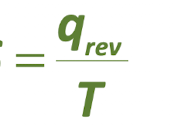
Which has state of H2O has the highest entropy?
Gas
if ΔS is positive
the products have greater entropy than reactants and there is less order
if ΔS is negative
the products have less entropy than reactants and there is more order
Gibbs free energy (ΔG) formula
ΔH - TΔS
if ΔG is positive
K < 1 and reaction is disfavored
is ΔG is negative
K > 1 and reaction is favored
Le Chatelier’s principle
if a system at equilibrium is subjected to a change or disturbance the direction in which the system proceeds back to equilibrium will attempt to OFFSET the change (till Q = K)
If a reaction is at equilibrium and products are added (or reactants removed), the reaction goes to the
left
If a reaction is at equilibrium and reactants are added (or products removed), the reaction goes to the
right
When the temperature of an endothermic reaction is increased
the equilibrium constant (K) also increases
When the temperature of an exothermic reaction is decreased
the equilibrium constant (K) also decreases
Solubility product (Ksp)
equilibrium constant for the reaction in which a solid salt dissolves to give its constituent ions in solution
saturated solution
equilibrium with excess, undissolved solid
the smaller the Ksp value, the ____ soluble and _____ to precipitate
LESS soluble and EASIER to precipitate
common ion effect
application of Le Chatelier’s principle where a salt is LESS soluble if one of its constituent ions is already present in solution
an acid increases the concentration of ____ when added to water
H3O+
A base increases the concentration of ___ when added to water
OH-
Kw=
[H3O+][OH-]
Protic
chemistry involving transfer of an H+ from one molecule to another
Autoprotolysis
self-ionization that all protic solvents undergo
ex: water undergoes this in which it can act as both an acid and base
Autoprotolysis Constant
Kw
varies with temperature
pH=
-log[H+]
at 25 C Kw=
1.01 ×10^-14
pH + pOH =
-log(Kw)
Acidic solutions
[H+] > [OH-]
Basic solutions
[H+] < [OH-]
strong acids and bases react ____ to produce H+/OH-
completely
weak acids and bases react ____ to produce H+/OH-
partially
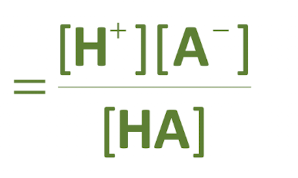
acid dissociation constant (Ka)
equilibrium constant for a weak acid reacting with water
When there is a small Ka
there is less acidity
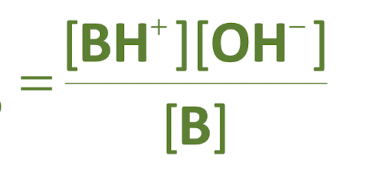
base hydrolysis constant
Kb
Kb=
Ka=
If you have a weak base the Kb will be
small
titrant
reagent solution
analyte
quantity calculated from amount of titrant consumed in reaction
Requirements when performing a titration
reaction must have a large equilibrium constant, reaction must proceed rapidly, and analyte should be completely used up
equivalence point
quantity of added titrant is exact amount necessary for stoichometric reaction with analyte
End point
actual measurement when titration is done, marked by a sudden change in physical property of the solution
titration curve
graph showing how the concentration of reactant varies as titrant is added
Ve
volume of titrant needed to consume all of analyte
before Ve
there is an excess of analyte
at Ve
no analyte remaining as it is all used up
after Ve
excess of titrant
pX =
-log[X]
high values of X indicate
very low concentrations of X
Fajans titration
adsorption indicator to find the end point of a direct titration of anion with standard AgNO3
turns from greenish yellow to pink
solvent sheath
ions and molecules in solution are surrounded by an organized sheath of solvent molecules
Smaller, and highly charged molecules…
bind more H2O molecules and behave as larger species in solution
Water binds to cations through
oxygen bonds
Water bonds to anions through the
hydrogen atoms
Why does the solubility increase when salts are added to the solution
Region of solution around an ion or charged particle & Contains an excess of the oppositely charged ions
Increasing ionic strength promotes dissociation
the greater the ionic strength of solution, the…
higher the charge on each ionic atmosphere
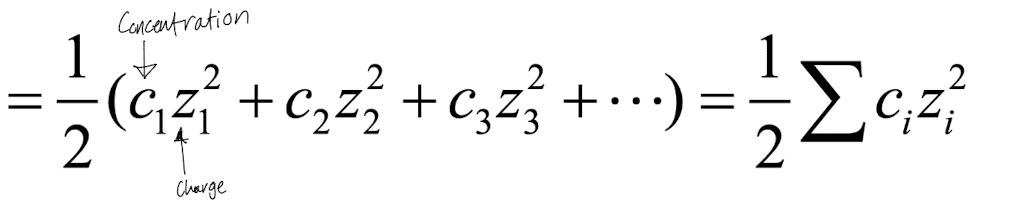
Ionic strength (μ) definition
measure of the total concentration of ions in solution
Ionic strength (μ) formula
To account for the effect of ionic strength, concentrations are replaced by
activities
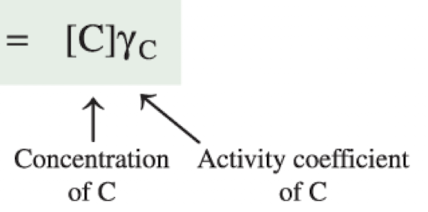
Activity (A)
value that replaces concentration in a thermodynamically correct equilibrium, expression
Activity of C formula
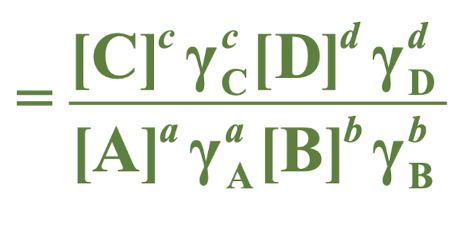
Thermodynamic equilibrium constant formula for
aA + bB → cC + dD
At low ionic strength (μ → 0M)
activity coefficient =1 to make behavior ideal & thermodynamic equilibrium constant approaches the concentration equilibrium constant
with increasing ionic strength (μ increased) by adding a second salt
activity coefficients must decrease
True or False:
A reaction is favored if ΔG is positive
False

adding HCl
which compound cannot undergo autoprotolysis?
CH3COOC2H5
True or False:
The end point of a titration is the same as the equivalence point of the titration
False
a critical step in titration calculations is to relate
moles of titrant to moles of analyte
What is the effect when a salt, such as KNO3, is added to a saturated CaSO4 solution?
the solubility of CaSO4 increases
What is true about a 0.10 M solution of Na2SO4 and a 0.05 M solution of CaCI2?
The ionic strength of 0.05 M CaCl2 is two times lower than the ionic strength of 0.10 M Na2SO4:
To correct for the effect of ionic strength on chemical reactions, concentrations are replaced by______ in equilibrium expressions.
activities
Identify the mass balance equation for F- in a 0.02 M aqueous solution of KF
[HF] + [F-] = 0.02 M
interpolation
estimation of a number that lies between two values in a table
interpolating activity coefficients

how to calculate pH when given activities

when a pH meter is used it is measuring
hydrogen ion activity
When can we no longer ignore the H+ or OH- generated from water
[acid] or [base] is between 10^-8 and 10^-6
charge balance definition
algebraic statement of electroneutrality; only one per solution
charge balance equation

mass balance (material balance) equation
quantity of all species containing a particular atom must be equal to the amount of that atom initially delivered to solution (one solution can have multiple)
mass balance equation

HCl
hyrocholric acid / hydrogen chloride
strong acid
HBr
hydrobromic acid / hydrogen bromide
strong acid
HI
Hydroiodic acid / hydrogen iodide
strong acid
H2SO4
sulfuric acid
strong acid
HNO3
Nitric acid
strong acid
HClO4
Perchloric acid
strong acid
LiOH
lithium hydroxide
strong base
NaOH
sodium hydroxide
strong base
KOH
Potassium hydroxide
strong base
RbOH
Rubidium hydroxide
strong base