4) Monitoring & Induction
 Call Kai
 Learn
 Practice Test
 Spaced Repetition
 Match
 Flashcards
 Knowt Play
1/132

There's no tags or description
Looks like no tags are added yet.
133 Terms
limb restrictions denoted with a…
pink band
examples of limb restrictions
lymph node dissections, AV fistula/graft
heart conduction pathway
sinus (SA) node → AV node → bundle of his → left & right bundle branches → purkinje fibers
SA node sends electrical pathways to ________ atria
both
define valve stenosis
stiff valve causing extra work of the chamber prior to it
define regurgitation
valve allows blood to leak from ventricle back up to atria
what event is associated with p-wave and what happens as a result of it?
atrial depolarization, contraction follows
what event is associated with QRS interval?
ventricular depolarization
extended PR interval is indicative of…
delayed conduction from SA to AV node
widened QRS interval is indicative of…
delayed ventricular conduction
what event is associated with t-wave?
ventricular repolarization
bipolar leads measure…
potential difference between 2 recording electrodes
bipolar leads come from…
einthoven’s triangle
in Einthoven’s Triangle, the right arm is always…
negative
in Einthoven’s Triangle, the left leg is always…
positive
in Einthoven’s Triangle, the left arm is…
positive from right arm and negative from left leg
in Einthoven’s Triangle, which lead lines up best with initial pathway of conduction in the heart?
II
as the electrical conduction travels up the purkinje fibers, there is a ________ in the ECG graph
downstroke
ECG: where is the j(unction) point?
end of QRS and beginning of ST segment
why is the ST segment important?
useful in determining if patient is having heart attack or ischemia
why is ischemia considered a supply and demand issue?
you can have normal supply, but increased demand or decreased supply and normal demand
ischemia is indicated on ECG by…
ST depression
infarcted tissue is indicated on ECG by…
ST elevation
unipolar (V) leads assess…
electrical fields in horizontal plane of chest
V1 placement
4th intercostal space, right of sternum
V2 placement
4th intercostal space, left of sternum
V3 placement
midway between V2 and V4
V4 placement
5th intercostal space, midclavicular line
V5 placement
5th intercostal space, anterior axillary line
V6 placement
5th intercostal space, midaxillary line
V2 and V5 best encapsulate…
heart function, specifically LV function
what 3 main electrolytes go in and out of the myocardial cell during an action potential?
sodium, potassium, calcium
Ca channel blockers slow depolarization of…
SA and AV nodes
Na channel blockers slow depolarization of…
purkinje fibers, delaying impulse to atrial/ventricular muscle cells
how long is a normal QRS?
0.2 sec
LV hypertrophy is indicated on ECG by…
larger r-waves in lateral leads V5 and V6 than other areas of the heart
each small box on the ECG = _________ sec
0.04
each big box on ECG = ________ sec
0.2
rate from ECG formula
rate = 300 / # of boxes between r-waves
define sinus tachycardia
HR > 100bpm
define sinus bradycardia
HR =< 60 bpm
atrial fibrillation
chaotic atrial depolarization that doesn’t allow the SA node to pace at a normal rhythm
in afib, what wave isn’t seen?
p-wave
afib results in…
pooling/blood clots in atria, leading to stroke
treatment for afib
blood thinners or cardioversion
define junctional rhythm
electrical signal originates from AV node or bundle of his instead of SA
in junctional rhythms, what wave isn’t seen?
p-wave
premature ventricular complex (PVC)
ventricular conduction when not filled, so no blood ejected (no pulse)
ventricular trigeminy
PVC every 3rd
what to do when ventricular bigeminy is observed?
immediate cardiac consult

pulsatile ventricular tachycardia treatment
cardioversion
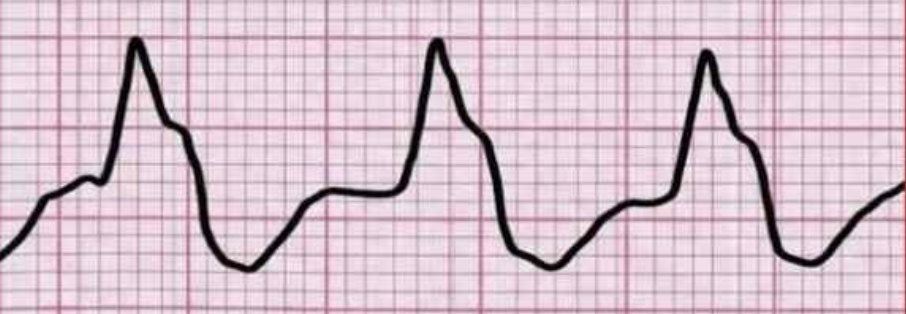
non-pulsatile ventricular tachycardia treatment
shock

asystole treatment
epinephrine, CPR
ventricular fibrillation
ventricular quivering, no contraction or pulse
ventricular fibrillation treatment
shock
what tissue is being affected when you see ST depression?
endocardium
what tissue is being affected when you see ST elevation?
endocardium, myocardium, epicardium (transmural MI)
too tight of a BP cuff provides incorrectly ________ readings
high
too loose of a BP cuff provides incorrectly ________ readings
low
oscillometry measures…
mean pressure and calculates systolic and diastolic
Korotkoff sounds measure…
systolic and diastolic
invasive blood pressure measures…
mean, systolic, diastolic
MAP > ____ mmHg will ensure adequate renal perfusion
80
MAP > ____ mmHg will ensure adequate cerebral perfusion
50
Beers-Lambert Law relates…
solute (hemoglobin) concentration to intensity of light transmitted through solution
oxyhemoglobin absorbs ________ light at ____ nm and transmits ________ light at ____ nm
infrared, 940, red, 660
de-oxyhemoglobin absorbs ________ light at ____ nm and transmits ________ light at ____ nm
red, 660, infrared, 940
pulsatile flow waveform
plethysmography
pulse ox > 80% is…
true and calculated
slowly decreasing EtCO2 indicates…
circulatory issue (hypotension, decreased cardiac output)
an immediate decrease in EtCO2 indicates…
pulmonary embolism
respiratory gas analysis measures…
EtCO2, inhalational agents, fresh gases, inspired/expired levels
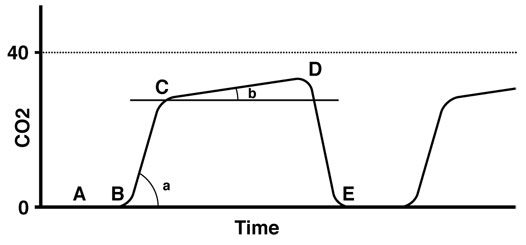
A-B
breathing out dead space
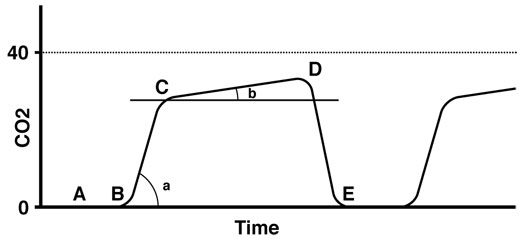
D-E
inspiration

D
reading of capnometry

B-C
dead space and alveolar air mixing

C-D
pure alveolar air
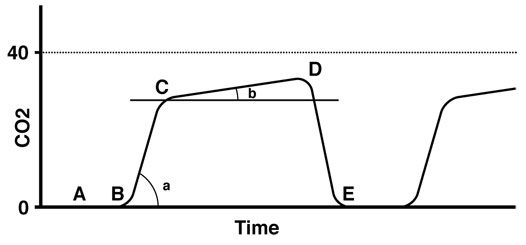
slow rate of rise seen from B-C indicates…
COPD, acute airway obstruction (bronchospasm)
how does neostigmine work to reverse paralysis?
decreases cleavage of ACh at NMJ, allowing it to overcome NDMR
neuromuscular monitoring is a ________ assessment that measures…
qualitative, effect of neuromuscular blockers (paralytic agents)
how many twitches is enough for neostigmine to get a patient breathing on their own?
1
Train of Four (TOF) = ____ equal stimuli at ____
4, 2 Htz
sustained tetany = ________ stimulus at ____
continuous, 50 Htz
the recommended site for neuromuscular monitoring is…
ulnar nerve
response of neuromuscular monitoring at ulnar nerve
adductor pollicis muscle
why is the ulnar nerve recommended for neuromuscular monitoring?
closely indicates diaphragm paralysis
response of neuromuscular monitoring at facial nerve
orbicularis occuli muscle
neuromuscular monitoring at facial nerve most closely indicates…
vocal cord paralysis
response of neuromuscular monitoring at posterior tibial nerve
plantar flexion of flexor hallucis
bispectral index (BIS) measures…
depth of anesthesia by brain activity
how long does a patient need to be able to lift their head off the table to be confident that they can breath on their own?
5 sec
BIS < ____ indicates brain function shutting down (________)
20, burst suppression
BIS between ________ is ideal for ________
40-60, no recall or response
when to use TIVA?
h/o PONV, family history of malignant hyperthermia, neuro-monitoring needed
BIS monitoring is useful alongside what anesthetic technique?
TIVA
transesophageal echocardiography (TEE) measures…
cardiac function (regional wall motion abnormalities, ischemia) and volume status (ventricles full, empty)
central venous pressure (CVP) measures…
right ventricular filling pressure
central venous pressure (CVP) indicates…
cardiac volume
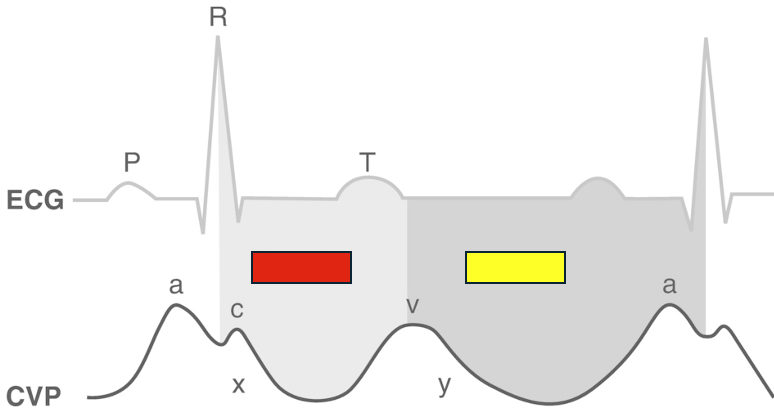
a
atrial contraction

c
ventricular contraction