Fundamentals of the Nervous System and Nervous Tissue
 Call Kai
 Learn
 Practice Test
 Spaced Repetition
 Match
 Flashcards
 Knowt Play
1/31

Earn XP
Description and Tags
Lecture 20
32 Terms
Nervous System
The master controlling and communicating system of the body
Functions
Sensory input- monitoring stimuli occurring inside and outside the body
Integration- interpretation of sensory input
Motor output- response to stimuli by activating effector organs
Nervous System

Organization of the Nervous System
Central nervous system (CNS)
Brain and spinal cord
Integration and command center
Peripheral nervous system (PNS)
Paired spinal and cranial nerves
Carries messages to and from the spinal cord and brain
Peripheral Nervous System (PNS): Two Functional Divisions
Sensory (afferent) division
Sensory afferent fibers- carry impulses from skin, skeletal muscles, and joints to the brain
Visceral afferent fibers- transmit impulses from visceral organs to the brain
Motor (efferent) division
Transmits impulses from the CNS to effector organs
Motor Division: Two Main Parts
Somatic nervous system
Conscious control of skeletal muscles
Autonomic nervous system (ANS)
Regulates smooth muscle, cardiac muscle, and glands
Divisions: sympathetic and parasympathetic
Histology of Nerve Tissue
The two principal cell types of the nervous system are:
Neurons- excitable cells that transmit electrical signals
Supporting cells- cells that surround and wrap neurons
Astrocytes
Most abundant, versatile, and highly branched glial cells
They cling to neurons and their synaptic endings, and cover capillaries
Functionally, they:
Support and brace neurons
Anchor neurons to their nutrient supplies
Guide migration of young neurons
Control the chemical environment
Astrocytes

Microglia and Ependymal Cells
Microglia- small, ovoid cells with spiny processes
Phagocytes that monitor the health of neurons
Ependymal cells- range in shape from squamous to columnar
They line the central cavities of the brain and spinal column
Microglia and Ependymal Cells

Oligodendrocytes, Schwann Cells, and Satellite Cells
Oligodendrocytes- branched cells that wrap CNS nerve fibers
Schwann cells (neurolemmocytes)- surround fibers of the PNS
Satellite cells surround neuron cell bodies with gangllia
Oligodendrocytes, Schwann Cells, and Satellite Cells

Neurons ( Nerve Cells)
Structural units of the nervous system
Composed of a body, axon, and dendrites
Long-lived, amitotic, and have a high metabolic rate
Their plasma membrane functions in:
Electrical signaling
Cell-to-cell signaling during development
Neurons (Nerve Cells)

Axons: Structure
Slender processes of uniform diameter arising from the hillock
Long axons are called nerve fibers
Usually there is only one unbranched axon per neuron
Rare branches, if present, are called axon collaterals
Axonal terminal- branched terminus of an axon
Axons: Function
Generate and transmit action potentials
Secrete neurotransmitters from the axonal terminals
Movement along axons occurs in two ways
Anterograde- toward the axonal terminal
Retrograde- away from axonal terminal
Myelin Sheath
Whitish, fatty (protein-lipoid), segmented sheath around most long axons
It functions to:
Protect the axon
Electrically insulate fibers from one another
Increase the speed of nerve impulse transmission
Myelin Sheath and Neurilemma: Formation
Formed by Schwann cells in the PNS
A Schwann cell:
Envelops an axon in a trough
Encloses the axon with its plasma membrane
Has concentric layers of membrane that make up the myelin sheath
Neurilemma: remaining nucleus and cytoplasm of a Schwann cell
Myelin Sheath and Neurilemma: Formation

Nodes of Ranvier ( Neurofibral Nodes)
Gaps in the myelin sheath between adjacent Schwann cells
They are the sites where axon collaterals can emerge

Unmyelinated Axons
A Schwann cell surrounds nerve fibers but coiling does not take place
Schwann cells partially enclose 15 or more axons

Regions of the Brain and Spinal Cord
White matter- dense collections of myelinated fibers
Gray matter- mostly soma and unmyelinated fibers
Neuron Classification
Structural:
Multipolar: three or more processes
Bipolar: two processes ( axon and dendrite)
Unipolar- single, short process

Neuron Classification
Functional:
Sensory (afferent)- transmit impulses toward the CNS
Motor (efferent)- carry impulses away from the CNS
Interneurons (association neurons)- shuttle signals through CNS pathways
Comparison of Structural Classes of Neurons
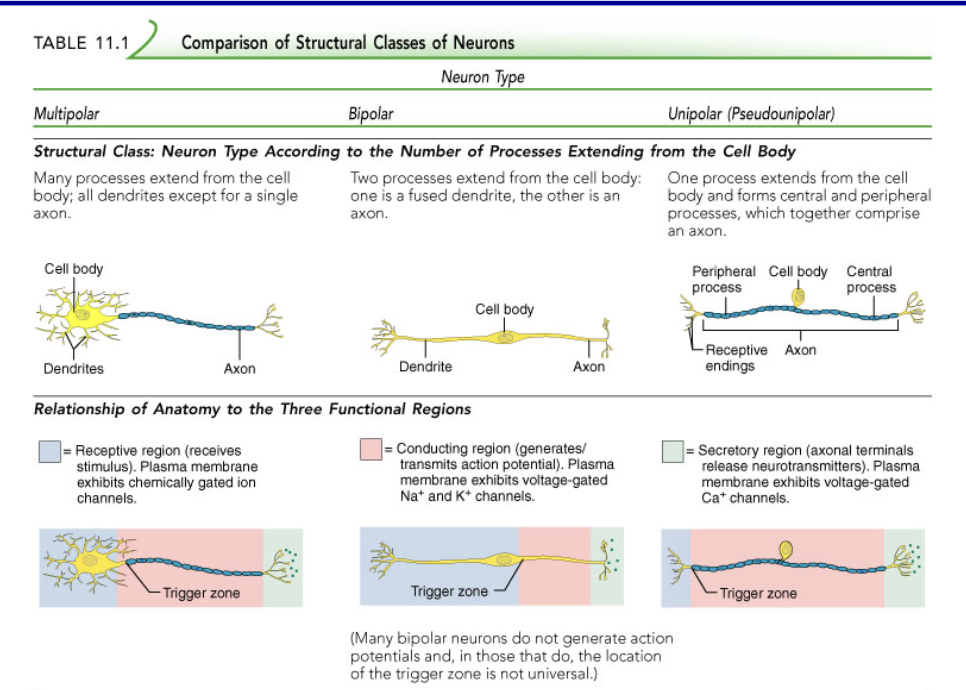
Comparison of Structural Classes of Neurons
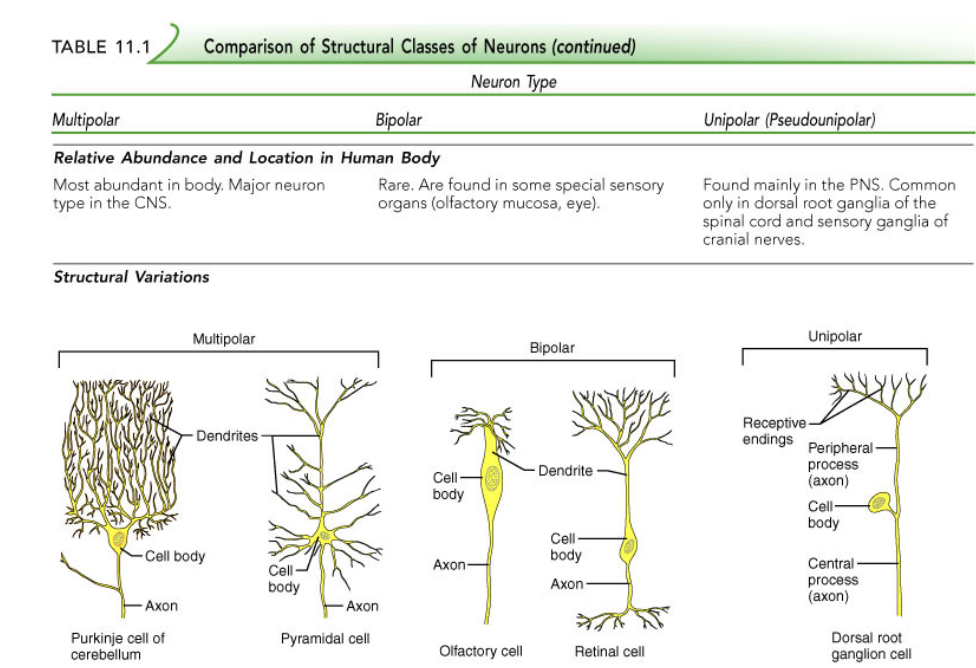
Comparison of Structural Classes of Neurons

Synapses
A junction that mediates information transfer from one neuron:
To another neuron
To an effector cell
Presynaptic neuron- conducts impulses toward the synapse
Postsynaptic neuron- transmits impulses away from the synapse
Synapses

Types of Synapses
Axodendritic- synapses between the axon of one neuron and the dendrite of another
Axosomatic- synapses between the axon of one neuron and the soma of another
Other types of synapses include:
Axoaxonic ( axon to axon)
Dendrodendritic (dendrite to dendrite)
Dendrosomatic ( dendrites to soma)
Electrical Synapses
Electrical synapses
Are less common than chemical synapses
Correspond to gap junctions found in other cell types
Are important in the CNS in:
Arousal from sleep
Mental attention
Emotions and memory
Ion and water homeostasis