Lab 13: Joint and Movement
 Call Kai
 Learn
Learn Practice Test
 Spaced Repetition
 Match
Match Flashcards
 Knowt Play
1/39

Earn XP
Description and Tags
Human Anatomy
Name | Mastery | Learn | Test | Matching | Spaced | Call with Kai | Chat |
|---|
No analytics yet
Send a link to your students to track their progress
40 Terms
Define joints
where bones join (come together) articulate
Functions of joints
movement and growth
What are the subtypes of the joint structural classifications: Fibrous
suture
syndesmosis
gomphosis
What are the subtypes of the joint structural classifications: Cartilaginous
synchondrosis
symphysis
What are the subtypes of the joint structural classifications: Synovial
pivot
hinge
saddle
condylar
plane/gliding
ball and socket
List the three functional classifications of joints
Immovable
Slightly movable
Freely movable
synarthrotic
amphiarthrotic
diarthrotic
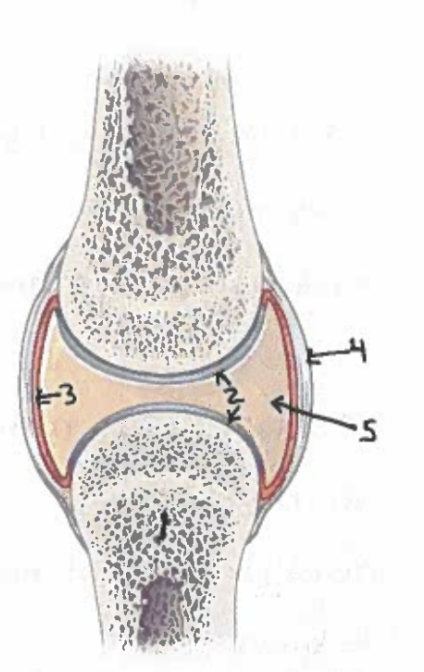
Label the synovial joint
Bone
Articular cartilage
Synovial membrane
Joint capsule/ Articular capsule
Joint cavity containing synovial fluid
Turning the foot so the plantar surface faces medially
Inversion
Bending of joint so that the angle between them decreases
Flexion
Turning the foot so the plantar surface faces laterally
Eversion
Moving a body part posteriorly
Retraction
Moving a part anteriorly
Protraction
Rotation of the forearm so the palm is upward, or facing anteriorly in the correct anatomical position
Supination
Moving a part away from the midline or from the axial line of the limb
Abduction
A term used to describe the extension of the parts at a joint beyond its anatomical position; often used to describe an abnormal extension beyond the normal range of motion
Hyperextension
Raising a body part superiorly
Elevation
Rotation of the forearm so the palm is downward, or facing posteriorly
Pronation
Movement at the ankle that beings the foot closer to the shin
Dorsiflexion
Movement at the ankle that brings the foot further from the shin
Plantar flexion
Moving a part toward the midline or toward the axial line of the limb
Adduction
Lowering a part inferiorly
Depression
Moving a part so that its ends makes a circular pattern in the air
Circumduction
Moving parts at a joint so that the angle between them increases and the parts move further apart
Extension
Movement of a body part around an axis
Rotation

For each joint determine the structural classification, subtype, and functional classification
A. Frontal and Parietal Bones
B. Mandibular Condyle and Temporal Bone
C. Mandible and Roof of mandibular
A.
Structural Classification: fibrous
Subtype: suture
Functional Classification: synarthrotic
B.
Structural Classification: synovial
Subtype: condylar
Functional Classification: diarthrotic
C.
Structural Classification: fibrous
Subtype: gomphosis
Functional Classification: synarthrotic

For each joint determine the structural classification, subtype, and functional classification
D. Occipital condyles and atlas
D.
Structural Classification: synovial
Subtype: condylar
Functional Classification: diarthrotic
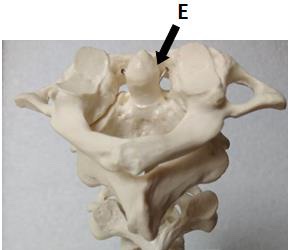
For each joint determine the structural classification, subtype, and functional classification
E. atlas and axis
E.
Structural Classification: synovial
Subtype: pivot
Functional Classification: diarthrotic

For each joint determine the structural classification, subtype, and functional classification
F. superior and inferior articulates process
F.
Structural Classification: synovial
Subtype: plane/gliding
Functional Classification: diarthrotic

For each joint determine the structural classification, subtype, and functional classification
G. sternum and true rib
H. acromion of scapula and clavicle
I. manubrium and clavicle
J. manubrium and 1st rib
K. head of humerus and glenoid cavity
L. vertebral bodies and intervertebral disc
G.
Structural Classification: synovial
Subtype: plane
Functional Classification: diarthrotic
H.
Structural Classification: synovial
Subtype: plane
Functional Classification: diarthrotic
I.
Structural Classification: synovial
Subtype: saddle
Functional Classification: diarthrotic
J.
Structural Classification: cartilaginous
Subtype: synchondrosis
Functional Classification: synarthrotic
K.
Structural Classification: synovial
Subtype: ball and socket
Functional Classification: diarthrotic
L.
Structural Classification: cartilaginous
Subtype: symphysis
Functional Classification: amphiarthrotic

For each joint determine the structural classification, subtype, and functional classification
M. trochlea of humerus and trochlear notch of ulna
N. head of radius/ radial notch of ulna
O. capitulum of humerus/ radial head
M.
Structural Classification: synovial
Subtype: hinge
Functional Classification: diarthrotic
N.
Structural Classification: synovial
Subtype: pivot
Functional Classification: diarthrotic
O.
Structural Classification: synovial
Subtype: plane
Functional Classification: diarthrotic

For each joint determine the structural classification, subtype, and functional classification
P. 4th middle and distal phalanx
Q. carpal and metacarpal
R. between carpals
S. radius and carpal
T. trapezium and 1st metacarpal
U. 2nd metacarpal and proximal phalanx
* Joint between radius and ulna
P.
Structural Classification: synovial
Subtype: hinge
Functional Classification: diarthrotic
Q.
Structural Classification: synovial
Subtype: plane
Functional Classification: diarthrotic
R.
Structural Classification: synovial
Subtype: plane
Functional Classification: diarthrotic
S.
Structural Classification: synovial
Subtype: condylar
Functional Classification: diarthrotic
T.
Structural Classification: synovial
Subtype: saddle
Functional Classification: diarthrotic
U.
Structural Classification: synovial
Subtype: condylar
Functional Classification: diarthrotic
*
1. Structural Classification: fibrous
Subtype: syndesmosis (interosseous ligament)
Functional Classification: amphiarthrotic

For each joint determine the structural classification, subtype, and functional classification
V. ilium and sacrum
W. head of femur/ acetabulum
X. pubic bone
V.
Structural Classification: synovial
Subtype: plane
Functional Classification: diarthrotic
W.
Structural Classification: synovial
Subtype: ball and socket
Functional Classification: diarthrotic
X.
Structural Classification: cartilaginous
Subtype: symphysis
Functional Classification: amphiarthrotic

For each joint determine the structural classification, subtype, and functional classification
Y. Femur and patella
Z. Femur and tibia
Y.
Structural Classification: synovial
Subtype: plane
Functional Classification: diarthrotic
Z.
Structural Classification: synovial
Subtype: condylar
Functional Classification: diarthrotic

For each joint determine the structural classification, subtype, and functional classification
AA. between tibia and fibula
BB. tibia/ talus
CC. tarsals
DD. tarsals and metatarsals
EE. proximal and distal phalanx
AA.
Structural Classification: fibrous
Subtype: syndesmosis
Functional Classification: amphiarthrotic
BB.
Structural Classification: synovial
Subtype: hinge
Functional Classification: diarthrotic
CC.
Structural Classification: synovial
Subtype: plane
Functional Classification: diarthrotic
DD.
Structural Classification: synovial
Subtype: plane
Functional Classification: diarthrotic
EE.
Structural Classification: synovial
Subtype: hinge
Functional Classification: diarthrotic

Name the areas around the knee
(Left: anterior; Right: posterior)
Patellar ligament (bottom); Patellar [Quadriceps] tendon (top)
Fibular collateral ligament (FCL/LCL)
Tibial collateral ligament (TCL/MCL)
Lateral meniscus
Medial meniscus
Femur
Tibia
Fibula
Anterior cruciate ligament (APL)
Posterior cruciate ligament (PCL)

Name the areas of the hip bone
(Left: anterior; Right: posterior)
ilium
pubis
ischium
iliofemoral ligament
pubofemoral ligament
ischiofemoral ligament

Name the areas in the sectioned shoulder
A. scapula
B. head of humerus
C. joint capsule
D. articular cartilage

Name the areas in the sectioned elbow
A. ulna
B. humerus
C. articular cartilage
D. radius

Name the areas in the sectioned hip
A. acetabulum
B. head of femur
C. ligaments od the head of the femur
D. articular cartilage

Name the areas in the sectioned knee
A. patella
B. femur
C. infrapatellar bursa
D. tibia
E. suprapatellar bursa
F. prepatellar bursa
G. patellar (quadriceps) tendon
H. patellar ligament