IB Bio test 9/30/26
 Call Kai
 Learn
Learn Practice Test
 Spaced Repetition
 Match
Match Flashcards
 Knowt Play
1/95

There's no tags or description
Looks like no tags are added yet.
Name | Mastery | Learn | Test | Matching | Spaced | Call with Kai | Chat |
|---|
No analytics yet
Send a link to your students to track their progress
96 Terms
Population
an interacting group of organisms of the same species that inhabit the same geographical area and are capable of breeding with one another, members of the same species that are reproductively isolated from different populations
Four essential factors of a population
Natality (birth rate), immigration, mortality (death rate), and emmigration
Sampling
numbers counted in small areas and extrapolated to estimate totals
sampling error
the difference between an estimate and the true size
Systemic sampling
positions of sampling points are assigned at fixed intervals throughout the target area, allows for the distribution of a population to be measured against a changing environmental factor
the population size or distribution of a non-motile species can be determined using
quadrats

standard deviation can be used to indicate __ about a population
how evenly distributed a population is over a habitat
community
group of populations living together and interacting with each other within a given area
species
a group of living organisms that share features and can breed with each other to produce healthy offspring
population
an interacting group of organisms of the same species that inhabit the same geographical area and are capable of breeding with one another
habitat
physical environment in which a community, species, population or organism normally lives
ecosystem
all interactions between a group of organisms and the environment
Lincoln index
capture-mark-release-recapture ( Population size= M x N / R)
M: the number of individuals that are captured in an area, then marked and released
N: The number of individuals that are recaptured after time has passed for reintegration
R: the number of marked individuals that are present within the recaptured sample

Lincoln index assumptions
all individuals in an area have an equal chance of being captured (random sampling)
marked individuals distribute randomly after release (evenly spread reintegration)
the action of marking individuals with not affect mortality or natality of a population
the markings will remain visible for the duration of the sampling process
population size does not change significantly between the first and second capture
Stable populations demonstrate a __ shaped population growth curve
sigmoidal (S-shaped)
Three stages of the sigmoidal population growth curve
Exponential Growth
Transitional phase
Plateau phase

Population growth can be modeled using simple organisms that grow rapidly under laboratory conditions, for example __
yeast, which can be grown in a broth and measured via the turbidity, and duckweed, which forms clusters of fronds that can be easily counted
random sample
every member of a population has an equal chance of being selected for the sample
density-independent factors
same effect no matter the population size, ex. fire
density-dependent factors
increasing effect when the population is bigger (predation, access to habitats, nutrient supply, disease, accumulation of wastes)
if the trend line of a population growth model is not linear, this suggests that
an abiotic factor is impacting the growth (not growing to biotic potential)
The carrying capacity for a given species is not a __value and may be influenced by __
not a static value and may be influenced by either abiotic or biotic factors

Intraspecific interactions
occur between members of the same species (cooperation - pack animals or competition - gorillas fighting for the opportunity to mate with females)
feeding relationships
herbivory, predation
symbiosis
a close and persistent interaction between two species (mutalism, commensalism, parasitism)

pathogenicity
infectious microorganisms living either inside or on the surface of a host organism and causing disease, the infectious agent (pathogen) causes the disease by disrupting the homeostatic processes occurring within the host organism
herbivory
the act of eating only plant matter
predation
a predator hunts and feeds on another organism
commensalism
one species benefits, other is unaffected
Mutualism examples
Legume root nodules trade resources with nitrogen-fixing bacteria, fungi and orchids can form a filamentous network called a mycorrhizae, photosynthetic algae provide nutrition inside a coral polyp’s endodermis
pathogenicity examples
pathogens can include bacteria, protozoa, fungi and multicellular parasites - viruses are also pathogenic but are not alive. mycobacterium causes tuberculosis in animals, powdery mildew can cause foliar disease in plants
allelopathy
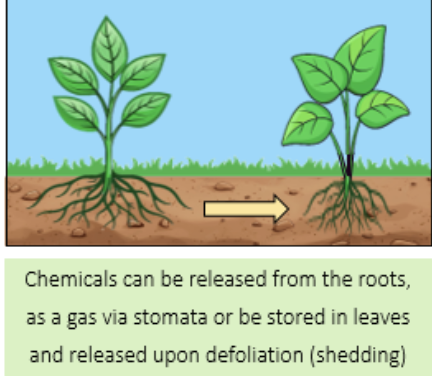
a biological interaction whereby an organism releases chemicals that influence the growth and survival of another organism, occurs mainly in plant species
Antibiotics
biological compounds that are released by certain organisms to kill or impede the growth of bacterial pathogens, specifically target components of prokaryotic cells, not effective against eukaryotic organisms

Interspecific competition
when different species compete for access to a limited resource, can either be direct or indirect
Invasive species
If an alien has a detrimental effect upon existing food chains, it is classed as invasive
Endemic
native to a region (indigenous)
characteristics of invasive species
possess a larger fundamental niche, often have faster reproduction rates, they commonly lack a predator capable of limiting their survival, may possess certain features that make them better suited to an area
Top-down control
Predators at the highest trophic level regulate the populations of lower levels (herbivores and producers). If top predators decrease, herbivores multiply and deplete plants
bottom-up control
Resource availability (nutrients, sunlight, and primary producers) at the base dictates the abundance and productivity of higher trophic levels.
Different research methods that interspecific competition can be assessed
Laboratory experiments (conducted under controlled conditions by measuring a dependent variable when the species are either both present or individually isolated), field manipulation (research may involve the selective removal of one species in order to determine the impact on the other species within the environment), field observations (sample sites are selected and then measured (using quadrats) for the presence or absence of each species to determine association
limiting factor
a variable which limits a population’s distribution or numbers ex. light intensity, temperature, edaphic factors (soil), climate
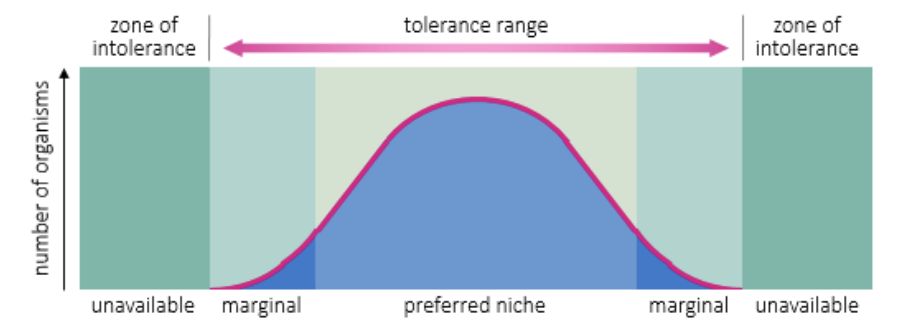
range of tolerance
organisms will demonstrate a range of tolerance for a limiting factor, as a population becomes exposed to abiotic extremes, the rates of survival begin to drop
Transects
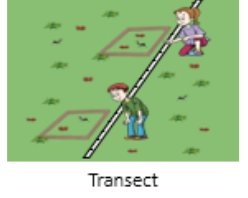
A straight line along an abiotic gradient from which population data is recorded to determine a pattern, may be used to assess species distribution in correlation with any abiotic factor that varies across a measurable distance
kite graph
used to represent changes in the distribution of a species in response to variations in the levels of a limiting factor, the relative width of each kite represents the abundance of an organism at any particular point along the length of a transect

coral reefs
a marine ecosystem whereby the distribution is determined by a wide range of abiotic conditions
reef-building coral that exist in symbiosis with photosynthetic algae are consequently influenced by
water depth/clarity, ocean pH, temperature, salinity

coral reef distribution
limited to shallow tropical and sub-tropical waters

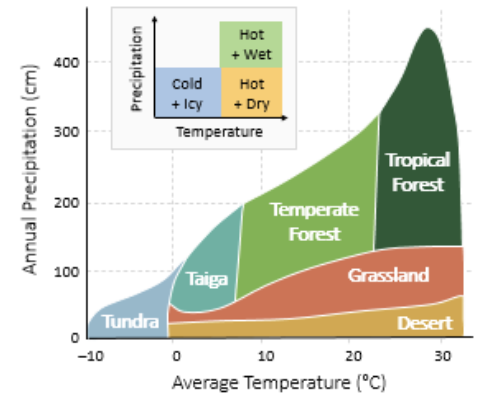
biomes
groups of ecosystems that share a climate and hence sustain similar communities

Hot desert
temperature: extreme, rainfall: very low, productivity: very low, biodiversity: very low
grassland
temperature: moderate, rainfall: fluctuates, productivity: low, biodiversity: low
temperate forest
temperature: seasonal, rainfall: high productivity: seasonal biodiversity: high
tropical rainforest
temperature: warm, rainfall: very high, productivity: high, biodiversity: very high
taiga (boreal forest)
temperature: cold, rainfall: low (snow), productivity: low, biodiversity: low
tundra
temperature: very low, rainfall: low, productivity: very low, biodiversity: very low
climograph
temperature and rainfall pattern conditions illustrated using a climograph
sand dune adaptations
marram grass has horizontal underground stems to maximize the penetration of roots and stabilize the plant, root system is extensive to improve anchorage and to allow the plant to access reservoirs of underground water, leaves are curled to reduce the exposure of somata to external air, stomata are sunk in pits to better trap water vapour

swamp adaptations
mangroves may have parts of their roots above ground, halophytes (salt tolerant) can sequester salts in cell walls or vacuoles, some mangroves may concentrate salts in particular leaves, which may then be separated from the plant via abscission

desert adaptations
plants adapted to desert conditions are called xerophytes and are low growing with reduced leaves, most desert plants will have a thickened waxy cuticle to reduce water loss by evaporation, animals have kidneys with longer loops of Henle, improves water retention within the body
rainforest adaptations
emergent trees grow above the canopy, animals have smaller stature and possess limb structures suited for climbing and brachiation, animals may be camouflaged or use biological mimicry to hunt or avoid predation
an ecosystem is considered stable if
it is capable of maintaining its ecological functions under changing conditions or during periods of environmental disturbances
four key requirements for ecosystem stability
Recycling of nutrients, Abiotic conditions, Genetic diversity, Energy supply

mesocosms
typically set up in sealed glass vessels to prevent the entry and exit of matter, while still allowing for energy transfer, a control mesocosm should be setup as a point of comparison

keystone species
disproportionately large impact on the environment relative to its abundance

sustainability
the capacity for an ecosystem to remain diverse and productive indefinitely
sustainable yield
the amount of a natural resource that can be taken away from an ecosystem without reducing the stock (rate of harvest is lower than rate of replacement)
sustainable practices
sustainable timber harvesting ensures that trees are logged and reliably replaced, sustainable fishing ensures that enough adult fish remain to allow repopulation, agricultural sustainability ensures that the land usage does not threaten the native species
agricultural sustainability issues
supply of fertilizers, carbon footprint, agrochemical pollution, leaching of nutrients, erosion
deforestation
the removal of trees will cause temperature and rainfall patterns to change significantly, this may create a tipping point beyond which an ecosystem is not stable or sustainable

rewilding
involves the use of conservation strategies to restore ecosystems to their original, natural conditions (ex. species reintroductions, improve habitat connectivity, minimize human activity)
pollutants
substances that are released into an environment and have a damaging effect, can be naturally forming but are mainly anthropogenic
anthropogenic
man-made
consequences of pollution
eutrophication, biomagnification, plastic persistence, increased CO2 concentrations
eutrophication
enrichment of an ecosystem (typically aquatic) with chemical nutrients
nutrients in eutrophication can be introduced via
leaching from soil by rainfall or released as sewage
consequences of increased nutrient supply within waterways
rapid growth in algal populations (algal blooms), subsequent spike in the number of decomposers when the algae die, a high rate of decomposition will result in an increased biochemical oxygen demand (BOD), this leads to the deoxygenation of the water supply, stressing survival of marine organisms, also increases turbidity, reducing O2 production by photosynthetic seaweed
BOD
Biological Oxygen Demand, eutrophication is common around agricultural lands where use of fertilisers are prevalent

Biomagnification
when pollutants become more concentrated at each trophic level, energy transformations are ~10% efficient, so high trophic levels must eat more biomass, this means higher order consumers experience increased contamination from pollutants

DDT
sprayed on water to eliminate mosquito larvae (malaria), DDT was taken up by the algae and passed onto the primary consumers, high levels of DDT were discovered in birds that preyed on fish, the birds exposed to higher levels of DDT produced thinner shells, this dramatically decreased the survival rates of fledgling birds

mercury
a heavy metal that can be released into the environment through anthropogenic activities, such as coal-fired power generation and gold mining
how mercury poisoning happens
mercury released, then converted by microorganisms into highly toxic methyl-mercury, which accumulates in the bodies of consumers (fish within impacted waterways), this can lead to mercury poisoning in humans who eat the larger predatory fish (including tuna or swordfish)
plastics
type of synthetic polymer that are not biodegradable and persist for centuries, large macroplastic debris may be broken down into smaller microplastic debris
plastic pollution
plastics leach chemicals into water and also absorb toxic contaminants called persistent organic pollutants (POPs) - microplastics will absorb more POPs due to smaller size

plastic impacts on sea turtles
sea turtles mistake plastic bags for jellyfish, which lodges in the oesophagus and causes ongoing feeding complications

plastic impacts on laysan albatross
ingests plastic when it skims the ocean with its beak, adults reguritate plastics but chicks are unable to

fossil fuels
form as a consequence of incomplete decomposition of organic biomass (i.e. subjected to anoxic or acidic conditions), peat and coal are formed from biomass in waterlogged soils, oil and natural gas are formed from marine biomass (sea bed)

how fossil fuels release carbon dioxide
combusted to produce energy (which can be used for industrial purposes) but will also release carbon dioxide, peat extraction from waterlogged soils also releases methane
CO2
carbon dioxide is a greenhouse gas that affects global climates
keeling curve
daily record of the global atmospheric CO2 concentrations, demonstrates that carbon dioxide levels are increasing due to human activity, and current carbon dioxide levels are the highest that have ever been recorded (comparable to 16 million years ago)

greenhouse gases
greenhouse gases act to trap and retain heat in the atmosphere, this ensures that temperatures on Earth stay stable at night
factors that determine the significance of a greenhouse gas
its ability to absorb and retain heat (long wave IR radiation)
its concentration within the atmosphere (and its persistence)

examples of greenhouse gases
main are water vapor and carbon dioxide, others include methane and nitrogen oxides

greenhouse effect
incoming solar radiation is a shorter wavelength (ultraviolet) → the earth’s surface absorbs and re-emits the solar radiation → the re-emitted radiation is at a longer wavelength (infrared) → greenhouse gases can trap the long-wave infrared radiation → this energy remains within the atmosphere as ambient heat

historical data on global temperatures
data from the antarctic ice cores shows a positive correlation between global temps and atmospheric carbon dioxide concentrations- however correlation does not equal causation
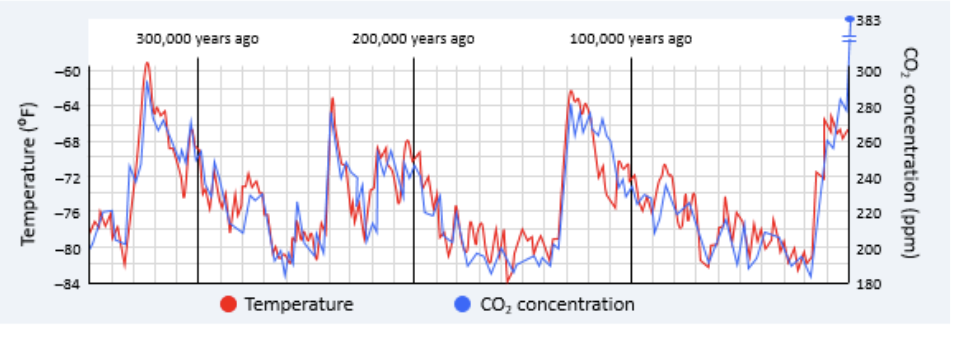
how human activity is increasing the concentration of greenhouse gases in the atmosphere in many ways
combustion of fossil fuels
deforestation will reduce CO2 uptake by plants
methane is a gaseous waste emitted by landfills and is also produced from agricultural farming
these are causing an enhanced greenhouse effect
positive feedback cycles
oceans are carbon sinks, but CO2 absorption is temperature dependent
ice reflects light energy - so the melting of polar ice caps means more heat is absorbed by Earth
permafrost is ground that remains frozen for more than two years- when it melts, stored organic matter is decomposed
increased droughts lead to more forest fires (produce CO2)
tipping point