Biology 196: Hardy Weinberg Equation (PWPT 6)
 Call Kai
 Learn
 Practice Test
 Spaced Repetition
 Match
 Flashcards
 Knowt Play
1/14

There's no tags or description
Looks like no tags are added yet.
15 Terms
If there are two or more alleles for a locus, what can individuals be?
homozygous or heterozygous
How do you find the total amount of dominant alleles? (MATH EQUATION)
Total dominant alleles=(2×# AA individuals)+(1×# Aa individuals)
How do you find the total amount of recessive alleles? (MATH EQUATION)
Total recessive alleles=(2×# aa individuals)+(1×# Aa individuals)
Suppose in a population there are:
10 individuals AA (Homozygous recessive)
5 individuals Aa (Heterozygous)
0 individuals aa (Homozygous recessive)
How many dominant alleles and recessive alleles are there?
Dominant alleles:
(2×10)+(1×5)=20+5= 25
Recessive alleles:
(2×0)+(1×5)=0+5= 5
If there are two alleles at a locus, what represents their frequencies?
p and q are used to represent their requecies
What does the frequency of all alleles in a population add up to?
Sooooooooo, p+q=1 broski


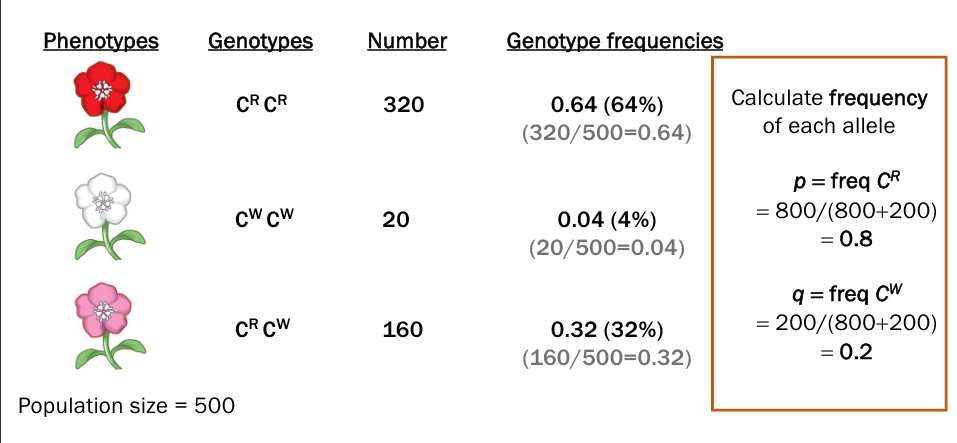
Find the Genotype Frequency for the following problem


Calculate the number or copes of each allele in the following problem.


Calculate the frequency of each allele for the following problem:
Check the answer:
p+q=1 —> 0.8+0.2= 1 ✅
What does the Hardy-Weinberg equation describe?
the genetic makeup we expect for a population that is NOT evolving at a particular locus
allele and genotype frequencies remain constant from generation to generation
if above is true, the population is in Hardy-Weinberg equilibrium
What does deviation from H-W equilibrium indicate?
the population is evolving at the locus
If p and q represent the relative frequencies of the only two possible alleles in a population at a locus, what can we expect?
expect genotype frequencies can be calculated assuming random mating

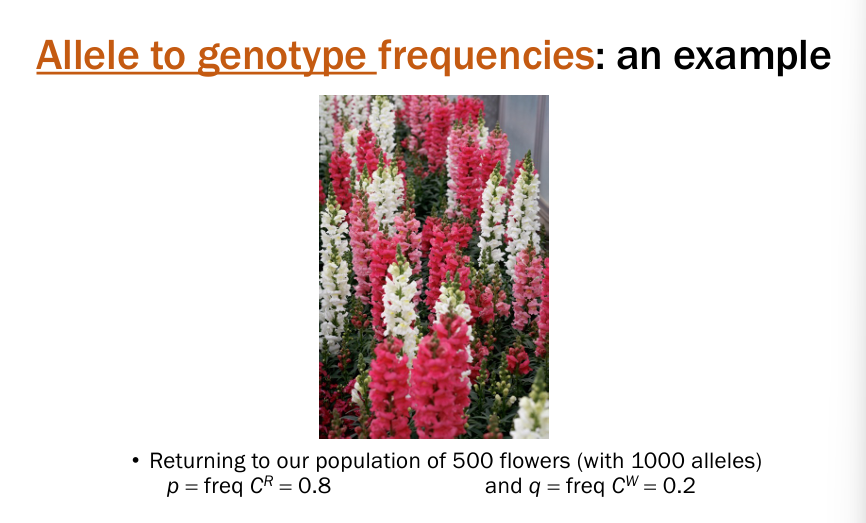
Example Problem Cont:
Calculate the equilibrium genotype frequencies


Calculate the equilibrium phenotype numbers

What are the five conditions that if met allele frequencies will be constant over time and the population is not evolving?
1) No mutation
2) Random Mating
3) No Natural selection
4) Extremely large population size (little genetic drift)
5) No movement of individuals between populations (No gene flow)