CHEMISTRY REACTIONS
 Call Kai
 Learn
 Practice Test
 Spaced Repetition
 Match
 Flashcards
 Knowt Play
1/24

There's no tags or description
Looks like no tags are added yet.
25 Terms
elimination reactions are favored in what type of temperature
High
addition reactions are favored, and what type of temperature
low

in Hydrohalogination, what are the reagent that could be used?
hBr Hcl Hi

im hydrogination were will the regent move to
what if we recated it with ROOR?
the more subsitued end
when reacted with ROOR, it would go to the least substituted and making the anti-mark Konikoff
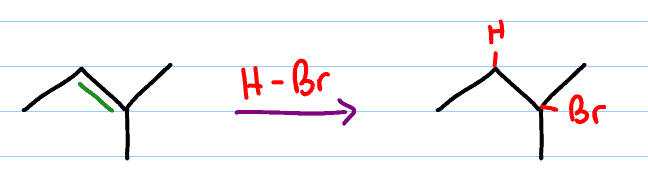
in hydrohalogination, if a new Chiral center is made, what is important to remember when predicting the product
you should have two products two sets of enatiomerz
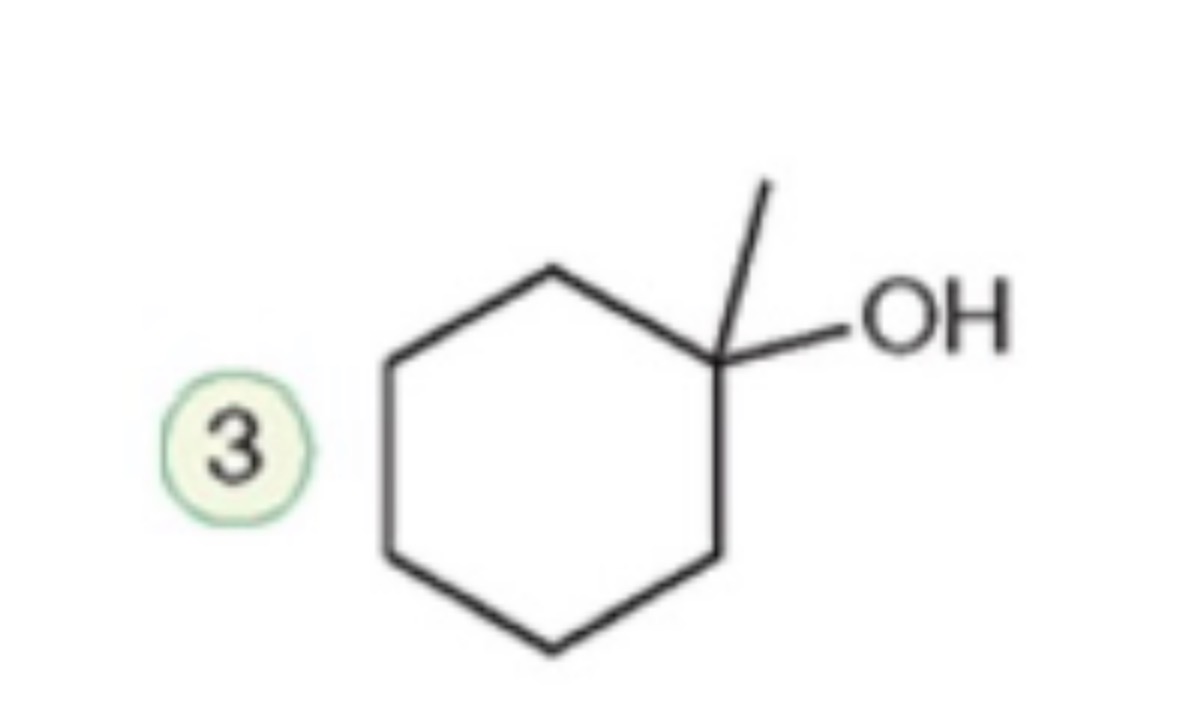
for acid catalyst hydration, what reagent do you need? ALKANE
H30+

oxidationdemeruiratio what type of agent is needed? ALKANE
what does the mechanism look like?
HG(Oac)2 and H20
OH bond is added to the more substituted end of the double bond


IN HYBROBORATION OXIDATION WHAT TYPE OF REAGENT DO YOU NEED? ALKANE
In in this reaction, where does the agent go?
BH3THF
H2O2, NAOH
three agent is gonna go to the least substituted and in an anti-or Konikoff fashion however, it'll add on the syn addition

in catalytic hydrogenation using
(PH3P)3RHCL WHAT CAN BE SAID ABOUT THE PRODUCT WHEN USING THIS SPECIFIC REGagent
The product is gonna be added in a syn fashion

for the following two reactions, explain what the products would look like for the second reaction Explain why the two reactions are different
for the first reaction, the BR are going to be added in in a trans edition for the second one one BR is gonna be added to the least substituted end and in a Trans fashion with an OH bond on the more sub end
what is the reagent needed to form an epoide?
give a brief description of what the product would look like
RCO3H
two OH BOMDS ADDED TRANZ


based on the reaction above, give a brief description of what the products would look like
removing a bond as we go and adding two X every time we remove a bond

when doing HYDROHALGENATION OF ALKYNES why is BR special?
you can only get E OR Z using BR and these types of reactions

in HAlOgenAtion of ALKYNES WHAT TYPE OF REAGENT DO YOU NEED
in what way does the reagent add onto the bonds?
you can use BR or CL but the second step needs to be CCL
The agents are going to add in a TRANZ FASHION

IN ACID CATALYED HYDRATION OF ALKYLES
What type of reagent do you need?
what is the outcome of this?
HGSO4 H2SO4 H20
u form ketone


IN BASE CATALYED HYDRATION OF ALKYLES
What type of reagent do you need?
what is the outcome of this?
R2BH H2O2 NAOH
YOU'RE GONNA FORM AN ALDEHYDE IN A ANTIMARK FASHOON


describe what the product would look like


for dissolving metals in alkynesss what type of reagent do you need?
NA NH3(l)


based on the information given above, explain whether the acid is strong enough to protonate the base
no, technically based on the information The PKA of the conjugate base is bigger than its acid MEANING THAT THE REACTION FAVORS THE REACTANTS MEANING THAT IT'S NOT STRONG ENOUGH

When is a chemical reaction considered thermodynamically favorable?
When Gibbs Free Energy (\Delta G) is negative (\Delta G < 0).
Why are alkene addition reactions generally favored at low temperatures?
Addition is exothermic (\Delta H < 0, favorable) but decreases entropy (\Delta S < 0, unfavorable because two molecules become one). At low temperatures, the enthalpy term dominates, making \Delta G negative.
Why are elimination reactions favored at high temperatures?
Elimination increases entropy (\Delta S > 0, splitting one molecule into two). At high temperatures, the -T\Delta S term dominates and drives \Delta G negative.
Is radical chlorination exothermic or endothermic, and is it selective or non-selective?
Strongly exothermic, with an early transition state. It has low selectivity and chlorinates positions almost randomly.
Is radical bromination exothermic or endothermic, and is it selective or non-selective?
Back: Endothermic, with a late transition state. It has high selectivity and heavily favors forming the most stable radical (tertiary).
How does the Hammond Postulate explain the difference in selectivity between chlorination and bromination?
Exothermic steps have early transition states that resemble reactants (low selectivity), while endothermic steps have late transition states that resemble radical products (high selectivity based on radical stability).