Carbohydrates- polysaccharides
 Call Kai
 Learn
 Practice Test
 Spaced Repetition
 Match
 Flashcards
 Knowt Play
1/21

There's no tags or description
Looks like no tags are added yet.
22 Terms
When and how are polysaccharides formed
When more than 2 monosaccharides are joined by condensation reactions with glycosidic bonds forming
Main 3 examples of polysaccharides
Starch, Glycogen, cellulose
Use of starch
Cells get energy from glucose and they store excess glucose as starch so when they need more glucose for energy they can break the starch down
Why is starch a good storage substance
It is insoluble in water and doesn't affect water potential meaning it doesn't cause water to enter cells by osmosis which would make them swell
What polysaccharides is starch made up of
2 polysaccharides of alpha glucose- amylose and amylopectin
Structure of amylose
A long unbranched chain of Alpha glucose
Functions of the structure of amylose
The angles of its glycosidic bonds give it a coiled almost cylindrical structure making it compact and really good for storage as more can fit in a smaller space
Picture of the structure of amylose

Structure of amylopectin
A long, branched chain of alpha glucose
Functions of the structure of amylopectin
Its side branches allow enzymes to break down the molecule to get at glycosidic bonds easily so glucose can be quickly released
Picture of the structure of amylopectin

How do you test for starch
Add iodine dissolved in potassium iodide solution
Positive result = brown-orange –> dark blue-black
Use of Glycogen
Animal cells also get energy from glucose but they store their excess glucose as glycogen instead of starch
What is Glycogen a polysaccharide of
Alpha glucose
Structure of glycogen
Similar to amylopectin- a long branched chain of Alpha glucose- except it has loads more side branches
Uses of the structure of glycogen
Very compact molecule making it good for storage as more can fit in less space and loads of branches allowing enzymes to get at glycosidic bonds allowing quick release of stored glucose
Picture of structure of Glycogen
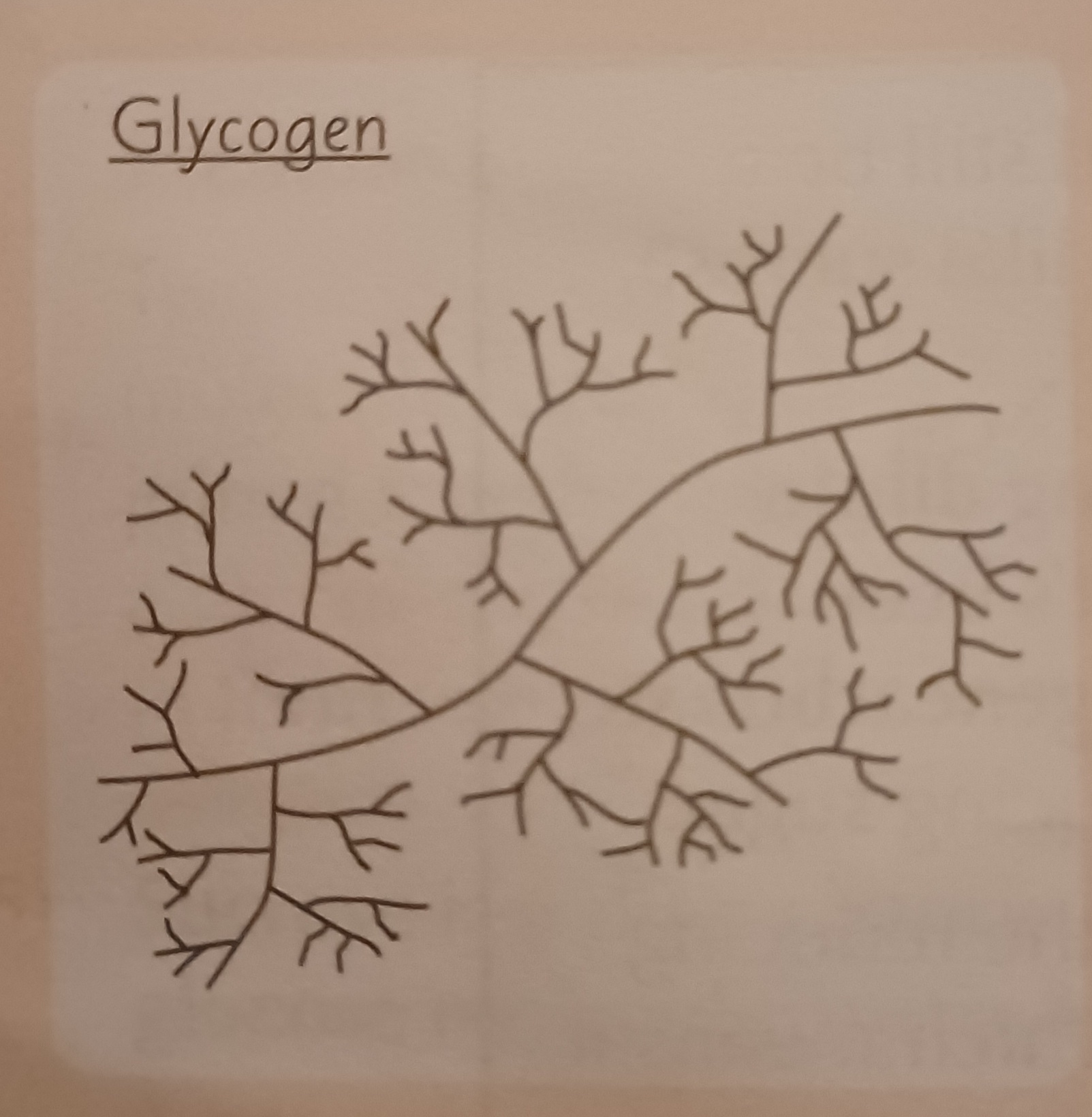
Use of cellulose
Major component that strengthen cell walls in plants
What is cellulose a polysaccharide of
B-glucose molecules
Structure of cellulose
Long unbranched chains of beta glucose forming straight cellulose chains linked by hydrogen bonds
Use of the structure of cellulose
Hydrogen Bond links form microfibrilis which are strong fibers allowing cellulose to give structural support for cells such as plant cell walls
Picture of structure of cellulose
