UNT Molecular Biology Exam 3
 Call Kai
 Learn
 Practice Test
 Spaced Repetition
 Match
 Flashcards
 Knowt Play
1/37

There's no tags or description
Looks like no tags are added yet.
Name | Mastery | Learn | Test | Matching | Spaced | Call with Kai | Chat |
|---|
No analytics yet
Send a link to your students to track their progress
38 Terms

Strand Displacement Mechanism
in viruses (typically mammalian); new DNA strand grows by displacing the previous (homologous) strand of the duplex; only one strand replicated at a time.
How do terminal proteins enable initiation at ends of viral DNAs?
A percursor terminal protein (pTP) binds to the 5’ end of DNA and provides a cytidine nucleotide (dCTP) with a 3’-OH end that primes replication; pTP also associates with DNA polymerase

Rolling Circle
generates multiple single stranded copies of the original replicon sequence (can remain attached as multimers).
Examples of organisms that use rolling circle?
Some phages; monomers can be packaged into phage particles (e.g. Phage ΦX174). Also used by some plasmids in bacterial conjugation.
Conjugation (bacterial mating)
two cells come in contact and transfer genetic material (donor cell → recipient cell) - horizontal gene transfer
F Plasmid
AKA F factor, fertility factor; replicon that is maintained as one plasmid per bacterial chromosome → cell is capable of conjugation
How does F plasmid function?
encodes a DNA translocation complex (tra genes) and a specific pilus that forms on the surface of the bacterium
F-pilus
enables an F-positive bacterium (donor) to contact an F-negative bacterium (recipient) and initiate conjugation

Bacterial Conjugation Transfer of F Plasmid: Step One
Pilus of donor cell attaches to recipient cell. Pilus contracts, drawing cells together to make contact with one another.

Bacterial Conjugation Transfer of F Plasmid: Step Two
One strand of F plasmid DNA transfers from donor cell to recipient cell

Bacterial Conjugation Transfer of F Plasmid: Step Three
Donor synthesizes complementary strand to restore plasmid. Recipient synthesizes complementary strand to become F+ cell with pilus.
What types of bacterial cells primarily go through bacterial conjugation through transfer of F plasmid?
Gram negative

Conjugation: Transfer of ssDNA
Transfer of F plasmid initiated when rolling circle replication begins at origin (oriT). Tra (transfer) genes on the F plasmid are required for DNA translocation. Transferred DNA is converted into double-stranded form in recipient bacterium. Conjugation “infects” the recipient bacterium with a copy of the free F plasmid.
Plasmid Copy Number
number of copies of a plasmid that is maintained in a bacterium → consequence of the type of replication control mechanism (determines number of origins that can be present in the cell)

Partition Systems
ensure duplicated plasmids are segregated to different daughter cells produced by a division. Multi-copy plasmids → partition can be random, single-copy plasmids → partitioning is controlled.
How is plasmid R1 partitioned?
Involves polymerization of the ParM ATPase between plasmids
Plasmid addiction system (PAS)
“survival” mechanism used by plasmids → kills bacterium if plasmid is lost. This is common in plasmids with essential survival genes, such as antibiotic resistance.
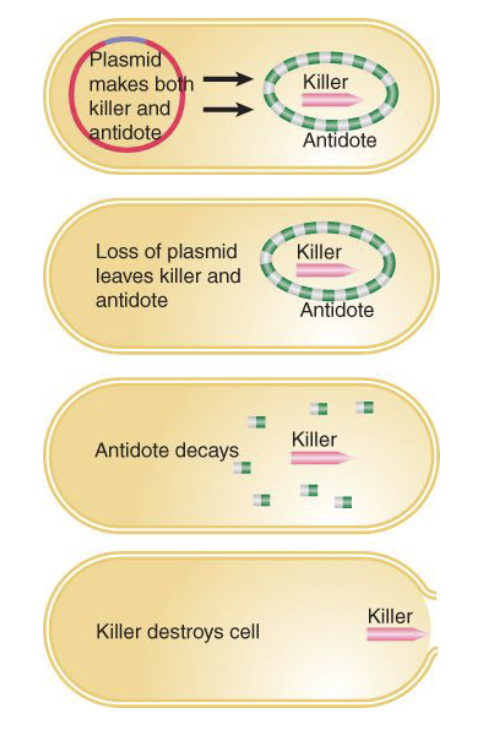
One mechanism of PAS?
Plasmid synthesizes a long-lived killer (toxin) and a short-lived antidote (antitoxin) → both are synthesized at the same time. If the plasmid is present and functional both will be present and cancel each other out. If the plasmid is lost, the toxin is long-lasting and once the remaining antitoxin is degraded it will kill the cell.

Plasmid Incompatibility
Plasmids in the same incompatibility group have origins that are regulated by a common control system → they are incompatible because they compete for the same replication control machinery. Incompatibility may also be caused by having the same partitioning system.

Crown gall disease
caused by infection with Agrobacterium tumefaciens → formation of tumors. They infect the crown of the plant.
What is the infectious agent of crown gall disease?
Ti (Tumor-inducing) plasmid; it contains genes for synthesizing and metabolizing opines (arginine derivatives) that are used by the bacterium as a source of energy for growth and division.
Nopaline plasmid
tumor cells retain the ability to differentiate into early embryonic structures
Octopine plasmid
forms tumors that are undifferentiated.
Agropine plasmid
tumors usually die early
Ri plasmid
plasmids found in Agrobacterium rhizogenes; also cause disease in infected plants → disease causes formation of “hairy roots” phenotype
T-DNA (Transfer DNA)
part of the DNA of the Ti plasmid that is transferred to the plant cell nucleus

Double-strand break repair (DSBR) Model: Step 1
5’ end resection → exonuclease action generates 3′–single-stranded ends
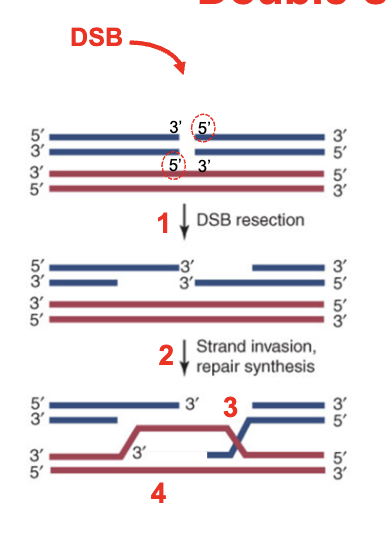
Double-strand break repair (DSBR) Model: Step 2
Single-strand invasion → single strand from one duplex displaces its counterpart in the other duplex → creates a branched structure called a D-loop (Displacement loop)

Double-strand break repair (DSBR) Model: Step 3
Strand exchange generates a stretch of heteroduplex DNA consisting of one strand from each parent

Double-strand break repair (DSBR) Model: Step 4
New DNA synthesis replaces the material that has been degraded

Double-strand break repair (DSBR) Model: Step 5
Capture of the second double-strand break end by annealing → generates recombinant joint molecule in which the two DNA duplexes are connected by heteroduplex DNA and two Holliday junctions
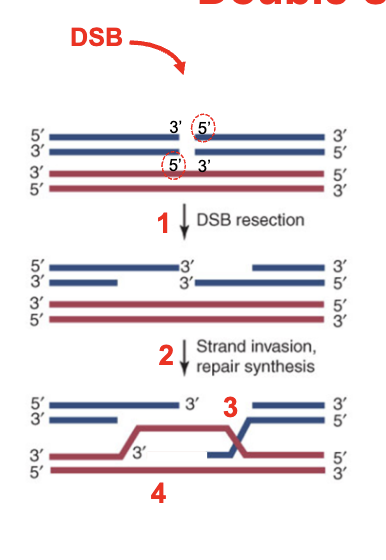
Double-strand break repair (DSBR) Model: Step 6
Resolution of the joint molecule into two separate duplex molecules by nicking two of the connecting strand

Double-strand break repair (DSBR) Model: Step 7
Formation of recombinants depends on how Holliday junctions are resolved, i.e., how strands are nicked by the resolvase enzyme complex:
Both at blue arrows (horizontal axis) → no crossing over
One at red arrows (vertical axis), one at blue arrows → crossing over (recombinant)
Gene Conversion
When cell is attempting to repair a break in DNA, a cell can use a homologous chromosome as a template. In the process of repair the new synthesized strand adopts the sequence of the homologous chromosome rather than its original sequence.
(One DNA sequence replaces a homologous sequence such that the sequences become identical after the conversion event → usually by mismatch repair or gap repair during homologous recombination)

What is the only difference between synthesis-dependent strand annealing model (SDSA) double-strand break repair model (DSBR)?
Second end capture does not happen; Most recombinant events are repaired by SDSA and result in non-crossovers.
Where does single strand annealing (SSA) mechanism occur?
SSA occurs at double stranded breaks between direct repeats; no strand invasion. Resection of DSB → 3’-single-stranded tails

Break-Induced Replication (BIR)
Initiated by a one-ended double-stranded break at fragile sites located near the end of the chromosome during DNA replication. It uses a non-homologous chromosome as template; can lead to genetic disorders.Repair by BIR at repeated sequences can result in non-reciprocal translocations

Does synaptonemal complex form during or after recombination?
It forms after: Cytological and molecular evidence suggests the synaptonemal complex is a consequence rather than the cause of recombination. One evidence: chromatids are too far apart in the SC to allow recombination. Double stranded breaks that initiate recombination occur before the synaptonemal complex forms.