Radiation therapy chap. 8
 Call Kai
 Learn
 Practice Test
 Spaced Repetition
 Match
 Flashcards
 Knowt Play
1/107

There's no tags or description
Looks like no tags are added yet.
108 Terms
Baseline shift
Steady position change
V&R systems
A Verify and Record (V&R) system in radiation therapy is an automated safety and management software framework that checks treatment parameters against the prescription before allowing a linear accelerator or other machine to deliver radiation
Beam Modifiers
Devices that change treatment field shape or radiation distribution at depth.
BEV
Beam’s eye view
Collimation
Arrangement of shielding material designed to define the X&Y dimensions of the field

Compensator
Skin sparing for irregular surfaces

Conformal therapy
applies 3-dimensional tumor volume localization to treatment field definition

Coplanar
aligned with the gantry rotation plane

Elapsed days
Total time over which treatment is protracted.
En-face
Directly facing
Feathering
Adjusting junction lines between adjacent fields

Fiducial
Placed object used as a point of reference

Fraction
Individual dose intended for a treatment session.
Hinge angle
Angle between two intersecting treatment beams’ central rays

IGRT
Image guided radiation therapy
Immobilization devices
Devices that restrict movement such as casts, masks, and or bite blocks
IMRT
Intensity-modulated radiation therapy—Delivers non uniform, modulated exposure across the BEV

Indexing:
Fixed, incremented PSA positions
Interlocks:
Prevent beam initiation and include alerts prompting treatment setup and safety procedure completion
Interfraction
Between treatment sessions
Intrafraction
During a treatment session
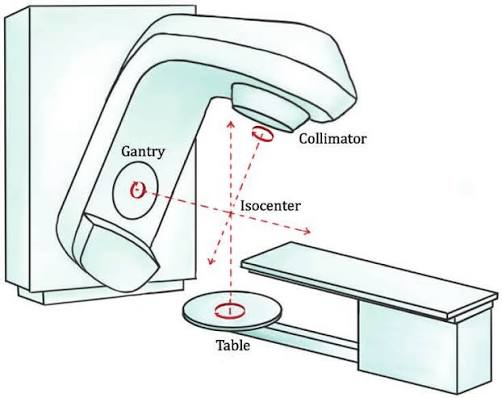
Isocenter and PSA
The intersection point for the linac’s three axes rotation (gantry, collimator, and patient support assembly--PSA also referred to as couch or table base)
Localization
Hidden anatomy identification relative to observable or palpable surface landmarks.
Meterset
Measurement unit for the machine delivered by monitor units or time.
Method of delivery
Minimally, photons, electrons, or identifying an isotope
Noncoplanar
not aligned with gantry rotation plane
Orthogonal images
two beams perpendicular to one another with a 90° angle between them
Protraction
time over which the treatment will be given
SABR
stereotactic ablative radiation

SBRT
Stereotactic body radiation therapy

SGRT
Surface guided radiation therapy--Allows therapists to have less initial setup variability, helps provide verification of immobilization of the patient throughout treatment, and provides real time surface information for use in treatments requiring gating or breath holds.
Stereoscopic
Two planar images from different angles focused on the same point
Topographic Anatomy:
Relationships between anatomic structures in a region
Treatment Field:
Tissue volume exposed to radiation from a single radiation beam
Treatment history Record:
information about the patient’s treatment history
Triangulation:
Three point
Universal Precautions:
Infection control methods in which any human blood or body fluid is treated as if it were known to be infectious
Universal protocol:
Pre-procedure verification, marked procedure site, timeout.
Verification Imaging:
planar or CT images that confirm treatment setup

VMAT:
Volumetric-modulated arc therapy
How often is the radiation chart reviewed?
prior to treatment start and at least weekly during a treatment course.
The chart must be current and accurate and contain...
Treatment rationale
Informed consent
Treatment plan
Treatment delivery records.
the final part of the patient’s chart.
planar or CT images (verification imaging)
Verification documents treatment…
localization reproduction.
patient information necessary for treatment reproduction.
Birth date, Identification image, street address, and phone number
Confirm patient identity using at least __ methods.
2
Pre-procedure verification:
verify procedure, patient site, identify items which must be available for procedure, and match items to patient.
DVH
Dose volume histogram
ODI
Optical Distance indicator
The Joint Commission requires accredited organizations to comply with the universal protocol and time out procedure: (3)
Pre-procedure verification
Mark procedure site
Timeout
Timeout
standardized process within organization
initiated by a designated team member at every instance
immediate team members performing the procedure actively communicating
correct patient confirmed using at least two methods
correct site, markings verified new line correct procedure to be undertaken
Document, organization determines form and amount
Radiation orders are written as ________ that must be signed by the ______ _______before treatment begins
prescriptions, radiation oncologist
prescription components include:
protraction (or time over which the treatment will be given) schedule, planning instructions, information specifying beam energy, portal sizes and energy angles, and beam modifiers with patient positioning information
Dose distributions and meterset calculations, typically prepared by the medical ________, are reviewed and signed by at least ___ treatment planning team members before being made available for treatment. Before treatment, radiation therapists independently review the treatment plan for calculation factor _______ against treatment parameters.”
dosimetrist, two, faithfulness
Treatment room design may be viewed as…
radiating outward from the isocenter
Before the patient arrives, radiation therapists must review…
treatment setup dimensions, field size, gantry, collimator, and PSA positions.
A beam aperture set, in the gantry position so that _____ are visible at the ________ and the field light crosshairs project in a vertical or horizontal direction.
The treatment ___ is raised or lowered appropriate to the patient's transportation method.
Position the PSA window where treatment fields will reach the patient without _______ the PSA.
_____covers the PSA windows supporting the patient without _______ the treatment beam.
Support may be enhanced by carbon fiber supports beneath the _____
lasers, isocenter, PSA, intercepting, mylar, attenuating, mylar.
Since comfort affects the patient's ability to maintain a treatment position…
headrests, leg sponges, and immobilization devices are used to support the elected position
The treatment session positioning goal is…
planned position reproduction
Landmark alignment with internal targets relies on _______ ___ ________ ______; Even slight body position variation can mean significant _______ with the internal location a surface landmark represents.
vertical and horizontal planes, discrepancies
What moves with, and is hidden within the patient?
Treatment isocenter
Landmarks include…
natural anatomy or artificial fiducials positioned at a fixed relationship to unseen anatomy.
Surface landmarks include…
visible and palpable anatomy
Fiducials may be…
permanent or semi-permanent at the skin's surface, internal, or fixed external to the patient
To align the patient to the isocenter, the patient will be raised on the treatment ___ until the _____ side lasers coincide with the patient marks on the right and left side
PSA, lateral
X=
left and right
Y=
in and out
Z=
depth
SGRT offers opportunities to eliminate…
skin marks
This system allows for continuous monitoring of patient positioning during treatment, which helps improve patient safety and comfortability while also streamlining workflows for radiation therapists.
SGRT
SGRT utilizes optical surface imaging and achieves small margins and a lower dose in three ways:
By reducing intrafraction setup uncertainty
By monitoring intrafraction movement
By enabling respiratory treatments to involve gating and or breath hold techniques
Stereoscopic images are…
two planar images from different angles focused on the same point
Accuracy _____ as beam coincidence _____
increases, decreases
orthogonal images are two beams _______ to one another with a __ angle between them.
perpendicular, 90°
Strategies for managing tumor motion during treatment include:
free breathing, compression, breath hold, gating, and tracking
gating systems actively monitor…
target positions, stopping the beam as the target moves out of range. The beam may be restarted when the target returns to range or the PSA may be adjusted to correct for a steady position change, a baseline shift
Once isocenter coincidence is accepted…
rotate the gantry to the projection angle for treatment initiation
Because neither people nor tumors present in squares or rectangles, treatment plans generally require…
further treatment aperture shaping
Linear accelerators equipped with MLC (______) systems customize field shapes using ____ sliced into leaf banks where opposing leaf banks form leaf pairs. Leaf pairs quickly and flexibly produce _____ treatment field shapes
(multi-leaf collimators), jaws, complex
Portal images verify…
the BEV path, the beam shape, and projection using the MV (megavoltage) treatment beam

Portal images use…
single or double exposure techniques
materials whose interactions with the radiation beam mimic tissue
Bolus
Skin sparing for irregular surfaces can be preserved using a ______
compensator
Composed of copper, brass, lead, or Lucite, compensators are positioned in the treatment machine head with a minimum of __ centimeters between the compensator and the patient service. The air gap allows _______ scatter absorption, preserving skin sparing
15, electrons
These are Designed to change the isodose angle relative to the beam axis at a specified depth within the patient
wedges
thick end of wedge:
heel
thin end of wedge
toe
standard wedge sizes:
15, 30, 45, and 60 degrees
At least ___ cameras maintained visual contact with the patient
two
These prevent beam initiation and include alerts prompting treatment setup and safety procedure completion.
interlocks
Options for beam interruption by the radiation therapist include…
pressing a beam off button, turning the operation key to the off position, or opening the treatment unit door. If these actions fail to stop the beam, an emergency off switch must be available, completely turning off the treatment unit.
Most treatment plans require radiation delivery through _____ ports to achieve optimal dose homogeneity through the target volumes
multiple
the most basic multiple field technique is the…
parallel opposed portal (POP).

The hinge angle for POP fields equals:
180°
___ ______ demonstrates the ultimate multiple field technique, and ____ may be defined in coplanar and non-coplanar arrangements.
Arc therapy, arcs

overlapping multiple intensity modulated fields, high radiation doses are delivered to targets that are irregularly shaped or close to critical structures describes what?
intensity-modulated radiation therapy
intensity-modulated radiation therapy description
Rather than using a uniform beam, IMRT breaks the radiation down into small "beamlets" and varies the intensity (strength) of each beam

A treatment technique that involves the use of dynamic multi leaf collimation and gantry arcing
Volumetric-modulated arc therapy

These techniques treat small targets with many intersecting beams creating concentrated dose areas with very sharp dose falloff.
Stereotactic radiation therapy (gamma knife)

two types of Stereotactic radiation therapy
Stereotactic body radiation therapy (SBRT) or stereotactic ablative radiation (SABR) use stereotactic techniques to treat small well-defined lesions outside of the cranial, head and neck regions. Highly precise localization and treatment plans deliver intense radiation doses