Cardiovascular & Peripheral Vascular
 Call Kai
 Learn
 Practice Test
 Spaced Repetition
 Match
 Flashcards
 Knowt Play
1/107

There's no tags or description
Looks like no tags are added yet.
108 Terms
where does the left side of the heart receive blood from and where does it send blood
- receives from the lungs
- delivers to the body
where does the right side of the heart receive blood from and where does it send blood
- receives from the body
- delivers to the lungs
what does S1/"lub" mean
- that the tricuspid and mitral valves are closed
- it is the beginning of systole
what does S2/"dub" mean
- that the aortic and pulmonic valves are closed
- it is the end of systole & the beginning of diastole
what is atrial kick
- 25% of total blood volume in the ventricles
systole vs diastole
systole: the contraction and the propelling of blood forward
diastole: when the heart muscle relaxes and fills with blood
what does cardiac output (amount of blood leaving the heart) depend on?
- stroke volume (amount of blood that is ejected from the heart with one contraction)
- heart rate (60-100 normally)
what is preload?
- degree of stretch of the heart muscle before contraction
what is afterload?
- the pressure that the heart muscle has to overcome to eject blood during contraction
what is contractility?
- force of contraction of the myocardium
what does inotropic mean?
- medications that tell your heart to contract with more or less power
difference between normal ejection fraction (EF) and low ejection fraction (EF)
normal ejection fraction (EF): 55%-70% of the blood in the left ventricle is pumped out with each contraction (EF of 0.55 or 0.7)
low ejection fraction (EF): following a heart attack, damaged heart muscle can not pump as efficiently -- leading to less blood being pumped out to the body with each heartbeat
What are the normal BPM for the SA node
60-100 BPM
What are the normal BPM for the AV node
40-60 BPM
What are the normal BPM for the Bundle of His node
20-40 BPM
how does the respiratory system interact with the cardiovascular system
- exchanges O2/CO2
- angiotensin I to II
- maintains BP
how does the endocrine system interact with the cardiovascular system
- distributes hormones
- secretes ANP
- fluid and electrolyte balances
- lowers blood volume and pressure
- erythropoietin
- RBC production
- epinephrine/norepinephrine
- increases HR
- increases contraction force
how does the muscular system interact with the cardiovascular system
- nutrient delivery
- removes CO2/lactic acid
how does the skeletal system interact with the cardiovascular system
- delivers calcium, minerals, calcitonin
- produces blood cells
- produces heart
how does the urinary system interact with the cardiovascular system
- regulates volume
- renin/angiotensin
- erythropoietin
what is the order in which blood pumps from your heart and lungs
body -> right atrium -> right ventricle -> pulmonary artery -> lungs to be exchanged -> comes back thru pulmonary veins -> left atrium -> left ventricle -> aorta -> body
how does the sympathetic nervous system affect HR vs the parasympathetic nervous system
SNS: increases HR
PNS: decreases HR
what are some developmental variations in infants in their cardiovascular system?
murmurs, and HR 110-160 -- usually the time when murmurs are noted or picked up
what are some developmental variations in children in their cardiovascular system?
sinus arrhythmia (the heart rate increases slightly when you breathe in and slows down when you breathe out), S3, innocent murmurs, and HR 60-100
what are some developmental variations in pregnant women in their cardiovascular system?
systolic murmur, apical impulse displace, changes in BP
what are some developmental variations in older adults in their cardiovascular system?
orthostatic hypotension, auscultatory gaps, decrease in CO, thickening of heart valves, increase in systolic BP
what are some cultural/ethnic variations with japanese & puerto ricans
lower HTN (hypertension), and cholesterol
what are some cultural/ethnic variations with middle aged white people
higher mortality with coronary artery disease
what are some cultural/ethnic variations with black people
earlier onset and greater severity of coronary artery disease
what are some cultural/ethnic variations with african american women
increased incidence of coronary artery disease
what are some cultural/ethnic variations with native americans under 35 yro
2x mortality from heart disease
what are some cultural/ethnic variations with mexican people
greater risk of obesity
what are classic symptoms of chest pain/heart issues
- angina/chest pain
- dyspnea
- cough
- edema
- syncope (fainting)
- palpitations
- fatigue
- paresthesia (pins and needles)
- intermittent claudication (blockage)
what are not so classic symptoms of chest pain/heart issues
- nausea
- epigastric distress
what are some COLDSPA symptoms of angina (myocardial ischemia)
C: tight pressing, heavy
O: discomfort occurring often w/exertion
L: across the chest and may radiate to shoulders, jaw, neck, upper abdomen
D: lasts up to 20 mins
S: mild to moderate pain
P: may be relieved with nitroglycerine
A: may occur w/difficulty breathing, nausea, or sweating
what are some COLDSPA symptoms of myocardial infarction (irreversible heart damage due to myocardial ischemia)
C: tight pressing, heavy
O: discomfort occurring with or w/o exertion
L: across the chest and may radiate to shoulders, jaw, neck, upper abdomen
D: lasts 20 mins to hours
S: often moderate to severe pain
P: rest does not relieve
A: may occur w/nausea, vomiting, weakness, sweating
what are some COLDSPA symptoms of aortic dissecting aneurysm (tear in the wall lining of aorta)
C: tearing ripping sensation
O: abrupt
L: in chest radiating to neck, back, abdomen
D: lasts hours
S: severe
P: aggravated by hypertension; relieved only with treatment
A: also seen with difficulty swallowing, hoarseness, leg pain, syncope
what are some COLDSPA symptoms of pericarditis (inflammation of the parietal pleura next to the pericardium)
C: sharp, stabbing, pounding feeling when heart beats
O: ongoing
L: pericardial pain radiating to shoulders or neck
D: ongoing
S: severe
P: aggravated by breathing position changes, coughing, and may be relieved with sitting forward
A: also seen with fever, weakness, tiredness, coughing, trouble breathing, or pain when swallowing
edema is a sign of what kind of heart disease
right sided heart failure and vascular disease
dyspnea / cough is a sign of what kind of heart disease
left sided heart failure
what is intermittent claudication
- muscle pain, cramping, aching, or fatigue in the lower extremities (most commonly the calves, thighs, or buttocks)
- triggered by physical activity like walking and quickly relieved (usually within 10 minutes) by rest.
- critical warning sign PAD
- indicates reduced blood flow
what is important to remember when assessing the carotid artery
to assess one side at a time
explain what the abdominojugular reflux/hepatojugular refux is when assessing the jugular vein
- patient lies flat or with their upper body elevated at a 30- to 45-degree angle, with the neck relaxed so the internal jugular venous pulse is visible
- The clinician will apply firm, steady pressure to the mid-abdomen or right upper quadrant for 10 to 30 seconds.
- The clinician watches the column of blood in the internal jugular vein in the neck
positive: sustained rise in jugular venous pressure (JVP) of greater than 3 cm that lasts for more than 10 to 15 seconds during continued abdominal pressure -- this tells us that the right ventricle cannot handle the temporary increase in blood returning from the abdomen.
negative: The neck veins may rise briefly when pressure is first applied, but they quickly return to baseline within 10 seconds despite holding the abdominal pressure.
what is a bruit?
a blowing, swishing sound indicating blood flow turbulence outside of the heart, usually in blood vessels; normally none is present
when auscultating the heart, what region do you listen for rate, rhythm, extra sounds or murmurs
apex/mitral -- functionally the same thing/area
what is a murmur?
An unusual or extra whooshing/swishing sound originating inside the heart or across its valves.
what is a thrill?
A palpable (physical) vibration or buzz felt by touch. (often compared to the purring of a cat)
what are we looking for when we percuss the heart
the size of it
what are abnormal pulsations in a cardiovasc. assessment of the precordium (thorax)
- thrills at the base
- life/heave at the sternal border
- volume overload at the apex
- pressure overload at the apex
what are the 3 positions you want a patient in when auscultating their heart
- sitting up/forward
- 30-45 degrees laying supine
- left lateral side
where is S1/"lub" heard best on the body
- apex
- left sternal border
what accentuates the S1 sound
- anemia
- hyperthyroidism
- exercise
- mitral or tricuspid stenosis (abnormal narrowing or constriction)
what can diminish the S1 sound
- a 1st degree atrioventricular (AV) block
- a mild heart rhythm delay where electrical signals take longer than normal to pass from the heart's atria to its ventricles
where is S2/"dub" heard best on the body
- base
- erbs point
- with diaphragm of stethoscope
what accentuates the S2 sound
- exercise
- hypertension
- pulmonary hypertension (high blood pressure in the arteries that carry blood from the right side of the heart to the lungs)
what diminishes the S2 sound?
- aortic stenosis (narrowing of the aortic valve opening)
- pulmonary stenosis (pulmonary valve or the area around it is too narrow)
what causes a S4 sound to be heard
- enlarged ventricles (puts pressure on valves)
- hypertension
- aortic stenosis
- history of myocardial infarction (MI)
what is a pericardial rub and what does it sound like
- when two pericardial layers rub together (extra fluid)
- high pitched leathery sound even when a patient holds their breath
what conditions is pericardial rub associated with
- pericarditis
- pericardial effusion
- acute myocardial infarction (MI) = heart attack
where is the aortic area (anatomically)
second right intercostal space
where is the pulmonic area (anatomically)
second left intercostal space
where is the erbs point (anatomically)
third left intercostal space (left sternal border)
where is the tricuspid area (anatomically)
fourth left intercostal space (left lower sternal border)
where is the mitral/apex area (anatomically)
fifth left intercostal space (mid clavicular line)
what are the 5 different types of ways a murmur can happen/look
1. increased flow thru normal valve
2. flow thru constricted valve
3. flow into dilated camber
4. backflow thru incompetent valve
5. shunting (splitting off of the normal route)
what are the signs of right sided heart failure
- fatigue
- increased peripheral venous pressure
- ascites
- englarged liver & spleen
- distended jugular veins
- anorexia/GI distress
- weight gain
- edema (knee and below)
what are the signs of left sided heart failure
- paroxymal nocturnal dyspnea
- elevated pulmonary capillary wedge pressure (increased pressure in the left atrium and left ventricle during filling)
- cough
- crackles
- wheezes
- blood tinged sputum (spitting up blood)
- restlessness
- confusion
- orthopnea
- tachycardia
- exertional dyspnea
- cyanosis
in an adult, what pulse is strongest/most commonly assessed
radial and pedal (dorsalis pedis)
in an child, what pulse is strongest/most commonly assessed
brachial and femoral
what are the 5 arteries/pulse locations and point where they are
1. brachial
2. femoral
3. popliteal
4. tibial
5. dorsalis pedis (pedal)
what are the 2 deep veins
femoral and popliteal
what are the 2 superficial veins
great saphenous and small saphenous
what is/are perforator veins
they connect superfical veins with deep veins
what is stasis
when blood sticks to an area
- can coagulate and block flow
explain the rates for pulses
0 = non-palpable/absent
+1 = weak, diminished, and barely palpable
+2= normal, expected
+3 = strong obliterates with pressure
+4 = bounding unable to obliterate
document a normal pulse as 2+/4
what are 3 functions of the lymphatic system
- drains excess fluids & plasma proteins & returns to venous system
- trap & destroy microorganism part of the immune system
- absorbs lipids from the small intestine into the bloodstream
*if it hurts, its an infection*
*if it doesn't hurt, it's cancer*
how big should lymphnodes be
less than 1 inch
where are epitrochlear nodes located
- located approximately 3 cm above the elbow on the inner (medial) aspect of the arm
what do epitrochlear nodes do
- drain the lower arm and hand
- lymph from the remainder of the arm and hand drains to the axillary lymph nodes
what are the 2 groups of superficial inguinal nodes
1. horizontal chain
2. vertical chain
where is the horizontal chain located
on the anterior thigh just under the inguinal ligament
where is the vertical chain located
close to the great saphenous vein (superficial vein that runs up the inside of the leg from the foot to the groin)
what is the function of the superficial inguinals
to drain the legs, external genitalia, and lower abdomen and buttocks
what is PAD stand for
peripheral artery disease
what does PVD stand for
peripheral vascular disease
what age does PAD prevalence rise
>10% in clients 60-70
what are signs and symptoms of PAD
- painful cramping
- leg numbness or weakness
- coldness in lower leg or foot
- sores
- change in color of the leg
- hair loss
what are signs of PAD progressing/worsening
- pain at rest
- intensity
- lack of relief
- neuropathy may cause these symptoms not to show
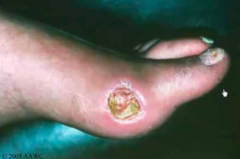
what is this called
arterial insufficiency
- not a pressure wound!
- just an ulcer

what is this called
venous insufficiency
- PVD
what is critical limb ischemia
not getting O2 to tissues
- may need amputation
what would be a way of treating critical limb ischemia
restore blood flow, heal wounds, and save the limb
what are the 6 P's (for not having O2 to an extremity)
- pain
- pulseness
- paresthesia (numbness/tingling)
- paralysis
- pallor (pale)
- poikilothermic (cold)
what is the order in which you would preform the assessment
- inspection
- palpation
- auscultation
*percussing is not a thing when assessing PVS*
what are you inspecting in the arms
- size, edema, patterning
- color
- fingertips (clubbing spooning)
What are you palpating in the arms?
- temp
- capillary refill
- pulses
- lymph nodes -> generally shouldn't feel
what are you inspecting in the legs
- color
- hair
- ulcers
- edema
- varicosities (veins in legs) & thrombophlebitis (blood clot)
What are you palpating in the legs?
- edema
- temp
- lymph nodes
- pulses

what is this test called
allen's test

what is this test called
manual compression test